NR 509 Week 3 Quiz
Question and Answers Grade A Plus
1) A teenage girl has arrived complaining of pain in her left wrist. She was playing basketball when
she fell and landed on her left hand. The FNP examined her hand
...
NR 509 Week 3 Quiz
Question and Answers Grade A Plus
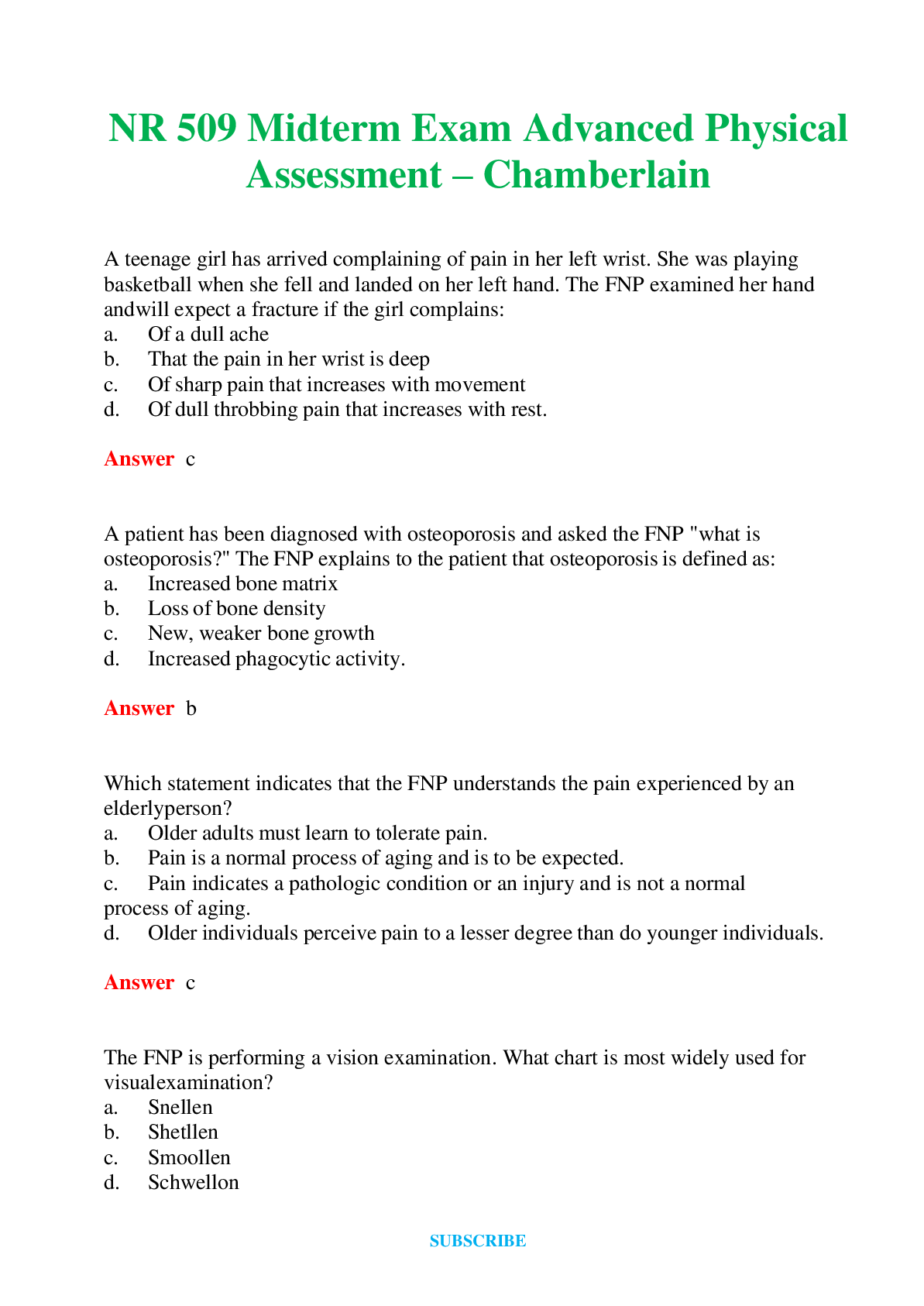
1) A teenage girl has arrived complaining of pain in her left wrist. She was playing basketball when
she fell and landed on her left hand. The FNP examined her hand and will expect a fracture if the
girl complains:
Answer: Of sharp pain that increases with movement
2) A patient has been diagnosed with osteoporosis and asked the FNP “what is osteoporosis?” The
FNP explains to the patient that osteoporosis is defined as:
Answer: Loss of bone density
3) Patient states, “I can hear a crunching or grating sound when I kneel”. She also states “that it is
very difficult to get out of bed in the morning because of stiffness and pain in my joints”. The
FNP should assess for signs of what problem?
Answer: Crepitation
4) When taking the history on a patient with a seizure disorder the FNP assesses whether the
patient has an aura. Which of these would be the best question for obtaining this information?
Answer: Do you have any warning sign before you receive your starts?
5) The FNP is teaching a class on osteoporosis prevention to a group of post menopausal women. A
participant shows that she needs more instruction when she states I will:
Answer: “Start swimming to increase my weight bearing exercise”
6) The FNP is performing a neurological assessment on a 41-year-old woman with a history of
diabetes. When testing her ability to feel the vibrations of a tuning fork the FNP notices that the
patient is unable to feel vibrations on the great toe or ankle bilaterally, but she is able to feel
vibrations on both patella. Given this information what would the FNP suspect?
Answer: Peripheral neuropathy
7) And 80-year-old woman is visiting the clinic for a check up. She states “I can’t walk as much as I
used to”. The FNP is observing from motor dysfunction in her hip and should have her:
Answer: Abduct her hip while she is lying on her back
8) The FNP is testing the function of cranial nerve XI. Which of these best describes the response
the FNP should expect if the nerve is intact? The patient:
Answer: Moves the head and shoulders against resistance with equal strength
9) A 50-year-old woman is in a clinic for weakness in her left arm and leg that she noticed for the
past week. The FNP should perform which type of neurologic examination?
Answer: Complete neurologic examination
10) During the neurological assessment of a healthy 35-year-old patient the FNP asks him to relax
his muscles completely. The FNP then moves each extremity through full range of motion.
Which of these results would the FNP expect to find?Answer: Mild, even resistance to movement
11) A woman who is 8 months pregnant comments that she has noticed a change in posture and is
having lower back pain. The FNP tells her that during pregnancy women have a posture shift to
compensate for the enlarging fetus. This shift and posture is known as:
Answer: Lordosis
12) A patient is able to flex his right arm forward without difficulty or pain but is unable to abduct
his arm because of pain and muscle spasm’s. The FNP should suspect:
Answer: Rotator cuff lesions
13) A professional tennis player comes into the clinic complaining of a sore elbow. The FNP will
assess for tenderness at the:
Answer: Medial and lateral epicondyle
14) The FNP suspect that a patient has carpal tunnel syndrome and wants to perform the Phalens
test. To perform this task the FNP should instruct the patient to:
Answer: Hold both hands back to back while flexing the wrists 90° for 60 seconds
15) During the history a patient tells the FNP that “it feels like the room is spinning around me”. The
FNP would document this as:
Answer: Vertigo
16) The assessment of a 60-year-old patient has taken longer than anticipated. In testing his pain
perception the FNP decides to complete the test as quickly as possible. When the FNP applies
the sharp point of a pin on his arm several times he is only able to identify these as one very
sharp prick. What would be the most accurate explanation for this?
Answer: This is most likely the result of the summation effect
17) An 85-year-old patient comments during his annual physical that “he seems to be getting
shorter as he ages”. The FNP should explain that decrease height occurs with aging because:
Answer: Of the shortening of the vertebral column
18) A patient is complaining of pain in his joints that is worse in the morning, is better after he has
moved around for a while, and then gets worse again if he sits for long periods of time. The FNP
should assess for other signs of what problem?
Answer: Rheumatoid arthritis
19) When the FNP asks a 68-year-old patient to stand with feet together and arms at his side with
his eyes closed he starts to sway and moves his feet farther apart. The FNP would document this
finding as:
Answer: Positive Romberg sign
20) During an assessment of the cranial nerves the FNP finds the following asymmetry when the
patient smiles or frowns, uneven lifting of eyebrows, sagging of lower eyelids, and escape of air
when the FNP presses against the right path cheek. This would indicate dysfunction of which of
these cranial nerves?
Answer: Motor component of VII21) The FNP is teaching a class on osteoporosis prevention to a group of postmenopausal women
which of these actions is the best way to prevent or delay bone loss in this group?
Answer: Taking calcium and vitamin D supplements
22) In obtaining a history on a 74 year old patient the FNP notes that he drinks alcohol daily and that
he has noticed a tremor in his hands that affects his ability to hold thing. With this information
what should the FNP‘s response be?
Answer: Does the tremor change when you drink the alcohol?
23) During a history of a 78-year-old man his wife states that “he occasionally has problems with
short-term memory loss and confusion. He can’t even remember how to button his shirt”. In
doing the assessment of his sensory system which action of the FNP‘s is most appropriate?
Answer: Before testing, the FNP would assess the patient’s mental status and ability to follow
directions at this time
24) While obtaining a history of a 3 month old infant from the mother the FNP asks about the
infants ability to suck and grass the mothers finger. What is the FNP assessing?
Answer: Reflexes
25) The FNP is doing an assessment on a 29-year-old woman who visits the clinic complaining of
always dropping things and falling down. While testing rapid alternating movements the FNP
notices that the woman is unable to pat both her knees. Her response is very slow and she
misses frequently. What should the FNP suspect?
Answer: Dysfunction of the cerebellum
[Show More]








![Preview of NR667 Complete Question Bank with Correct Answers: Final Exam Study Guide [2026 Updated]](https://browseimages.nyc3.digitaloceanspaces.com/paper-images/2026/02/25/AULA53fD2026-02-25-02-58699ee3d811bc7.png)