WGU C963 - Significant Court Cases
Latest 2023 with Certified Solutions
Marbury v. Madison (1803, 5 US 137) ✔✔This case involved the Judiciary Act of 1789.
Supreme Court declared that the law conflicted with the US Co
...
WGU C963 - Significant Court Cases
Latest 2023 with Certified Solutions
Marbury v. Madison (1803, 5 US 137) ✔✔This case involved the Judiciary Act of 1789.
Supreme Court declared that the law conflicted with the US Constitution, and the case
established the principle of judicial review wherein the Supreme Court has the power to declare
laws passed by Congress and signed by the President to be unconstitutional.
Dred Scott v. Sandford (1856, 60 US 393) ✔✔Supreme Court declared that slaves were not
citizens of the United States and could not sue in Federal courts. In addition, this decision
declared that the Missouri Compromise was unconstitutional and that Congress did not have the
authority to prohibit slavery in the territories. Dred Scott decision was overturned by the 13th
and 14th Amendments to the Constitution.
Plessy v. Ferguson (1896, 163 US 537) ✔✔Supreme Court decision that upheld the
constitutionality of racial segregation under the "separate but equal" doctrine. In 1892, Homer
Plessy refused to sit in a car for blacks. Rejecting Plessy's argument that his constitutional rights
were violated, Supreme Court ruled that a law that "implies merely a legal distinction" between
whites and blacks was not constitutional.
United States v. Miller (1939, 307 US 174) ✔✔In the early 1980's, following an assassination
attempt on President Ronald Reagan, laws requiring background checks for prospective gun
buyers were passed. In this case, Supreme Court upheld the 1934 National Firearms Act's
prohibition of sawed-off shotguns, largely on the basis that the possession of such a gun was not
related to the goal of promoting a "well regulated militia."
Korematsu v. United States (1944, 323 US 214) ✔✔During WW2, citizens of Japanese descent
living on the West Coast, whether naturalized immigrants or Japanese Americans born in the US,
were subjected to the indignity of being removed from their communities and interned under
Executive Order 9066. When challenged, Supreme Court decision was to upheld the actions of
the government as a necessary precaution in a time of war.
Brown v. Board of Education of Topeka (1954, 347 US 483) ✔✔This case challenged the
principle of "separate but equal." It was brought by students who were denied admittance to
certain public schools based exclusively on race. The unanimous decision in this case determined
that the existence of racially segregated public schools violated the equal protection clause of the
14th Amendment.
Sherbert v. Verner (1963, 374 US 398) ✔✔In this case the Supreme Court ruled that states could
not deny unemployment benefits to an individual who turned down a job because it required
working on the Sabbath.
Miranda v. Arizona (1966, 384 US 436) ✔✔Supreme Court ruled that detained criminal
suspects, prior to police questioning, must be informed of their constitutional right to an attorney
and against self-incrimination. Case began when Ernesto Miranda was charged with crimes, not
informed of his rights prior to interrogation, and confessed to committing the crimes. Miranda
appealed to the court claiming that the police had unconstitutionally obtained his confession.
Gideon v. Wainwright (1963, 372 US 335) ✔✔This case perpetuated from the arrest of a man
who was accused of breaking into a poolroom and stealing money from a cigarette machine. Not
being able to afford a lawyer and being denied a public defender by the judge, the man defended
himself and was subsequently found guilty. Upon his appeal the Supreme Court declared that the
Sixth Amendment required that those facing felony criminal charges be supplied with legal
representation.
Tinker v. Des Moines (1969, 393 US 503) ✔✔Students were suspended for wearing black
armbands to school as a protest against the continuing American involvement in the Vietnam
conflict. Supreme Court ruled in this case the suspensions violated the free speech rights of the
students and the symbolic political speech that this protest represented.
Griswold v. Connecticut (1965, 381 US 479) ✔✔Although several state constitutions do list the
right to privacy as a protected right, the explicit recognition by the Supreme Court of a right to
privacy in the US Constitution emerged only in the middle of the twentieth century. In this 1965
case, the court spelled out the right to privacy for the first time in a case that struck down a state
law forbidding even married individuals to use any form of contraception.
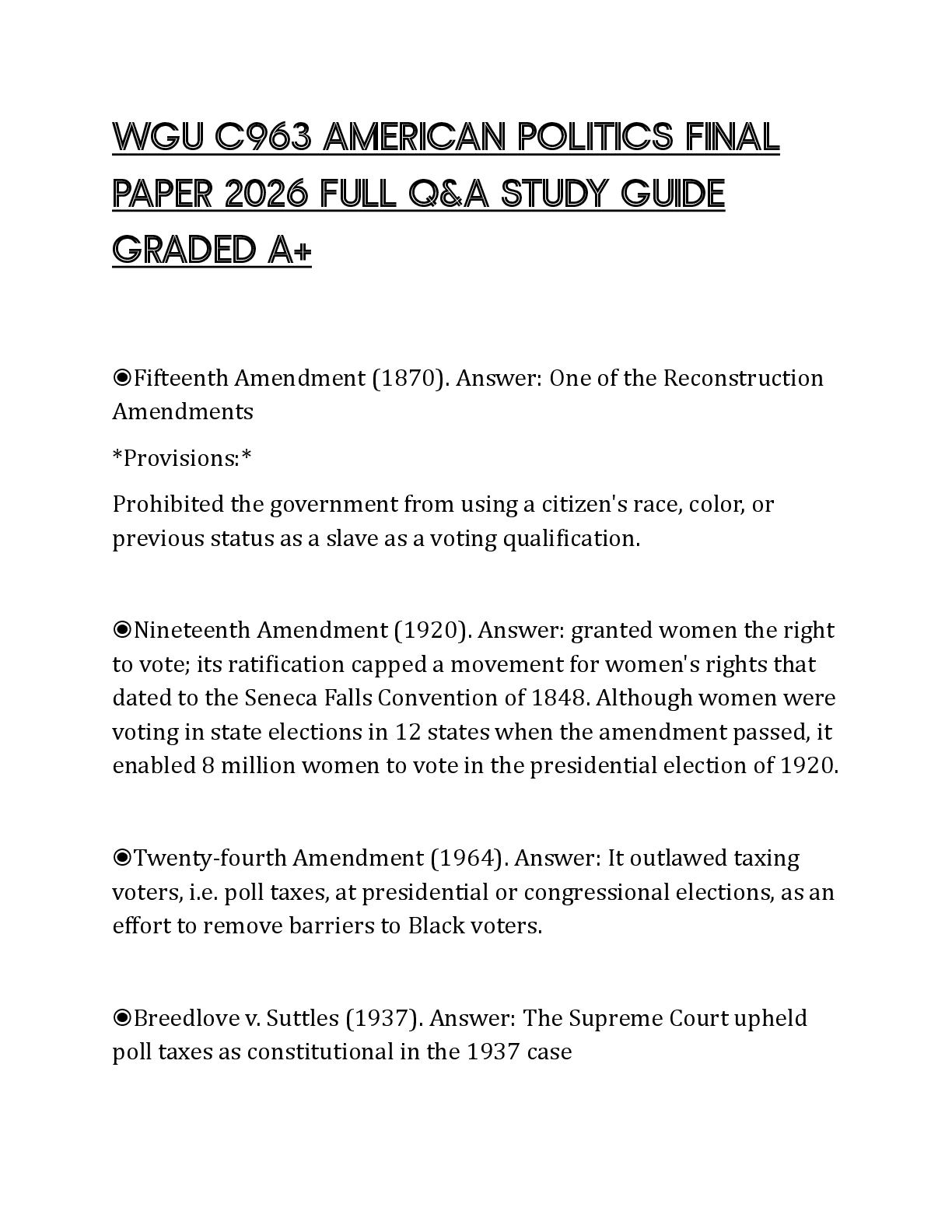
Harper v. Virginia Board of Elections (1966, 383 US 663) ✔✔Before this case, Congress
proposed what later became the Twenty-Fourth Amendment, which banned the poll tax in
elections to federal (but not state or local) office; in this case, the Supreme Court declared that
requiring payment of a poll tax in order to vote in an election at any level was unconstitutional.
Mapp v. Ohio (1961, 367 US 643) ✔✔In this Supreme Court case it was decided that evidence
obtained without a warrant that didn't fall under one of the exceptions mentioned above could not
be used as evidence in a state criminal trial, giving rise to the broad application of what is known
as the exclusionary rule, which was first established in 1914 on a federal level in Weeks v. US
Brandenburg v. Ohio (1969, 395 US 444) ✔✔In this case involving the KKK, the Supreme
Court found that only speech or writing that constituted a direct call or plan to imminent lawless
action, an illegal act in the immediate future, could be suppressed; the mere advocacy of a
hypothetical revolution was not enough.
Furman v. Georgia (1972, 408 US 238) ✔✔A man was caught burglarizing a private home. As
he fled the scene he tripped causing the gun to accidentally fire, killing the individual who
discovered him. He was convicted of murder and sentenced to death. In this case the court laid
out guidelines for capital punishment.
Lemon v. Kurtzman (1971, 403 US 602) ✔✔In this case the Supreme Court established a test for
deciding whether a law or other government action that might promote a particular religious
practice should be allowed to stand.
Miller v. California (1973, 413 US 15) ✔✔The Supreme Court used this case to establish a test
for deciding whether something is obscene.
Planned Parenthood v. Casey (1992, 505 US 833) ✔✔Supreme Court justices appointed by
Republican presidents began to roll back the Roe decision. A key turning point was the court's
ruling in this case, which rejected Roe's framework based on trimesters of pregnancy and
replaced it with the undue burden test, which allows restrictions prior to viability that are not
"substantial obstacles" to women seeking an abortion.
McDonald v. Chicago (2010, 561 US 742) ✔✔When the Supreme Court initially decided that
the Second Amendment protects an individual's right to keep and bear arms, it did not decide that
it was a fundamental liberty the states must uphold as well until this case two years later.
Roe v. Wade (1973, 410 US 113) ✔✔This case involved a pregnant woman from Texas who
desired to terminate her pregnancy. The Supreme court declared that the right to privacy
included a woman's right to an abortion.
Burwell v. Hobby Lobby Stores (2014, 573 US) ✔✔This case challenged a mandate in the
Patient Protection and Affordable Care Act that required that all employment-based group health
care plans provide coverage for certain types of contraceptives. The decision declared that the
Religious Freedom Restoration Act of 1993 (RFRA) permits for-profit companies to deny
coverage for contraception in their health plans when that coverage violates a religious belief.
Citizens United v. Federal Election Commission (2010) ✔✔A nonprofit corporation was
prevented by the Federal Election Commission (FEC) from showing a movie about a presidential
candidate of the time because it violated the Bipartisan Campaign Reform Act (BCRA). The
decision in this case concluded that the restrictions imposed by BCRA and enforced by the FEC
violated the corporation's First Amendment right to free expression.
Gillette v. United States (1971, 401 US 437) ✔✔To avoid serving in the Vietnam War, many
people claimed to have a conscientious objection to military service on the basis that they
believed this particular war was unwise or unjust. However, the Supreme Court ruled in this case
that to claim to be a conscientious objector, a person must be opposed to serving in any war, not
just some wars.
Texas v. Johnson (1989, 491 US 397) ✔✔As a part of a protest, an individual set fire to a US
flag that another protester had torn from a flagpole. He was arrested, charged with "desecration
of a venerated object" and eventually convicted. However, the Supreme Court decided in this
case that burning the flag was a form of symbolic speech protected by the First Amendment and
found the law, as applied to flag desecration, to be unconstitutional.
Cohen v. California (1971, 403 US 15) ✔✔This case involved an arrest and conviction for
disturbing the peace for wearing a jacket expressing opposition to the draft (and the Vietnam
War). The conviction was overturned by the Supreme Court since his actions were silent and he
made no attempt to otherwise disturb the peace.
[Show More]
.png)
.png)