Civics EOC "Checklist" Questions &
Answers, 100% Verified. Latest Update.
How is a resident alien different from an immigrant? - ✔✔-An alien is any person not a citizen or
national of a country whereas an immigrant
...
Civics EOC "Checklist" Questions &
Answers, 100% Verified. Latest Update.
How is a resident alien different from an immigrant? - ✔✔-An alien is any person not a citizen or
national of a country whereas an immigrant is a person who comes to a country to live permanently.
What is the difference between law of blood & law of soil? - ✔✔-Law of Blood: a person is a US citizen
because they their parents are US citizens.
Law of Soil: a person is a US citizen because they were born in the US.
What is the Selective Service System? - ✔✔-The Selective Service System is an independent agency of
the United States government that maintains information on those potentially subject to military
conscription.
How does the 14th amendment define a U.S. citizen? - ✔✔-defines citizenship, grants citizenship to
former slaves, and defines voters as males at least 21 years of age
What is the difference between an obligation/duty & a responsibility? - ✔✔-Obligations are required of
citizens. Duties/Responsibilities are things good citizens should do.
What are the five obligations/duties of a US citizen? - ✔✔-1. Pay Taxes
2. Obey the Law
3. Go to School
4. Defend the Nation
5. Attend Jury Duty
What are the two main responsibilities of a US citizen? - ✔✔-1. Be an Informed Citizen and Vote
2. Participate in Government
Why is it important to be an active participant in society and government? - ✔✔-Because the
government is their to serve the people, and people should have the opportunity to get involved in
government.
What is the process of becoming a US citizen called? - ✔✔-The Naturalization Process
Describe the legal process it takes to become a naturalized citizen? - ✔✔-1. Be 18 Years Old
2. Live in the US for 5 Years
3. Fill out an application with the USICS
4. Have an interview
5. Take the citizenship test in English
6. Attend the ceremony and say the Oath of Allegiance
What is a Prime Minister? - ✔✔-the head of state in a parliamentary system
Direct Democracy - ✔✔-a form of government in which the power to govern lies directly in the hands of
the people rather than through elected representatives
Representative Democracy/Republic - ✔✔-a system of government in which the people elect
representatives to make policies and laws for them
Socialism - ✔✔-an economic system in which the government owns the primary means of production
Communism - ✔✔-a form of government in which a single ruling party owns and controls all production
and distribution of goods, and in which no private ownership is allowed
Absolute Monarchy - ✔✔-a form of autocracy where a person becomes the sole leader of a country by
being born into a family of rulers
Limited Monarchy - ✔✔-A monarchy that has limited power because of a Constitution
Oligarchy - ✔✔-a form of government in which a small group has total control and power
Autocracy - ✔✔-a form of government where one person has unlimited power
Parliamentary - ✔✔-a system of government where power lies with the legislative body and the leader
of the country is part of the legislature
Federal - ✔✔-a system of government where power is shared between a central government and state
Confederal - ✔✔-a system of government where power is located with the independent states and
there is little power in the central government
Unitary - ✔✔-a system of government where almost all power is located with the central government
Self-Government - ✔✔-government of a country by its own people, especially after having been a
colony.
Assent - ✔✔-to agree
Oppression - ✔✔-the use of authority or power in a cruel or unjust manner
Self-evident - ✔✔-obvious, having no need of proof
Tyranny - ✔✔-a government in which a single ruler possesses and abuses absolute power
Social Contract - ✔✔-an implied agreement among the people of an organized society that defines the
rights, duties, and limitations of the governed and the government
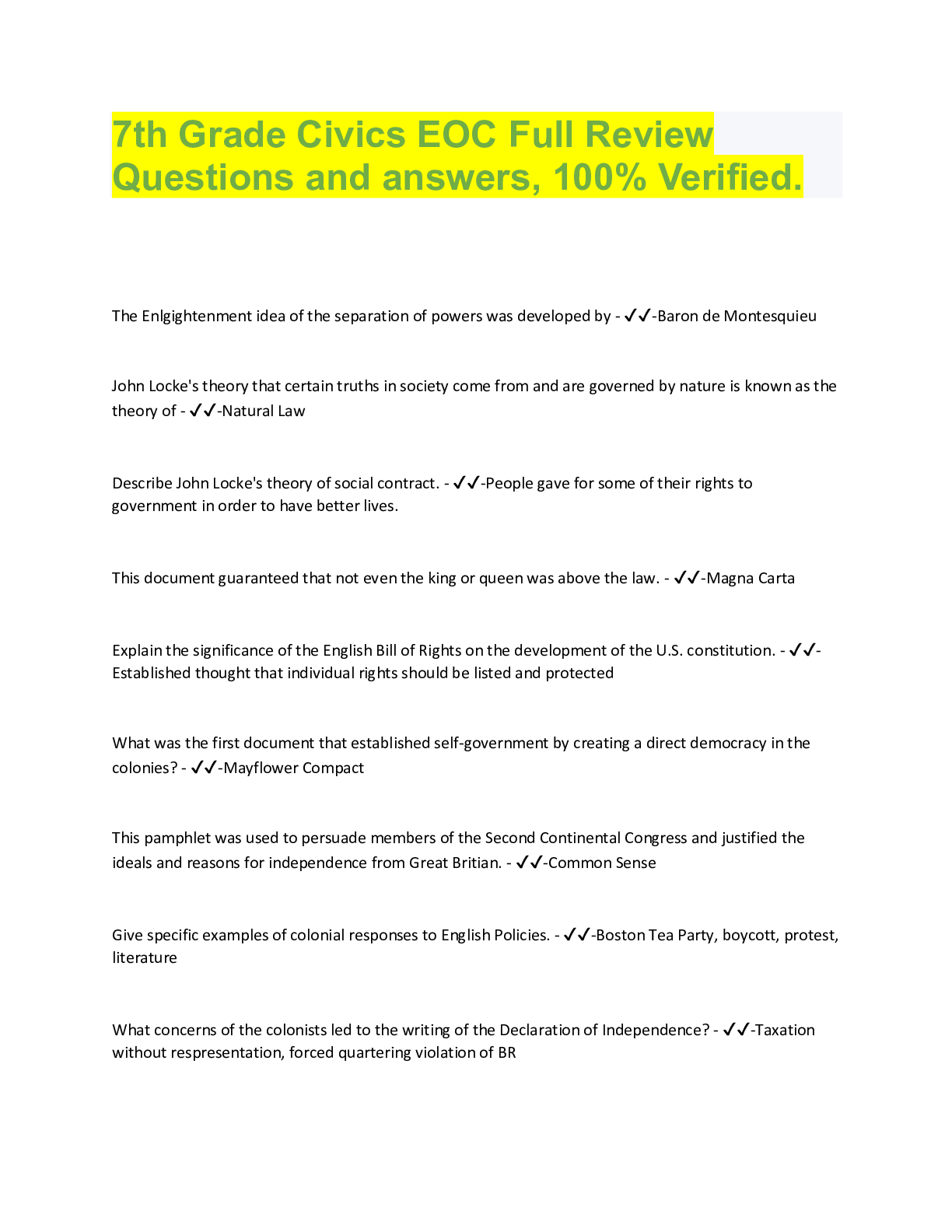
Explain John Locke's theory of natural rights/law. - ✔✔-All people are entitled to the rights of Life,
Liberty and Property
What does the phrase "natural rights" mean? - ✔✔-Rights that all people are born with that cannot be
taken away
Describe Montesquieu's theory of separation of powers. - ✔✔-Government should be separated into
three branches to prevent one branch from getting too powerful.
How did Montesquieu's idea of separation of powers influence our founding fathers? - ✔✔-They created
a government system with three branches: Legislative, Executive, and Judicial
Compare Locke's natural law theory with that of Jefferson's natural rights listed in the D.O.I. - ✔✔-
Jefferson changed it to: life liberty and the pursuit of happiness
What are the important ideas within the Magna Carta and how did they impact our founding fathers'
idea of government? - ✔✔-1. Limited Government
2. Trial by Jury
3. King cannot put unjust taxes
4. Rule of Law
5. People have the right to rebel against the government if it is being unjust.
Explain the significance of the English Bill of Rights and how it impacted the Constitution. - ✔✔-a
government document that expanded the powers of the English Parliament and expanded the rights of
the people, as well as further limited the rights of the king; written by the members of the English
Parliament in 1689
What was Common Sense and what impact did it have on our founding fathers? - ✔✔-a pamphlet
published by Thomas Paine in 1776 to convince the American colonists to support becoming
independent from England. It influenced Thomas Jefferson to write the DOI
What was the main reason the colonists become increasingly unhappy with the British Government?
(Hint: "no taxation without representation!") - ✔✔-The king was violating their natural rights of life,
liberty and property.
How did the British government respond when colonists in Boston became rebellious to their policies? -
✔✔-The pass the Intolerable Acts
What does it mean in the D.O.I. by "People are endowed by their creator with certain unalienable
rights?" - ✔✔-People are born with rights that cannot be taken away from them.
What does it mean in the D.O.I when it says "Governments are instituted among men to secure these
rights?" - ✔✔-The government is to serve the people, and should never take away people's natural
rights.
What does it mean in the D.O.I when it says "Governments derive their just powers from the consent of
the governed?" - ✔✔-The government is to protect the people, and people must follow the rules of the
government.
What does it mean in the D.O.I when it says "Whenever any form of government becomes destructive of
these ends, it is the right of the people to alter or abolish it?" - ✔✔-People have the right to rebel
against their government if it is being unjust.
What is the "rule of law"? - ✔✔-a concept that those who govern are bound by the laws; no one is
above the law
Imposing taxes without their assent - ✔✔-The government should not put taxes on its citizens without
them knowing.
Suspending trial by jury - ✔✔-Getting rid of a fair trial by jury
Limiting the power of the judges - ✔✔-Taking power away from judges and giving it to King George III
Quartering soldiers - ✔✔-Citizens must house British soldiers
There are six main weaknesses in the Articles of Confederation. What are they? - ✔✔-1. Congress had
no power to collect taxes.
2. Congress had no power to regulate trade.
3. Congress had no power to enforce its laws.
4. No single leader or group directed government policy.
5. No national court system existed.
6. Congress could not pass laws without the approval of 9 states.
7. The Articles could not be changed without the agreement of all 13 states.
What occurred during Shay's Rebellion? - ✔✔-2000 Massachusetts farmers rebelled against land
foreclosures and debt from the Revolutionary War
Why did the Articles of Confederation need to be replaced? - ✔✔-It lack a strong central government.
Gave too much power to the states. Did not unify the country.
What are the six main principles of the US Constitution? - ✔✔-1. popular sovereignty
2. limited government and the
3. rule of law
4. separation of powers
5. checks and balances
6. federalism
Who were the Federalists and what was their viewpoint on ratifying the Constitution? - ✔✔-a group of
people in the early United States who favored the establishment of a strong national government and
who worked for ratification of the U.S. Constitution
Who were the Anti-Federalists and what was their viewpoint on ratifying the Constitution? - ✔✔-a
group of people in the early United States who opposed ratification of the U.S. Constitution because
they feared a strong national government and a lack of protection for individual rights. Would not ratify
the US Constitution until a Bill of Rights was added.
What was to be added for the Anti-Federalists to ratify the Constitution? Why did they want this added?
- ✔✔-Bill of Rights. To give more civil liberties to the citizens.
What are the Federalist Papers? - ✔✔-a series of essays written to explain and defend the proposed U.S.
Constitution
What is the purpose of the Preamble to the Constitution? - ✔✔-The introduction to the US Constitution
that outlines the six goals to improve the United States from the Artic
[Show More]