EIP Final Exam Review. 100%
comprehension. Rated A
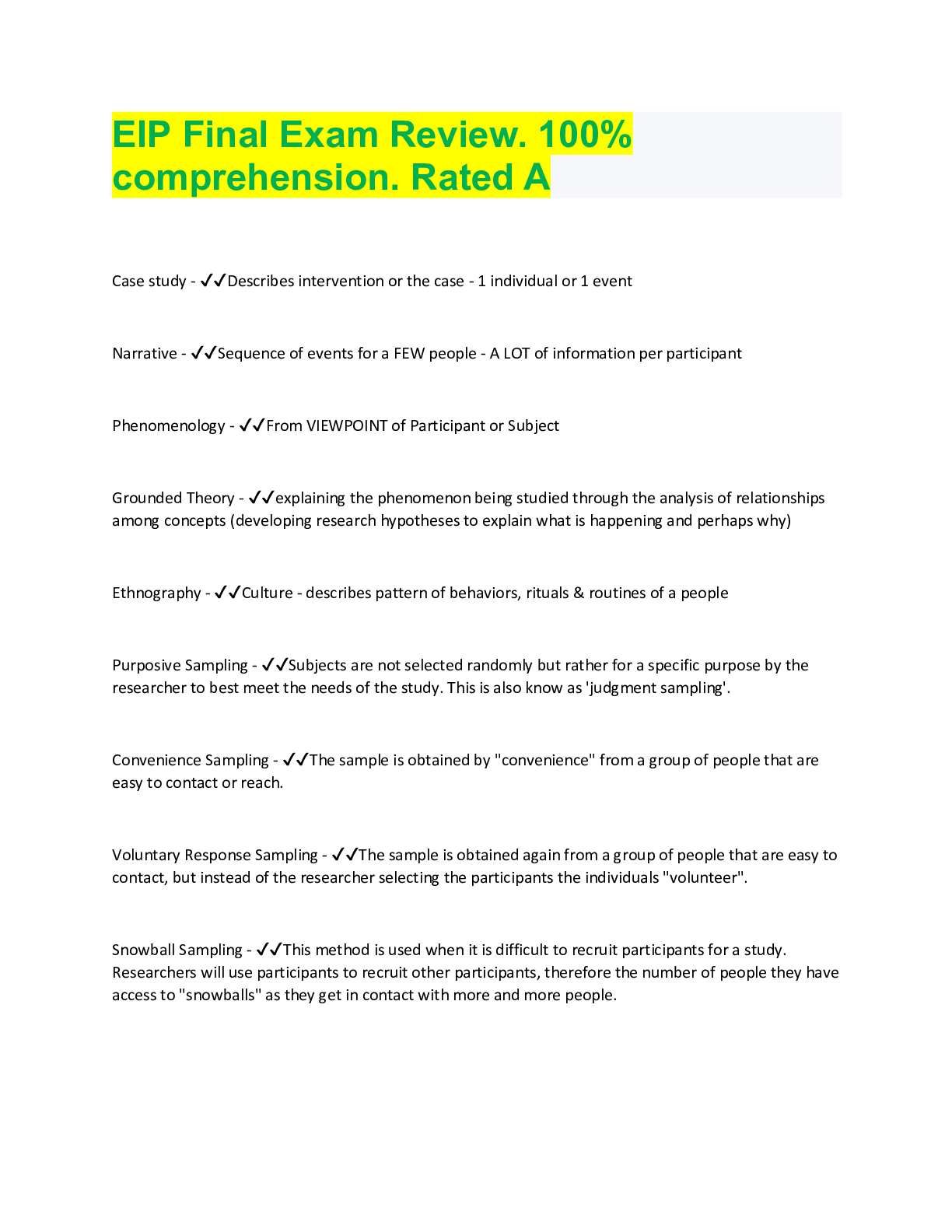
Case study - ✔✔Describes intervention or the case - 1 individual or 1 event
Narrative - ✔✔Sequence of events for a FEW people - A LOT of information per participant
...
EIP Final Exam Review. 100%
comprehension. Rated A
Case study - ✔✔Describes intervention or the case - 1 individual or 1 event
Narrative - ✔✔Sequence of events for a FEW people - A LOT of information per participant
Phenomenology - ✔✔From VIEWPOINT of Participant or Subject
Grounded Theory - ✔✔explaining the phenomenon being studied through the analysis of relationships
among concepts (developing research hypotheses to explain what is happening and perhaps why)
Ethnography - ✔✔Culture - describes pattern of behaviors, rituals & routines of a people
Purposive Sampling - ✔✔Subjects are not selected randomly but rather for a specific purpose by the
researcher to best meet the needs of the study. This is also know as 'judgment sampling'.
Convenience Sampling - ✔✔The sample is obtained by "convenience" from a group of people that are
easy to contact or reach.
Voluntary Response Sampling - ✔✔The sample is obtained again from a group of people that are easy to
contact, but instead of the researcher selecting the participants the individuals "volunteer".
Snowball Sampling - ✔✔This method is used when it is difficult to recruit participants for a study.
Researchers will use participants to recruit other participants, therefore the number of people they have
access to "snowballs" as they get in contact with more and more people.
A researcher immerses themselves in the participants way of life in order to examine the attitudes and
challenges of Caregivers for family members with CVA's. This is what type of Qualitative Design? -
✔✔Ethnographical
A researcher is needs participants for a study they are doing on children with Autism. They recruit
participants from clients at a local outpatient clinic. This is an example of what type of sampling
method? - ✔✔Convenience Sampling
Describing the individual's condition or response to treatment, unusual patient problems or innovative
treatment approach and the results are key components of what type of Qualitative design? - ✔✔Case
Study Design
The following is an example of which type of qualitative study?
The Use of Animal-Assisted Therapy in Combination with Physical Therapy in an Inpatient Rehabilitation
Facility
Background Animal-assisted therapy (AAT) is a growing form of intervention in the field of rehabilitation
often with the goals of decreasing pain, anxiety, and depression. There is a lack of literature on the use
of AAT in inpatient rehabilitation facilities (IRF).
Materials and methods This patient was treated with standard of care physical and occupational therapy
in an IRF with the addition of AAT within 32% of the therapy sessions. AAT sessions focused on sitting
and standing tolerance, standing balance, endurance, ambulation, stair negotiation and kitchen
mobility. Clinical measures included the 6 Minute Walk Test (6MWT), the Functional Independence
Measure (FIM) total score and the FIM motor subscale score.
Clinical findings From admission to discharge from the IRF, change was noted in the areas of sitting
tolerance, total FIM score, the motor subscale score of the FIM, and on 6MWT distance. Due to other
therapies simultaneously occurring, no conclusions on AAT as a treatment can be made. AAT did provide
more opportunities for this patient to engage in therapeutic activities.
Conclusion AAT was used during PT, in attempt to facilitate participation and distract from pain in order
to work on therapeutic activities and achieve the patient's functional goals. This case report can be used
as a model for other IRF therapy programs interested in AAT, can provide information about a
therapeutic modality and hopefully will inspire future rigorously designed research studies.
Denzer-Weiler, C., & Hreha, K. (2018). The use of animal-assisted therapy in combination with physical
therapy in an inpatient rehabilitation facility: A case report. Complementary Therapies in Clinical
Practice, 32, 139-144. https://doi.org/10.1016/j.ctcp.2018.06.007 - ✔✔Case study
Which of the following IS NOT a method for collecting data in a qualitative research study?
a. Observations
b. Artifacts
c. Interviews
d. Standardized Test - ✔✔Standardized Test
The following is an example of which type of qualitative study?
A Qualitative Analysis of Burn Injury and Recovery on Peer Support Websites
Objectives: To: 1) Examine and further understand the discourse of burn survivorship in peer support
social media content, 2) establish commonalities in the sharing community and key themes related to
recovery and adaptation.
Methods: This qualitative enquiry began with a comprehensive overview of burn narratives on survivor
peer generated websites. We conducted a purposeful sampling of 21 biographies posted on burn
survivor peer and patient support websites. Participants with greater than 30% burn injury were
included that provided narrative and discourse regarding burn recovery and survivorship. Underlying
story arcs, meaning behind sentences and shared language of the experience were investigated using
thematic analysis.
Results: Four themes were identified: retelling of the traumatic event; social support; body image, the
new normal; and rebirth and transformation. Accounts reflected the traumatic nature of the event with
slowed downtime, attention to details and heightened recall. The value of peer and family support was a
common theme. There was attention to the challenges related to changed body image and regaining
confidence in body appearance. Most stories also documented transitioning and rebirth and other more
positive aspects of trauma recovery.
Conclusions: Accounting the burn experience and recovery is part of the reclamation process.
Biographies document the trauma recovery process. Storying the event is an integral component of burn
survivor community content. These online communities have become a mainstream resource and part
of the reclamation process.
Cristall, N. M. S. W., Kohja, Z., Gawaziuk, J. P., Spiwak, R., & Logsetty, S. (2020). Narrative discourse of
burn injury and recovery on peer support websites: A qualitative analysis. Burns, 47(2), 397-401.
https://doi.org/10.1016/j.burns.2020.10.004 - ✔✔Narrative Discourse
The following is an example of which type of qualitative study?
Hip-Fracture Care in Rural Southwestern Ontario: A Study of Patient Transitions and Physiotherapy
Handoffs
Purpose: To examine information exchange by physiotherapists during care handoffs of patients with
hip fracture in a rural health care setting. Methods: This study used observation and interviews of 11
networks of patients with hip fracture (n ¼ 11), family caregivers (n ¼ 8), and health care providers (n ¼
24). Patients were followed from acute care through each subsequent care setting. Data were
supplemented by health care records and policy documents. Results: Findings revealed that handoffs
were less successful when information transfer was untimely or incomplete. Family caregivers
experienced challenges in obtaining information required to facilitate the handoff, especially when
direct contact with physiotherapists was not possible as a result of distance or other factors.
Physiotherapists had to navigate multiple data sources to retrieve important information and managed
information gaps in various ways. Information flow was often unidirectional and suggested no further
clinical accountability for the discharging physiotherapist. Conclusions: Providing information in a
structured and timely fashion facilitated physiotherapy handoffs. Inadequate handoffs compromised
continuity of care, delayed progress in rehabilitation, and resulted in families' missing information of
vital importance to their caregiving role. A multi-directional exchange of information is needed between
patients, families, and health care providers across care settings.
Johnson, H., Forbes, D., Egan, M. Y., Elliott, J., Stolee, P., & Chesworth, B. M. (2013). Hip-fracture care in
rural southwestern Ontario: An ethnographic study of patient transitions and physiotherapy handoffs.
Physiotherapy Canada, 65(3), 266-275. https://doi.org/10.3138/ptc.2012-19 - ✔✔Ethnographical
Which of the following are TRUE about qualitative study designs? Select all that apply.
a. Relies on words and images
b. Uses the subject's own words and narrative summaries of observable behavior to express data, not
numbers
c. Relies on numerical and ordinal data
d. Must be tied to understanding, explanation, or the development of theory about an observed
phenomenon - ✔✔a. Relies on words and images
b. Uses the subject's own words and narrative summaries of observable behavior to express data, not
numbers
d. Must be tied to understanding, explanation, or the development of theory about an observed
phenomenon
Which of the following sampling methods DOES NOT apply when selecting subjects to participate in a
qualitative research study?
a. Uses purposive sampling where subjects are not selected randomly but rather for a specific purpose
b. Uses convenience sampling where subjects are selected from a group of people that are easy to
contact or reach.
c. Uses a combination of purposive and snowball sampling techniques to select subjects
d. Uses randomized sampling methods where subjects are selected randomly from the general
population - ✔✔Uses randomized sampling methods where subjects are selected randomly from the
general population
Some of the arguments AGAINST using qualitative research designs are that they use a more flexible
approach and can explain phenomena not easily explained or revealed with numbers and ordinal data.
(True/False) - ✔✔False
The following is an example of which type of qualitative study?
Delivering High Quality Hip Fracture Rehabilitation: The Perspective of Occupational and Physical
Therapy Practioners.
Aim: The majority of post-acute hip fracture rehabilitation in the US is delivered in skilled nursing
facilities (SNFs). Currently, there are limited guidelines that equip occupational and physical therapy
practitioners with a summary of what constitutes evidence-based high quality rehabilitation. Thus, this
study aimed to identify rehabilitation practitioners' perspectives on the practices that constitute high
quality hip fracture rehabilitation.
Methods: Focus groups were conducted with 99 occupational and physical therapy practitioners
working in SNFs in southern California. Purposive sampling of facilities was conducted to capture
variation in key characteristics known to impact care delivery for this patient population (e.g., financial
resources, staffing, and patient case-mix). Questions aimed to elicit practitioners' perspectives on high
quality hip fracture rehabilitation practices. Each session was audio-recorded and transcribed. Data
were systematically analyzed using a modified grounded theory approach.
Results: Seven themes emerged: objectives of care; first 72 h; positioning, pain, and precautions; use of
standardized assessments; episode of care practices; facilitating insight into progress; and
interdisciplinary collaboration.
Conclusions: Clinical guidelines are critical tools to facilitate clinical decision-making and achieve desired
patient outcomes. The findings of this study highlight the practitioners' perspective on what constitutes
high quality hip fracture rehabilitation. This work provides critical information to advance the
development of stakeholder-driven rehabilitation clinical guidelines. Future research is needed to verify
the findings from other stakeholders (e.g., patients), ensure the alignment of our findings with current
evidence, and develop measures for evaluating their delivery and relationship to desired outcomes.
Implications for Rehabilitation: this study highlights occupational and physiotherapy practitioners'
perspectives on the best practices that reflect high quality care, which should be delivered during hip
fracture rehabilitation. While this study was limited to two professions within the broader
interdisciplinary team, consistently occupational and physiotherapy therapy practitioners situated their
role and practices within the team, emphasizing that high quality care was driven by collaboration
among all members of the team as well as the patient and caregivers. Future research needs to evaluate
the (a) frequency at which these practices are delivered and the relationship to patient-centered
outcomes, and (b) perspectives of rehabilitation practitioners working in other PAC settings, patients,
caregivers, as well as the other members of the interdisciplinary PAC team.
Leland, N. E., Lepore, M., Wong, C., Chang, S. H., Freeman, L., Crum, K., Gillies, H., & Nash, P. (2018).
Delivering high quality hip fracture rehabilitation: The perspective of occupational and physical therapy
practitioners. Disability & Rehabilitation, 40(6), 646-654. - ✔✔Grounded Theory
The following is an example of which type of qualitative study?
Impact of a Child-Based Health Promotion Service-Learning Project on the Growth of Occupational
Therapy Students
This study revealed the lived experiences of occupational therapy students as they embarked on a
semester-long volunteer health promotion service-learning project during their entry-level master's
program. Data analysis extrapolated themes from student journals, transcriptions of pre-and-post
interviews, and field notes. Student roles were exemplified by what students wanted to learn, what they
actually learned, and the unexpected benefits they experienced. In particular, issues with teaming,
interprofessional development, and time management were discovered. The findings add to the
growing literature about the benefits of service-learning as a teaching strategy and how it facilitates
mindfulness of community service, communication, and clinical reasoning of future therapists.
Implications for learning and practice are discussed.
[Show More]


.png)