EIP I Final Exam review questions,
Revision cases. 100% verified. Rated A
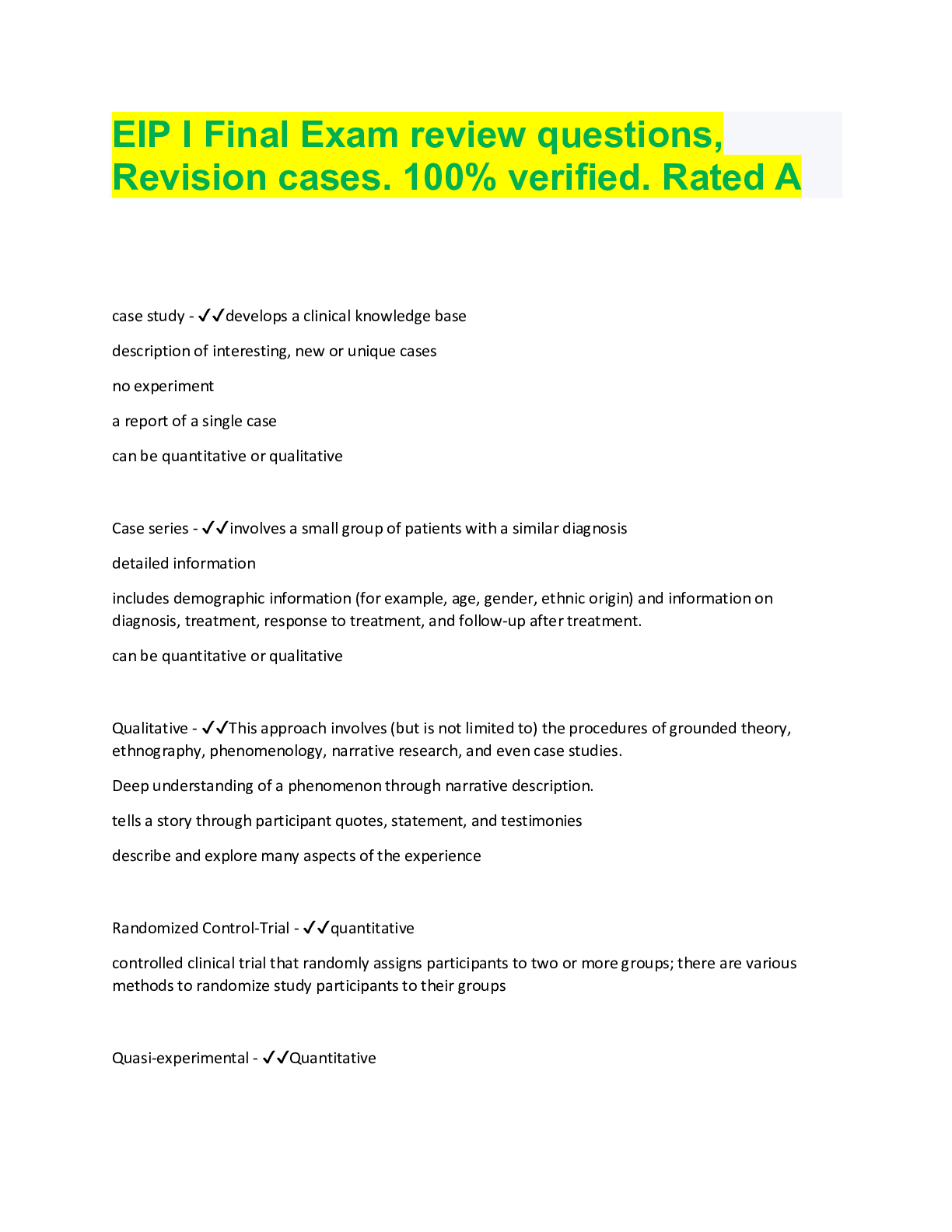
case study - ✔✔develops a clinical knowledge base
description of interesting, new or unique cases
no experiment
a report of a single case
...
EIP I Final Exam review questions,
Revision cases. 100% verified. Rated A
case study - ✔✔develops a clinical knowledge base
description of interesting, new or unique cases
no experiment
a report of a single case
can be quantitative or qualitative
Case series - ✔✔involves a small group of patients with a similar diagnosis
detailed information
includes demographic information (for example, age, gender, ethnic origin) and information on
diagnosis, treatment, response to treatment, and follow-up after treatment.
can be quantitative or qualitative
Qualitative - ✔✔This approach involves (but is not limited to) the procedures of grounded theory,
ethnography, phenomenology, narrative research, and even case studies.
Deep understanding of a phenomenon through narrative description.
tells a story through participant quotes, statement, and testimonies
describe and explore many aspects of the experience
Randomized Control-Trial - ✔✔quantitative
controlled clinical trial that randomly assigns participants to two or more groups; there are various
methods to randomize study participants to their groups
Quasi-experimental - ✔✔Quantitative
manipulation of an independent variable without the random assignment of participants to conditions
or orders of conditions.
Narrative Review - ✔✔Review of similar topic articles to a meaningful conclusion - may lack specified
organization
quantitative or qualitative
Systematic Review - ✔✔Typically similar levels of evidence
may be quantitative or qualitative
summary of the clinical literature; a critical assessment and evaluation of all research studies that assess
a particular clinical issue
organized method of locating, assembling, and evaluating a body of literature on a particular topic using
a set of specific criteria
Typically includes a description of the findings of the collection of research studies
May also include a quantitative pooling of data called a meta-analysis
Meta-analysis - ✔✔Systematic review concluding with overall effectiveness statistic
quantitative
way of combining data from many different research studies; a statistical process that combines the
findings from individual studies
Level of Evidence I - ✔✔Evidence from a systematic review or meta-analysis of all relevant RCTs
(randomized controlled trial) or evidence-based clinical practice guidelines based on systematic reviews
of RCTs or three or more RCTs of good quality that have similar results.
Level of Evidence II - ✔✔Evidence obtained from at least one well-designed RCT (e.g. large multi-site
RCT).
Level of Evidence III - ✔✔Evidence obtained from well-designed controlled trials without randomization
(i.e. quasi-experimental).
Level of Evidence IV - ✔✔Evidence from well-designed case-control or cohort studies.
Level of Evidence V - ✔✔Evidence from systematic reviews of descriptive and qualitative studies (metasynthesis).
Level of Evidence VI - ✔✔Evidence from a single descriptive or qualitative study.
Level of Evidence VII - ✔✔Evidence from the opinion of authorities and/or reports of expert
committees.
Bias - ✔✔Allowing assumptions to influence your thoughts; Can be prejudices; Very subjective based on
one's past experiences; It is one's personal view
personal biases
social biases
bias toward familiar ideas, likes and dislikes
Qualitative Research - ✔✔answers open-ended questions about populations, events, phenomena, and
maybe even test instruments where we don't have sufficient information to ask the what question,
instead answering the why and how questions of a large population study
What are the advantages of qualitative research? - ✔✔Naturalistic setting = no control
Researcher as the instrument
Emergent design: come in with a question and work with gate keepers to find your subjects and start
process
Recursive inductive and deductive data collection and analysis
Multiple sources of data
Participants meanings
Reflexivity: being aware of their own biases, theme test to confirm it's the participants meanings and
not their own, make sure researcher isn't shaping the data to their own bias
Holistic account
directional hypothesis - ✔✔A hypothesis that makes a specific prediction about the direction of the
relationship between two variables
Can be bias
Non-directional hypothesis - ✔✔Predicts the existence of a relationship, not its direction
Open-ended question, has less bias than directional hypothesis
Descriptive hypothesis - ✔✔A prediction about the results of a study that describes the behavior or the
relationship between behaviors
Written for each independent variable and dependent variable
Inferential Hypothesis - ✔✔Follow descriptive questions and relate variable or compare groups
Minimal Detectable Change (MDC) - ✔✔The amount of change in a variable that must be achieved to
reflect a true difference. The smallest amount of change that passes the threshold of erro
[Show More]