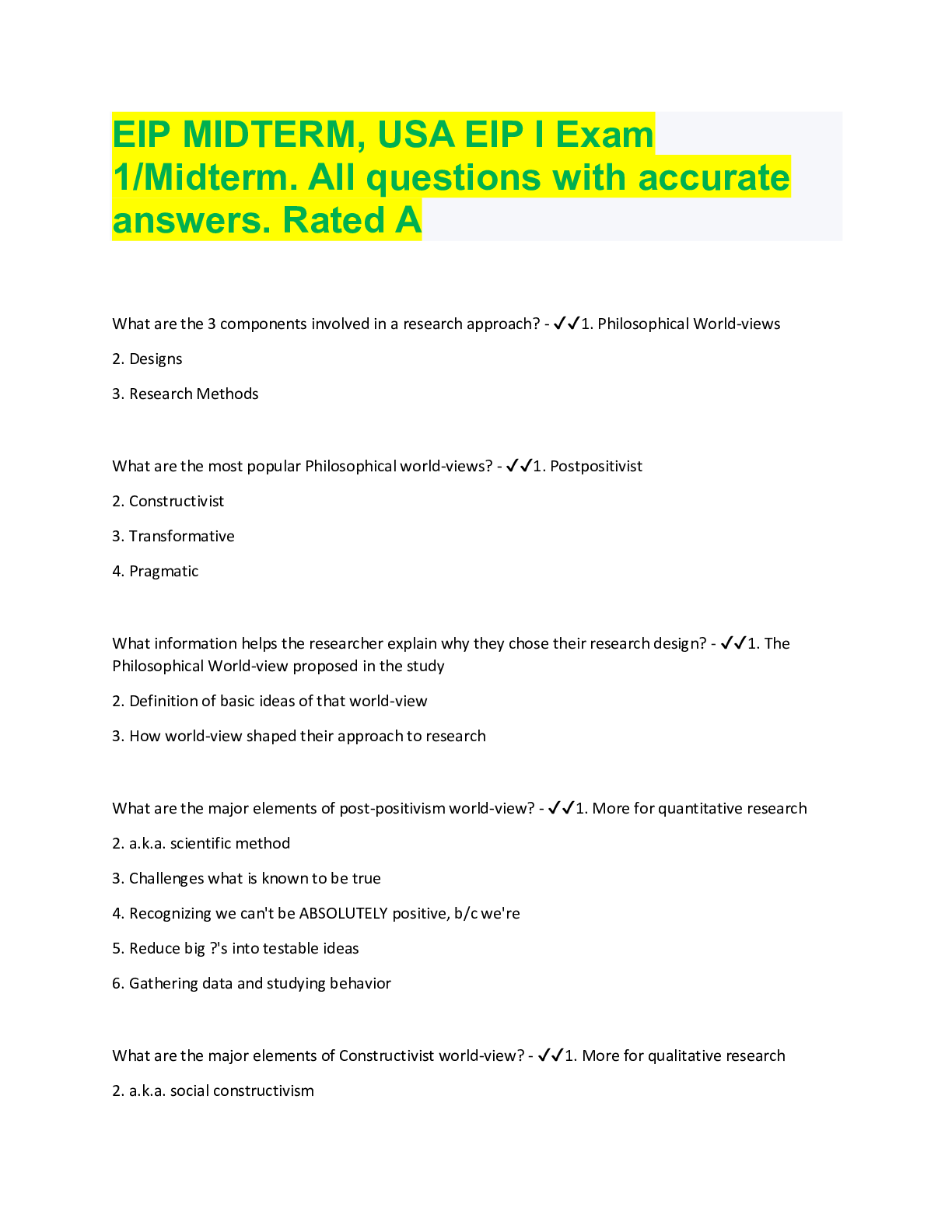
EIP MIDTERM, USA EIP I Exam
1/Midterm. All questions with accurate
answers. Rated A
What are the 3 components involved in a research approach? - ✔✔1. Philosophical World-views
2. Designs
3. Research Methods
What
...
EIP MIDTERM, USA EIP I Exam
1/Midterm. All questions with accurate
answers. Rated A
What are the 3 components involved in a research approach? - ✔✔1. Philosophical World-views
2. Designs
3. Research Methods
What are the most popular Philosophical world-views? - ✔✔1. Postpositivist
2. Constructivist
3. Transformative
4. Pragmatic
What information helps the researcher explain why they chose their research design? - ✔✔1. The
Philosophical World-view proposed in the study
2. Definition of basic ideas of that world-view
3. How world-view shaped their approach to research
What are the major elements of post-positivism world-view? - ✔✔1. More for quantitative research
2. a.k.a. scientific method
3. Challenges what is known to be true
4. Recognizing we can't be ABSOLUTELY positive, b/c we're
5. Reduce big ?'s into testable ideas
6. Gathering data and studying behavior
What are the major elements of Constructivist world-view? - ✔✔1. More for qualitative research
2. a.k.a. social constructivism
3. Seek to understand the world in which they live
4. Look for complexity of the view from participants experiences
5. Uses open-ended questions
6. Theory generation & always understanding social and historical settings
7. Unlike post-positivism, they generate (construct) theory
What are the major elements of Transformative world-view? - ✔✔1. research needs to be intertwined
with politics to confront social oppression.
2. Contains an action agenda for reform that may change participants life
3. Addresses important social issues
4. Collaborative with participants directly involved in social injustice - creates voice for them by them
helping design and collect data
What are the major elements of Pragmatic world-view? - ✔✔1. Unlike postpositivist, arises out of
actions, situations, and consequences
2. Mixed methods approach- use qualitative and quantitative
3. Is problem-centered, want to understand research problem
4. Look to what and how to research
5. "Real world" practice oriented
What are the different research designs? - ✔✔1. Quantitative
2. Qualitative
3. Mixed Methods
Mixed methods uses both predetermined and emerging methods in research design. Which of these is
qualitative and quantitative? - ✔✔Predetermined- Quantitative
Emerging- Qualitative
Mixed methods use both open- and closed-ended questions in their research design, which one is
qualitative and quantitative? - ✔✔open ended- Qualitative
Closed-ended- Quantitative (instrument based ?'s)
Mixed methods use multiple forms of data drawing on all possibilities in their research design, describe
quantitative and qualitative data - ✔✔1. Quantitative date- performance, attitude, observational, senses
2. Qualitative- interview, observation, document, and audiovisual
Mixed methods use statistical and text analysis in its research design, which one is qualitative and
quantitative? - ✔✔Quantitative- statistical analysis
Qualitative- Text and image analyisis
Mixed methods collect data by interpreting statistical analysis and themes & patterns analysis, which
one is qualitative and quantitative? - ✔✔Quantitative- statistical interpretation
Qualitative- Themes and pattern interpretation
Which research approach uses constructivist/ transformative claims? - ✔✔Qualitative
Which research approach uses postpositivist claims? - ✔✔Quantitative
Which research approach uses pragmatic claims? - ✔✔Mixed Methods
What are the alternative designs that make up quantitative research? - ✔✔1. Survey Designs (and
sometimes data surveys) getting a description of trends
2. Experimental Designs (treatment vs. control group)
-Random, quasi-experiment (non�random & single subject)
3. Longitudinal Designs- collects data over time
What are the alternative designs that make up qualitative research? - ✔✔1. Narrative design
2. Phenomenology
3. Grounded Theory
4. Ethnographies
5. Case studies
What are the alternative designs that make up mixed methods research? - ✔✔1. Combines qualitative &
quantitative design
2. Explanatory Sequential- quantitative data collected 1st, then elaborate w/ qualitative research
3. Exploratory Sequential- qualitative data (views) collected 1st, then elaborate w/ quantitative research
In qualitative research, which design focuses on studying lives of individuals and often combines views
of participant in collaboration with researcher(s) life? - ✔✔Narrative research
In qualitative research, which design focuses on philosophy and psychology in a group of participants
experiencing 1 phenomenon, and typically conducts ________________. - ✔✔Phenomenological
research
Interviews
In qualitative research, which design focuses on sociology and emerging patterns grounded in the views
of the participants? - ✔✔Grounded Theory
In qualitative research, which design focuses on sociology in which researcher studies shared patterns of
behaviors, language, and actions of an intact culture group in a natural setting in a prolonged period of
time? Data collection also involves ________ and __________. - ✔✔Ethnography
Observation
Interviews
In qualitative research, which design focuses on in-depth analysis of a case, often a program, event,
activity, process, or one or more individuals. - ✔✔Case Study
Given the scenario, illustrate the 3 research designs and the overall approach used.
Researcher tests a theory by specifying narrow hypothesis and collection of data to support or refute
hypothesis. Attitudes are assessed both before and after an experimental treatment. Data is collects on
instrument that measures attitudes, and info. is analyzed using statistical procedures and hypothesis
testing. - ✔✔Quantitative approach; postpositivist worldview; experimental design, and pretest and
posttest measures of attitude (survey)
Given the scenario, illustrate the 3 research designs and the overall approach used.
Researcher seeks to establish meaning of phenomenon from views of participants. This means
identifying culture sharing group, and studying how it develops shared patterns of behavior over time.
One of key elements of collecting data in this way is to observe participant behaviors during their
engagement in activities. - ✔✔1. Qualitative approach
2. Constructivist world view *Key word- establishing meaning of phenomenon from participants views
3. Ethnographic design *Key word- behavior over time
Given the scenario, illustrate the 3 research designs and the overall approach used.
Researcher bases inquiry on assumption that collecting diverse types of data best provides a more
complete understanding of a research problem than either quantitative or qualitative data alone. The
study begins with a broad survey in order to generalize results to a population and then, in a 2nd phase,
focuses on qualitative, open-ended interviews to collect detailed views from participants to help explain
the initial quantitative survey. - ✔✔1. Mixed Methods Approach
2. Pragmatic Worldview
3. Explanatory sequential design
Given the scenario, illustrate the 3 research designs and the overall approach used.
The inquirer seeks to examine an issue related to oppression of individuals. To study this, stories are
collected of individual oppression. Individuals are interviewed at some length to determine how they
have personally experienced oppression. - ✔✔1. Qualitative approach
2. Transformative Worldview
3. Narrative design
4. Open-ended interviewing
When conducting a literature search, what steps should you take and how do you prioritize those? -
✔✔1. Start w/ broad search of literature
2. Research journal articles that answer ?
3. Books related to specific topic
4. Conference papers from national conferences
5. Scan dissertation abstracts
6. Online journals from the web
What are the 7 steps for conducting a literature review? - ✔✔1. Identify keywords
2. Search databases on computer
3. Locate 50 reports related to topic
4. Skim articles and collect ones essential to topic
5. Design a literature map
6. Summaries of relevant articles
7. Assemble lit. review organizing important concepts
When researchers perform a literature review, abstracts can be written to synthesize the information
for easy reference. Review what should be included in an abstract. - ✔✔1. Mentions problem being
addressed
2. State central purpose or focus of study
3. Briefly state info. about sample, population, or subjects
4. Review key results that relate to proposed study
5. If it is critique or methods review, point out technical and methodological flaws.
What are the 4 types of literature review? - ✔✔1. Narrative
2. Systematic
3. Meta-analysis
4. Meta-synthesis
What type of review is a gathering of information from an expert in the field? - ✔✔Narrative
What type of review is a summary of the literature that uses clear methods to perform a thorough
search and critical appraisal of individual studies on a defined topic area for which there are sufficient
studies of similar design? - ✔✔Systematic
What type of review contains a statistical summary of at least one outcome in 2 or more trials? These
results are presented statistically in ________ form. - ✔✔Meta-analysis
Graphic
What type of review comes from qualitative studies and uses language-based data rather than
numerical data found in quantitative research? - ✔✔Meta-synthesis
What are 9 intellectual standards in order? - ✔✔1. Clarity
2. Accuracy
3. Precision
4. Relevance
5. Depth
6. Breadth
7. Logic
8. Significance
9. Fairness
_______ is understandable, meaning can be grasped, and elaborates on the point. - ✔✔Clarity
_________ is free from errors or distortions. Verify facts, check source to make sure it's valid. -
✔✔Accuracy
________ is exact to the necessary level of detail. More specific, details. - ✔✔Precision
________ is relating to the matter at hand. - ✔✔Relevance
________ is containing complexities and multiple interrelationships. - ✔✔Depth
_______ is encompassing multiple viewpoints. - ✔✔Breadth
________ is the parts make sense together, no contradictions. How does it all fit together? - ✔✔Logic
_______ is focusing on the important, not trivial facts. - ✔✔Significance
_____ is justifiable, not self-serving or one-sided. Representing all viewpoints. - ✔✔Fairness
What type of egocentric thinker regards their own needs as the center of all things - ✔✔Innate
egocentrism
What type of egocentric thinker would look at viewpoint of social group? - ✔✔Sociocentrism
Innate egocentric thinking is developed because I want to believe it and I believe in whatever puts me in
a positive light. - ✔✔Innate wish fulfillment
Innate egocentric thinking is developed because it is my selfish interest to believe it. - ✔✔Innate
Selfishness
Innate egocentric thinking is developed because I have always believed it. - ✔✔Innate Self-Validation
________ is assumption that influences thought - ✔✔Bias
What is bias due to? - ✔✔1. Personal view
2. Familiar ideas
3. Likes/dislikes
What is physiognomy in regards to bias? - ✔✔Perceiving information through facial expressions
___________ is the interrelationships among basic elements - ✔✔Conceptual Knowledge
________ entails the interrelationships and synthesis of information which judgement is made utilizing
reflection of self-awareness. - ✔✔Conceptual Reasoning
What is acronym for WISE approach? - ✔✔W-wonder (reflect on experiences)
I-investigate (gain info.)
S-speculate (identify possible solutions)
E-evaluate (test solutions)
What is the purpose of a literature review? - ✔✔1. Integrate prior studies
2. Connect dots so it becomes series of related topics
3. Identify central issue
4. Provide more rigor than single study
5. Lack of time to read multiple studies
6. Provides info. on population intervention, and outcome
7. Confirmation of results
What is the difference between a search engine and a repository? - ✔✔Search engine: google scholar
Repository: Physical building of books
List the 5 levels of evidence from most rigorous to least? - ✔✔1. Systematic review of RCT
2. Systematic review of cohort studies
3. Systematic review of Case control studies
4. Case series and Case control studies
5. Expert opinion without explicit critical appraisal
What are the 4 key characteristics of Evidence Based Practice? - ✔✔1. Clinician Experience / Expertise
2. Patient Values & Preferences
3. Reviewing best Available Research
4. How It Was Developed
What are the steps in the process of evidence based practice? - ✔✔1. Posing clinical question (PICO)
2. Searching for evidence
3. Appraising Literature
4. Making a decision
5. Assessing effectiveness of intervention & ones proficiency with EB
[Show More]


.png)




.png)
.png)
.png)









