PCT NHA Examinable Questions and
answers. Updated Version. Rated A
1. The lavender-topped tube contains:
a. No additive
b. SPS
c. Na+ citrate
d. EDTA - ✔✔-d. EDTA
1. The additive in a gray-topped tube is:
a. K+
...
PCT NHA Examinable Questions and
answers. Updated Version. Rated A
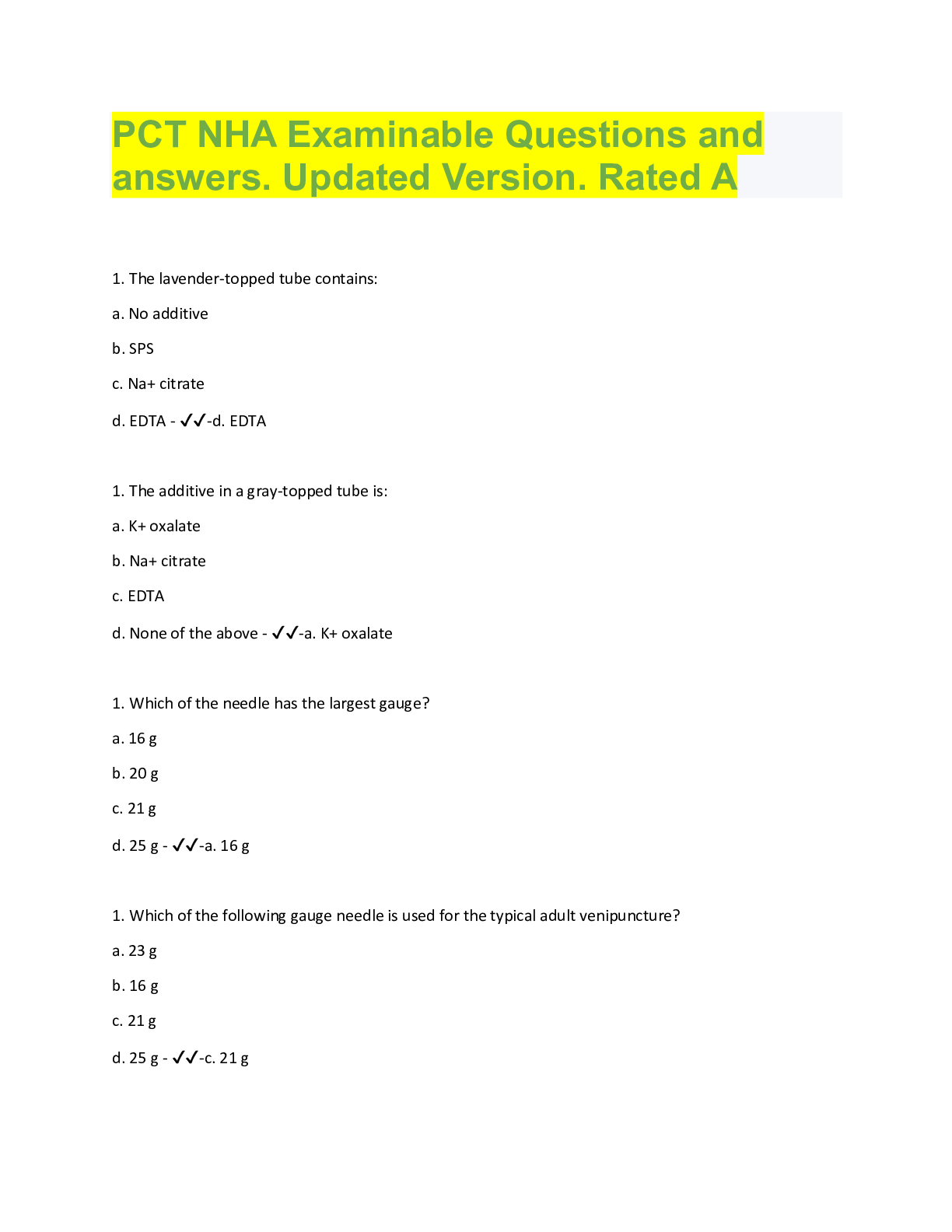
1. The lavender-topped tube contains:
a. No additive
b. SPS
c. Na+ citrate
d. EDTA - ✔✔-d. EDTA
1. The additive in a gray-topped tube is:
a. K+ oxalate
b. Na+ citrate
c. EDTA
d. None of the above - ✔✔-a. K+ oxalate
1. Which of the needle has the largest gauge?
a. 16 g
b. 20 g
c. 21 g
d. 25 g - ✔✔-a. 16 g
1. Which of the following gauge needle is used for the typical adult venipuncture?
a. 23 g
b. 16 g
c. 21 g
d. 25 g - ✔✔-c. 21 g
1. The venipuncture equipment that consists of a needle attached to a plastic tubing is known as:
a. Syringe
b. Evacuated tube
c. Winged infusion set
d. Micro-collection container - ✔✔-c. Winged infusion set
1. All of the following are true about winged infusion sets EXCEPT:
a. Commonly referred to as a butterfly
b. Comes in needles sizes of 16g and 18g
c. Used on fragile veins
d. Preferred over a syringe - ✔✔-b. Comes in needles sizes of 16g and 18g
1. You are about to draw a FBG on a patient and the patient states that he took his medications with
some orange juice this morning. What would you do next?
a. Draw the patient's blood
b. Explain to the patient that you cannot draw his blood without speaking to his physician first
c. Tell the patient to call his physician immediately
Ask the patient to leave and come back tomorrow - ✔✔-b. Explain to the patient that you cannot draw
his blood without speaking to his physician first
1. Which of the following actions is incorrect when performing a dermal puncture?
a. Using a 2.0 mm lancet on a child
b. Puncturing the plantar surface of the heel
c. Allowing the alcohol to dry onsite prior to puncture
d. Collecting the first drop of blood - ✔✔-d. Collecting the first drop of blood
1. The function of veins is to:
a. Carry oxygen-rich blood to the heart
b. Facilitate the exchange of oxygen-rich blood and deoxygenated blood
c. Carry deoxygenated blood away from the heart
d. Carry deoxygenated blood to the heart - ✔✔-d. Carry deoxygenated blood to the heart
1. The function of arteries is to:
a. Facilitate the exchange of oxygen-rich blood and deoxygenated blood
b. Carry oxygen-rich blood away from the heart
c. Carry deoxygenated blood to the heart
d. Pump blood to all parts of the body - ✔✔-b. Carry oxygen-rich blood away from the heart
1. The average heart rate is:
a. 72 bpm
b. 62 bpm
c. 82 bpm
d. 92 bpm - ✔✔-a. 72 bpm
1. Which of the following actions should the PCT take if the baseline of the ECG is off center?
a. Adjust the standardization button
b. Adjust the sensitivity
c. Adjust the stylus (although ECG machines no longer have styluses)
d. Adjust the paper feeder - ✔✔-c. Adjust the stylus (although ECG machines no longer have styluses)
1. Which of the following is the inner layer of the heart?
a. Pericardium
b. Endocardium
c. Epicardium
d. Myocardium - ✔✔-b. Endocardium
1. What is the universal standard for recording an ECG?
a. 20 mm/sec
b. 25 mm/sec
c. 30 mm/sec
d. 35 mm/sec - ✔✔-b. 25 mm/sec
1. Which of the following structures separates the right atrium from the right ventricle?
a. Aortic valve
b. Mitral valve
c. Bicuspid valve
d. Tricuspid valve - ✔✔-d. Tricuspid valve
1. The approximate time for one cardiac cycle is
a. 1.0 sec
b. 0.25 sec
c. 0.8 sec
d. 0.08 sec - ✔✔-d. 0.08 sec
1. The lower chambers of the heart are the
a. Ventricles
b. Atria
c. Septum
d. Apex - ✔✔-a. Ventricules
1. A term that means "deficiency of red blood cells" is
a. Erythocytopenia
b. Atheroma
c. Erythrocytosis
d. Hematemesis - ✔✔-a. Erythopenia
1. The term thrombophlebitis means
a. Pain in a vessel
b. Inflammation of a vein in the presence of a clot
c. Clotting cell
d. None of the above - ✔✔-b. Inflammation of the vein in the presence of a clot
1. The term angioedema means
a. Swelling of an artery
b. Narrowing of the aorta
c. Swelling of a vessel
d. Rupture of a lymphatic vessel - ✔✔-c. Swelling of a vessel
1. Which of the following is the proper conduction sequence:
a. SA node -> AV node -> bundle of His -> Purkinje fibers
b. AV node -> SA node -> Purkinje fibers -> bundle of His
c. SA node -> bundle of His -> Purkinje fibers -> AV node
d. SA node -> AV node -> Purkinje fibers -> bundle of His - ✔✔-a. SA node -> AV node-> Bundle of His->
Purkinje fibers
1. Which of the following statements is true regarding myocardial infarction?
a. Presenting symptoms may be different in women than in men
b. Individuals with chest pain should immediately drive themselves to the hospital rather than waiting
on an ambulance
c. Confusion and hallucinations are a common symptom
The test that is considered most reliable in diagnosing an MI is the ECG - ✔✔-a. Presenting symptoms
may be different in women than in men
1. Which of the following statements is true regarding heart failure?
a. The right ventricle is the part of the heart most effected
b. Those at greatest risk for developing heart failure include African Americans and the elderly
c. The most common symptoms include pain in the chest, jaw, and left arm
The most useful test for diagnosing heart failure is the ECG - ✔✔-Those at greatest risk for developing
heart failure include African Americans and the elderly
1. All of the following statements are true regarding aneurysm EXCEPT:
a. It is an abnormal dilation of the wall of a blood vessel by more than 50% due to weakness in the vessel
b. Brain aneurysms, which are usually congenital, are most common in adult women
c. A common examination finding in those with brain aneurysm is a murmur
d. Rupture of an abdominal aortic aneurysm causes pain in the abdomen or back, and is a medical
emergency - ✔✔-c. A common examination finding in those with brain aneurysm is a murmur
1. A 67-year-old man presents to the urgent care clinic complaining of a squeezing sensation in his chest
and difficulty breathing. The PCT should respond in all of the following ways EXCEPT:
a. Escorting him to a treatment room, applying oxygen, and having him rest while waiting his turn to be
seen
b. Taking him to a treatment room by a wheelchair and obtaining a set of vital signs
c. Preparing to obtain an immediate ECG
Preparing to administer aspiring and nitroglycerin - ✔✔-Escorting him to a treatment room, applying
oxygen, and having him rest while waiting his turn to be seen
2. The PCT understands that the cardiologist evaluates patients for signs and symptoms of heart disease
such as:
a. Flat neck veins
b. Upper extremity edema
c. Lung congestion
d. Skin rashes - ✔✔-c. Lung congestion
1. The PCT understands that all of the following are true regarding ECG except:
a. The paper used in ECG machines is pressure and heat sensitive
b. between bold vertical lines (five tiny boxes) represents 0.2 seconds of time
c. Electrodes that transmit data about cardiac electrical activity to the ECG machine are placed on the
patient's arms, legs and chest
d. Most medical offices today use metal disks, rubber bands, and suction cups to attach electrodes and
keep them in place - ✔✔-d. Most medical offices today use metal disks, rubber bands, and suction cups
to attach electrodes and keep them in place
1. The PCT who is teaching her patient about an event recorder realizes that the patient needs further
instruction when he states
a. "This is a small, portable monitor that I can wear around my neck or put in my shirt pocket."
b. "I will have two electrodes on my chest that I can activate if I feel any symptoms."
c. "This device will send an electric shock to my heart if I need it."
d. "I should only have to wear this device for 24 hours." - ✔✔-c. "this device will send an electric shock
to my heart if I need it"
1. The PCT who is teaching her patient about a Holter monitor realizes that the patient needs further
instruction when he states:
a. "I will wear this device for up to 48 hours."
b. "I must keep a journal of my activities and any symptoms I have."
c. "I can shower or bathe as I normally do while wearing this monitor."
d. "A cardiologist will review and interpret the results of this test." - ✔✔-c. I can shower or bathe as I
normally do while wearing this monitor?
1. The PCT who is teaching her patient about a cardiac stress test realizes that the patient needs further
instruction when he states:
a. "We are doing this to see how well my heart tolerates physical activity."
b. "I will walk on a treadmill during the test."
c. "I will be closely monitored during the test."
d. "There are no risks to worry about during this test." - ✔✔-d. There are no risks to worry about during
this test.
1. The PCT who is teaching her patient about a cardioverter defibrillator realizes that the patient needs
further instruction when he states:
a. "This is essentially the same thing as a pacemaker."
b. "This will send information about my heart rate and rhythm to the medical office on a continuous
basis."
c. "This might send an electric shock to my heart if I need it."
"This is the same size as a pacemaker." - ✔✔-b. This will send information about my heart rate and
rhythm to the medical office on a continuous basis
1. The PCT who is teaching her patient about a cardiac pacemaker realizes that the patient needs further
instruction when he states:
a. "This device will deliver electrical impulses to my heart to make it beat."
b. "It will be implanted in my right chest wall beneath the skin."
c. "There are many different types of pacemakers."
d. "Since mine will be a rate-responsive pacemaker, it will sense my activity and increase or decrease the
rate as I need it." - ✔✔-b. It will be implanted in my right chest wall beneath the skin
1. The PCT understands the following about ECG waveforms:
a. A large QRS waveform is an abnormal finding
b. The simplest way to calculate the ventricular rate is to **** the number of R waves in a 6-second strip
(30 large squares) and multiply by 10
c. The typical rate for normal sinus rhythm (NSR) is 40-60
Sinus bradycardia is always a life-threatening rhythm - ✔✔-b. The simplest way to calculate the
ventricular rate is to count the number of R waves in a 6-second strip (30 large squares) and multiply by
10
1. The PCT understands that the most life-threatening of the following cardiac rhythms is:
a. Ventricular fibrillation
b. Atrial flutter
c. Sinus arrhythmia
d. Sinus tachycardia - ✔✔-a. ventricular fibrillation
1. Which of the following is NOT a component of the cardiovascular system?
a. Spleen
b. Heart
c. Arteries
d. Capillaries - ✔✔-a. spleen
1. Which of the following is the correct term for absence of urine?
a. Nonuria
b. Anuria
c. Dysuria
d. Oliguria - ✔✔-Anuria
1. If a patient is complaining of difficulty or painful urination, he is said to have
a. Oliguria
b. Polyuria
c. Nocturia
d. Dysuria - ✔✔-d. Dysuria
1. If a urine specimen cannot be tested within 30-60 minutes, the PCT should
a. Leave the specimen on the counter
b. Put the urine in the incubator
c. Put the urine in a specimen collection bag
Put the urine in the refrigerator - ✔✔-d. Put the urine in the refrigerator
1. All of the following are guidelines for handling urine reagent strips except:
a. Store in the refrigerator when not in use
b. Check the expiration date prior to use
c. Check each strip for color changes prior to use
d. Keep cover on container when not in use - ✔✔-a. Store in the refrigerator when not in use
1. The pregnancy test tests for which of the following hormones?
a. Growth hormone
b. Progesterone
c. Human chorionic gonadotropin
d. Estrogen - ✔✔-c. Human chorionic gonadotropi
[Show More]