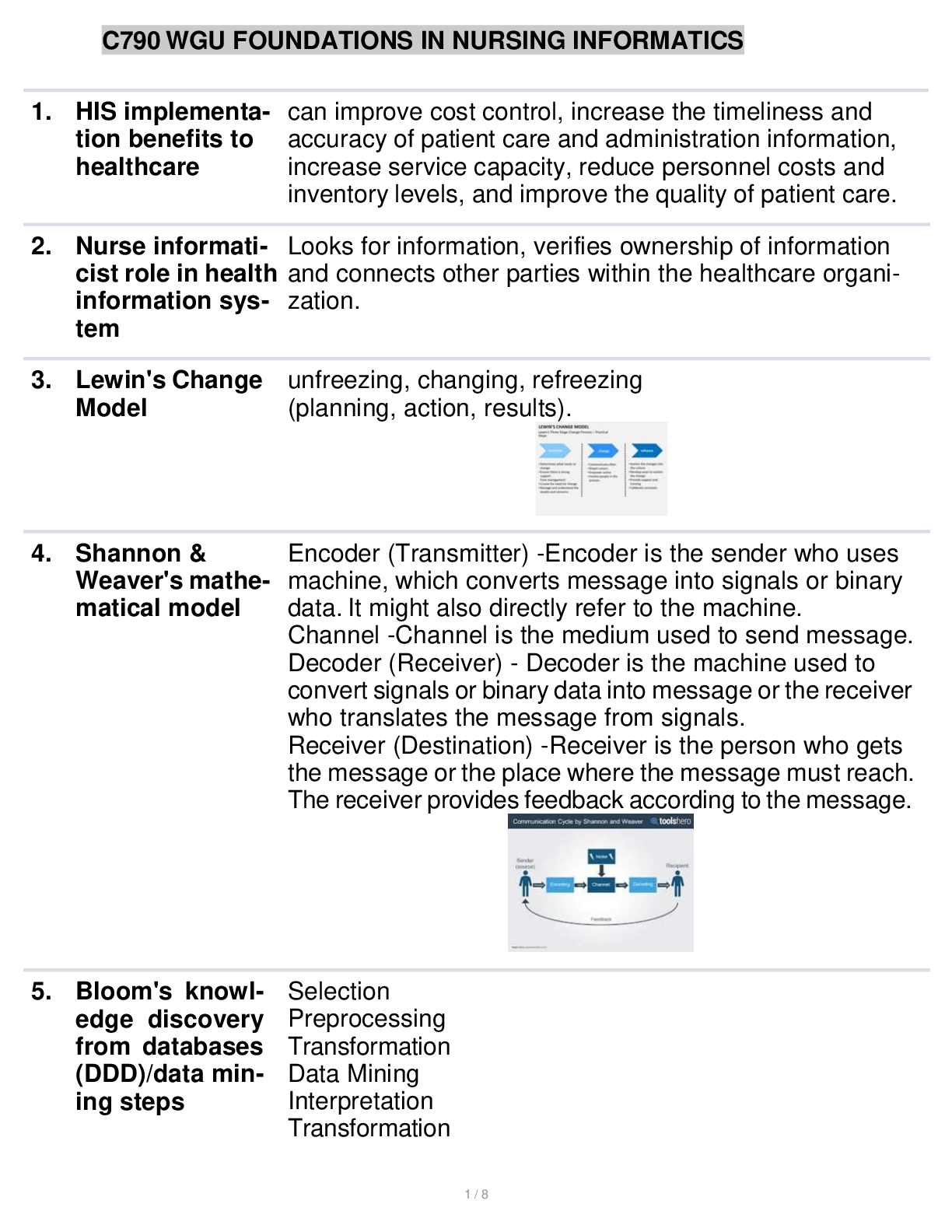
C790 WGU FOUNDATIONS IN NURSING
INFORMATICS, Full Exam Preview, rated
A+. verified.
HIS implementation benefits to healthcare
can improve cost control, increase the timeliness and accuracy of patient care and admin
...
C790 WGU FOUNDATIONS IN NURSING
INFORMATICS, Full Exam Preview, rated
A+. verified.
HIS implementation benefits to healthcare
can improve cost control, increase the timeliness and accuracy of patient care and administration
information, increase service capacity, reduce personnel costs and inventory levels, and improve
the quality of patient care.
Nurse informaticist role in health information system
Looks for information, verifies ownership of information and connects other parties within the
healthcare organization.
00:0201:36
Lewin's Change Model
unfreezing, changing, refreezing
(planning, action, results).
Shannon & Weaver's mathematical model
Encoder (Transmitter) –Encoder is the sender who uses machine, which converts message into
signals or binary data. It might also directly refer to the machine.
Channel –Channel is the medium used to send message.
Decoder (Receiver) – Decoder is the machine used to convert signals or binary data into
message or the receiver who translates the message from signals.
Receiver (Destination) –Receiver is the person who gets the message or the place where the
message must reach. The receiver provides feedback according to the message.
Bloom's knowledge discovery from databases (DDD)/data mining steps
Selection
Preprocessing
Transformation
Data Mining
Interpretation
Transformation
CIO role in HIS implementation
oversees the operation of the information technology department and consults with other C-level
personnel on technology-related needs and purchasing decisions.
SLC Phases
Solution Life Cycle
* Discover, Analyze, & Recommend.
* Design, Develop, & Integrate.
* Test & Quality Assurance.
* Deploy & Maintain.
* Evaluate.
* Archive & Retire.
SDLC
#1) Requirement Gathering and Analysis.
#2) Design.
#3) Implementation or Coding.
#4) Testing.
#5) Deployment.
#6) Maintenance.
Waterfall Model Phases
Requirements analysis and definition
System and software design
Implementation and unit testing
Integration and system testing
Operation and maintenance
NO OVERLAP
Agile Model
A development model that emphasizes continuous feedback and cross-functional teamwork.
adaptive approach to the SDLC
approach that assumes the project must be more flexible and adapt to changing needs as the
project progresses
Predictive approach to the SDLC
an approach that assumes the project can be planned in advance and that the new information
system can be developed according to the plan
Project Management Phases
Project management consists of a number of required activities that are grouped into four major
stages of activity referred to as phases. They are: Definition Phase, Planning Phase, Execution
Phase and Analysis Phase
[Show More]