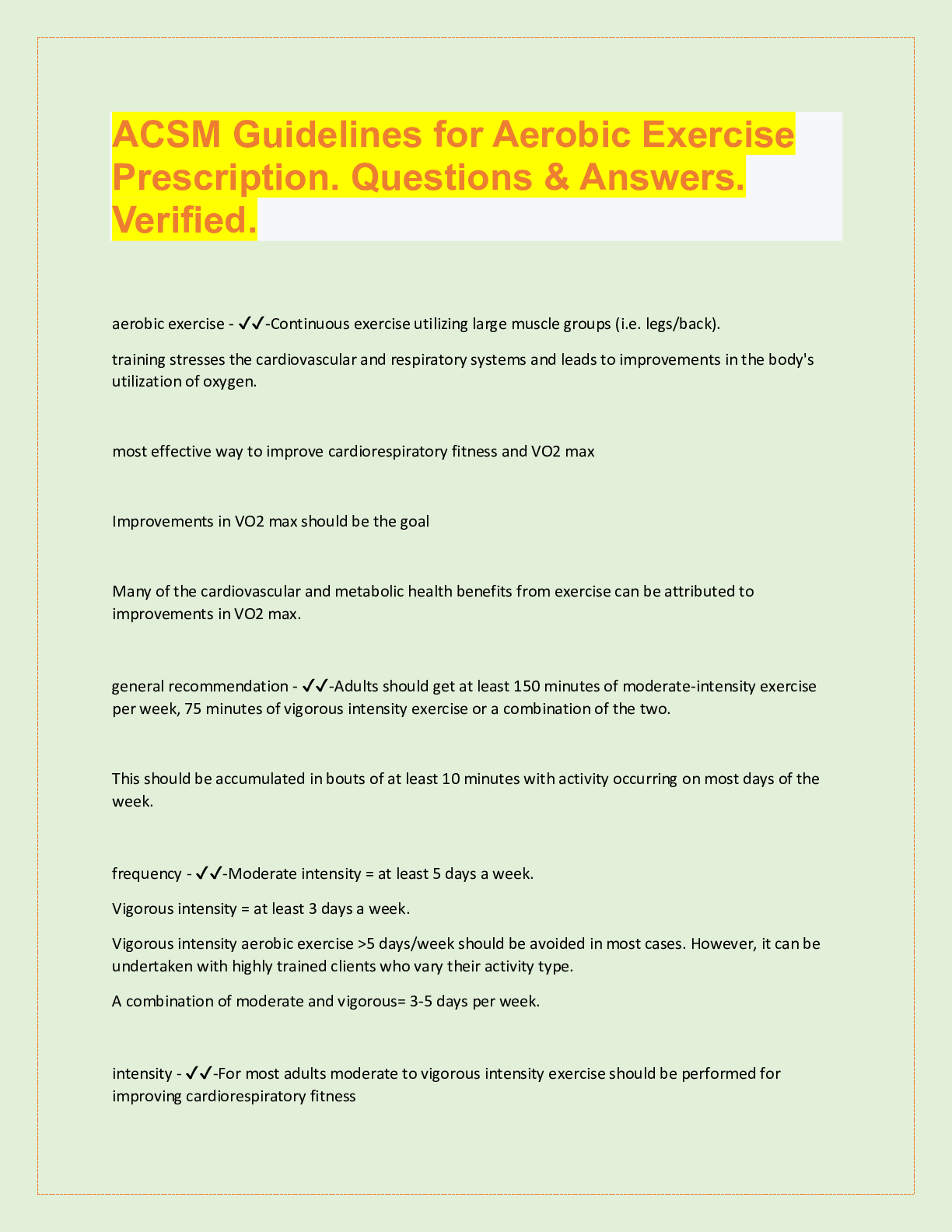
ACSM Guidelines for Aerobic Exercise
Prescription. Questions & Answers.
Verified.
aerobic exercise - ✔✔-Continuous exercise utilizing large muscle groups (i.e. legs/back).
training stresses the cardiovascular and r
...
ACSM Guidelines for Aerobic Exercise
Prescription. Questions & Answers.
Verified.
aerobic exercise - ✔✔-Continuous exercise utilizing large muscle groups (i.e. legs/back).
training stresses the cardiovascular and respiratory systems and leads to improvements in the body's
utilization of oxygen.
most effective way to improve cardiorespiratory fitness and VO2 max
Improvements in VO2 max should be the goal
Many of the cardiovascular and metabolic health benefits from exercise can be attributed to
improvements in VO2 max.
general recommendation - ✔✔-Adults should get at least 150 minutes of moderate-intensity exercise
per week, 75 minutes of vigorous intensity exercise or a combination of the two.
This should be accumulated in bouts of at least 10 minutes with activity occurring on most days of the
week.
frequency - ✔✔-Moderate intensity = at least 5 days a week.
Vigorous intensity = at least 3 days a week.
Vigorous intensity aerobic exercise >5 days/week should be avoided in most cases. However, it can be
undertaken with highly trained clients who vary their activity type.
A combination of moderate and vigorous= 3-5 days per week.
intensity - ✔✔-For most adults moderate to vigorous intensity exercise should be performed for
improving cardiorespiratory fitness
Previously sedentary individuals should begin with light to moderate intensity activities when starting an
exercise program.
calculating exercise intensity - ✔✔-Max HR
HRR
VO2 Max
VO2 reserve
METS
RPE
Max HR - ✔✔-HR max is the highest a person's heart rate will go.
Intensity can be expressed as % of HR max
HR goes down with age
Predicted HR max
220-age
HRR - ✔✔-Intensity expressed as % of this
Intensity=Resting HR + %intensity x HRR (HR max- resting heart rate)
VO2 Max - ✔✔-This intensity is expressed as a % of this
You are less likely to use this value in actual training because it is difficult to obtain this, but you WILL
see this on the test.
To calculate you will just multiply % intensity by this.
VO2 Reserve - ✔✔-This similar to HRR
Intensity= VO2 at rest + % intensity x VO2R (VO2 max-resting)
Resting VO2 is usually not measured, and the average resting VO2 is 3.5 ml/kg/min
METS - ✔✔-This method stands for metabolic equivalents. You will likely not use this in practice, but will
likely see at least one question on the exam about it.
1 of these = 3.5 ml/kg/min.
To determine this value of an exercise, you will divide VO2 by 3.5.
RPE - ✔✔-Simple, yet accurate
Sometime's called Borg's RPE scale
Measured as either 6-20 or 1-10 with 10/20 being the hardest possible exercise and 1/6 being no
exertion at all.
HRR Equation - ✔✔-Target HR = (MaxHR-RestHR)x intensity % + RestHR
HRR intensities - ✔✔-light <40%
mod 40-59%
vigorous 60-89%
near max >90%
VO2 reserve equation - ✔✔-Target VO2VOR = (Max VO2-RestVO2) x intensity % + RestVO2
VO2 reserve intensities - ✔✔-light <40%
mod 40-59%
vigorous 60-89%
near max >90%
HR max equation - ✔✔-Target HR = Max HR x intensity %
HR max intensities - ✔✔-light <64
mod 64-76
vigorous 77-95
near max >95
VO2 max equation - ✔✔-Targ
[Show More]