APES Population, Questions and
answers, 100% Accurate. Rated A+
population ecology - ✔✔-The study of populations in relation to the environment, including
environmental influences on population density and distribut
...
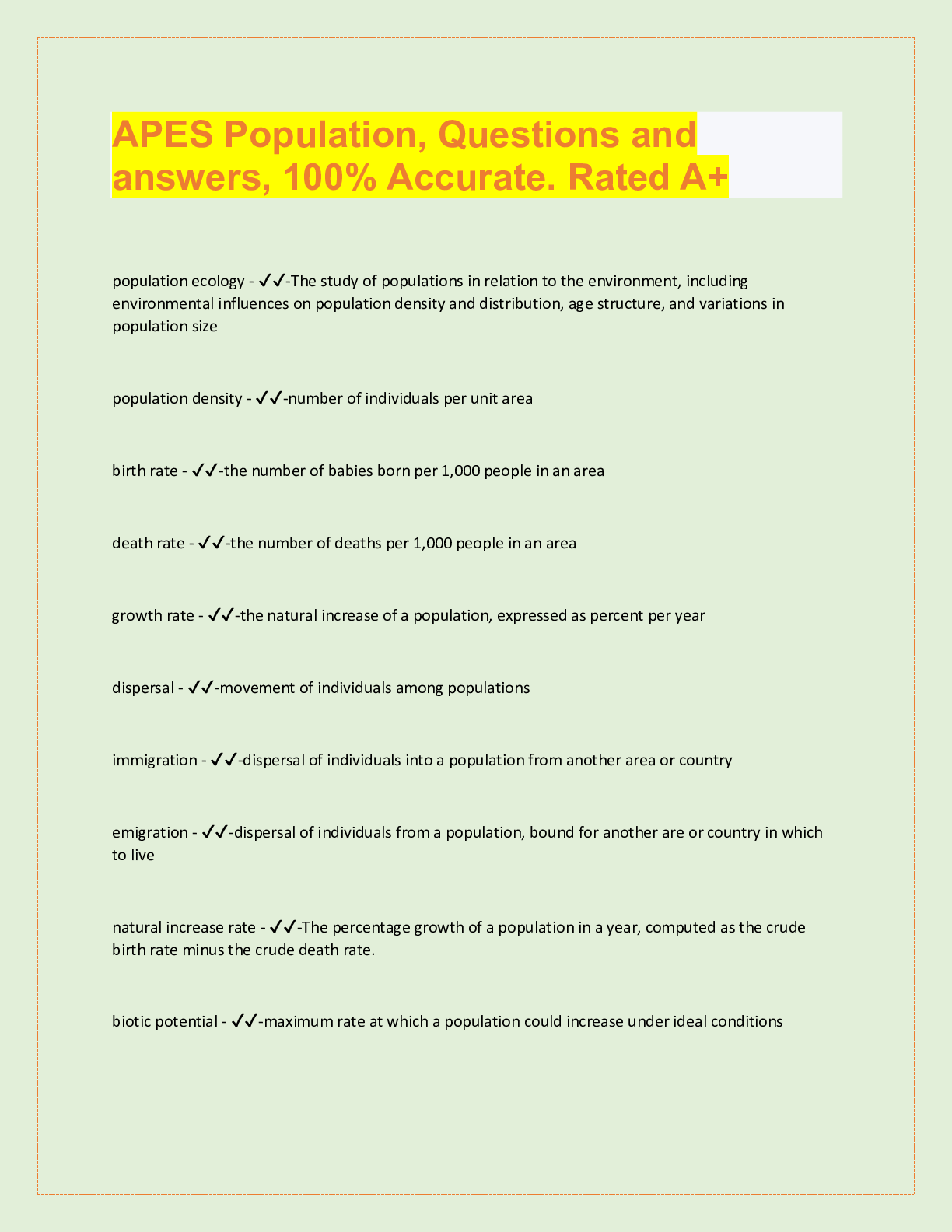
APES Population, Questions and
answers, 100% Accurate. Rated A+
population ecology - ✔✔-The study of populations in relation to the environment, including
environmental influences on population density and distribution, age structure, and variations in
population size
population density - ✔✔-number of individuals per unit area
birth rate - ✔✔-the number of babies born per 1,000 people in an area
death rate - ✔✔-the number of deaths per 1,000 people in an area
growth rate - ✔✔-the natural increase of a population, expressed as percent per year
dispersal - ✔✔-movement of individuals among populations
immigration - ✔✔-dispersal of individuals into a population from another area or country
emigration - ✔✔-dispersal of individuals from a population, bound for another are or country in which
to live
natural increase rate - ✔✔-The percentage growth of a population in a year, computed as the crude
birth rate minus the crude death rate.
biotic potential - ✔✔-maximum rate at which a population could increase under ideal conditions
exponential population growth - ✔✔-Growth of a population in an ideal, unlimited environment,
represented by a J-shaped curve when population size is plotted over time.
environmental resistance - ✔✔-All the limiting factors that tend to reduce population growth rates and
set the maximum allowable population size or carrying capacity of an ecosystem
carrying capacity - ✔✔-(K) represents the largest population that can be maintained for an indefinite
period by a particular environmnet
survivorship - ✔✔-probability that a given individual in a population will survive to a particular age
density- dependent factor - ✔✔-an environmental factor whose effects on a population change as
population density change: it tends to retard pop. growth as population density increases and enhance
pop growth as pop density decreases
density- independent factor - ✔✔-an environmental factor that affects the size of pop but is not
influenced by changes in pop density
zero population growth - ✔✔-when a pop is no longer increasing (or decreasing)
(b)rate = (d)rate
doubling time - ✔✔-the number of years it will take a population to double in size, given its current
growth rate
infant mortality rate - ✔✔-the # of infant deaths per 1,000 live births
replacement- level fertility - ✔✔-# of children a couple must have to "replace" themselves
total fertility rate - ✔✔-the average number of children born to each woman during her lifetime
MDCs - ✔✔-USA, Canada, France, Germany, Sweden, Australia, Japan
MDC - ✔✔-low growth rate
highly industrial
low birth rates
low infant mortality rates
longer life expectancy
moderately developed countries - ✔✔-(b)rates & IMR are higher than MDCs.
medium level of industrialization
LDCs - ✔✔-Bangladesh, Nigera, Ethiopia, Laos, Cambodia
LDC - ✔✔-opposite of MDC status
demographic transition - ✔✔-The process of change in a society's population from a condition of high
crude birth and death rates and low rate of natural increase to a condition of low crude birth and death
rates, low rate of natural increase, and a higher total population.
preindustrial stage - ✔✔-(b)rates and (d)rates are high, pop grows at a modest rate. IMF is high (Finland
during the late 1700s)
transitional stage - ✔✔-lowered (d)rate, (b)rate is still high, pop grows rapidly (Finalnd in mid-1800s)
industrial stage - ✔✔-decline in (b)rate and takes place during industrialization process. pop growth,
(d)rate is low (Finland in early 1900s
[Show More]