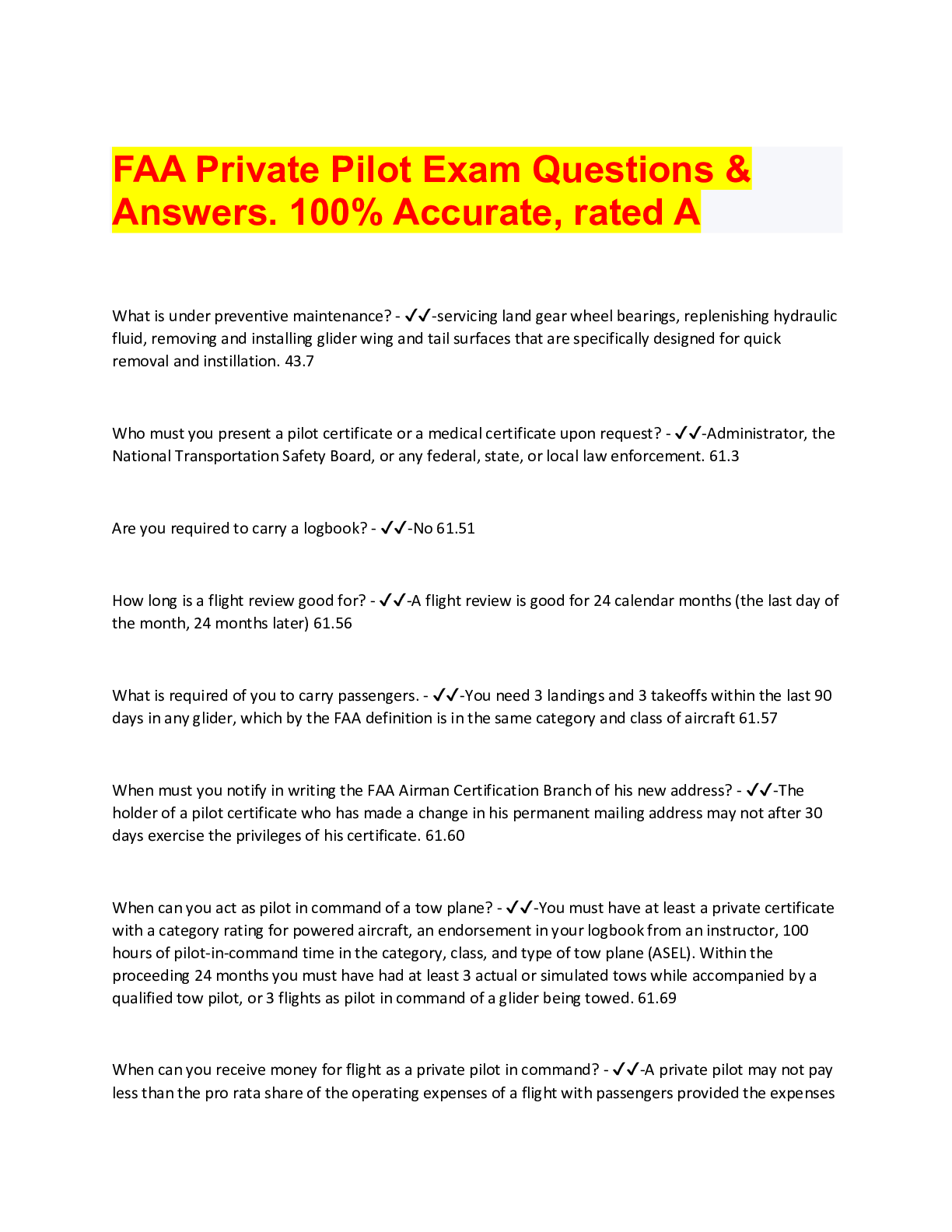
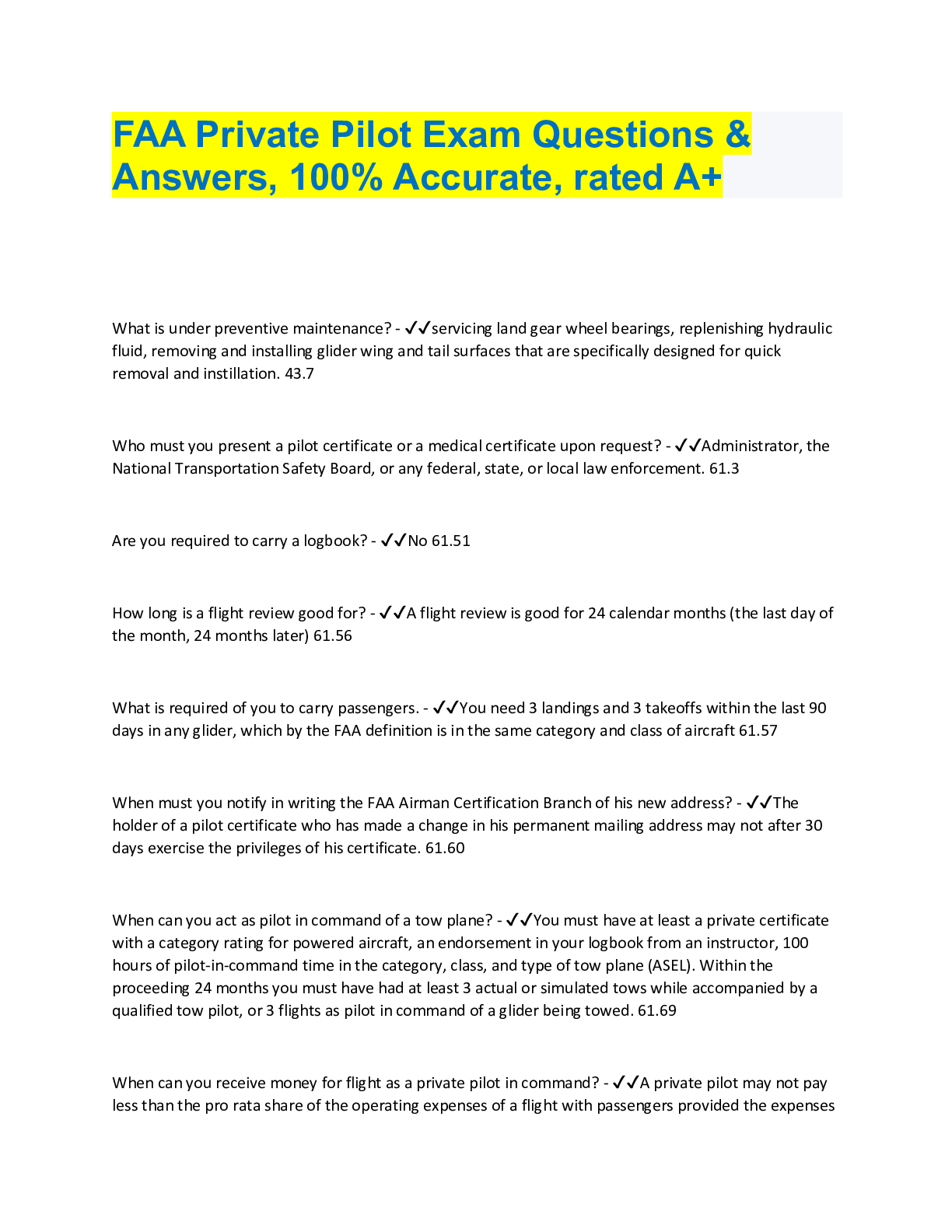
FAA Private Pilot Exam Questions with
accurate answers, rated A+
What are the three axis the aircraft moves about?
A. lateral, vertical, pitch
B. vertical, horizontal, lateral
C. longitudinal, vertical, lateral - ✔
...
FAA Private Pilot Exam Questions with
accurate answers, rated A+
What are the three axis the aircraft moves about?
A. lateral, vertical, pitch
B. vertical, horizontal, lateral
C. longitudinal, vertical, lateral - ✔✔-C. longitudinal, vertical, lateral
Which function does the rudder provide?
A. pitch
B. yaw
C. roll - ✔✔-B. yaw
What does pitching the nose up or down in fight primarily do?
A. change the altitude
B. change airspeed
C. change the heading - ✔✔-B. change the airspeed
During your preflight you should take a sample of fuel from the plane (this plane is 100LL plane). Which
color should the fuel be?
A. Blue
B. Green
C. Red
D. Clear - ✔✔-A. Blue
During your preflight you should take a sample of fuel from the plane (this plane is jet A plane). Which
color should the fuel be?
A. Blue
B. Green
C. Red
D. Clear - ✔✔-D. Clear
During your preflight you should take a sample of fuel from the plane (this plane is 100 plane). Which
color should the fuel be?
A. Blue
B. Green
C. Red
D. Clear - ✔✔-B. Green
During your preflight you should take a sample of fuel from the plane (this plane is 80 plane). Which
color should the fuel be?
A. Blue
B. Green
C. Red
D. Clear - ✔✔-C. Red
Where can you find information about how to conduct a proper preflight of the airplane you will be
flying?
A. Cessna wedbite
B. POH
C. Google - ✔✔-B. POH
What controls our altitude?
A. power
B. elevator
C. pitch - ✔✔-A. power
What instrument does the Pitot Tube send information to?
A. VSI (vertical speed indicator)
B. altimeter
C. airspeed indicator
D. all the above - ✔✔-c. airspeed indicator
What are the three primary flight controls?
A. elevator, flaps, throttle
B. ailerons, rudder, elevator
C. ailerons, trim, elevator - ✔✔-B. ailerons, rudder, elevator
What does the "stall sensor" or stall warning device measure to warn of an impeding stall?
A. angle of attack
B. airspeed
C. pitch angle
D. A and C
E. all the above - ✔✔-A. angle of attack
During a normal takeoff, when do you apply back pressure to the control yoke?
A. after you apply full power
B. when you want to go up
C. at rotation speed - ✔✔-A. after you apply full power
What are the four left turning tendencies of the airplane from the list below?
- gyroscopic procession
- spiraling slipstream
- power effect
- torque effect
- p-factor - ✔✔-gyroscopic procession, spiraling slipstream, torque effect, and p-factor
The four basic part of a radio call...
A. your call sign, where you are, what tower you are calling, your aircraft type
B. your type aircraft, your position, who you are, what you want
C. who you are calling, who you are, where you are, what you want - ✔✔-C. who you are calling, who
you are, where you are, what you want
To make a turn in slow flight, it is best to use ____ bank.
A. just a little
B. no
C. a lot of - ✔✔-A. just a little
At a non-towered airport, you begin and end your radio calls with the name of the airport.
A. True
B. False - ✔✔-A. True
During slow flight what will you primarily use to control altitude?
A. bank (ailerons)
B. pitch (elevator)
C. power (throttle) - ✔✔-C. power (throttle)
During slow flight what will you primarily use to control airspeed?
A. bank (ailerons)
B. pitch (elevator)
C. power (throttle) - ✔✔-B. pitch (elevator)
What is the proper response when experiencing P-factor while climbing after takeoff?
A. apply right rudder
B. slow down
C. bank right - ✔✔-A. apply right rudder
P factor is most noticeable at____________.
A. cruise flight at cruise speed
B. high speeds, descending
C. slow speeds, high power settings - ✔✔-C. slow speeds, high power settings
What should you do first before practicing slow flight?
A. Perform a clearing turn
B. Retract Flaps
C. Turn off all exterior lights on the aircraft - ✔✔-A. preform a clearing turn
Ailerons - ✔✔-bank the aircraft left/right
Elevator - ✔✔-pitches the aircraft up/down
Rudder - ✔✔-connected to nose wheel, moves left/right (also used to steer aircraft on the ground)
Longitudinal axis - ✔✔-long axis from the nose to the tail (ailerons roll the plane around this axis)
Lateral axis - ✔✔-goes wingtip to wingtip (the aircraft pitches about this axis by the elevator)
Vertical axis - ✔✔-goes from the bottom up (the aircraft yaws about this axis controlled by the rudder)
Secondary flight controls - ✔✔-flaps, trim, spoilers
Primary flight controls - ✔✔-ailerons, elevator, rudder
P-factor - ✔✔-due to the angle of attack of the PROPELLOR, or the angle at which the air meet the
propellor
Spiral slip stream - ✔✔-air being spiraled around fuselage due to propeller not only pushing air
backwards to pull the plane through the air, but also slipping air around as it moves through the blades
Torque effect - ✔✔-propellor turning to the right, and being that it is heavy and generating trust
(airplane turns let as a reaction ot the propeller turning right)
Gyroscopic procession - ✔✔-result of applying a force to a gyroscope (propeller in this case) and having
that force act 90 degrees later in the direction of rotataion
If you maintain a 30 degree bank to the right, and increase your airspeed, your RADIUS of turn will
_________.
A. decrease
B. stay the same
C. increase - ✔✔-C. increase
What is the load factor in a level 60 degree bank turn?
A. 1g
B. 2g
C. 1.5g - ✔✔-B. 2g
An on glidepath indication from a tri-color VASI is _________.
A. Amber
B. Red
C. Green - ✔✔-C. green
When taxiing with a quartering tailwind from the right, what should the control positions be?
A. Elevator down, ailerons turned to the left
B. Elevator down, ailerons turned to the right
C. Elevator up, ailerons turned to the left - ✔✔-A. Elevator down, ailerons turned to the left
What are the two types of drag on an airplane categorized as? - ✔✔-Parasitic
Induced
What is the limiting factor to how slow the airplane can
[Show More]





, 1e by Nicola Vittorio.png)