NFSC 112 Exam 1 Questions with
Accurate answers, Rated A+
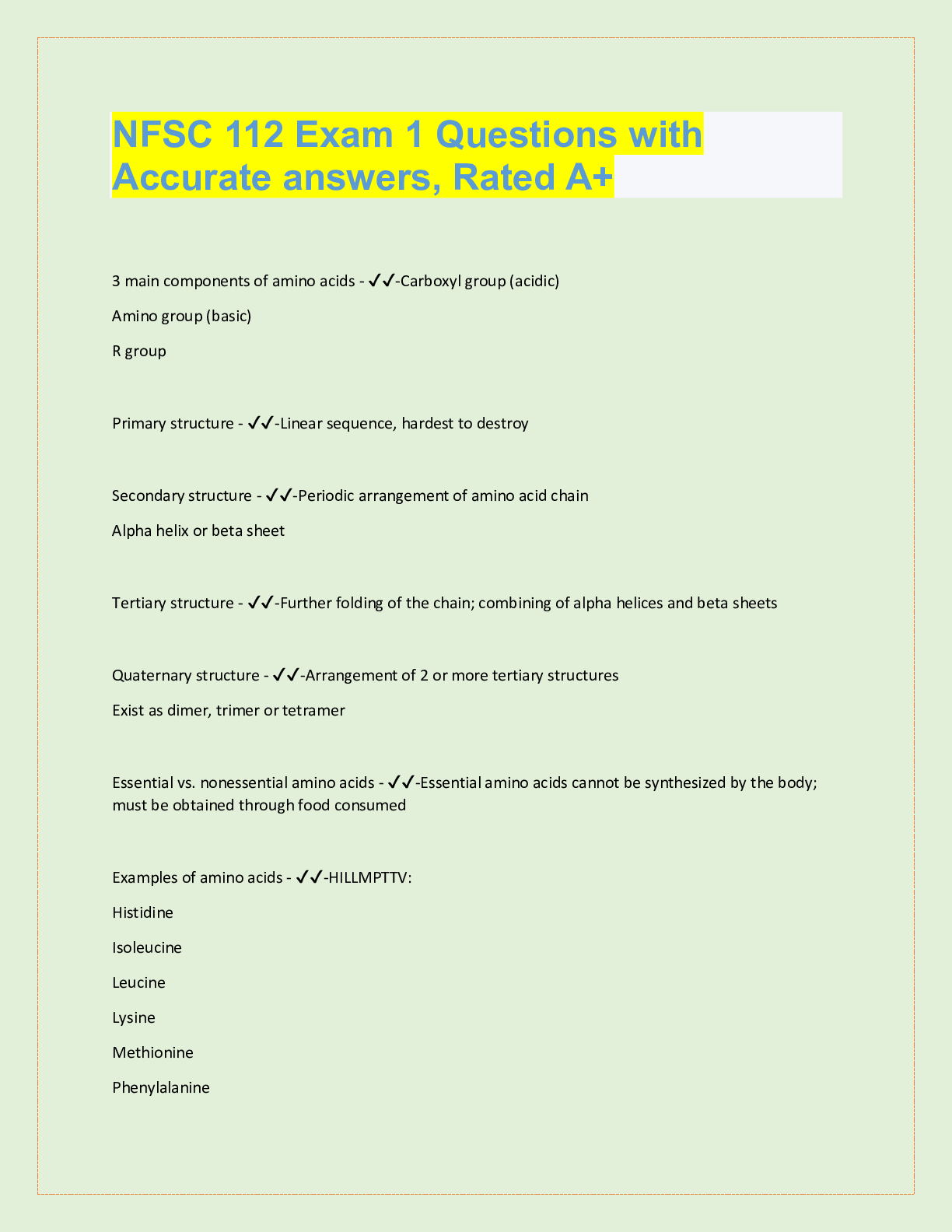
3 main components of amino acids - ✔✔-Carboxyl group (acidic)
Amino group (basic)
R group
Primary structure - ✔✔-Linear sequence, hardest to destroy
Second
...
NFSC 112 Exam 1 Questions with
Accurate answers, Rated A+
3 main components of amino acids - ✔✔-Carboxyl group (acidic)
Amino group (basic)
R group
Primary structure - ✔✔-Linear sequence, hardest to destroy
Secondary structure - ✔✔-Periodic arrangement of amino acid chain
Alpha helix or beta sheet
Tertiary structure - ✔✔-Further folding of the chain; combining of alpha helices and beta sheets
Quaternary structure - ✔✔-Arrangement of 2 or more tertiary structures
Exist as dimer, trimer or tetramer
Essential vs. nonessential amino acids - ✔✔-Essential amino acids cannot be synthesized by the body;
must be obtained through food consumed
Examples of amino acids - ✔✔-HILLMPTTV:
Histidine
Isoleucine
Leucine
Lysine
Methionine
Phenylalanine
Threonine
Tryptophan
Valine
3 examples of good sources of protein - ✔✔-Meat, eggs, nuts
Why do some people avoid gluten in their diet? - ✔✔-Celiac disease, immune system treats gluten
protein as a foreign invader
Functions of proteins in food - ✔✔-Gives food structure
Acts as an emulsifier, able to separate oil
Gelation: holds water fat and other food ingredients together
Foaming: ability to incorporate gas/air in food systems; colloidal dispersion of gas in liquid
Flavoring: can bind some flavors, mean analogues, aspartame & MSG
Browning (coloring)
Denaturation: change in molecular structure due to heat, pH, freezing, mechanical beating
Enzymes - ✔✔-Proteins that can reduce the energy required for a chemical reaction (catalyze reactions)
Are not permanently altered in the process
E+S->ES->P+E - ✔✔-Enzyme and substrate link, substrate becomes product and enzyme remains
unchanged
Where are enzymes present? - ✔✔-In living cells, may become active when cells are ruptured
Example of desirable enzymatic activities in food - ✔✔-Sweetener, meat tenderizer
Examples of undesirable enzymatic activities in food - ✔✔-Browning, rancidity, unfavorable flavor
Protease function - ✔✔-Break down proteins, help cook meats faster
Carbohydrase and amylase function - ✔✔-Break down carbohydrates
Lipase function - ✔✔-Break down fats
Catalyze rearrangement of fatty acid structures
Control methods for enzymatic activity in foods - ✔✔-Change temp
Change pH
Introduce enzyme inhibitors
Introduce chemicals
Reducing vs. non-reducing sugar - ✔✔-Reducing sugar has a hydroxyl group on the anomeric carbon
that is available for bonding.
Non-reducing sugar has no such availability. All monosaccharides and disaccharides are reducing sugars,
with the exception of sucrose.
Why is it important to know if a sugar is reducing or not? - ✔✔-Whether or not the sugar is available for
further bonding
Whether or not the sugar will participate in the browning chemical reaction
Which carbohydrates are typically sweet/which are not sweet? - ✔✔-Related to chemical
structure/conformation.
Sucrose is always sweet. Fructose is sweeter at lower temperatures.
Galactose and lactose have very little sweetness.
Why is fructose less likely to crystallize than glucose? - ✔✔-Crystallinity favored by homogeneity.
Because fructose can form 4 different rings, it is more difficult for it to form crystals.
Monosaccharides that make up each disaccharide - ✔✔-Lactose: glucose & galactose
Sucrose: glucose & fructose
Maltose: glucose & glucose
Why does table sugar not turn brown? - ✔✔-Table sugar is not a reducing sugar. Anomeric carbon is not
available for bonding.
If you wanted to produce color on the surface of a cake, would you use a reducing or non-reducing
sugar? - ✔✔-Reducing, it can participate in Millard browning
Which carbohydrates are typically soluble/insoluble? - ✔✔-Soluble: Monosaccharides (glucose, fructose,
galactose)
Insoluble: Polysaccharides (Starch, Cellulose)
The larger the carbohydrate, the more insolubl
[Show More]