P&C EXAM Questions and answers,
100% Accurate, rated A+
Which part of an insurance policy covers claims-related expenses, reasonable expenses incurred by an
insured to protect damaged property from further loss, or
...
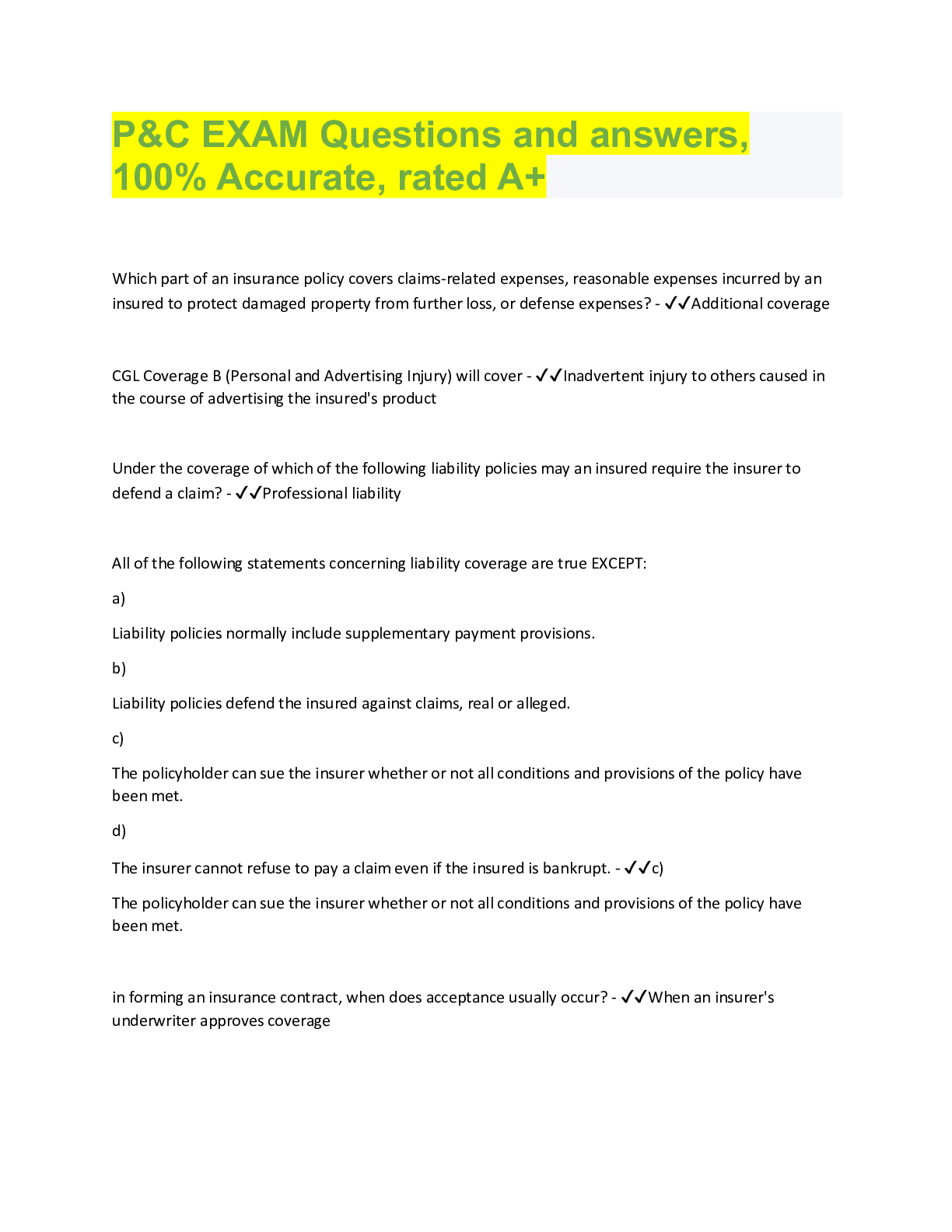
P&C EXAM Questions and answers,
100% Accurate, rated A+
Which part of an insurance policy covers claims-related expenses, reasonable expenses incurred by an
insured to protect damaged property from further loss, or defense expenses? - ✔✔Additional coverage
CGL Coverage B (Personal and Advertising Injury) will cover - ✔✔Inadvertent injury to others caused in
the course of advertising the insured's product
Under the coverage of which of the following liability policies may an insured require the insurer to
defend a claim? - ✔✔Professional liability
All of the following statements concerning liability coverage are true EXCEPT:
a)
Liability policies normally include supplementary payment provisions.
b)
Liability policies defend the insured against claims, real or alleged.
c)
The policyholder can sue the insurer whether or not all conditions and provisions of the policy have
been met.
d)
The insurer cannot refuse to pay a claim even if the insured is bankrupt. - ✔✔c)
The policyholder can sue the insurer whether or not all conditions and provisions of the policy have
been met.
in forming an insurance contract, when does acceptance usually occur? - ✔✔When an insurer's
underwriter approves coverage
Which of the following would be covered under the Broad Form (DP-2) policy's falling object peril? -
✔✔Interior building damage if the exterior was damaged first
All of the following are considered parts of the policy structure EXCEPT
a)
Insuring clause.
b)
Conditions.
c)
Provisions.
d)
Exclusions - ✔✔Provisions
In the personal auto policy, owned trailers being towed by an insured auto are automatically covered for
- ✔✔Uninsured motorist coverage- Trailers, while being towed by an insured auto, are covered
automatically for bodily injury (BI), property damage (PD) and uninsured motorist (U/M) under Part A of
a personal auto policy.
A sworn written statement that must be furnished by the insured to the insurer before any loss under a
policy can be paid is called - ✔✔Proof of loss- Proof of loss is a sworn statement that must usually be
furnished by the insured to an insurer before any loss under a policy can be paid. Proof of loss must be
in writing.
Which of the following is an example of a protective safeguard in a businessowners policy? -
✔✔Automatic sprinkler system
The protective safeguards endorsement adds a policy condition requiring the insured to maintain
protective safeguards (automatic sprinkler system, fire alarm, etc.) as a condition for coverage.
The other insurance provision that limits the liability of the insurer to a portion of the loss no greater
than the amount the insurer bears to all the insurance covering the property is called - ✔✔Pro rata
liability- To preserve the principle of indemnity, each policy pays a pro rata share based upon the share
of the coverage. The insured cannot collect the full amount of loss from each policy.
A commercial property special form covers property in transit up to - ✔✔5,000- A commercial property
special form covers property in transit up to $5,000. This extension of coverage may be added to the
special form. It is additional insurance (in addition to the coverage limit), and coinsurance does not
apply.
Coverage under a Floor Plan Merchandise form is written on a reporting form basis that requires the
insured to file reports with the insurer. What is the time frame for those reports? - ✔✔Within 30 days
after the end of each month
All of the following statements concerning coinsurance are true EXCEPT
a)
The coinsurance formula will also be applied to total losses.
b)
It is used to help adequacy and equity in rates.
c)
The insured agrees to maintain insurance equal to some specified percentage of the value of the
property.
d)
If the insurance carried is less than required, the insurance may not cover the whole loss. - ✔✔The
coinsurance formula will also be applied to total losses.-In the event of a total loss, the coinsurance
clause does not operate and the face amount of the policy is paid.
When a vehicle travels from one state to another, what happens to the limits of policy liability in a
personal auto policy? - ✔✔They do not change
The minimum liability limits do not change when a vehicle travels from state to state and remain the
same regardless of the state the vehicle is in.
What is the purpose of the coinsurance clause found in property insurance policies? - ✔✔Encourage the
insured to insure the property closer to its full value- In return for the insured's promise to insure the
property to some certain percent of its value, the insurer agrees to give the insured a reduced rate per
hundred on the insurance and pay partial losses in ful
[Show More]