C425 Wgu 2022, Exam Questions with
accurate answers, rated A+
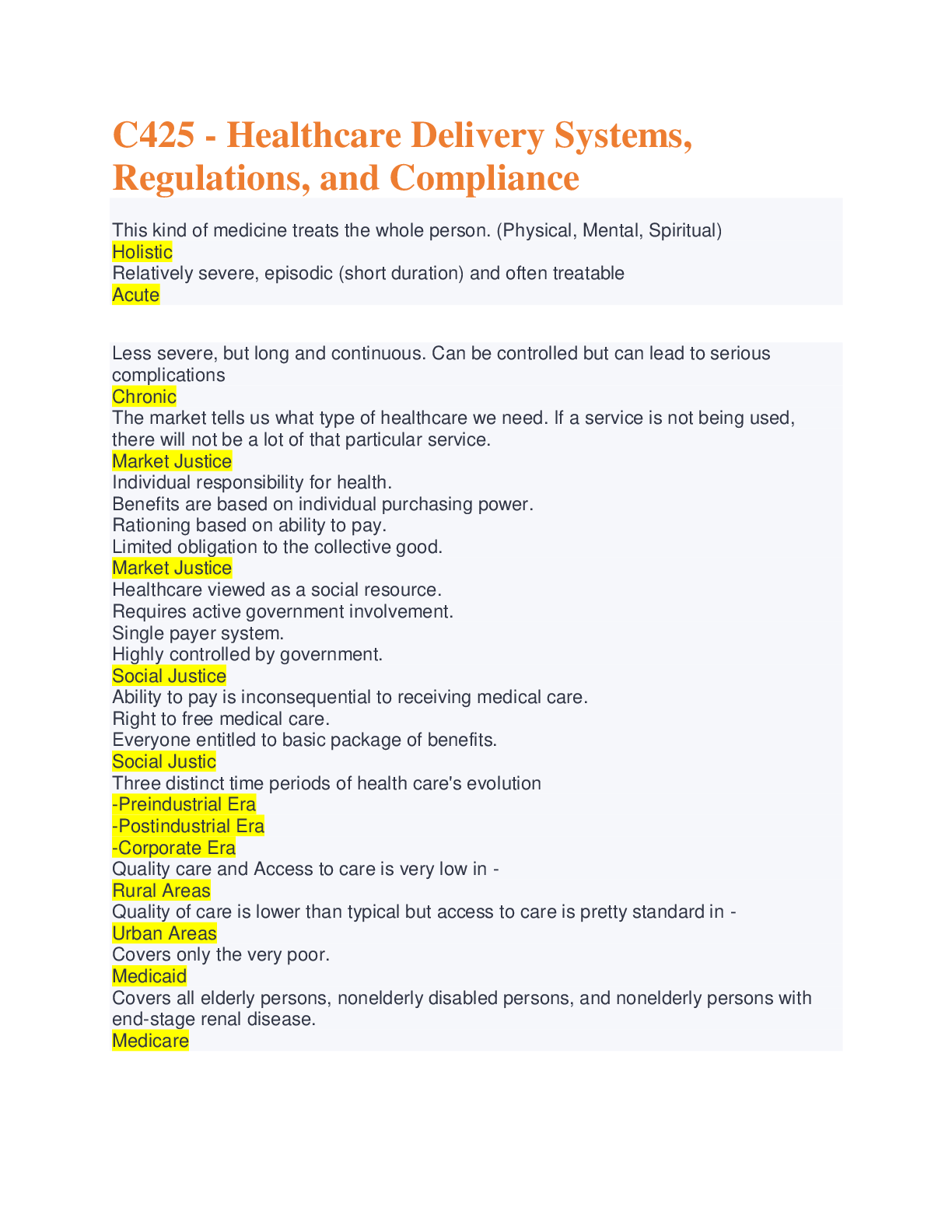
What is the dominant healthcare delivery system in the USA
Managed care, employers and government are primary suppliers
What Population does the VA serve
...
C425 Wgu 2022, Exam Questions with
accurate answers, rated A+
What is the dominant healthcare delivery system in the USA
Managed care, employers and government are primary suppliers
What Population does the VA serve
Veterans TRICARE is insured for military personnel active and non-active
Describe the affordable care act and its role in healthcare reform
Main goal was to expand coverage increase access to care Medicaid expansion and take away pre�existing conditions
List for key characteristics of the US healthcare system
No central governing agency technology driven and focuses on acute care, high cost, unequal access and
average outcomes, imperfect market conditions for healthcare delivery, fusion of market and social
justice, multiple players in balance of power access to healthcare is selectively base on insurance.
Define health
Overall well-being of mental and physical well-being
Discuss disease classifications acute, subacute, chronic
Acute: Patient received short-term treatment for severe injury or episode of illness and urgent medical
condition or recovery from surgery examples, heart attack lack of kidney function. Subacute:
Comprehensive in patient care someone who has an acute illness injury or disease trach tube feeding
tube wound care.
Chronic: Less severe but is continuous can be controlled but if uncontrolled can lead the serious
complications sometimes even if controlled. Examples, diabetes, hypertension, asthma.
Define market justice
Fair distribution of healthcare to market forces in a free economy, medical services are based on
peoples willingness to pay individuals are responsible for their own achievements. Less involvement
with government. People view this as if you can't pay you shouldn't have health insurance
Social Justice
More government involvement in medical insurance, insurance for all
What is Healthy People 2020?
10 your plans, focused on medical care, prevention, and education. Creating environments that promote
good health for all. Healthy development behaviors across all life stages
What is the Flexner Report?
Report by Abraham Flexner by the Carnegie Commission to evaluate medical schools
Outlined the inadequacies of medical schools that did not use the German model that promoted
medical education on the principles of scientific discovery
Caused schools that did not use this scientific model to close from lack of funding.
what is workers compensation?
Insurance that aids cash or medical insurance when you are hurt on the job.
Who is covered by Medicare?
Elderly over the age of 65, disabled, and those with high end renal failure" kidney disease"
Who is covered by Medicaid
Low income adults, children, elderly and disabled. Means test determines need for Medicaid. Each state
defines their own outline of need for people applying for Medicaid
Describe cost sharing in the three main types of cost sharing in private health insurance
Premium cost sharing: Insured assume some part of the risk purposes to reduce miss use of insurance
benefits. Deductible; amount insured pays before benefits are paid by the plan. Copayments;'s money
paid out of pocket each time services are rendered. Coinsurance; amount Insured has to pay at a certain
percentage after deductible is met before insurance covers at 100%
What is covered in Medicare a
Medicare a covers inpatient and hospital services nursing care, hospice care, and limited home health
services.
What is covered under Medicare B
Ambulance services clinical research, mental health, RX drugs, and DME, DME is a durable medical
equipment.
What is covered under Medicare C
Routine dental, vision, hearing aids and wellness programs
What is CHIP?
Children's Health Insurance Program, Provides insurance for children who do not qualify for Medicaid.
List three main sources of financing healthcare?
Private health insurance, public programs which include Medicaid and Medicare, and uncompensated or
charity care.
List two requirements for a hospital to be required a hospital?
Hospitals must be licensed have organized physicians, provide continue nursing services under RNs,
have a governing body for hospital conduct, have a CEO with responsibility for operations.
What is the Hill-Burton Act of 1946?
A law passed in 1946 to give hospitals, nursing homes and other health facilities grants and loans for
construction and modernization. It had the biggest impact on expansions of hospitals. The creation of
Medicare and Medicaid in 1965 also fueled demand for hospital services .
What is informed consent?
Informed consent to medical treatment is fundamental in both ethics and law. Patients have the right to
receive information and ask questions about recommended treatment so that they can make well
considered decisions about their care. Successful communication in the patient physician relationship
fosters trust and support shared decision making.
What is the Stark Law?
Section 1877 of the Social Security act also known as this physician self referral law. Prohibits physicians
from making referrals for certain designated health services payable by Medicare to an entity which he
or she or immediate family member has a financial relationship, unless exception applies. So basically a
physician cannot refer patients to his brother that is a foot doctor or orthopedic surgeon or a physician
cannot refer to his wife who owns a pharmacy.
What is outpatient care?
A service that does not require an overnight stay, ambulatory care diagnostic and therapeutic services
and treatment for the walking patient. Outpatient care can also be with mobile diagnostic units and
home health it takes services to the patients. Outpatient care would also be physicians offices, clinics,
and any service that is Done on an outpatient basis i.e. colonoscopy, scope, angioplasty.
What is hospice care?
Hospice care is pain management psychosocial and spiritual, medical social services provided.
What is long-term care?
Long-term care involves a variety of services designed to me a person's health or personal care needs
during a short or long period of time. These services help people live as independently and safely as
possible when they can no longer perform an every day activities on their own.
What is a gate keeper?
The gatekeeper and medical is usually the primary care physician the role is to protect patients from
unnecessary treatments. Patients cannot see a specialist without a physicians referral.
What is the HITECH Act?
2009 legislation that was created to stimulate the adoption of electronic health records in the
supporting technology in United States.
Community hospitals
Nonfederal short stay hospital services are to the general public more than 87% of the hospitals are
community hospitals.
public hospitals
Government ownership federal, state, local. 1/4 of US hospitals, only state/local hospitals are open to
the public. Often located in large urban areas. Serve mainly inner-city disadvantage populations, higher
utilization, and offer a lot of charity care.
Private Nonprofit Hospitals
Often called voluntary hospitals non-government and privately owned. Make a profit but do not pay
taxes, operated by community associations, churches and other non-government organizations. More
than 50% of US hospitals are nonprofit. To qualify for this the IRS requirements are as follows; must
provide some public good, service, education, and community welfare. They cannot give profits to
anyone. More than 50% of hospitals are nonprofit
Private For-profit hospital's
Investor owned hospitals owned by individuals partnerships or corporations for-profit operated by
financials and benefit the shareholders.
general hospital
Most hospitals in the USA are general. Provide a broadside of services for various conditions. OB/GYN,
diagnostic, treatment and surgery.
Specialty Hospitals
Psychiatric, rehabilitation, tuberculosis, children's hospitals some other specialize in orthopedic,
cardiology or cancer.
rual hospitals
Treat larger percentage of the poor elderly patients these hospitals often find themselves in money
trouble
Critical care hospitals
These hospitals have 25 beds or less often in rule areas, if they need funding or need to expand CMS is
the one who would pay for it.
What are advance directives?
Legal document where patient's wishes regard to continue or withdrawal treatment when patient lacks
decision-making capabilities.
Who is the largest player in home health care?
Medicare
What is managed care?
Managed care is a system of health care delivery that seeks to achieve efficiencies by integrating the
basic functions of health care delivery, and employs mechanisms to control utilization of medicalservices
and the price at which the services are purchased. In simple terms the providers have a set cost that
they would charge the insured for services
Define HMO (Health Maintenance Organization)
HMO stands for health maintenance organization and the coverage restricts patients to a particular
group or physicians called a network
What is a PPO (Preferred Provider Organization)?
PPO is short for a preferred provider organization and allows patients to choose any physician they wish
either inside or outside of their net work.
Describe patient centered care
Patient centered care is about treating a person receiving healthcare with dignity and respect and
involving them and all decisions about their health It is a approach that is linked to a persons health care
right.
What is a means test?
It means test is a determination whether someone or family is eligible for government assistance
Medicaid is mean tested this is typically income based
Medicare (1965)
A two part program for the elderly provided health insurance regardless of income Medicaid, low
income elderly the blind and disabled receiving SSI and pregnant women. Medigap pays for all the part
of deductible and copayments. Part B Medicare as preventative part D is RX coverage.
What is the Affordable Care Act (ACA)?
This law includes premium tax credits in cashiering reductions to help lower expensive to lower income
individuals and families the affordable care act is the name of the comprehensive healthcare reform law
and its amendments the law address is health insurance covered healthcare cost and preventative care.
What is the importance of health insurance portability and accountability act also known as HIPAA
HIPAA helps to ensure that any information disclose to healthcare providers and health plans or
information that is created by them transmitted Or stored by them, is subject to strict security controls.
Patients are also given control over who their information is released to and who it is shared with.
Reduce healthcare fraud and abuse, enforce standards for health information, guarantee security and
privacy of health information, assure health insurance portability by eliminating job lock due to pre�existing medical conditions.
HMO (Health Maintenance Organization)
Offers lower monthly premiums but offers less accessibility to providers and networks, limited provider
options, focus on primary care must go to PCP for referral to a specialist, no benefits outside of network,
have a maximum out-of-pocket, musttan network except for emergency services,.
PPO (Preferred Provider Organization)
Higher monthly premiums, very flexible broad range of providers no referral needed have a deductible
and out-of-pocket.
Six domains of healthcare quality?
Safe: Avoiding harm to patients from the care that is intended to help them. Effective:providing services
based on scientific knowledge to all who could benefit refraining from providing services to those not
likely to benefit (avoiding miss use or under use)
Patient centered: providing care that is respectful and responsive to an individual patient's preference,
needs, values and ensuring patients values guide all clinical decisions. Timely: reducing patient weight
times and harmful delays for those who both receive and give care.
Efficient avoiding waste including waste of equipment supplies ideas and energy.
Equitable; providing care that does not vary in quality because of personal characteristics such as
gender, ethnicity, geographic location, and socioeconomic status.
Which populations in the US face grader challenges in obtaining timely healthcare?
Racial and ethical minorities, uninsured children and women, rule areas, homeless, mentally ill,
chronically ill and disabled and HIV/AIDS patients
Who are the populations and why are they vulnerable?
They are at risk for poor physical psychological and/or social health. They are called medically
undeserved, medically disadvantage, underprivileged, American under class and undeserved
populations. These categories are racial and ethical minorities children and women, homeless, mentally
ill, chronically ill and disabled, HIV and AIDS patients
Describe the role of the joint commission
The joint commission also known as TJC is an independent, not for profit organization created a 1951
that accred more than 20,000 US healthcare programs and organizations. The joint commission goal and
mission are to ensure quality healthcare for patients, prevent harm, and improve patient advocacy
What is HTA?
The HTA is health technology assessment refer to the systematic evaluation of properties, effects,
impacts of health technology. Use a scientific evidence to determine if Health services are safe and
effective.
Technology in Healthcare
Can improve efficiency, can make patient records more accessible, increase communication between
providers, increased access to healthcare and create global health networking
What is diagnosis related group also known as a DRG
Is a patient classification system that standers dies is prospective payment to a hospital and encourages
cost containment and initiatives. Includes any services provided by a provider, Medicare develop this as
a cost reduction tool
Prospective payment system also known as PPS
For inpatient services Medicare patients under the system a hospital is pay to fix them out for each
patient discharge in a particular category or DRG I E diagnosis related group.
Acute Care Facility (ACF)
Emergency services cardiac care neonatal intensive care coronary care.
Acute/General Hospital
In institution who's primary function is to provide impatient diagnostic and therapeutic services for a
variety of medical conditions, both surgical and nonsurgi
[Show More]


.png)
.png)
.png)