WGU C165, Top Exam Questions with
accurate answers, graded A+
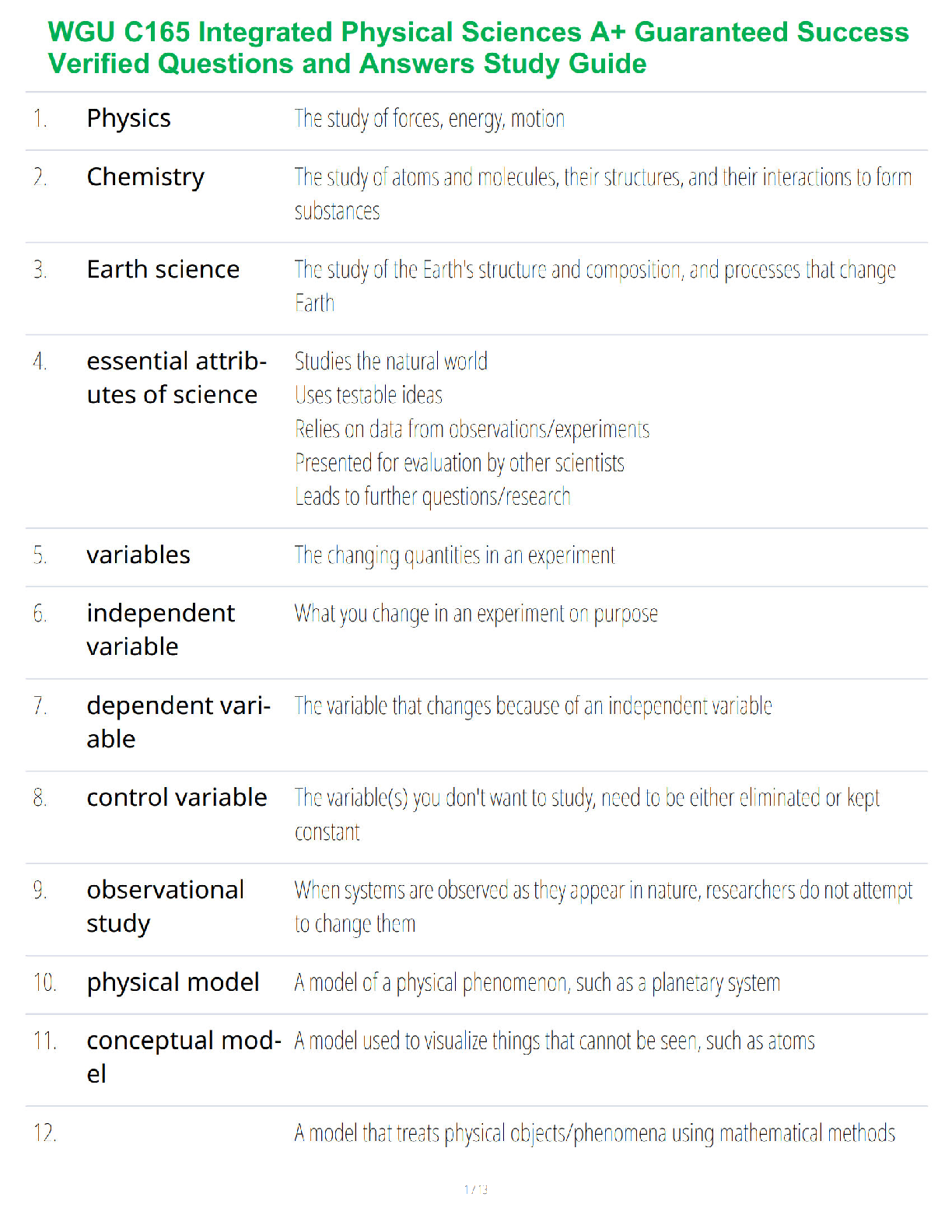
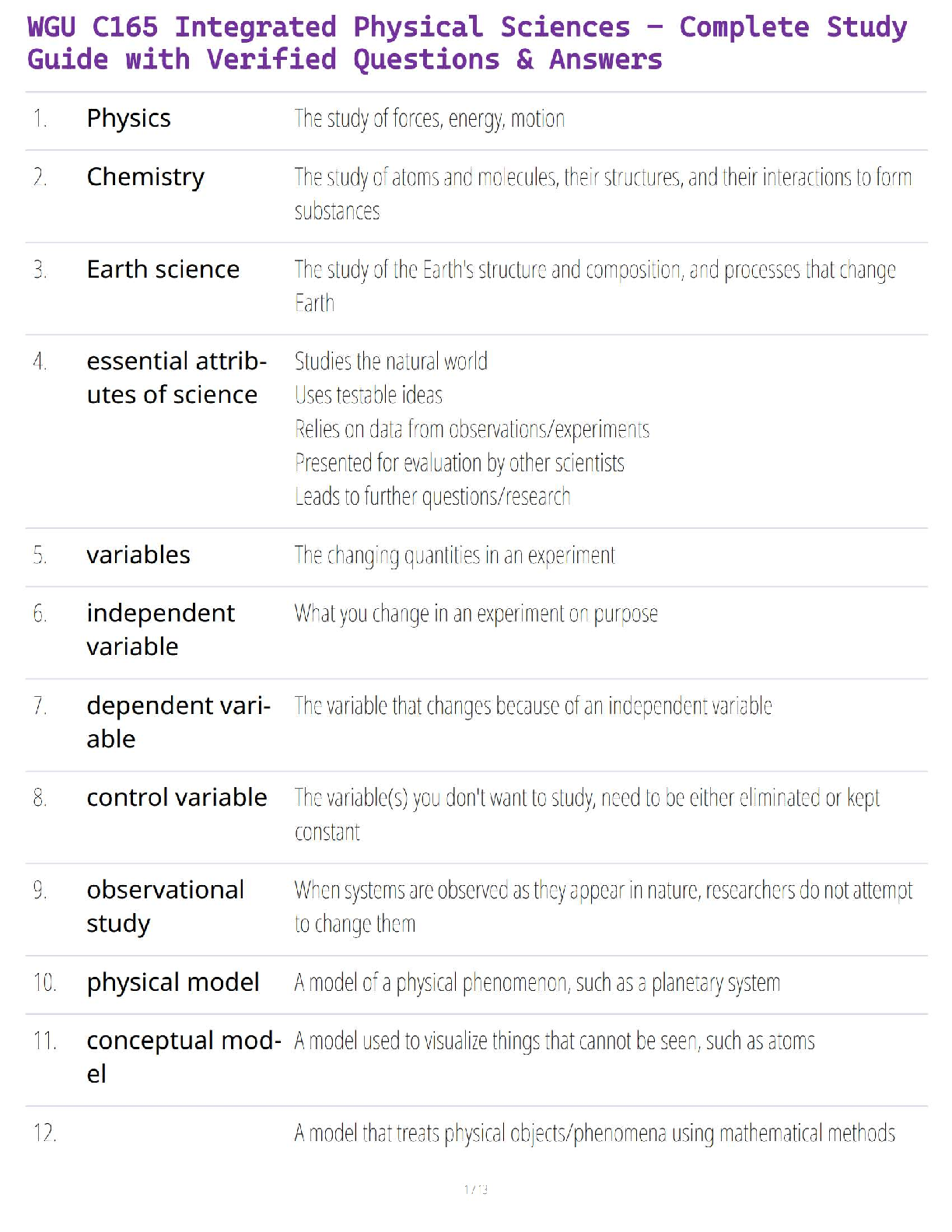
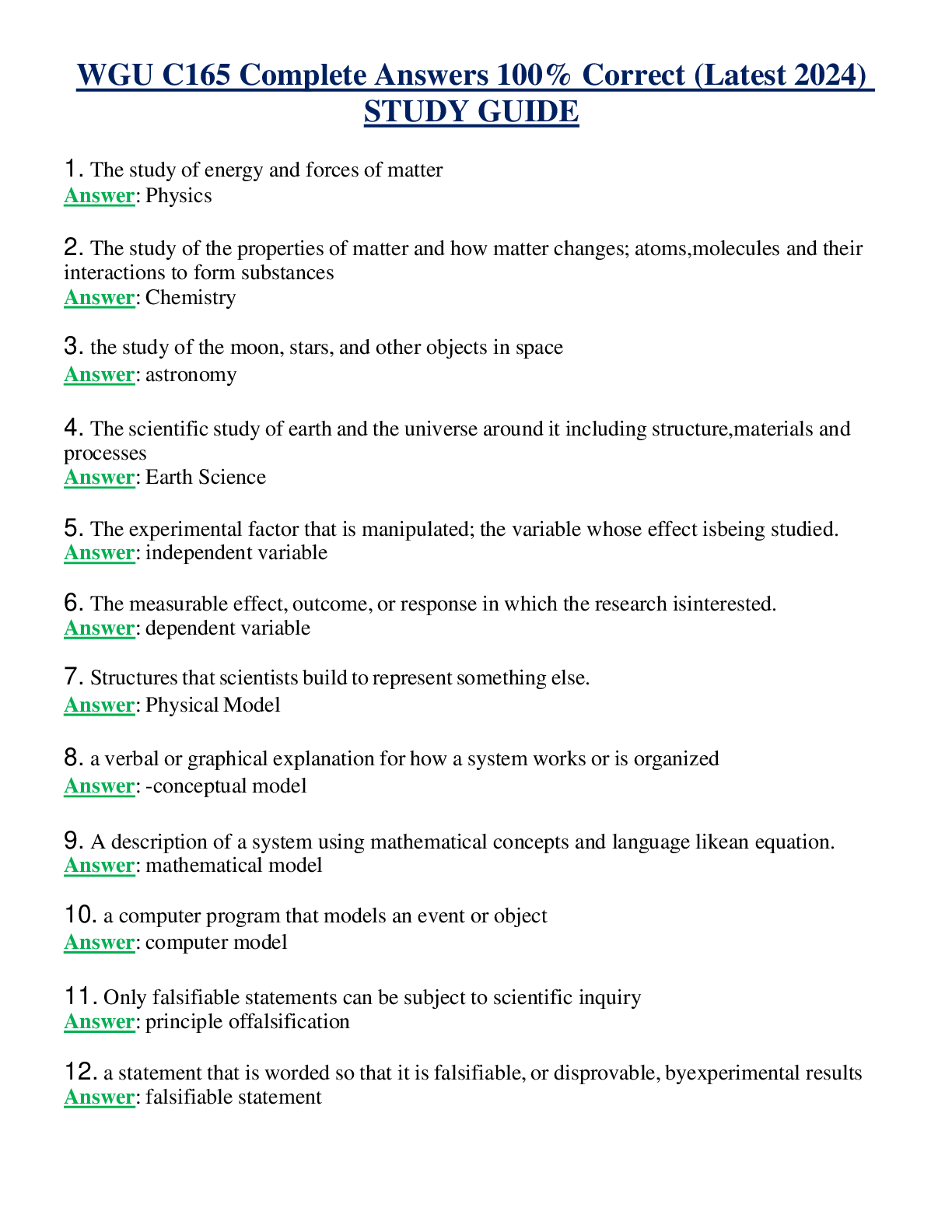
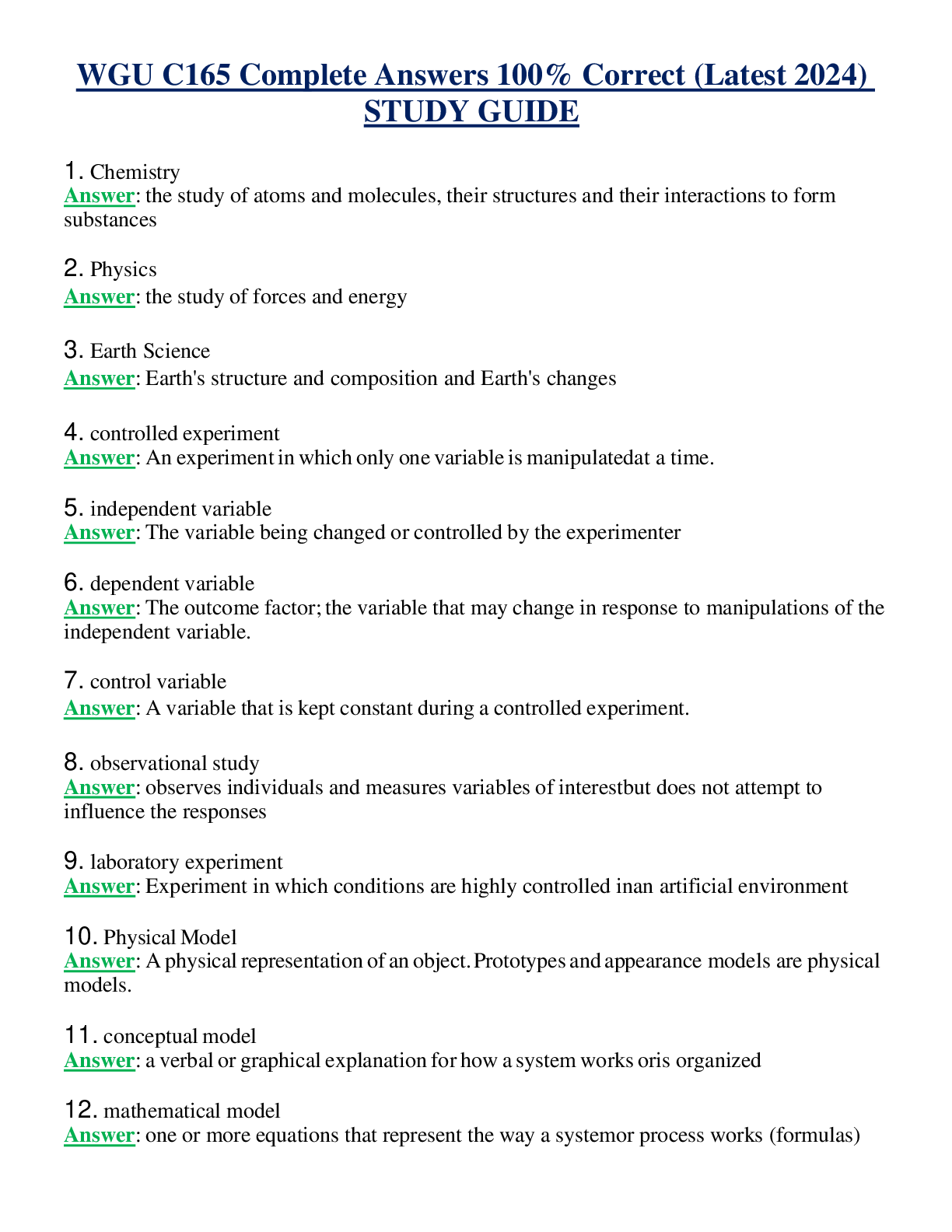
The study of energy and forces of matter - ✔✔-Physics
The study of the properties of matter and how matter changes; atoms, molecules and their interaction
...
WGU C165, Top Exam Questions with
accurate answers, graded A+
The study of energy and forces of matter - ✔✔-Physics
The study of the properties of matter and how matter changes; atoms, molecules and their interactions
to form substances - ✔✔-Chemistry
the study of the moon, stars, and other objects in space - ✔✔-astronomy
The scientific study of earth and the universe around it including structure, materials and processes -
✔✔-Earth Science
The experimental factor that is manipulated; the variable whose effect is being studied. - ✔✔-
independent variable
The measurable effect, outcome, or response in which the research is interested. - ✔✔-dependent
variable
Structures that scientists build to represent something else. - ✔✔-Physical Model
a verbal or graphical explanation for how a system works or is organized - ✔✔-conceptual model
A description of a system using mathematical concepts and language like an equation. - ✔✔-
mathematical model
a computer program that models an event or object - ✔✔-computer model
Only falsifiable statements can be subject to scientific inquiry - ✔✔-principle of falsification
a statement that is worded so that it is falsifiable, or disprovable, by experimental results - ✔✔-
falsifiable statement
Concise statement that summarizes the results of many observations and experiments - ✔✔-Law
A well-tested explanation for a wide range of observations or experimental results. - ✔✔-scientific
theory
The theory that the universe originated in a huge explosion that released all matter and energy. - ✔✔-
Big Bang Theory
Sections of the Earth's crust that move due to convection currents. - ✔✔-tectonic plates
The hypothesis that the continents slowly move across Earth's surface. - ✔✔-continental drift
International System of units based on the metric system and units derived from the metric system -
✔✔-SI system
kilogram (kg) - ✔✔-SI unit for mass
meter (m) - ✔✔-SI unit for length
seconds (s) - ✔✔-SI unit for time
Kelvin (K) - ✔✔-SI unit for temperature
prefix used in the International System to indicate a power of 10 - ✔✔-SI prefix
centi (c) - ✔✔-SI prefix meaning 0.01
milli (m) - ✔✔-SI prefix meaning 0.001
kilo (k) - ✔✔-SI prefix meaning 1,000
Micro - ✔✔-SI prefix meaning .000001
Nano (n) - ✔✔-SI prefix meaning .000000001
Mega (M) - ✔✔-SI prefix meaning 1,000,000
The distance an object travels per unit of time - ✔✔-Speed
Amount of space occupied by an object - ✔✔-Volume
Mass per unit volume - ✔✔-Density
Mass divided by volume D=m/v - ✔✔-Density formula
a relationship in which one variable increases with an increase in another variable or vice versa - ✔✔-
direct relationship
a relationship in which one variable decreases when another variable increases and vice versa - ✔✔-
inverse relationship
defined in terms of standards - ✔✔-base quantity
a physical aspect described by a combination of base quantities - ✔✔-derived quantity
The speed of an object in a particular direction - ✔✔-Velocity
Change in velocity divided by the time it takes for the change to occur - ✔✔-Acceleration
Speeds up
Slows down
And/or
Changes direction - ✔✔-Acceleration occurs when an object
A push or pull exerted on an object - ✔✔-Force
Newton (N) - ✔✔-SI unit for force
The combination of all forces acting on an object - ✔✔-net force
forces acting on an object that combine and form a net force of zero - ✔✔-balanced forces
Forces that produce a nonzero net force, which changes an object's motion - ✔✔-unbalanced forces
(An object continues in uniform motion in a straight line/ at rest unless a resultant force acts.)
The net force on an object is the cause of its acceleration - ✔✔-Newton's First Law
The tendency to keep the same motion- remaining at rest or maintaining the same velocity - ✔✔-Inertia
The acceleration of an object depends on the mass of the object and the amount of force applied.
F=ma - ✔✔-Newton's Second Law
For every action there is an equal and opposite reaction - ✔✔-Newton's Third Law
The force that two surfaces exert on each other when they rub against each other - ✔✔-Friction
The force of friction between two objects that are moving against each other - ✔✔-kinetic friction
frictional force that prevents two surfaces from sliding past each other - ✔✔-static friction
A force of attraction between objects that is due to their masses. - ✔✔-Gravity
mass times velocity - ✔✔-linear momentum
Momentum is conserved when two or more objects collide. Momentum may transfer but total
momentum within the group stays the same - ✔✔-Law of conservation of momentum
The ability of a material to bounce back after being disturbed - ✔✔-Elasticity
Force exerted on an object that causes it to move - ✔✔-Work
The ability to do work or cause change - ✔✔-Energy
energy of motion - ✔✔-kinetic energy
Energy that is stored and held in readiness - ✔✔-potential energy
Force x distance - ✔✔-Work formula
Joule (J) - ✔✔-SI unit for work and energy
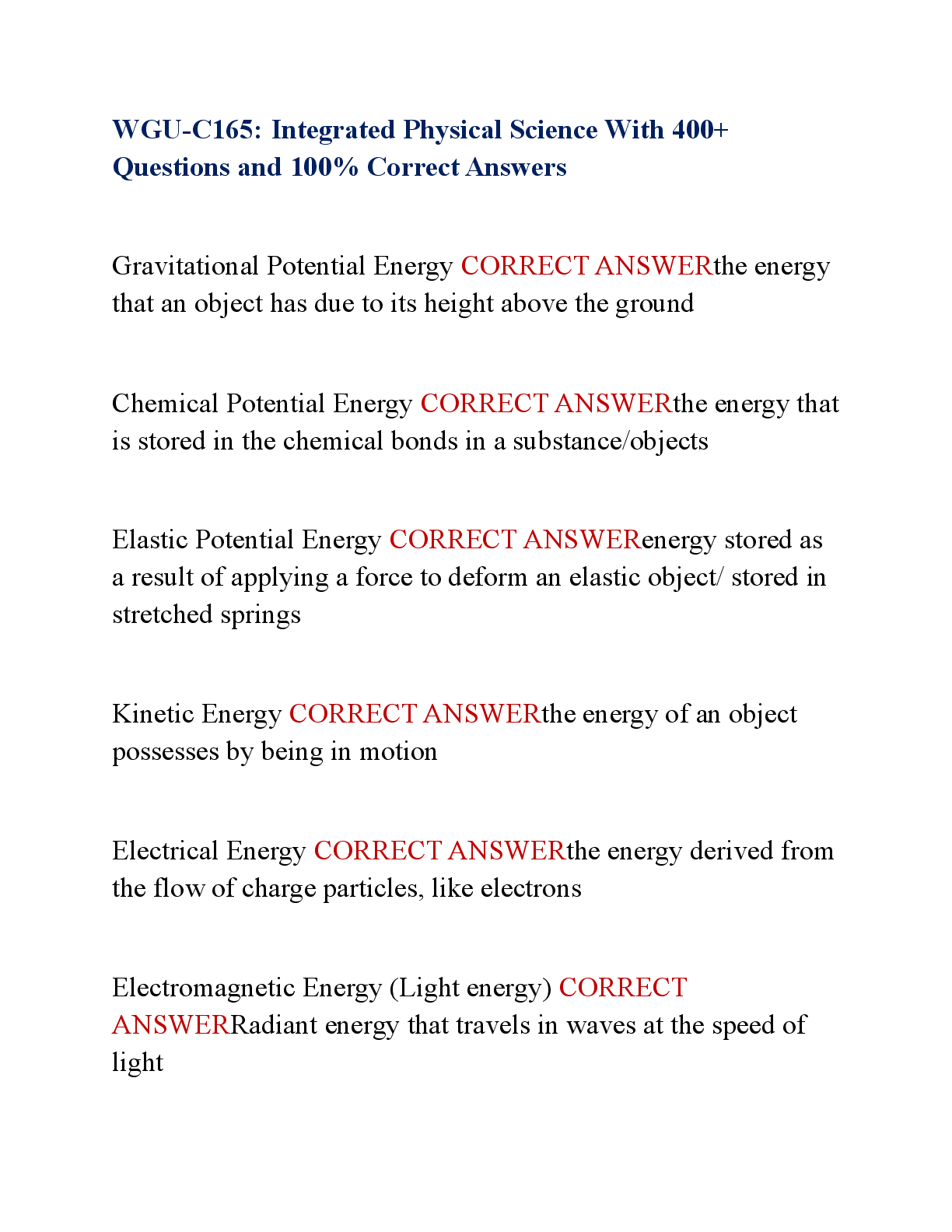
Energy stored by objects due to their position above Earth's surface. Increases with mass. - ✔✔-
gravitational potential energy
the energy stored in the chemical bonds of a substance - ✔✔-chemical potential energy
Energy stored by something that can stretch or compress - ✔✔-elastic potential energy
Energy carried by electromagnetic waves - ✔✔-Electromagnetic energy (light energy)
The total energy of motion in the particles of a substance - ✔✔-thermal energy
The rule that energy cannot be created or destroyed only transferred or converted - ✔✔-Law of
Conservation of Energy
the act or state of swinging back and forth with a steady, uninterrupted rhythm - ✔✔-Oscillation
A state of balance to which an oscillating object eventually returns to after a disturbances is gone - ✔✔-
Equilibrium
waves that require a medium through which to travel - ✔✔-mechanical waves
A wave that can transfer electric and magnetic energy through the vacuum of space - ✔✔-
Electromagnetic waves
A space where no particles of matter exist - ✔✔-Vacuum
the oscillation is parallel to the direction the wave is traveling. - ✔✔-longitudinal wave
Highest point of a wave - ✔✔-Crest
Lowest point of a wave - ✔✔-Trough
the maximum extent of a vibration or oscillation, measured from the position of equilibrium. The height
of the wave. - ✔✔-Amplitude
Horizontal distance between the crests or between the troughs of two adjacent waves - ✔✔-
Wavelength
The amount of time it takes one wavelength to pass a
[Show More]


.png)