WGU C165 Integrated Physical Sciences,
Exam Sections coverage, 100% Accurate
answers, rated A+
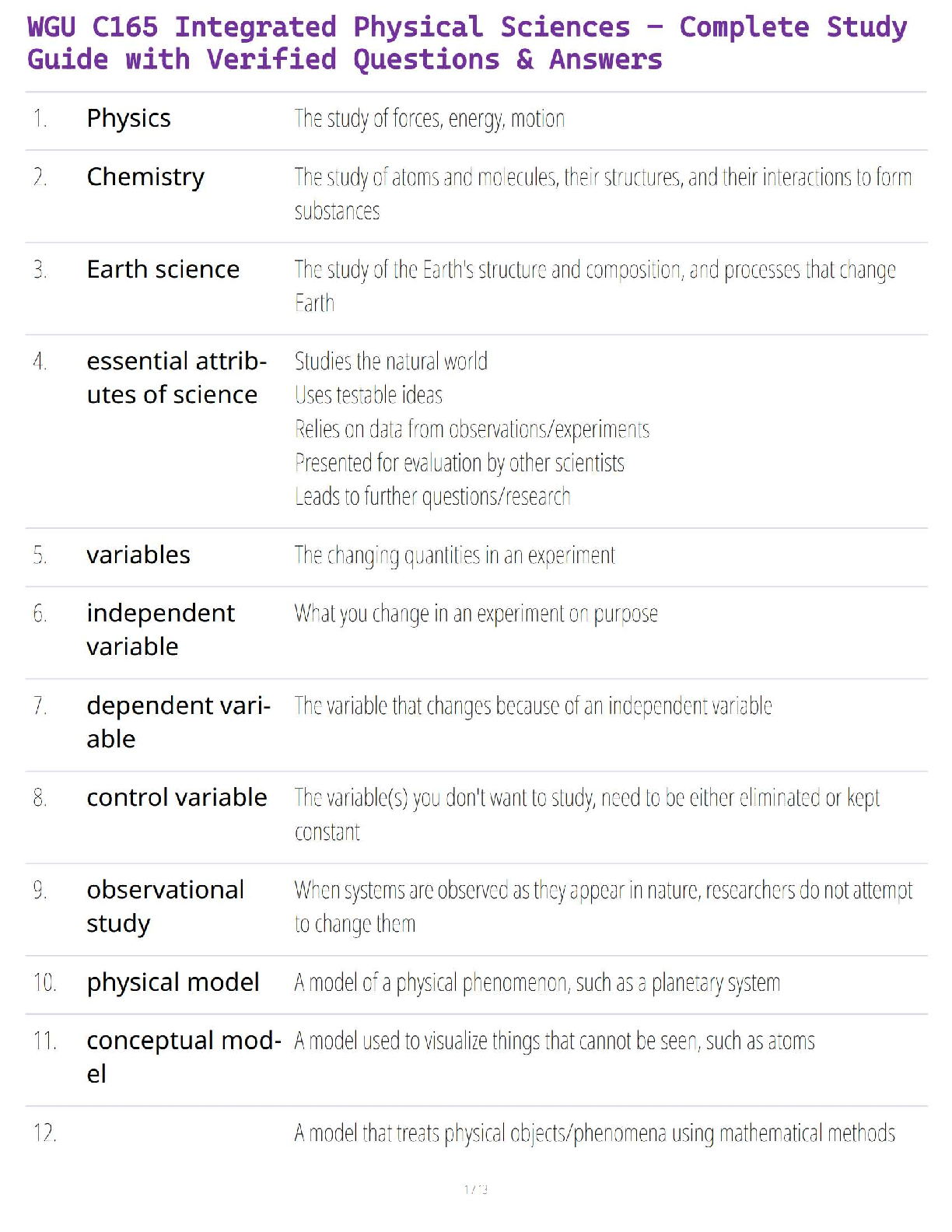
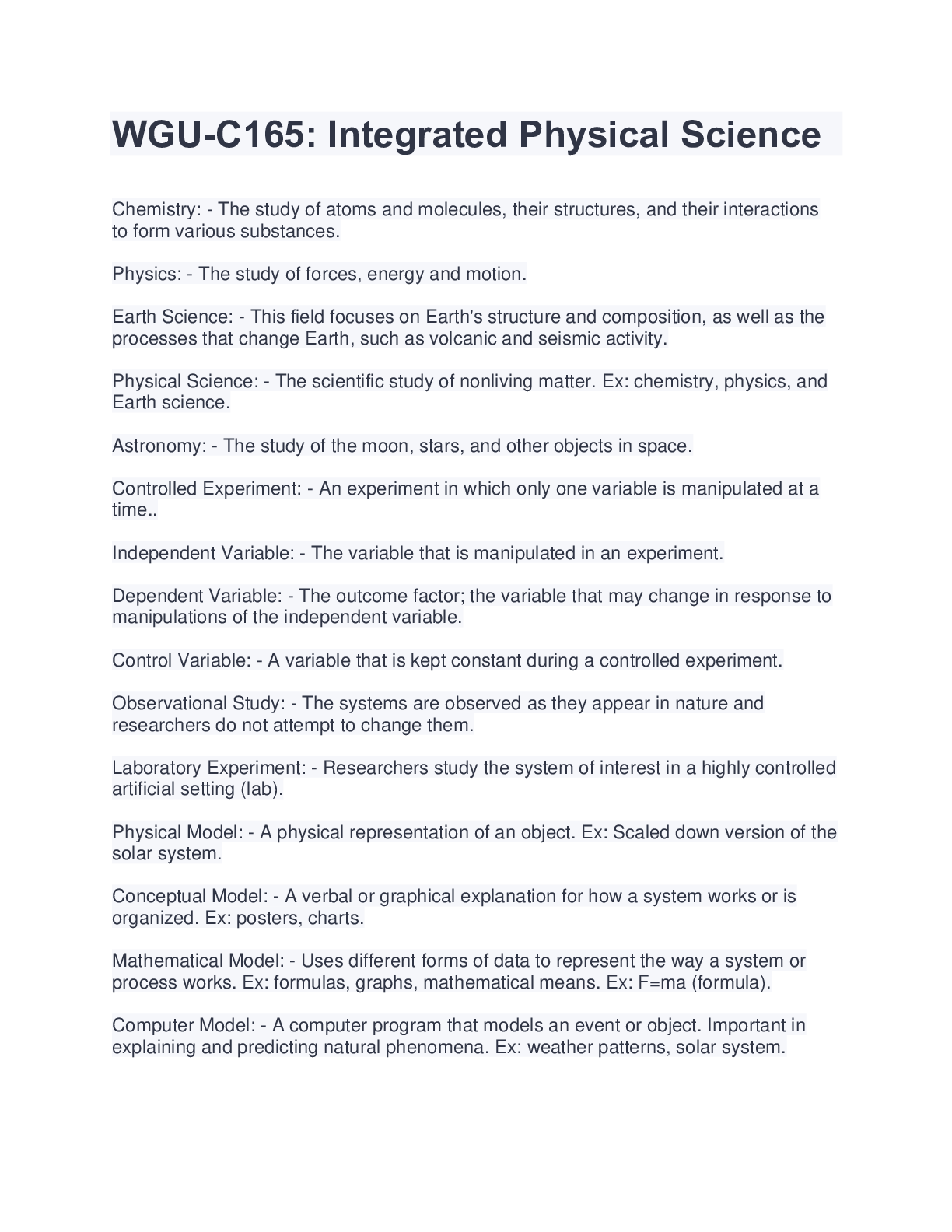
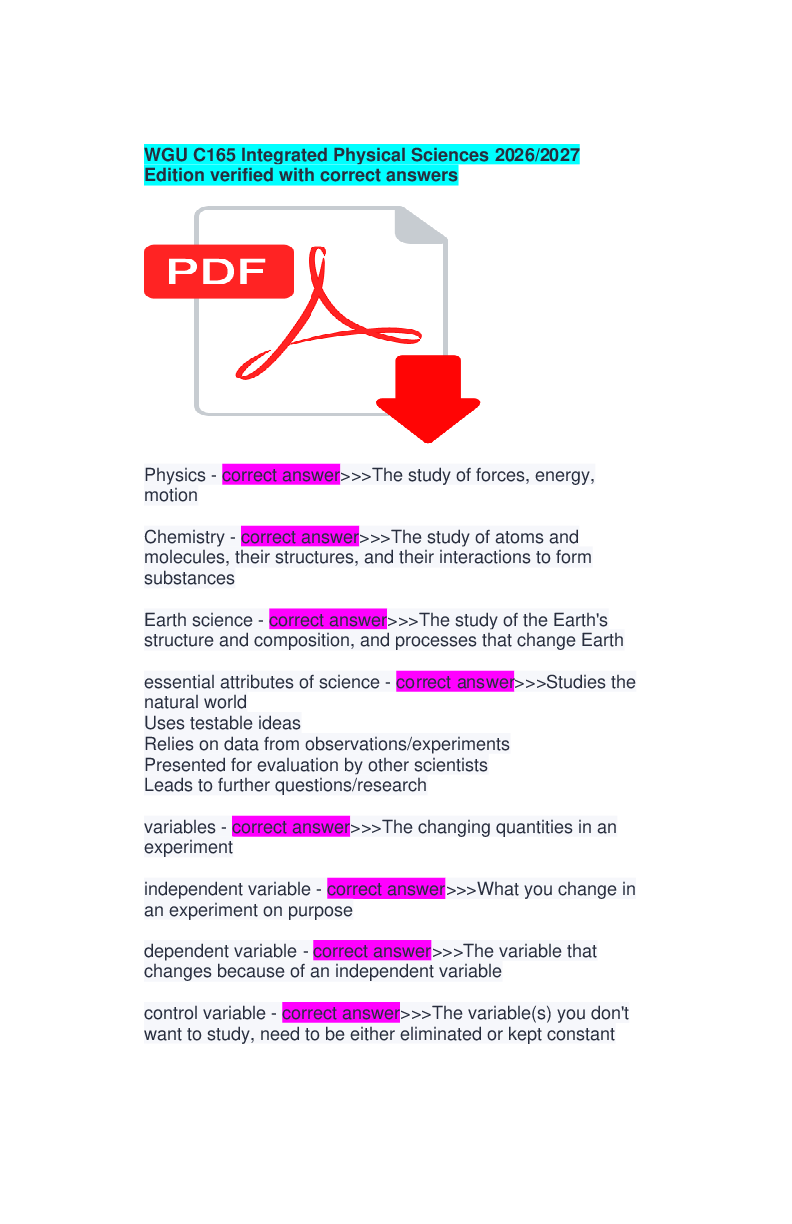
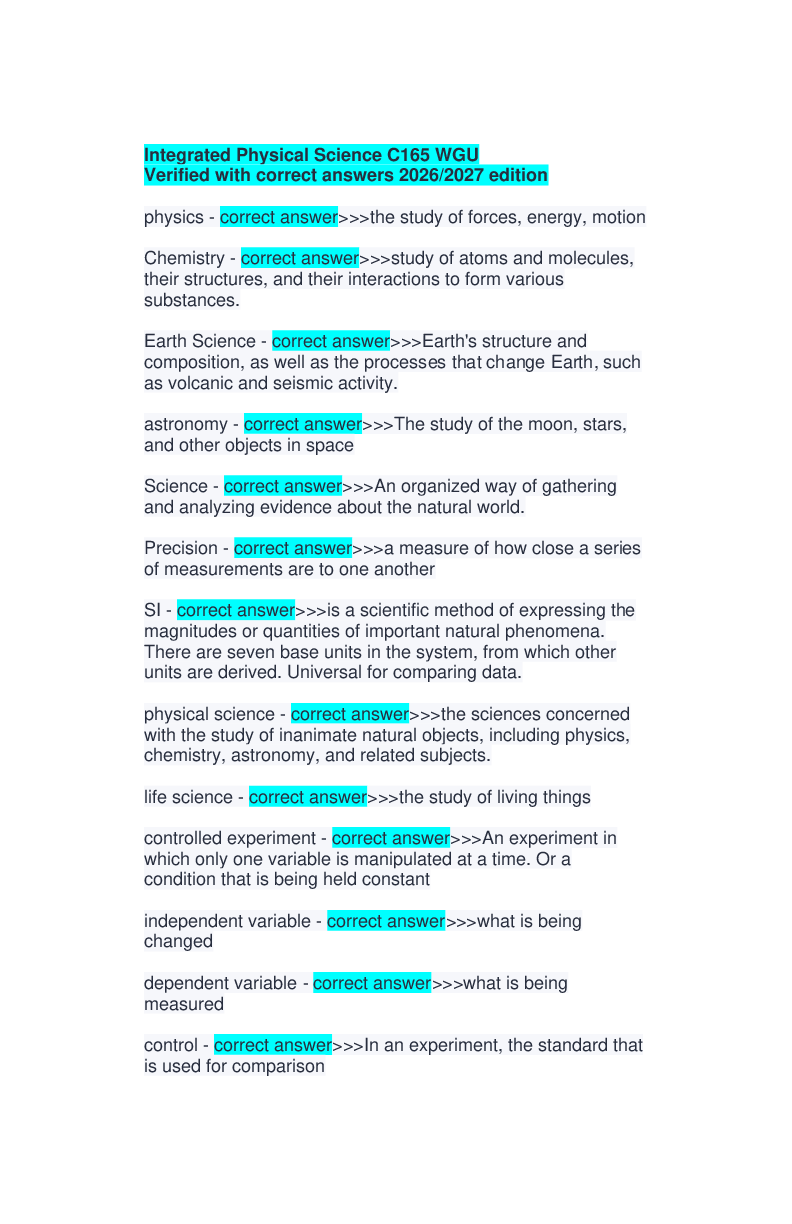
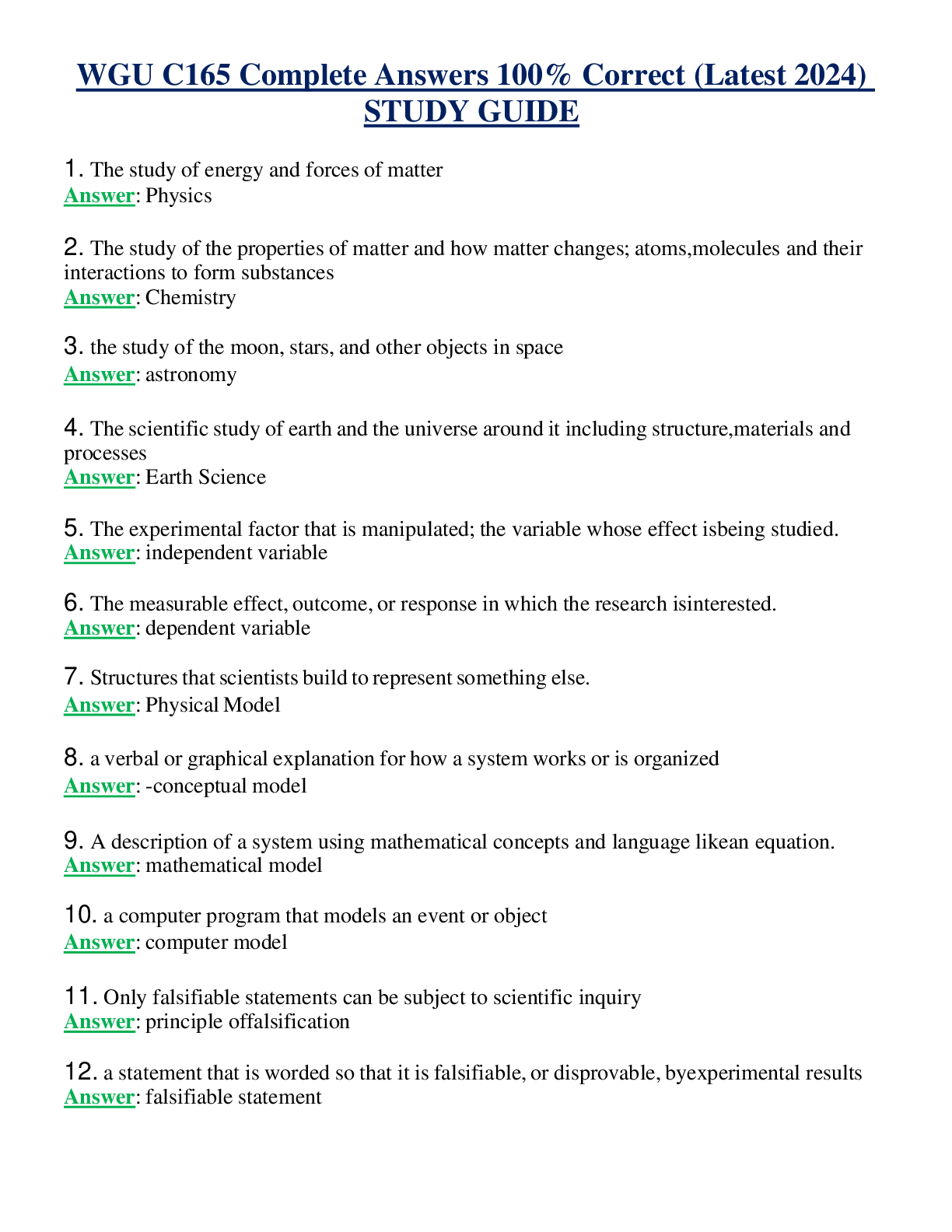
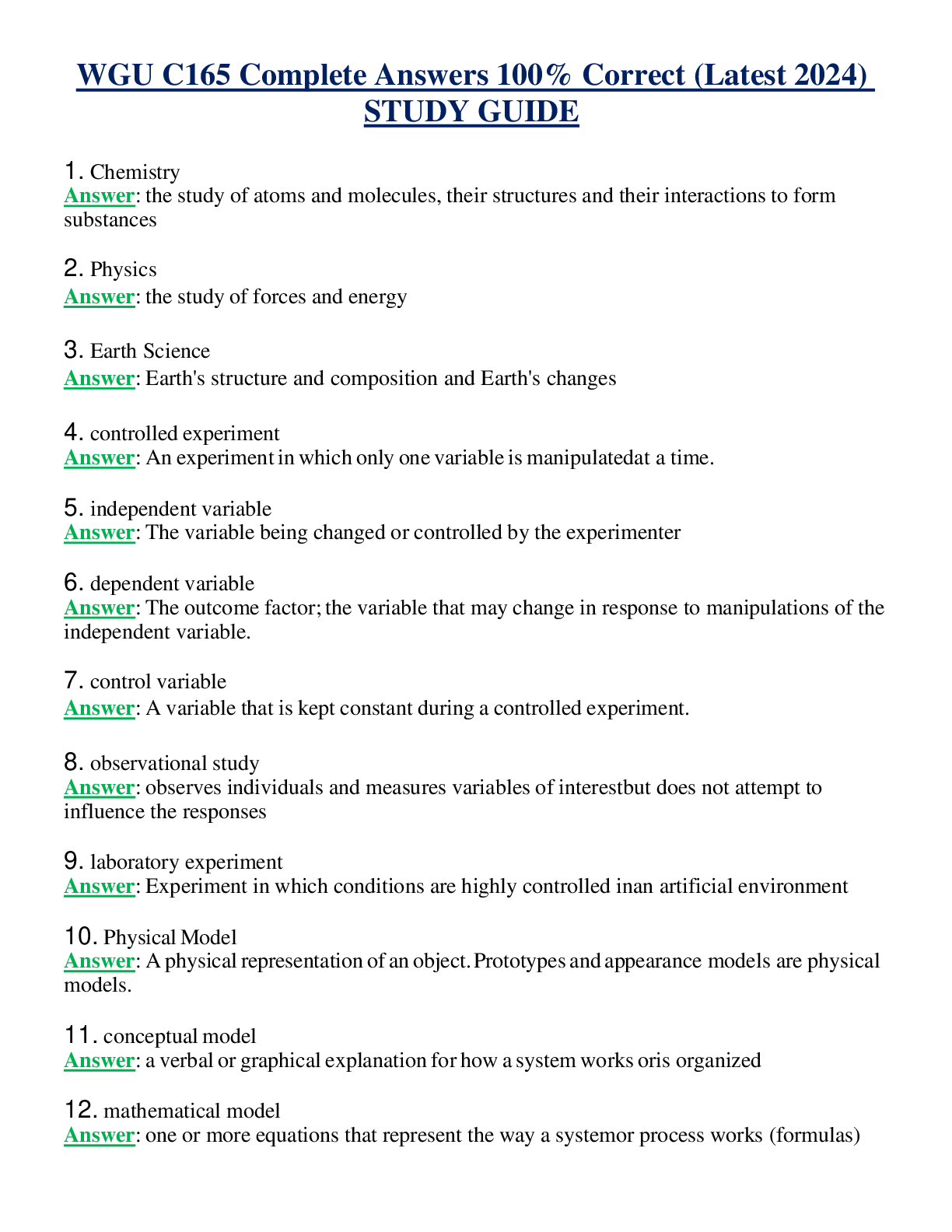
Physics - ✔✔-The study of forces, energy, motion
Chemistry - ✔✔-The study of atoms and molecules, their structures, and
...
WGU C165 Integrated Physical Sciences,
Exam Sections coverage, 100% Accurate
answers, rated A+
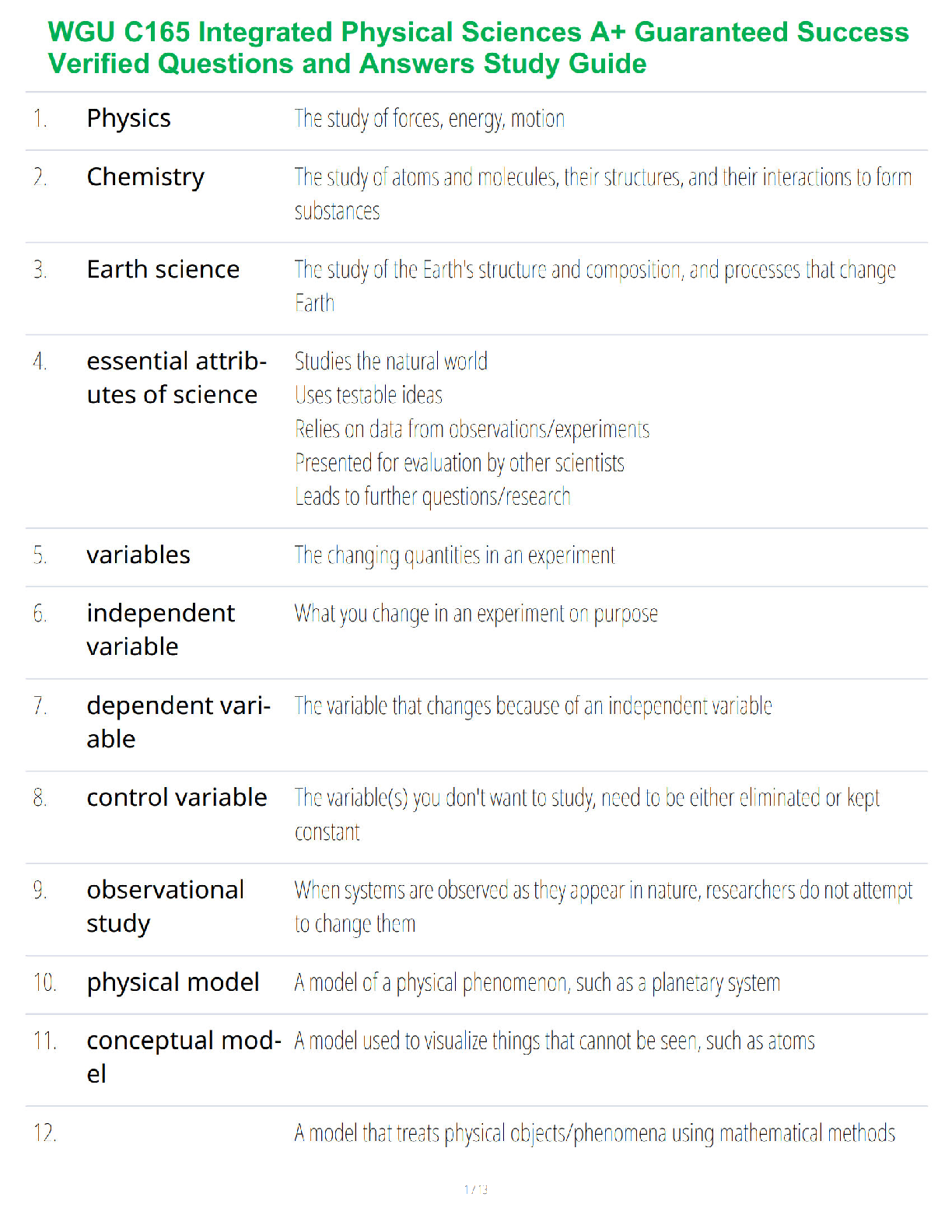
Physics - ✔✔-The study of forces, energy, motion
Chemistry - ✔✔-The study of atoms and molecules, their structures, and their interactions to form
substances
Earth science - ✔✔-The study of the Earth's structure and composition, and processes that change Earth
essential attributes of science - ✔✔-Studies the natural world
Uses testable ideas
Relies on data from observations/experiments
Presented for evaluation by other scientists
Leads to further questions/research
variables - ✔✔-The changing quantities in an experiment
independent variable - ✔✔-What you change in an experiment on purpose
dependent variable - ✔✔-The variable that changes because of an independent variable
control variable - ✔✔-The variable(s) you don't want to study, need to be either eliminated or kept
constant
observational study - ✔✔-When systems are observed as they appear in nature, researchers do not
attempt to change them
physical model - ✔✔-A model of a physical phenomenon, such as a planetary system
conceptual model - ✔✔-A model used to visualize things that cannot be seen, such as atoms
mathematical model - ✔✔-A model that treats physical objects/phenomena using mathematical
methods
computer model - ✔✔-A detailed, complex model calculated by a computer
principle of falsification - ✔✔-Principle that only falsifiable statements can be subject to scientific inquiry
hypothesis - ✔✔-A testable statement about how something in nature works
law - ✔✔-A concise statement that is supported by scientific evidence and repeated experiments,
describes a widespread pattern in nature (what)
theory - ✔✔-A statement that explains a wide range of observations, supported by a large body of
scientific evidence (how/why)
meter - ✔✔-Base unit of length
kilogram - ✔✔-Base unit of mass
second - ✔✔-Base unit of time
kelvin - ✔✔-Base unit of temperature
Derived units - ✔✔-What is produced when the base units/quantities are combined
Speed - ✔✔-The name for the distance traveled divided by an interval of time
Volume - ✔✔-Term for the amount of space an object occupies
Liquid displacement - ✔✔-Method of determining the volume of an object by measuring the amount of
liquid it displaces
direct relationship - ✔✔-A relationship between two variables where increasing one increases the other,
and vice versa
inverse relationship - ✔✔-A relationship between two variables where increasing one decreases the
other, and vice versa
Velocity - ✔✔-A combination of speed and direction
Acceleration - ✔✔-Term for any change in an object's speed and/or direction
Force - ✔✔-Term for a push or a pull with direction and magnitude. You may not feel it.
Net force - ✔✔-The sum of all forces acting on an object
balanced forces - ✔✔-Term for forces that combine to produce a net force of 0
Newton's first law - ✔✔-An object in motion remains in motion unless acted on by a net force
inertia - ✔✔-The tenancy to keep the same motion/velocity or remain at rest. Newton's first law
Newton's second law - ✔✔-Net force = mass x acceleration (F = ma)
Newton's third law - ✔✔-When one object exerts a force on a second object, the second object exerts a
force of the same magnitude in the opposite direction on the first object ("For every action, an equal
and opposite reaction")
friction - ✔✔-The force that opposes the motion of an object on which it acts
Kinetic friction - ✔✔-Friction between two objects moving against each other
Static friction - ✔✔-Friction between two objects touching but not moving against each other
Fluid resistance - ✔✔-Friction when an object moves through a gas or liquid
Gravity - ✔✔-Attractive force between objects directly proportional to their masses and inversely
proportional to the square of their distance
Linear momentum - ✔✔-Name for the mass of an object times its velocity
Law of conservation of momentum - ✔✔-Term for the fact that momentum is conserved when two or
more objects collide
elasticity - ✔✔-The amount of bounce an object has after a collision
Elastic collision - ✔✔-A collision in which the total kinetic energy is conserved
Inelastic collision - ✔✔-A collision in which the total kinetic energy is not conserved
Work - ✔✔-Term for the displacement of an object in the direction of an applied force by
using/converting energy
Energy - ✔✔-The capacity to do work or cause change
Kinetic energy - ✔✔-The energy objects have because they are moving. Increases with mass and velocity
potential energy - ✔✔-Energy that is stored
Formula for work - ✔✔-work = force x displacement
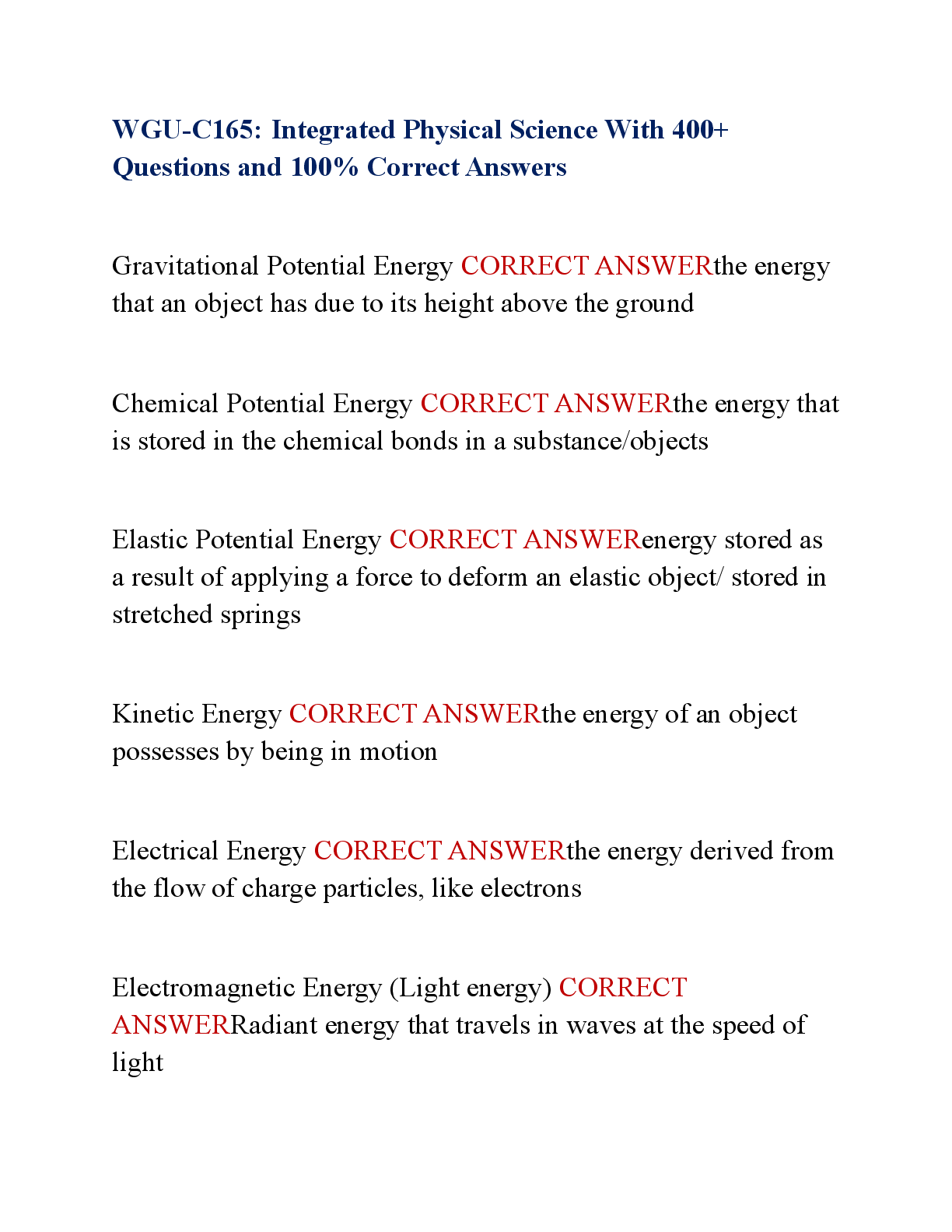
gravitational potential energy - ✔✔-Energy an object has due to its height above the ground. Increases
with mass and height.
chemical potential energy - ✔✔-Energy that is stored in the chemical bonds in a substance
elastic potential energy - ✔✔-Energy stored in stretched springs, rubber bands, etc.
electromagnetic energy - ✔✔-Energy carried by electromagnetic waves. Light energy.
thermal energy - ✔✔-Energy from the motion of atoms and molecules. Depends on mass and
temperature
Law of conservation of energy - ✔✔-Term for the fact that energy cannot be created/destroyed, only
transferred/converted
oscillation - ✔✔-A repetitive motion that occurs around a center point or equilibrium
equilibrium - ✔✔-A position or state to which an oscillating object eventually returns to
wave - ✔✔-A repeating and periodic disturbance (oscillation) that travels from one point to another,
transferring energy
mechanical waves - ✔✔-Type of waves that require a medium (air, water, etc.) to travel through, cannot
travel through a vaccuum
transverse wave - ✔✔-Wave where the oscillation is perpendicular to the direction the wave is traveling
longitudinal wave - ✔✔-Wave where the oscillation occurs along the direction the wave is traveling
electromagnetic waves - ✔✔-Waves with both an electric and magnetic component. Can only be
transverse waves and can travel through a vaccuum
compression - ✔✔-Region of longitudinal wave where particles are close together
expansion - ✔✔-Region of longitudinal wave where particles are far apart (aka rarefaction)
crest - ✔✔-The highest point in a wave above equilibrium
trough - ✔✔-The lowest point in a wave under equilibrium
amplitude - ✔✔-The distance between a wave's equilibrium and crest/trough in a transverse wave, or
how compressed/expanded the medium becomes in a longitudinal wave
wavelength - ✔✔-The horizontal distance after which the wave repeats
period - ✔✔-The amount of time needed for one full oscillation/one wave to pass
frequency - ✔✔-Number of wave oscillations in a given period of time
sound wave - ✔✔-A disturbance we can hear that moves through a medium away from the source
Matter - ✔✔-Anything that takes up space and has mas
[Show More]


.png)