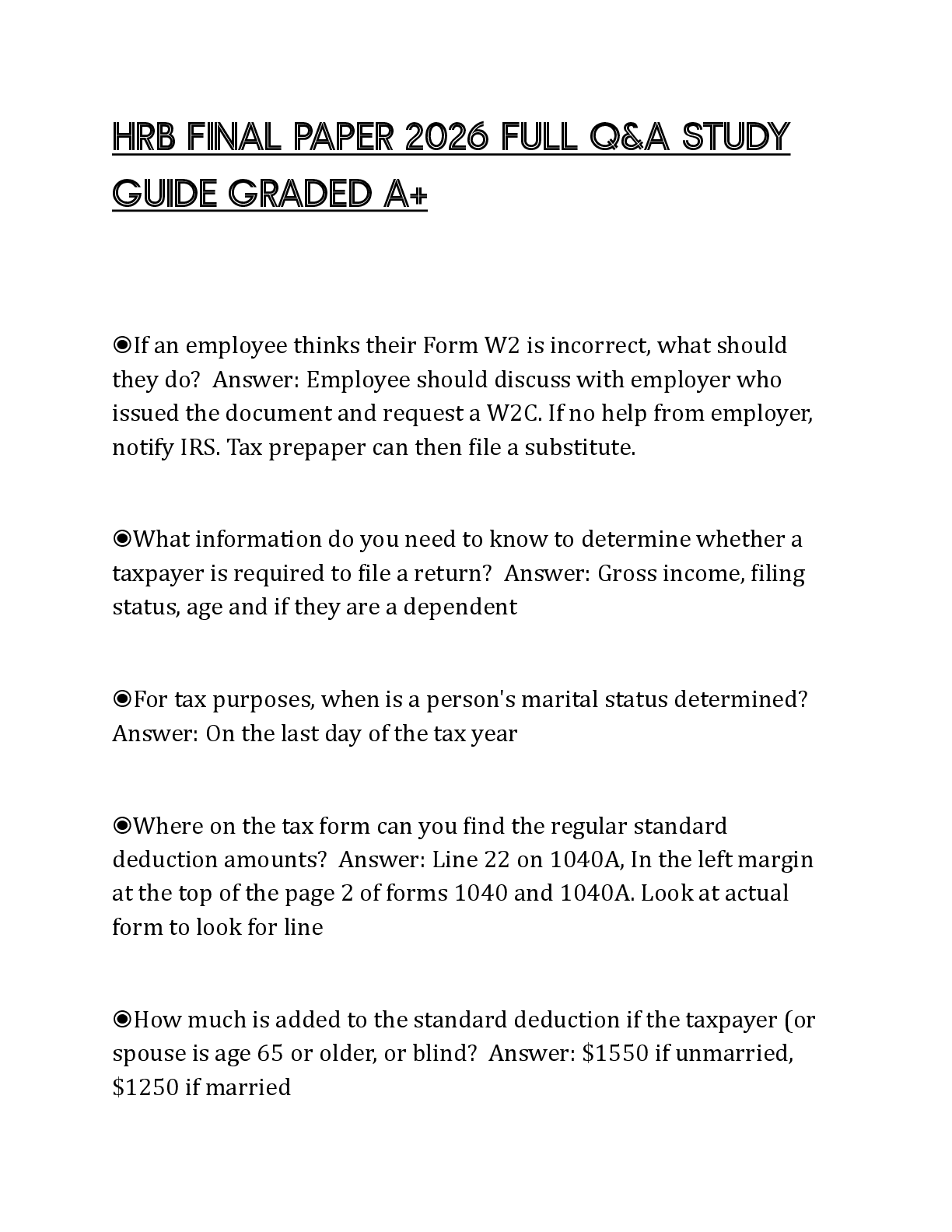
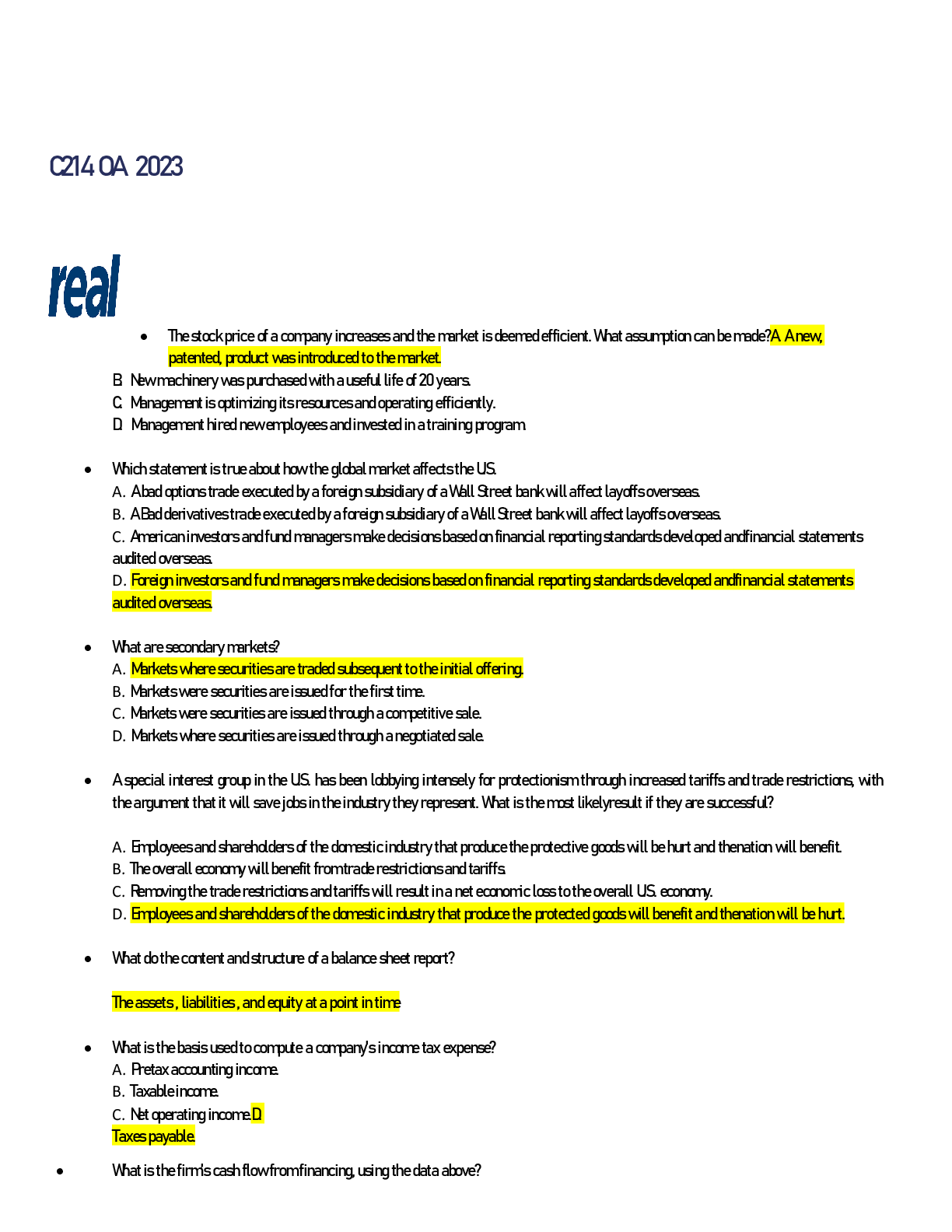
WGU C214 Practice Test, Questions with
accurate answers, 100% Accurate,
graded A+
1. A firm reported the following:
Net Income 100,000
Depreciation 25,000
Change in NWC 15,000
What is the CFO (cash flow from ope
...
WGU C214 Practice Test, Questions with
accurate answers, 100% Accurate,
graded A+
1. A firm reported the following:
Net Income 100,000
Depreciation 25,000
Change in NWC 15,000
What is the CFO (cash flow from operations)?
a. 100,000
b. 110,000
c. 120,000
d. (130,000) - ✔✔-CFO = Net Income + Depreciation - Increase NWC
=100,000 + 25,000 - 15,000
2. What is the Cash Flow from Investing?
Beginning Net PP&E 50,000
Ending Net PP&E 200,000
Depreciation Expense 40,000
a. (190,000)
b. 150,000
c. 200,000
d. (150,000) - ✔✔-Cash Flow Investing (CFI)
Change in Investment = (Change in Net PPE + Depreciation)
=(200,000 - 50,000) + 40,000
Change Invest = 190,000
CFI = (-1) * Change in Invest = (190,000)
3. What is the Cash Flow from Financing?
Accounts Payable 50,000
Stock Issuance 75,000
Increase in Bonds Payable 125,000
Dividends Paid 80,000
a. 150,000
b. 120,000
c. 100,000
d. 145,000 - ✔✔-Cash Flow Financing
CFF = Increase in Stock + Increase in Debt - Dividends Paid
=75,000+125,000-80,000
=120,000
4. A couple wants to save for a down payment on a house. They think they need to accumlate 100,000 in
five years. If the interest rate is 5% and they start at the end of the year when they both get bonuses
from their employers, what do they have to put aside annually?
a. 22,096
b. 17,752
c. 18,097
d. 18,462 - ✔✔-100,000 FV
5 N
5 I/Y
Cpt PMT = 18,097
5. Hedgeco had sales of 70,000,000, expenses of 50,000,000 and has a 40% tax rate. It has equity of
40,000,000. The board approved dividends of 4,000,000. What is the company's Sustainable Growth
Rate?
a. 20%
b. 15%
c. 25%
d. 14% - ✔✔-SGR = ROE * ( 1 - Payout Ratio )
ROE = Net Income / Equity
Payout Ratio = Dividends Paid / Net Income
Net Income = (70 - 50)*(1-0.4) = 12 ROE = 12/40 = 0.30
Payout Ratio = 4/12 = .33
SGR = .30 * (1 - 0.33) = .20
6. A company wishes to issue 10 year semi-annual pay bonds with a face value of $1,000 and a coupon
rate of 5%. The market has shifted before the issuance and the bonds will sell at 95% of face value. What
is the YTM of the bonds when they are sold?
a. 6.71%
b. 5.50%
c. 5.66%
d. 6.33% - ✔✔-20 N
1000 FV
25 PMT
(950) PV
Cpt I/Y = 2.83 * 2 = 5.66%
7. What does a stock have to sell for one year in the future, if it currently sells for $75, has a planned
dividend of $2 a share and an expected return of 12%?
a. 75
b. 79
c. 82
d. 85 - ✔✔-1 N
(75) PV
2 PMT
12 I/Y
Cpt FV = 82
8. A company just paid a dividend of 2.00 to its shareholder. It estimates that future growth will be at
5%. What is the value of the stock if you are looking for an 10% return on your investment?
a. 41.75
b. 42
c. 41
d. 39 - ✔✔-Price = Projected Next Div / (Req Return - Growth Rate)
Next Dividend = Last Dividend x (1+growth rate)
= (2 * 1.05) / (0.10 - 0.05)
= 42
9. To create a fund for annual college scholarships of $100,000 that will last forever, how much must be
invested today if the interest rate is 5%?
a. 1,000,000
b. 5,000,000
c. 500,000
d. 2,000,000 - ✔✔-Perpetuity: Present Value = Payments / Interest Rate
PV = 100,000 / .05
PV = 2,000,000
10. The market yield is 15% and Treasury bonds are yielding 3%. If a stock has a beta of 1.5. What is that
stock's expected return?
a. .17
b. .18
c. .21
d. .15 - ✔✔-E(r) = Risk Free Rate + Beta * ( Market Yield - Risk Free Rate)
E(r) = Risk Free Rate + Beta * ( Market Risk Premium)
=.03 + 1.5 * (.15 - .03)
=.03 + .18
=.21
11. Common stock is valued at 500,000 and Long-term debt is valued at 300,000. What is the WACC if
common stock costs .15 and long-term debt costs .07? The tax rate is 40%.
a. .1275
b. .125
c. .1225
d. .1095 - ✔✔-WACC = (Stock/Total Funds) x Rate + (Debt/Total Funds) x Rate x (1-tax rate)
=(500/800)*.15 + (300/800)*.07*(1-0.4)
=0.625*.15 + (0.375*.07*0.6)
= 0.0938 + 0.0158
= 0.1095
12. What is the Initial Cash Flow (ICF) given the following information:
· Equipment Price 400,000
· Installation 10,000
· Shipping 5,000
· Working Capital 100,000
a. (415,000)
b. 615,000
c. (515,000)
d. 510,000 - ✔✔-ICF = Asset Cost + Ship & Install + Increase NWC
=400,000+10,000+5,000+100,000
=515,000 outflow
= (515,000)
13. A couple wants to have an annuity of $25,000 payable at the beginning of each year for 10 years. If
they have 20 years to save for that annuity, how much must be saved from their annual year-end
bonus? Assume a 5% interest rate.
a. 5,838
b. 6,130
c. 6,437
d. 6,552 - ✔✔-Step 1: Begin Mode: 25,000 PMT 10 N 5 I/Y CPT PV = 202,696
Step 2: End Mode: 202,696 FV 20 N 5 I/Y CPT PMT = 6,130
14. At sales of $100 million, a firm estimates AR at 15% of sales & inventory at 20% of sales. If it has $5
million of equity and $15 million of debt, what is its DFN?
a. 40 mill
b. 50 mill
c. 15 mill
d. Insufficient data to determine - ✔✔-DFN = Incr Assets - Incr Liabilities - Incr Equity
Assets: 100 * (.15+.20) = 35
Sources of funds: 5 + 15 = 20
DFN = Assets - Sources = 35 - 20 = 15
15. A project is closing. Equipment is sold for 80,000 even though the book value was 100,000. The tax
rate is 30%. The project started with 50,000 in working capital. What is the Terminal Cash Flow?
a. 100,000
b. 50,000
c. 136,000
d. 85,000 - ✔✔-TCF = Decrease in NWC + Salvage Value
Salvage Value = Sales Price - (Sales Price - Book Value) x Tax Rate
=80,000 - (80,000 - 100,000) * 0.3 + 50,000
=80000+6000+50000 = 136,000
16. If a stock is purchased for $15, receives a $1 dividend, and is sold a year later for $20, what is the
return to the investor?
a. 33%
b. 40%
c. 43%
d. 5% - ✔✔-Return = Dollar Profit / Initial Investment
Dollar Profit = Dividend + Capital Gain
=1 + (20-15) = 6 = dollar profit; Return = 6/15 = 40%
or: (15) PV 1 PMT 1 N 20 FV CPT I/Y 0.40
17. A $1 million project was delayed for 3 years. If the inflation rate is 5%, how much should be
budgeted to fund the project after the delay?
a. $1.2 million
b. $1.3 million
c. $1.0 million
d. $ 0.8 million - ✔✔-Futre Value = Present Value * [ (1 + Inflation Rate)^(number of years) ]
1,000,000 PV 3 N 5 I/Y CPT FV = 1.157 million
18. If a firm has a 10% net margin on $100 million sales and a 20% payout ratio, what is the addition to
retained earnings?
a. $10 million
b. $20 million
c. $8 million
d. Cannot be determined - ✔✔-Change in Retained Earnings = Net Income - Dividends Paid
Net Income = 10% * 100 = 10 million
Dividends = Net Income * Payout Ratio = 10 * 20% = 2 million
Change in RE = 10 - 2 = 8 million
19. If a firm has $50 million of sales, 30 million of operating expenses, 10 million of depreciation, and a
20% tax rate, what is its net income?
a. 20 million
b. 8 million
c. 18 million
d. 10 million - ✔✔-Net Income = (Revenue - Expenses - Depreciation) * (1 - Tax Rate)
=(50 - 30 - 10 ) * (1 - .2 ) = 8 million
20. If a 5-year zero coupon bond sells for 900, what is its yield to maturity?
a. 0%
b. 10%
c. 2.13%
d. 2.22% - ✔✔-Yield = (Face Value / Price ) ^(1/N) - 1
=(1000/900)/ (1/5) - 1 = 2.13%
or
0 PMT 1000 FV (900) PV 5 N CPT I/Y = 2.13
21. The SEC Securities & Exchange Commission requires public companies to do the following:
a. File audited financial statements with SEC
b. Change CEOs on a regular basis
e. Regulates the Money Supply
d. Prohibits foreign bribery - ✔✔-A
File audited financial statements withSEC
22. What does the Sarbanes-Oxley Act require companies to do?
a. Have a board of directors
b. Register all foreign sales
c. Make estimated tax payments
d. Have internal control audits - ✔✔-D
Have internal control audits
23. If a company produces and sells a product only in the U.S., what international developments may
affect its sales?
a. Fluctuating exchange rates
b. Imports of competing products
c. Immigration policy
d. Inflation in Europe - ✔✔-B
Imports of competing products
24. The SEC requires the following to file audited financial statements:
a. All companies
b. All for-profit companies
c. All publicly-traded corporations
d. There is no such requirement - ✔✔-C
All publicly-traded corporations
25. Which best describes conceptually the valuation of all financial assets in financial markets?
a. Based on opinions of Wall Street analysts
b. The NPV of anticipated cash flows
c. Based on the book value of assets and liabilities
d. None of the above - ✔✔-B
The NPV of anticipated cash flows
26. Which accurately describes an "efficient" market?
a. Prices are low
b. Prices do not fluctuate
c. Deviations from "fair value" are quickly eliminated
d. It is a monopoly - ✔✔-C
Deviations from "fair value' are quickly eliminated
27. If a firm's goal is to maximize stockholder wealth, which would the firm avoid?
a. Stock buybacks
b. Risky long-term investments
c. Investments with negative NPV
d. Transparency in financial statements - ✔✔-C
Investments with negative NPV
28. To evaluate a non-public company, what sources would you use?
a. The financial statements filed with the SEC
b. The latest stock price quoted in the Wall Street Journal
c. The PE of a comparable public company
d. The book value of equity in its balance sheet - ✔✔-C
The PE of a comparable public company
29. Which section of the Statement of Cash Flows descibes the production and sales of the firm's
product?
a. Cash Flow Operations
b. Cash Flow Investing
c. Cash Flow Financing.
d. Cash Flow Securities - ✔✔-A
Cash Flow Operations
30. For calculating cash flows, why is depreciation added to Net Income?
a. To offset taxes
b. Depreciation is a non-cash deduction
c. To determine pre-tax income
d. None of the above - ✔✔-B
Depreciation is a non-cash deduction
31. What functions do market prices serve?
a. Convey information
b. Affect incentives
c. Affect allocation of resources
d. All of the above - ✔✔-D
All the above
32. What explains the size of the yield spread of junk bonds over Treasury?
a. The investor-perceived riskiness of the bond
b. The firm's ROE
c. The firm's efficiency ratio
d. The firm's Beta - ✔✔-A
The investor-perceived riskiness of the bond
33. What does Beta measure?
a. The yield on the S&P 500
b. The relative riskiness of an individual stock
c. Indicates the market value of the stock
d. Stocks to avoid purchasing - ✔✔-B
The relative riskiness of an individual stock
34. What is the most effective use of financial statements in valuing a stock?
a. Use the book value of equity on the balance sheet
b. Use GAAP earnnings
c. Use data to estimate future earnings
d. Read the footnotes - ✔✔-C
use data to estimate future earnings
35. If market interest rates rise, what impact does it have on a given bond?
a. Its price decreases
b. It will have a discount price
c. No impact since the coupon rate is fixed
d. Its price increases - ✔✔-A
Its price decreases
36. What impact did the recent corporate tax cut have on a firm's WACC?
a. It decreased WACC
b. It increased WACC
c. No impact since WACC depend on firm risk
d. None of the above - ✔✔-B
It increased WACC
37. Why do firms often use "sensitivity" tests in analyzing investment projects?
a. Required by the SEC
b. Uncertainty of forecast assumptions
c. Auditors require it.
d. Required section of financial statements - ✔✔-B
Uncertainty of forecast assumptions
38. If debt is less costly than equity, why don't firms maximize debt use?
a. Excessive debt inceases risk of bankruptcy
b. Restricted by Federal tax regulations
c. It reduces financial leverage
d. It increases operating leverage - ✔✔-A
Excessive debt increases risk of bankruptcy
39. Why does a firm's investment opportunities affect it dividend payout ratio?
a. Maximization of shareholder wealth strategy
b. Limited access to market financing
c. Attempts to increase stock price
d. All of the above - ✔✔-D
All of the above
40. If two annuities have the same payments and term, why is an Annuity Due more valuable than an
Ordinary Annuity?
a. The have equal value
b. Annuity Due payments occur earlier
c. Annuity Due uses a lower discount rate
d. Ordinary annuities are consider more risky - ✔✔-B
Annuity Due payments occur earlier
41. What is the impact of rising U.S. interest rates on foreign exchange?
a. Makes USD decline in value
b. Has no impact on USD
c. Increases the value of USD
d. Increases the value of EUR - ✔✔-C
Increase the value of USD
42. In cash flow statements, which section reflects so-called "spontaneous" accounts which vary with
sales?
a. Cash flow operations
b. Cash flow investing
c. Cash flow financing
d. Cash flow sales - ✔✔-A
Cash flow operations
43. What are the practical disadvantages of the Gordon model for equity valuation?
a. How to use if no dividends are paid
b. Must project dividends "forever" into the future.
c. Does not address the appropriate discount rate
d. All of the above - ✔✔-D
All of the above
44. What factor determines the "market risk premium" on stocks?
a. Credit rating agencies
b. The investor-perceived riskiness of stocks
c. Seasonality
d. Projected future earnings - ✔✔-B
The investor-perceived riskiness of stocks
45. Why would a company buy back outstanding stock?
a. To boost the price of the stock
b. To increase financial leverage
c. Lack of investment opportunities
d. All of the above - ✔✔-D
All of the above
46. Which factor does NOT affect a firm's WACC?
a. The market risk premium
b. The tax rate
c. Treasury yields
d. The foreign exchange rate - ✔✔-D
The foreign exchange rate
47. Why should an investor diversify the portfolio?
a. To achieve a better combination of risk and return
b. To avoid putting "all eggs in one basket"
c. Stock returns are a function of systematic risk
d. All of the above - ✔✔-D
All of the above
48. Which statement about a PE ratio is false?
a. High PE ratios reflect higher expected growth rates
b. Low PE stocks are cheap
c. PE is the ratio of price to earnings
d. All are false - ✔✔-B
Low PE stocks are cheap
49. If a firm cannot access markets sufficiently to meet their DFN, what strategies might they use?
a. Slow sales growth
b. Lower dividend payout
c. Increase the net margin
d. All of the above. - ✔✔-D
All of the above
50. Dodd-Frank regulates which segment of the U.S. Economy?
a. Fannie Mae and Freddie Mac (Housing finance)
b. Banking Industry
c. Multi-level Marketing Industry
d. Automobile Industry - ✔✔
[Show More]




.png)
.png)


.png)
.png)