WGU C963 Final Exam prep. Questions
with accurate answers, 100% accurate,
rated A+.
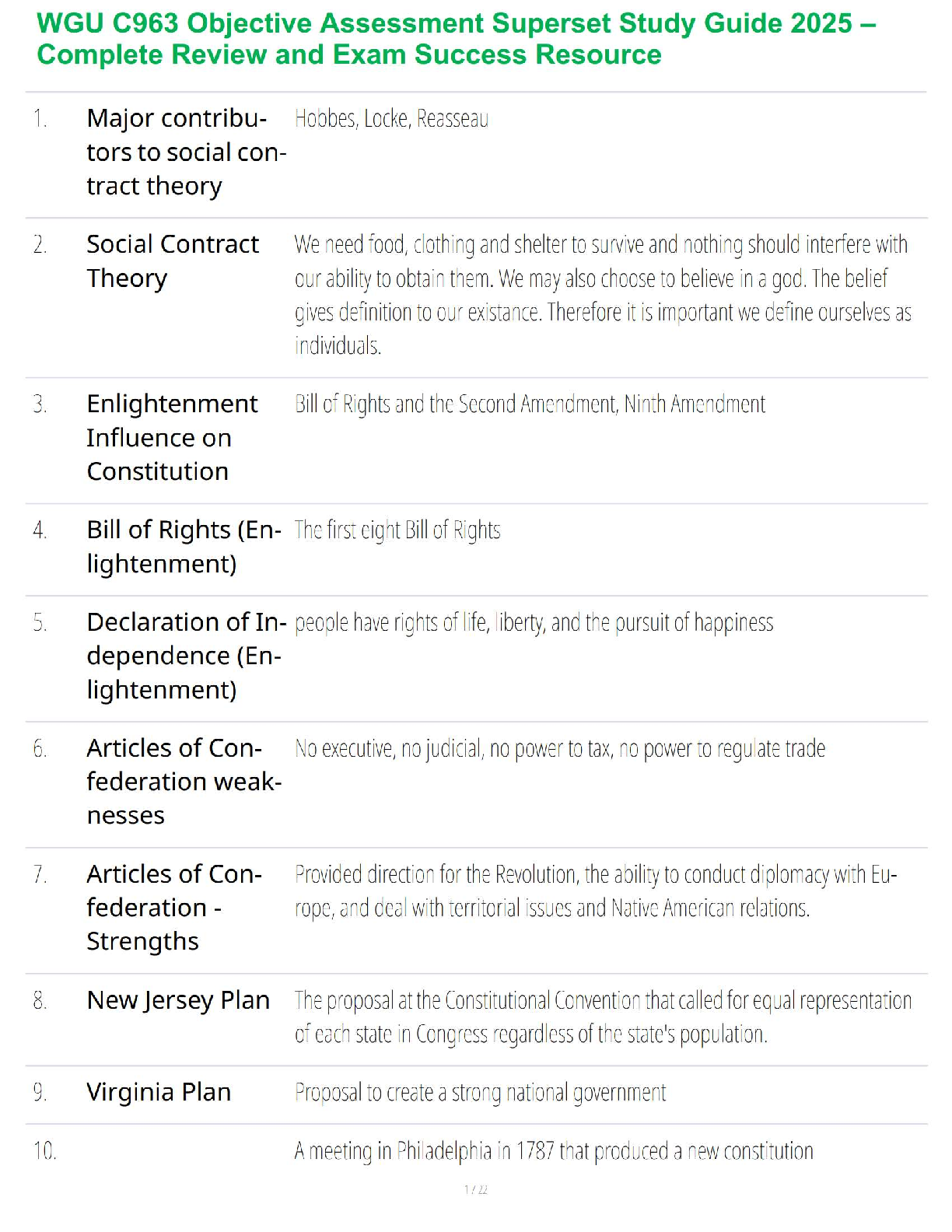
Major contributors to social contract theory - ✔✔-Thomas Hobbes, John Locke, Jean-Jacque Rousseau,
Montesquieu
Requirements to b
...
WGU C963 Final Exam prep. Questions
with accurate answers, 100% accurate,
rated A+.
Major contributors to social contract theory - ✔✔-Thomas Hobbes, John Locke, Jean-Jacque Rousseau,
Montesquieu
Requirements to be a Representative/term information - ✔✔-Citizen for 7 years, at least 25 years old/2
year term, based on population
Civil rights - ✔✔-Rights to be free from discrimination/free from unequal treatment/requirements for
government action
Powers of the legislative branch - ✔✔-Tax citizens, set budget, impeach, regulate commerce, declare
war provide advise and consent on appointments, oversee powers of other branches
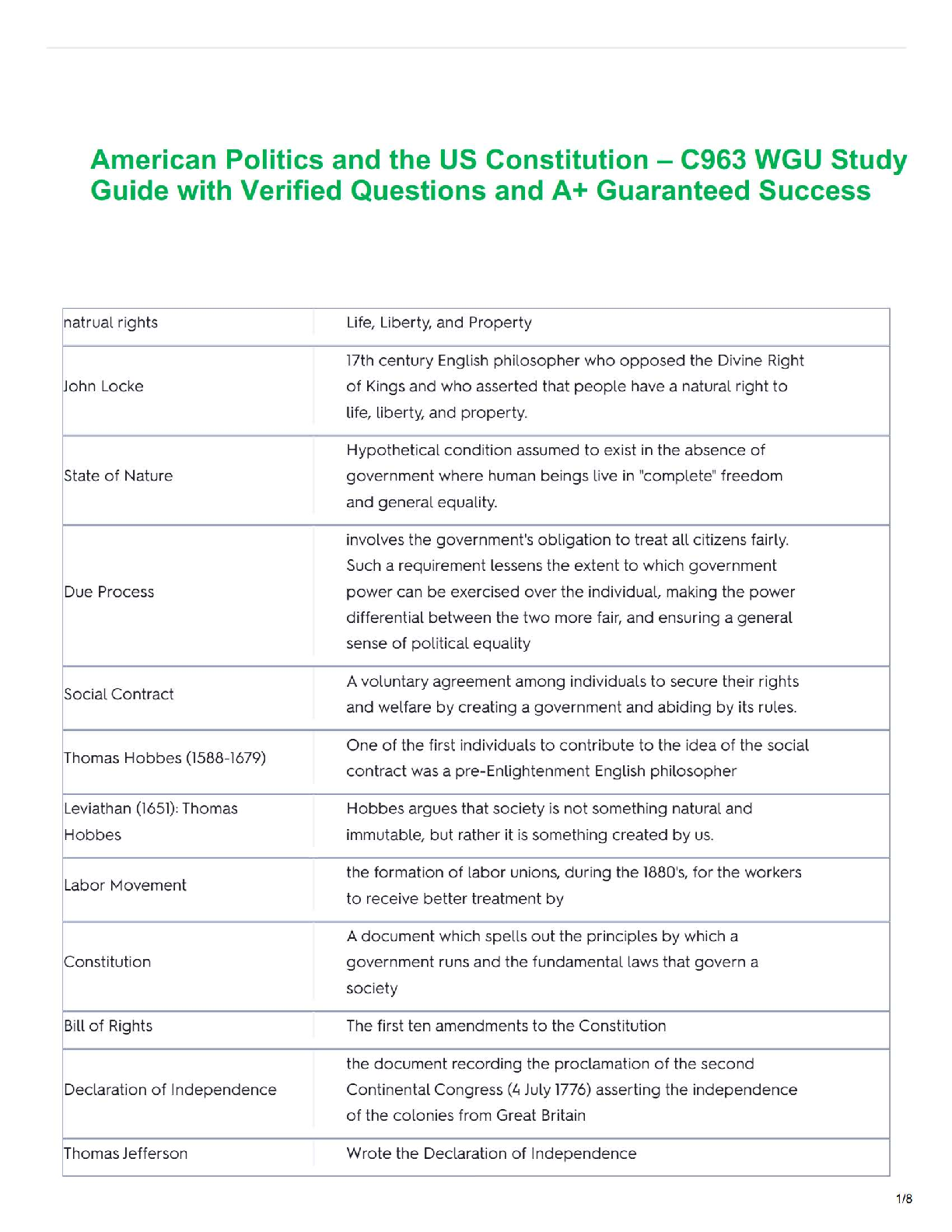
Thomas Hobbes view of society and what social contract theory should protect - ✔✔-World is nasty;
right to life
Implied powers - ✔✔-Powers not specifically mentioned in the constitution. Right to regulate banks,
establish minimum wage, construction and maintenance of highways.
Requirements to be a Senator/term information - ✔✔-Citizen for 9 years, at least 30 years old/6 year
term, 2 per state
Civil liberties - ✔✔-Basic freedoms/free to exercise religion, speech, etc.../restrictions on government
power
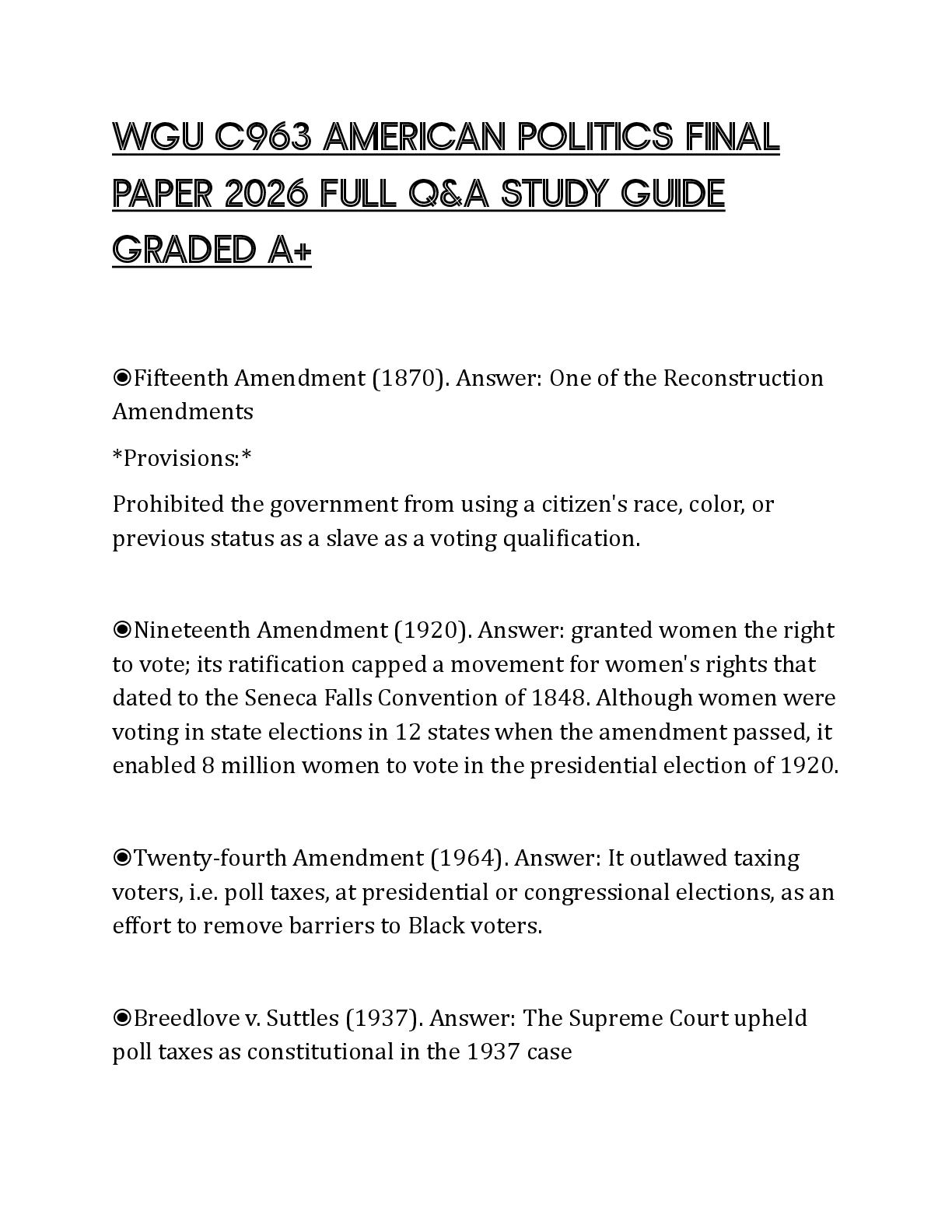
Thirteenth Amendment - ✔✔-Abolished slavery
John Locke view of society and what social contract theory should protect - ✔✔-World is decent and
rational; right to life, liberty, and property
How many members of the House of Representatives are there? - ✔✔-435
Enumerated/expressed powers - ✔✔-Powers explicitly stated in the Constitution. Right to levy taxes,
declare war, regulate money stuff, regulate immigration.
Mass media - ✔✔-All forms of media that communicate information to the general public, including TV,
radio, print, and the internet.
Jean-Jacque Rousseau view of society and what social contract theory should protect - ✔✔-World starts
out good but declines with population increase; right to liberty
Inherent powers - ✔✔-Powers that must be assumed to exist as a direct result of the country's
existence. Right to control borders of the state, expand territory, defend itself from revolution/coups.
Important acts to Congressional campaigns - ✔✔-Bipartisan Campaign Reform Act - limits soft money;
Federal Election Campaign Act - created FEC and discloses donors
Fourteenth Amendment - ✔✔-Formally defined citizenship and the requirement that privileges and
immunities of citizenship are respected. African Americans were allowed to be citizens.
Reserved powers - ✔✔-Powers not specifically granted to the federal government or denied to the
states belong to the states and the people
Concurrent powers - ✔✔-Powers held jointly by the national and state governments.
Hard money - ✔✔-Campaign money that is subject to regulations by the FEC; contributed directly to a
candidate
Fifteenth Amendment - ✔✔-Gave voting rights regardless of race or previous condition of servitude
State of nature - ✔✔-A condition in which no governments or laws existed at all
Commerce Clause - ✔✔-The clause in the Constitution (Article I, Section 8, Clause 1) that gives Congress
the power to regulate all business activities that cross state lines or affect more than one state or other
nations.
Social contract theory - ✔✔-A voluntary agreement between the government and the governed
Evidence of Congress exercising power of the commerce clause - ✔✔-Racial desegregation, No Gun
School Zone ruled unconstitutional, the Affordable Care Act
Soft money - ✔✔-Campaign contributions unregulated by federal or state law; usually given to parties
and party committees to help fund general party activities.
Rational scrutiny - ✔✔-Applies to most types of discrimination. The government has to demonstrate
only that it has a good reason for engaging in it (not allowing blind people to drive because it would be
dangerous)
Natural rights - ✔✔-The idea that all people have rights to life, liberty, and property
Ways the legislative branch checks the other branches - ✔✔-Advise and consent, impeachment, and
oversight
Why do incumbents win? - ✔✔-Name recognition, visibility, resources of office, money, professionalism,
and careerism
Intermediate scrutiny - ✔✔-Applies when discrimination is based on gender or sex. The government has
to prove why the unequal treatment is justified.
Framing - ✔✔-The process of giving a news story a specific context or background.
Hypodermic theory - ✔✔-An intended message is received and wholly accepted by the receiver.
Strict scrutiny - ✔✔-Applies when fundamental freedoms or suspected classes are the target. The
government has to prove why the unequal treatment is justified and that it has used the least restrictive
means.
Consensual political rule - ✔✔-Without consent, rule would be illegitimate
Congressional Committees - ✔✔-A smaller subset of representatives or senators that consider particular
types of bill (can be long standing or temporary), hold hearings for testifying for or against new bills
Priming - ✔✔-The process of predisposing readers or viewers to think a particular way.
How does a candidate ensure a win in the primaries? - ✔✔-Align with party ideals
Minimal effects theory - ✔✔-The idea that the media have little effect on citizens.
Areas of the Constitution influenced by the Enlightenment - ✔✔-Rousseau - property
Montesquieu - separation of powers
How is a law passed? - ✔✔-Introduced, sent to rules committee, debate and voting in the House and
Senate (separately), conference committee, unified bill is voted on, president signs or vetoes
How are presidential candidates nominated? - ✔✔-At national party conventions
Civil rights before the 1950's - ✔✔-The founding of the National Association for the Advancement of
Colored People (NAACP), which challenged Jim Crow laws in federal courts.
Pack journalism - ✔✔-A type of journalism where journalists cover the same things as everyone else
rather than seeking out their own stories.
Cultivation theory - ✔✔-Media affect a citizen's worldview through the information presented.
How are electoral votes determined? - ✔✔-Based on congressional representation (representatives +
senators)
Areas of the Bill of Rights influenced by the Enlightenment - ✔✔-Locke - right to bear arms
Montesquieu - due process
Standing committee - ✔✔-A permanent committee usually focusing on a policy area (finance,
agriculture, foreign relations, etc...)
Civil liberties allow one to choose - ✔✔-Purchases, where to live, occupation, who to marry, and religion
Prior restraint - ✔✔-The legal suppression of speech or media coverage before it's published or spoken;
very limited.
How are Electors selected? - ✔✔-They are nominated by the presidential candidate
Fundamental civil liberties in the Constitution - ✔✔-Habeas corpus (detention must be justified), no bills
of attainer or ex post facto laws, and treason must be witnessed by two people
Equal-time rule - ✔✔-Registered candidates running for office must be given equal airtime on radio and
non-cable TV.
Select committee - ✔✔-A temporary committee established for a limited time and for a special purpose
Areas of the Declaration of Independence influenced by the Enlightenment - ✔✔-Locke - liberty and
property
Who wrote the Declaration of Independence
[Show More]