WGU D196, Exam Questions and
answers, 100% Accurate, graded A+
Unit 2: International Accounting Standards Board (IASB)
A committee formed to develop international accounting standards.
Unit 2: American Institute of
...
WGU D196, Exam Questions and
answers, 100% Accurate, graded A+
Unit 2: International Accounting Standards Board (IASB)
A committee formed to develop international accounting standards.
Unit 2: American Institute of Certified Public Accountants (AICPA)
A professional organization for CPAs in which membership is voluntary. Professional Sanctions
Unit 2: Certified public accountant (CPA)
An accountant who has met specified professional requirements established by the AICPA and local and
state societies. A key service provided by CPAs is the performance of independent audits of financial
statements.
Unit 2: Securities and Exchange Commission (SEC)
The government body responsible for regulating the financial reporting practices of most publicly owned
corporations in connection with the buying and selling of stocks and bonds. Legal Punishment
Unit 2: Governmental Accounting Standards Board (GASB)
An independent private organization that sets the accounting and financial reporting standards for state
and local governments following GAAP.
Unit 2: Generally accepted accounting principles (GAAP)
Authoritative guidelines that define accounting practice at a particular time in the United States.
Unit 2: Financial Accounting Standards Board (FASB)
the private board that establishes the generally accepted accounting principles used in the practice of
financial accounting
variety of backgrounds
not a government agency - no legal power to enforce the accounting standards
Unit 2: accounting system
The procedures and processes used by a business to analyze transactions, handle routine bookkeeping
tasks, and structure information so it can be used to evaluate the performance and health of the
business.
Unit 2: Accounting
Quantitative information, primarily financial in nature, about economic entities that is intended to be
useful in making economic decisions.
Unit 2: Quantitative
Accounting relates to numbers.
Unit 2: Financial
The health and performance of a business are affected by and reflected in many dimensions
Unit 2: Useful
The practice of accounting is supported by a long tradition of theory.
Unit 2: Decisions
Although accounting is the structured reporting of what has already occurred, this past information can
only be useful if it impacts decisions about the future.
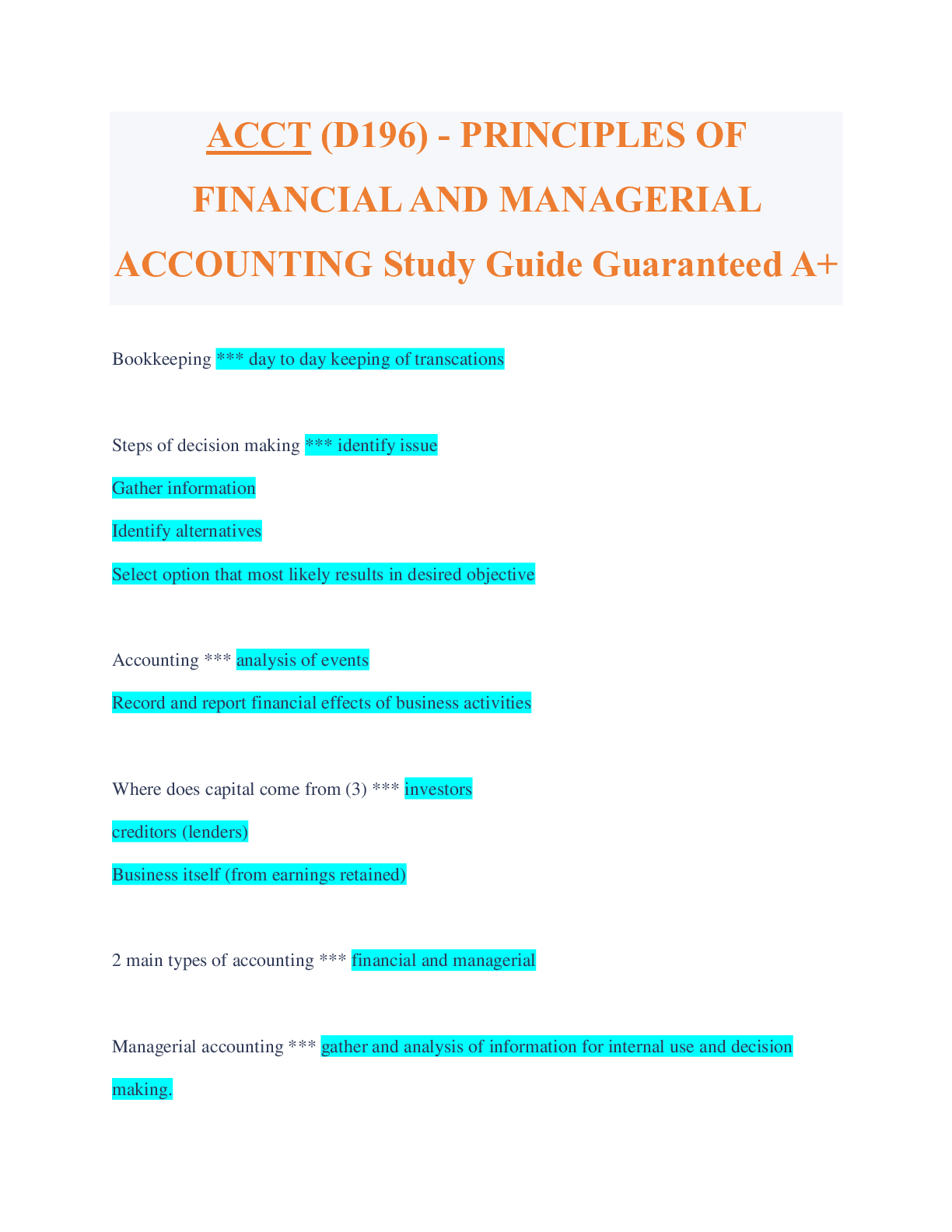
Unit 2: The Decision Making Process
Step 1: Identify Issue
Step 2: Gather Info
Step 3: Identify Alternatives
Step 4: Select Best Option
Unit 2: Revenues
The amount of assets created through the sale of goods and services.
Unit 2: Management accounting
The area of accounting concerned with providing internal financial reports to assist management in
making decisions.
Unit 2: Financial statements
Reports such as the balance sheet, income statement, and statement of cash flows, which summarize
the financial status and results of operations of a business entity.
Unit 2: Annual report
A document that summarizes the results of operations and financial status of a company for the past
year and outlines future plans.
Unit 2: Balance Sheet
Lists as of a point in time.
Provides Assets (resources)
Provide Liabilities (obligations)
Unit 2: Financial accounting
The area of accounting concerned with reporting financial information to interested external parties.
Unit 2: The income statement
For a period of time (such as a year.)
How much profit was made.
Unit 2: Statement of Cash Flows
For a period of time (such as a year.)
Where did our cash come from and where did it go?
Unit 2: External Stakeholders
Lenders and Investors
Unit 2: IRS (Internal Revenue Service)
Collects taxes and audits tax filings for mistakes or fraud. The IRS will notify companies or individuals if
their taxes have not been filed in accordance with income tax laws.
Unit 2: Internal Stakeholders
Managers, employees, suppliers, and customers.
Unit 2: Business documents
to confirm that a transaction has occurred
to establish the amounts to be recorded in the books
to facilitate the analysis of various types of business events
Unit 2: Step 1 of Accounting Cycle: Analyze
Confirm amount
Determine/Code what it was
Structure - to know what happened
Unit 2: Step 2 of Accounting Cycle: Record Effects of Transaction
Design a code/system that efficiently captures the essence of the transaction (credits and debits)
Unit 2: Step 3 of Accounting Cycle: Summarize Effects of Transaction
Posting journal entries and prepare trial balance
Unit 2: Step 4 of Accounting Cycle: Prepare Reports
Adjust entries
Prepare financial reports
Close the books
Unit 2: transaction
typically thought of as two parties exchanging something of value with one another.
Unit 2: What goes in accounting records?
Sales and deliveries
Paying employees
Borrowing money from lenders
Increase or decrease of investments
Unit 2: Arm's-length transaction
A transaction in which a buyer and seller act independently to get the best possible deal.
Unit 2: Accounting Equation
Assets = Liabilities + Owners' Equity
Unit 2: Account
An accounting record in which the results of transactions are accumulated; shows increases, decreases,
and a balance.
Unit 2: What is an account?
A "place" to keep track of similar transactions. Examples: Cash, Accounts Payable, Employee Wage
Expense.
Unit 2: What do Accountants do?
1) Measuring and reporting. Accountants measure and communicate (report) the results of business
activities
2) Advise managers on how to structure these activities so as to achieve the goals of the business.
Unit 3: Primary Financial Statements
B: balance sheet
I: income statement
S: statement of cash flows
Unit 3: Financial Statement: Balance Sheet
POINT IN TIME
Assets: Cash and thing it owns or controls
Liabilities: What a company owes (money or service)
Owner Equity
Unit 3: Financial Statement: Income Statement
PERIOD IN TIME (usually quarterly or annually)
One measure of economic performance
Revenue: increases based on what company does
Expenses: decrease based on what a company does
Net Income: Revenue - Expenses
Unit 3: Financial Statement: Statement of Cash Flows
Beginning of period to end of period
Cash inflow and outflow from operating activities
Cash inflow and outflow from investing activities
Cash inflow and outflow from financing activities
Unit 3: Statement of Retained Earnings
...
Unit 3: Assets Include
This that the business owns or controls:
Cash
Account Receivable
Inventory
Buildings
Unit 3: Liabilities Include
What the business owes:
Accounts Payable
Taxes Payable
Mortgage Payable
Unearned Revenue
Unit 3: Owners Equity Includes
Capital Stock
Retained earnings
Unit 3: Capital Stock
The amount given by shareholders to obtain shares of stock from a company
Unit 3: Retained Earnings
Earnings that are retained in the business or plowed back into the business
Unit 7: return on investment
A measure of operating performance and efficiency in utilizing assets; computed in its simplest form by
dividing net income by average total assets (also known as return on assets or ROA).
Unit 7: Management Accounting
Unique competitive tool
Both financial and nonfinancial data
Usually kept secret from competitors
Used for internal planning, control, and evaluation
Unit 7: Financial Accounting
Uniform across companies (generally accepted accounting principles)
Restricted to financial data
Data often made public
Used primarily by investors and creditors in deciding whether to provide capital to the company
Unit 7: cost accountant (or the cost accounting manager)
An accountant who is specially trained to prepare and analyze accounting information for internal
decision-making.
Unit 7: planning
Outlining the activities that need to be performed for an organization to achieve its objectives.
Unit 7: Long Run Planning
strategic planning, and
capital budgeting (acquisition of assets)
Unit 7: Short Run Planning
production and process prioritizing, and
operational budgeting (profit planning)
Unit 7: production prioritizing
Management's continual evaluation of various product lines and division profitability in order to analyze
and identify opportunities to improve profits.
Unit 7: operational budgeting (aka profit plans)
Managerial planning decisions regarding current and immediate future (a year or less) operations that
are characterized by regularity and frequency.
Unit 7: Controlling
involves the process of tracking actual performance.
Unit 7: Evaluating
involves analyzing results, providing feedback to managers and other employees, rewarding
performance, and identifying problems.
Unit 7: manufacturing business
which is any organization whose main economic activity involves using components or raw materials to
make finished goods for sale to customers
Unit 7: service business
is any organization whose main economic activity involves producing a nonphysical product that
provides value to a customer.
Unit 7: merchandising business
which is a business that purchases finished goods for resale. A merchandiser buys inventory from a
variety of suppliers and makes this inventory available in one place to its customers.
Unit 7: Which types of costs does a merchandiser have?
Both product and period costs
Unit 7: Which type of business is a typical retailer?
Merchandising business
Unit 7: product costs
Costs associated with products or services offered.
Unit 7: period costs
Costs not directly related to a product, service, or asset. They are charged as expenses to the income
statement in the period in which they are incurred.
Which characteristic is a unique feature of management accounting information?
Management accounting information is composed of both financial and nonfinancial data.
What is a profit center?
An organizational unit in which a manager has responsibility for both costs and revenues
Why do the notes to the financial statements contain a summary of significant accounting policies?
Because accounting involves making assumptions, estimates, and judgments
Information about accounting policies and practices, including assumptions, estimates, and judgments,
are included in which element of the financial statements?
The notes to the financial statements
Why do the notes to the financial statements contain additional information about summary totals?
Because the FASB and SEC both require supplementary information that must be reported in the
financial statement notes
What is the Securities and Exchange Commission (SEC)?
The U.S. government agency charged with regulating financial markets and ensuring the availability of
reliable financial information
Which resource or tool is used to identify unique companies in the SEC's 10-K filing database?
Central Index Key (CIK)
Why does the balance sheet not reflect the current value or worth of a company?
Many assets are recorded at cost, an
[Show More]







.png)