C712- Marketing Fundamentals WGU,
Exam Preview, question sections and
answers, graded A+
Planning - ✔✔-Process of anticipating future events and conditions and of determining the best way to
achieve organizational
...
C712- Marketing Fundamentals WGU,
Exam Preview, question sections and
answers, graded A+
Planning - ✔✔-Process of anticipating future events and conditions and of determining the best way to
achieve organizational objectives.
Marketing Planning - ✔✔-Implementing planning activities devoted to achieving marketing objectives.
Strategic Planning - ✔✔-Process of determining an organization's primary objectives and adopting
courses of action that will achieve these objectives.
Tactical Planning - ✔✔-Planning that guides the implementation of activities specified in the strategic
plan.
Mission - ✔✔-Essential purpose that differentiates one company from others.
Marketing Strategy - ✔✔-Overall, company wide program for selecting a particular target market and
then satisfying consumers in that market through the marketing mix.
Porter's Five Forces - ✔✔-Model developed by strategy expert Michael Porter that identifies five
competitive forces that influence planning strategies.
First Mover Strategy - ✔✔-Theory advocating that the company first to offer a product in a marketplace
will be the long-term market winner.
Second Mover Strategy - ✔✔-Theory that advocates observing closely the innovations of first movers
and then improving on them to gain advantage in the marketplace.
SWOT Analysis - ✔✔-Review that helps planners compare internal organizational strengths and
weaknesses with external opportunities and threats.
Strategic Window - ✔✔-Limited periods when key requirements of a market and a firm's particular
competencies best fit together.
Marketing Mix - ✔✔-Blending of the four strategy elements—product, distribution, promotion, and
pricing—to fit the needs and preferences of a specific target market.
strategic business units (SBUs) - ✔✔-Key business units within diversified firms.
Environmental scanning - ✔✔-Systematic study of the components of a purchase to determine the most
cost-effective approach.
Environmental Management - ✔✔-Assessment of supplier performance in categories such as price, back
orders, timely delivery, and attention to special requests.
Strategic Alliance - ✔✔-Partnership in which two or more companies combine resources and capital to
create competitive advantages in a new market.
competitive environment - ✔✔-Interactive process that occurs in the marketplace among marketers of
directly competitive products, marketers of products that can be substituted for one another, and
marketers competing for the consumer's purchasing power.
Monopoly - ✔✔-Market structure in which a single seller dominates trade in a good or service for which
buyers can find no close substitutes.
Antitrust - ✔✔-Laws designed to prevent restraints on trade such as business monopolies.
oligopoly - ✔✔-Market structure in which relatively few sellers compete and where high start-up costs
form barriers to keep out new competitors.
Competitive Strategy - ✔✔-Methods through which a firm deals with its competitive environment.
Time Based Competitition - ✔✔-Strategy of developing and distributing goods and services more quickly
than competitors.
political-legal environment - ✔✔-Component of the marketing environment consisting of laws and their
interpretations that require firms to operate under competitive conditions and to protect consumer
rights.
Gross Domestic Product (GDP) - ✔✔-Sum of all goods and services produced by a nation in a year.
Economic Environment - ✔✔-Factors that influence consumer buying power and marketing strategies,
including stage of the business cycle, inflation and deflation, unemployment, income, and resource
availability.
Business Cycle - ✔✔-Pattern of stages in the level of economic activity: prosperity, recession,
depression, and recovery.
Inflation - ✔✔-Rising prices caused by some combination of excess consumer demand and increases in
the costs of one or more factors of production.
Unemployment - ✔✔-Proportion of people in the economy actively seeking work that do not have jobs.
Discretionary Income - ✔✔-Money available to spend after buying necessities such as food, clothing,
and housing.
Demarketing - ✔✔-Process of reducing consumer demand for a good or service to a level that the firm
can supply.
Technology Environment - ✔✔-Application to marketing of knowledge based on discoveries in science,
inventions, and innovations.
VoIP (Voice over Internet Protocol) - ✔✔-A phone connection through a personal computer with any
type of broadband Internet connection.
Social-Culture Environment - ✔✔-Component of the marketing environment consisting of the
relationship between the marketer, society, and culture.
Consumerism - ✔✔-Social force within the environment that aids and protects the consumer by exerting
legal, moral, and economic pressures on business and government.
Consumer Rights - ✔✔-List of legitimate consumer expectations suggested by President John F.
Kennedy.
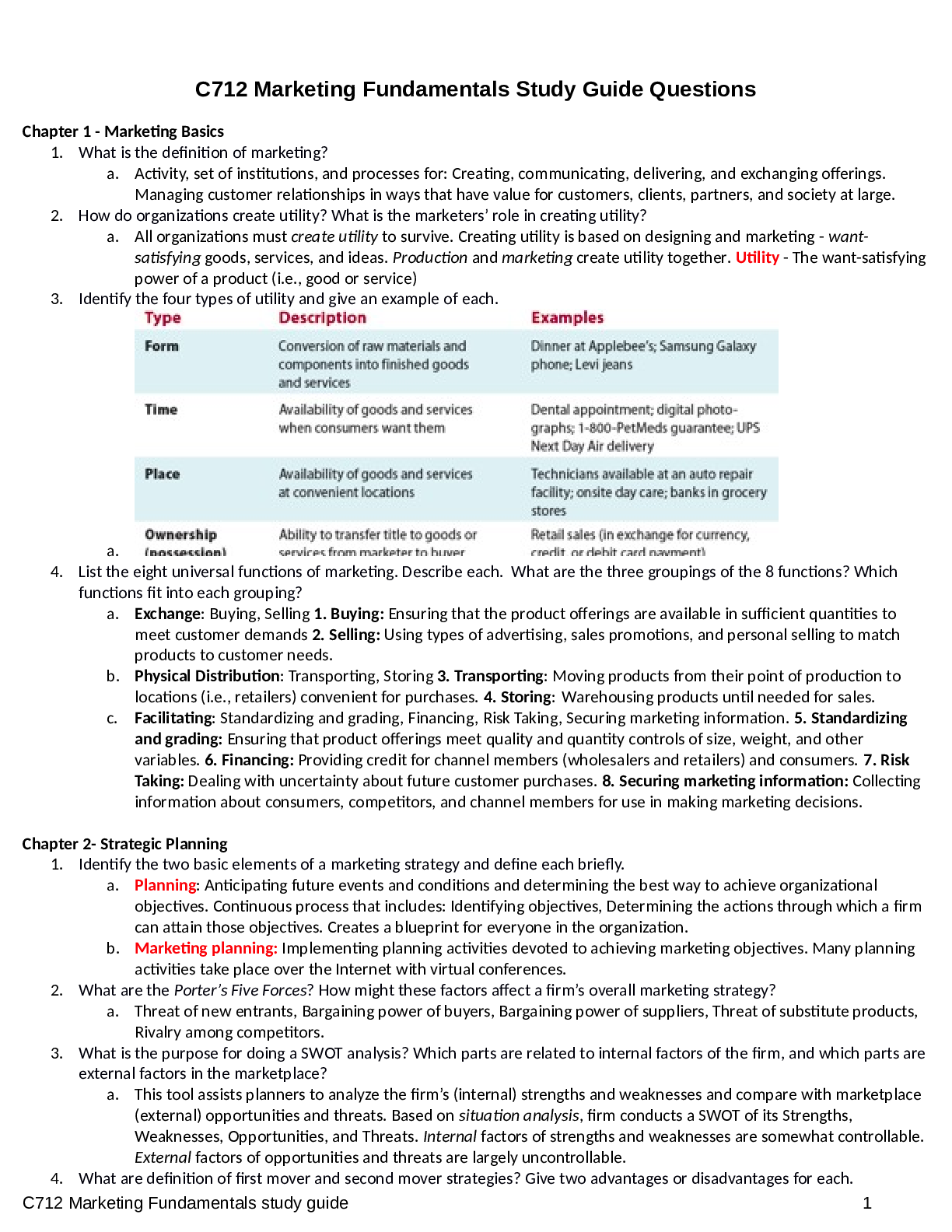
Marketing - ✔✔-The activity, set of institutions, and processes for creating, communicating, delivering,
and exchanging offerings that have value for customers, clients, partners, and society at large.
Wholesalers - ✔✔-Intermediaries that operate between producers and resellers.
Exchange Functions - ✔✔-Buying and selling.
Social Media - ✔✔-Different forms of electronic communication through which users can create online
communities to exchange information, ideas, messages, and other content, such as videos or music.
Social Media Platform - ✔✔-A type of software or technology that allows users to build, integrate, or
facilitate a community, interaction among users, and user-generated content.
Social Media Tool - ✔✔-Software (such as an app or blog) that enables users to communicate with each
other online.
Social-Networking sites - ✔✔-A website that provides virtual communities through which people can
share information, post opinions, and increase their circle of online friends.
Bookmarking - ✔✔-A platform that gives users a place to save, organize, and manage links to websites
and other Internet resources.
Social News Site - ✔✔-A platform where users can post news items to links to outside articles, then vote
on which postings get the most prominent display.
Online forums - ✔✔-A platform where users post messages and hold conversations on specified topics.
Blogging Sites - ✔✔-A platform where a host or writer posts information or opinions on various topics
and followers may respond.
Microblogs - ✔✔-A blog posting that contains only a few words (such as on Twitter).
App - ✔✔-Short for application, a free or purchased software download that links users to a wide range
of goods and services, media and text content, social media platforms, search engines, and the like.
QR Codes - ✔✔-Short for "quick response," a two-dimensional barcode that can be read by some mobile
phones with cameras.
Social Media Marketing (SMM) - ✔✔-The use of social media portals to create a positive influence on
consumers or business customers toward an organization's brand, products, public image, or website.
Social Media Marketing Plan - ✔✔-A formal document that identifies and describes goals and strategies,
targeted audience, budget, and implementation methods, as well as tactics for monitoring, measuring,
and managing the SMM effort.
Influenecers - ✔✔-Individuals with the capability of affecting the opinions or actions of others.
Content Marketing - ✔✔-Creating and distributing relevant and targeted material to attract and engage
an audience, with the goal of driving them to a desired action.
e-marketing - ✔✔-Strategic process of creating, distributing, promoting, and pricing goods and services
to a target market over the Internet or through digital tools.
Interactive Marketing - ✔✔-Buyer-seller communications in which the customer controls the amount
and type of information received from a marketer through channels such as the Internet and virtual
reality kiosks.
Corporate Websites - ✔✔-Site designed to increase a firm's visibility, promote its offerings, and provide
information to interested parties.
Marketing Websites - ✔✔-Site whose main purpose is to increase purchases by visitors.
Business-to-business (B2B) e-marketing - ✔✔-Use of the Internet for business transactions between
organizations.
e-procurement - ✔✔-Use of the Internet by organizations to solicit bids and purchase goods and
services from suppliers.
business-to-consumer (B2C) e-marketing - ✔✔-Selling directly to consumers over the Internet.
electronic storefronts - ✔✔-Company websites that sell products to customers.
Electronic Shopping Carts - ✔✔-File that holds items the online shopper has chosen to buy.
Bots (shopbots) - ✔✔-Software program that allows online shoppers to compare the price of a particular
product offered by several online retailers.
Encryption - ✔✔-The process of encoding data for security purposes.
Secure Sockets Layer (SSL) - ✔✔-Technology that secures a website by encrypting information and
providing authentication.
Electronic Signatures - ✔✔-Electronic identification that allows legal contracts such as home mortgages
and insurance policies to be executed online.
Firewall - ✔✔-Electronic barrier between a company's internal network and the Internet that limits
access into and out of the network.
Phishing - ✔✔-High-tech scam that uses authentic-looking email or pop-up messages to get
unsuspecting victims to reveal personal information.
Vishing - ✔✔-Scam that collects personal information through voice response systems; stands for voice
phishing.
Smishing - ✔✔-Scam that collects personal information through cell phone text messages; stands for
SMS (short message service) phishing
Channel Conflicts - ✔✔-Conflicts among manufacturers, wholesalers, and retailers.
Spam - ✔✔-Popular name for junk email.
Blog - ✔✔-Short for Web log, an online journal for an individual or organization.
Wikis - ✔✔-Web page that anyone can edit.
Podcasts - ✔✔-Online audio or video file that can be downloaded to other digital devices.
banner ads - ✔✔-Strip message placed in high-visibility areas of frequently visited websites.
Pop-up ads - ✔✔-Separate window that pops up with an advertising message.
Pre-roll video ads - ✔✔-Brief marketing message that appears before expected video content.
Search Marketing - ✔✔-Paying search engines, such as Google, a fee to make sure the company's listing
appears toward the top of the search results. Also called search engine optimization (SEO).
Skimming pricing strategies - ✔✔-Pricing strategy involving the use of a high price relative to
competitive offerings.
Market-plus pricing - ✔✔-Intentionally setting a relatively high price compared with the prices of
competing products; also known as skimming pricing.
Step out - ✔✔-Pricing practice in which one firm raises prices and then waits to see if others follow suit.
Penetration pricing strategy - ✔✔-Pricing strategy involving the use of a relatively low entry price
compared with competitive offerings, based on the theory that this initial low price will help secure
market acceptance.
Every day low pricing (EDLP) - ✔✔-Pricing strategy of continuously offering low prices rather than relying
on short-term price cuts such as cents-off coupons, rebates, and special sales.
Competitive pricing strategy - ✔✔-Pricing strategy designed to deemphasize price as a competitive
variable by pricing a good or service at the level of comparable offerings.
Opening price point - ✔✔-An opening price below that of the competition, usually on a high-quality,
private-label item.
Culture - ✔✔-Values, beliefs, preferences, and tastes handed down from one generation to the next.
Subculture - ✔✔-Groups with their own distinct modes of behavior.
Reference groups - ✔✔-People or institutions whose opinions are valued and to whom a person looks
for guidance in his or her own behavior, values, and conduct, such as a spouse, family, friends, or
celebrities.
Opinion Leaders - ✔✔-Trendsetters who purchase new products before others in a group and then
influence others in their purchases.
Need - ✔✔-Imbalance between a consumer's actual and desired states.
Motives - ✔✔-Inner state that directs a person toward the goal of satisfying a need.
Perception - ✔✔-Meaning that a person attributes to incoming stimuli gathered through the five senses.
Perceptual Screens - ✔✔-Mental filtering processes through which all inputs must pass.
Subliminal Perception - ✔✔-Subconscious receipt of incoming information.
Attitudes - ✔✔-Person's enduring favorable or unfavorable evaluations, emotions, or action tendencies
toward some object or idea.
Learning - ✔✔-Knowledge or skill acquired as a result of experience, which changes consumer behavior.
Shaping - ✔✔-Process of applying a series of rewards and reinforcements to permit more complex
behavior to evolve.
Self Concept - ✔✔-Person's multifaceted picture of himself or herself.
High-involvement purchase decision - ✔✔-Purchases with high levels of potential social or economic
consequences.
Low-involvement purchase decision - ✔✔-Routine purchases that pose little risk to the consumer.
Evoked set - ✔✔-Number of alternatives a consumer actually considers in making a purchase decision.
Evaluative Criteria - ✔✔-Features a consumer considers in choosing among alternatives.
cognitive dissonance - ✔✔-Imbalance among knowledge, beliefs, and attitudes that occurs after an
action or decision, such as a purchas
[Show More]