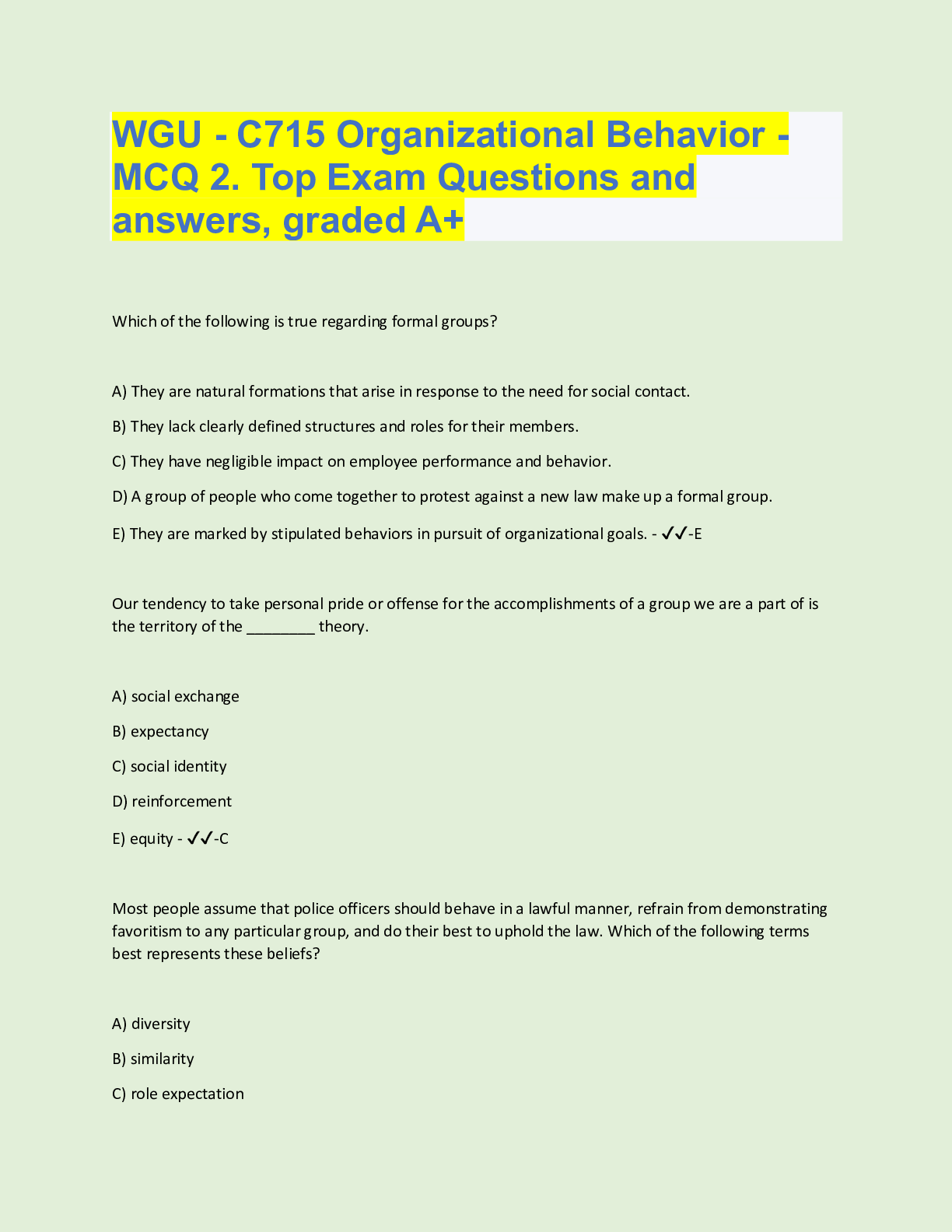
C715 WGU, Exam Questions and
answers, graded A+
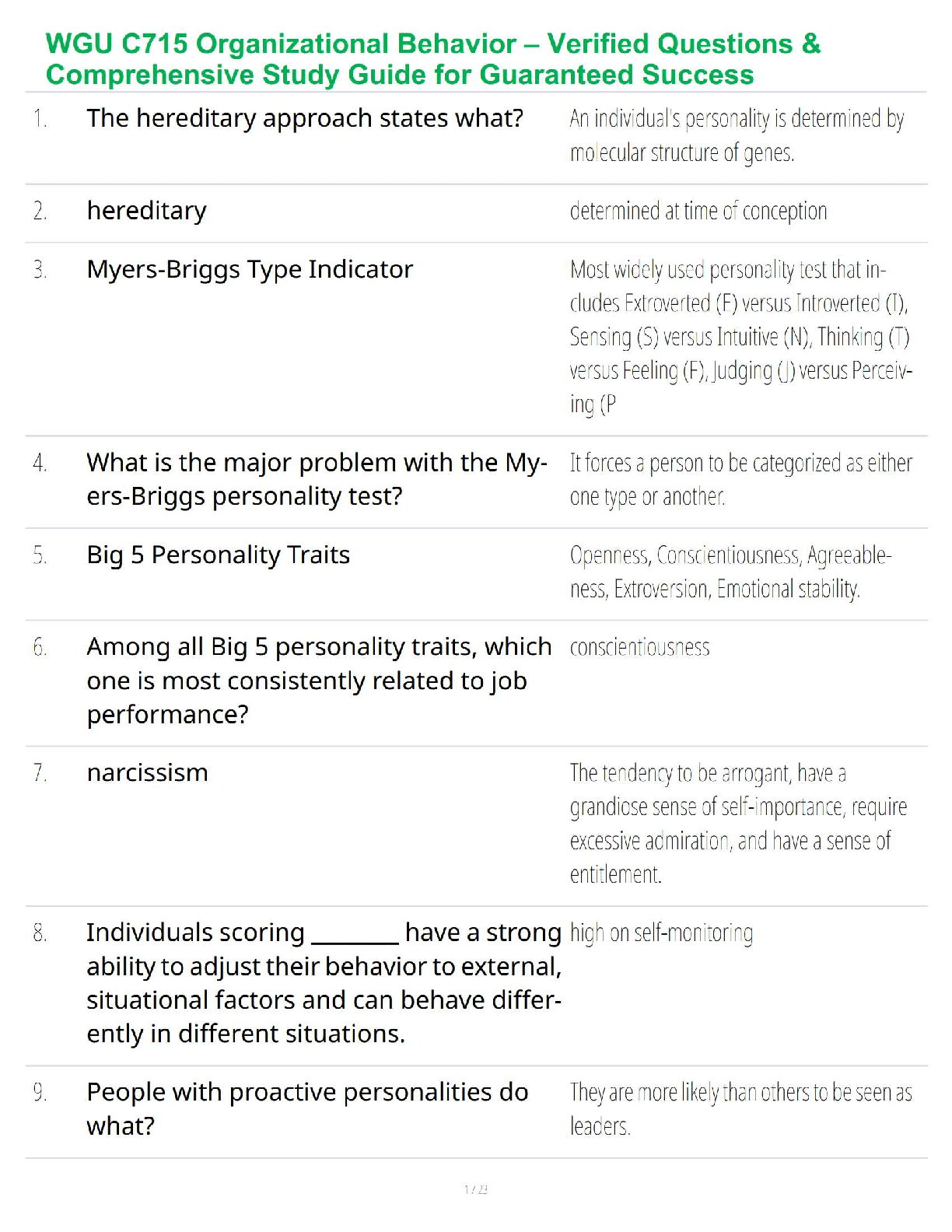
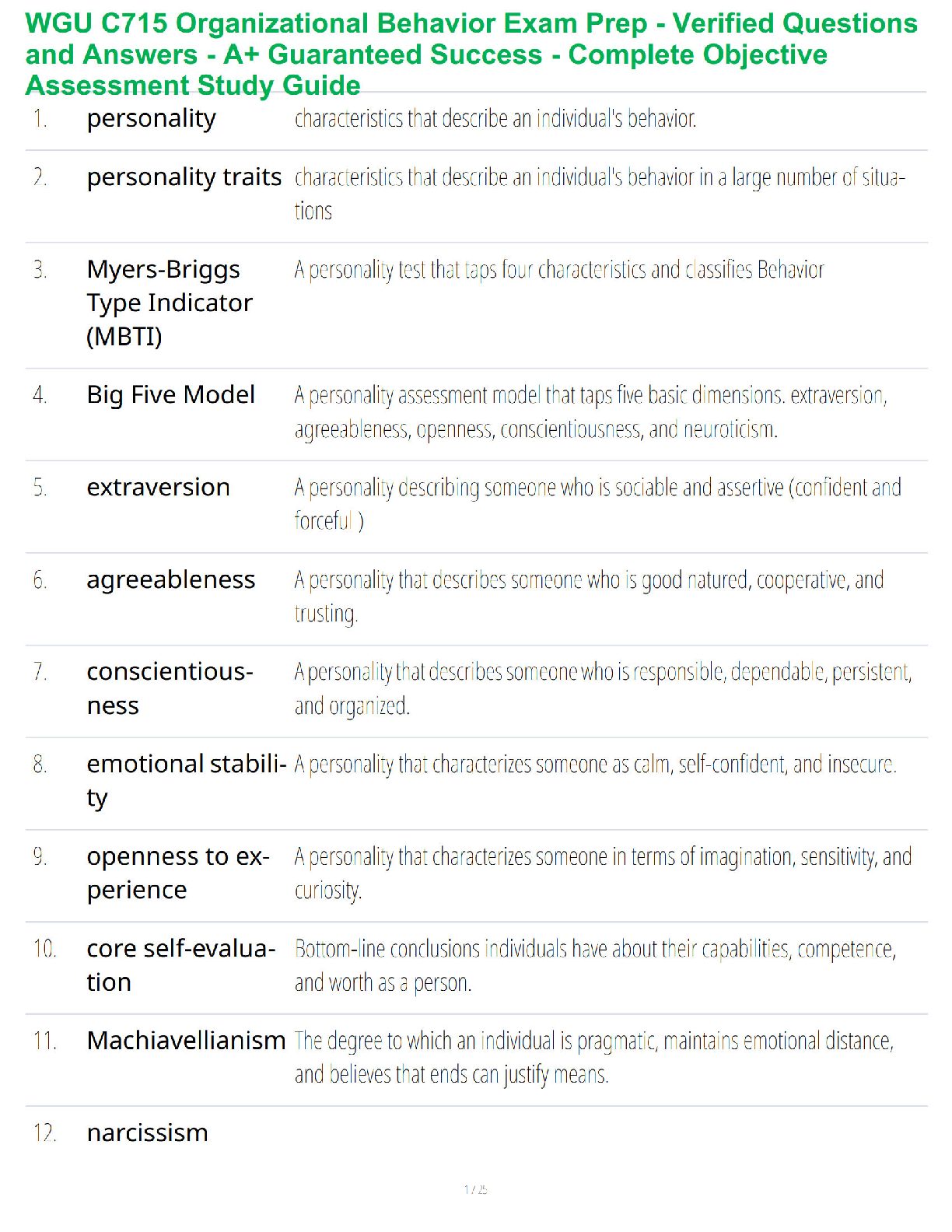
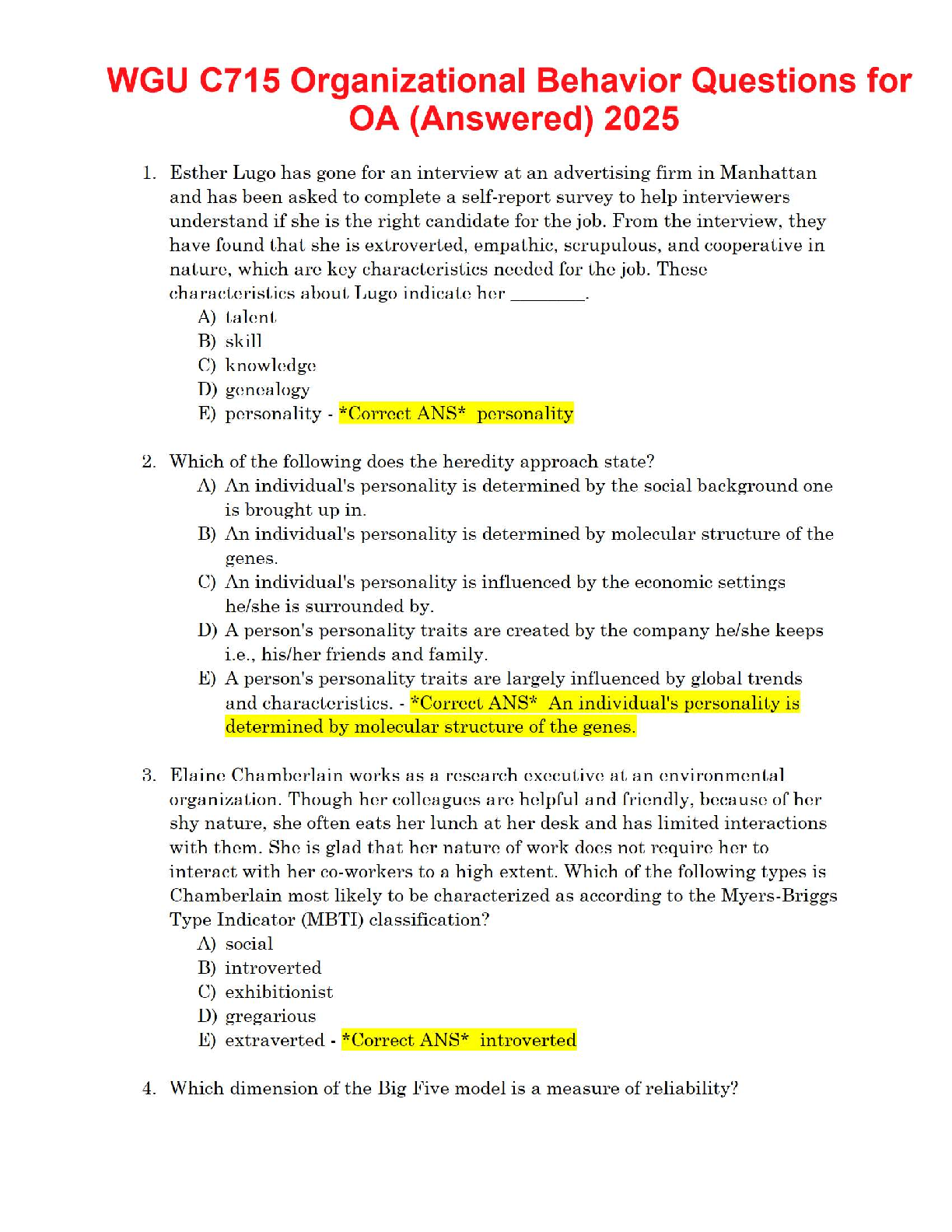
PERSONALITY - ✔✔-a complex set of characteristics that makes you unique
HEREDITY - ✔✔-factors determined at conception
MYERS-BRIGGS TYPE INDICATOR - ✔✔-the most widely
...
C715 WGU, Exam Questions and
answers, graded A+
PERSONALITY - ✔✔-a complex set of characteristics that makes you unique
HEREDITY - ✔✔-factors determined at conception
MYERS-BRIGGS TYPE INDICATOR - ✔✔-the most widely used personality assessment in the world.
includes scales on introversion/extroversion, sensing/intuition, thinking/feeling, and judging/perceiving
THE BIG FIVE PERSONALITY MODEL - ✔✔-personality typing instrument which includes extraversion,
agreeableness, conscientiousness, emotional stability, openness to experience
Machiavellianism - ✔✔-the degree to which an individual's pragmatic, maintains emotional distance,
and believes the end justifies the means
NARCISSM - ✔✔-the tendency to be arrogant, have a grandiose sense of self-importance, require
excessive admiration, and have a sense of entitlement
SELF-MONITORING - ✔✔-A personality trait that measures an individual's ability to adjust his or her
behavior to external, situational factors.
PROACTIVE PERSONALITY - ✔✔-people identify opportunities, show initiative, take action, and
persevere until meaningful change occurs.
VALUES - ✔✔-basic convictions that a specific mode of conduct or end-state of existence is personally or
socially preferable to an opposite or converse mode of conduct or end-state of existence
TERMINAL VALUES - ✔✔-desirable end-states of existence; the goals a person would like to achieve
during his or her lifetime
INSTRUMENTAL VALUES - ✔✔-preferable modes of behavior or means of achieving one's terminal
values
POWER DISTANCE - ✔✔-a national culture attribute that describes the extent to which a society accepts
that power in institutions and organizations is distributed unequally
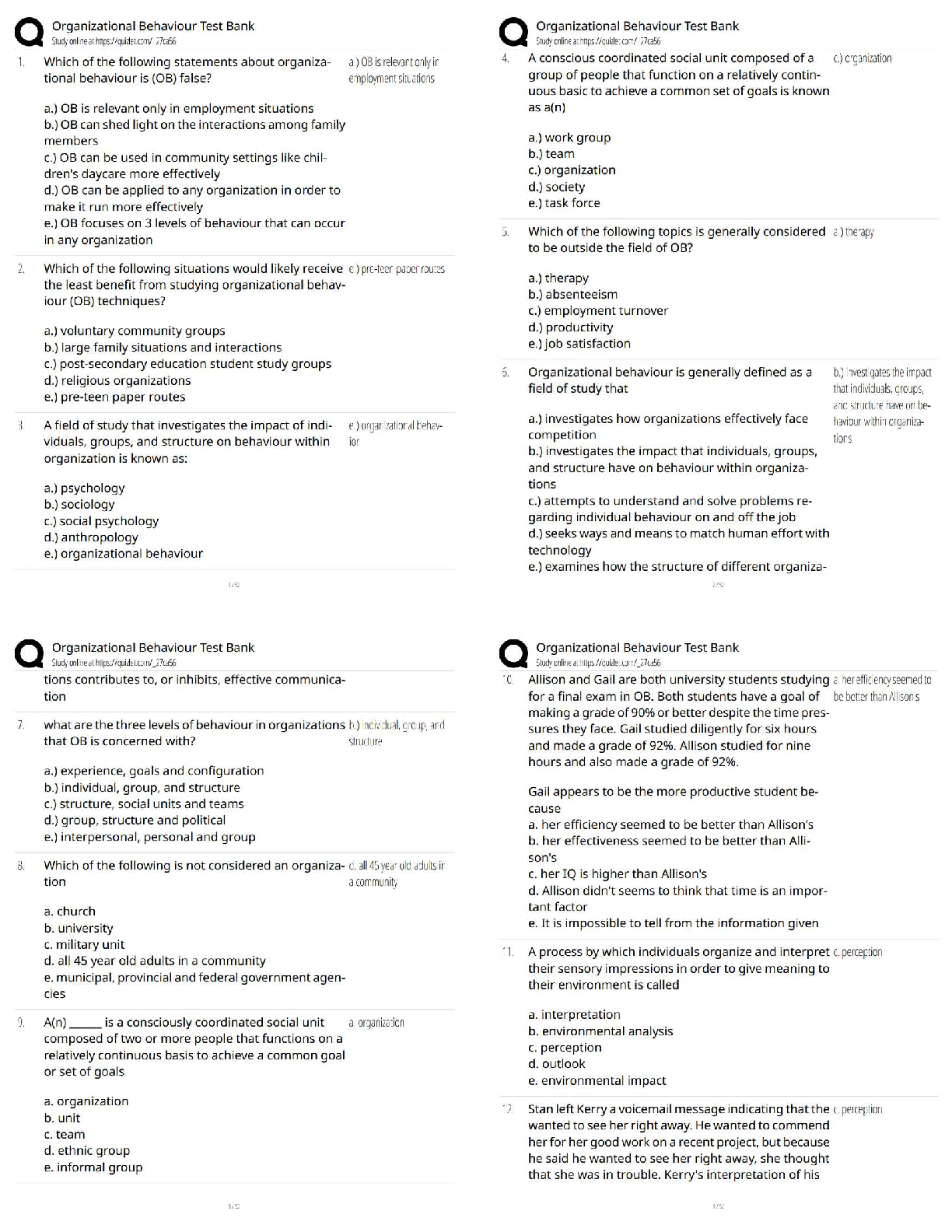
PERCEPTION - ✔✔-a process by which individuals organize and interpret their sensory impressions in
order to give meaning to their environment
ATTRIBUTION THEORY - ✔✔-an attempt to determine whether an individual's behavior is internally or
externally caused
FUNDAMENTAL ATTRIBUTION ERROR - ✔✔-the tendency to underestimate the influence of external
factors and overestimate the influence of internal factors when making judgments about the behavior of
others
SELF-SERVING BIAS - ✔✔-the tendency for individuals to attribute their own successes to internal factors
and put the blame for failures on external factors
SELECTIVE PERCEPTION - ✔✔-the tendency to selectively interpret what one sees on the basis of one's
interests, background, experience, and attitude
HALO EFFECT - ✔✔-the tendency to draw a general impression about an individual on the basis of a
single characteristic
CONTRAST EFFECT - ✔✔-evaluation of a person's characteristics that is affected by comparisons with
other people recently encountered who rank higher or lower on the same characteristics
STEREOTYPING - ✔✔-judging someone on the basis of one's perception of the group to which it belongs
SELF-FULFILLING PROPHECY - ✔✔-a situation in which a person inaccurately perceives a second person,
and the resulting expectations cause the second person to behave in ways consistent with the original
perception
RATIONAL DECISION-MAKING MODEL - ✔✔-a decision-making model that describes how individuals
should behave in order to maximize some outcomes
BOUNDED RATIONALITY - ✔✔-a process of making decisions by constructing simplified models that the
essential features from problems without capturing all their complexity
INTUITION DECISION-MAKING - ✔✔-an unconscious process distilled out of distilled experience
ANCHORING BIAS - ✔✔-a tendency to fixate on initial information from which one then fails to
adequately adjust for subsequent information
CONFIRMATION BIAS - ✔✔-the tendency to seek out information that reaffirms past choices and to
discount information that contradicts past judgments
RISK ADVERSION - ✔✔-the tendency to prefer a sure gain of a moderate amount over a riskier outcome
even if the riskier outcome might have a higher expected payoff
MOTIVATION - ✔✔-the processes that account for an individuals intensity, direction, and persistence of
effort toward maintaining a goal
HIERARCHY OF NEEDS - ✔✔-abram maslow's _________ (5) physiological, safety, social, esteem, and
self-actualization- in which as each need is substantially satisfied, the next becomes dominant
LOWER ORDER NEEDS - ✔✔-needs that are satisfied externally, such as physiological and safety needs
SELF-ACTUALIZATION - ✔✔-the drive to become what a person is capable of becoming
HIGHER-ORDER NEEDS - ✔✔-needs that are satisfied internally, such as social, esteem, and self�actualization
THEORY X - ✔✔-the assumption that employees dislike work, are lazy, dislike responsibility, and must be
coerced to perform
THEORY Y - ✔✔-the assumption that employees like work, are creative, seek responsibility, and can
exercise self-direction
HYGIENE FACTORS - ✔✔-factors, such as company policy, and administration, supervision, and salary�that when adequate in a job, placates workers. When these factors are adequate, people will not be
dissatisfied
MCCLELLANDS THEORY OF NEEDS - ✔✔-a theory that states achievement, power and affiliation are
three important needs that help explain motivation
COGNITIVE EVALUATION THEORY - ✔✔-a version of self determination theory which holds that
allocating extrinsic rewards for behavior that had been previously intrinsically rewarding tends to
decrease the overall level of motivation if the rewards are seen as controlling
SELF-CONCORDANCE - ✔✔-the degree to which peoples' reasons for pursuing goals are consistent with
their interests or core values
MANAGEMENT BY OBJECTIVES (MBO) - ✔✔-a program that encompasses specific goals, participatively
set, for an explicit time period, with feedback on goal progress
DISTRIBUTIVE JUSTICE - ✔✔-perceived fairness of the amount and allocation of rewards among
individuals
INTERACTIONAL JUSTICE - ✔✔-the perceived degree to which an individual is treated with dignity,
concern, and respect
GROUP - ✔✔-2 or more individuals interacting and interdependent, who have come together to achieve
particular objectives
FORMAL GROUP - ✔✔-a designated work group defined by an organization's structure
INFORMAL GROUP - ✔✔-a group that is neither formally structured nor organizationally determined:
such a group appears in response to the need for social contact
SOCIAL IDENTITY THEORY - ✔✔-perspective that considers when and why individuals consider
themselves members of groups
FIVE STAGE GROUP DEVELOPMENT MODEL - ✔✔-the 5 distinct stages groups go through are: forming,
storming, norming, performing, and adjourning
FORMING STAGE - ✔✔-first stage of group development characterized by a lot of uncertainty
STORMING STAGE - ✔✔-second stage of group development characterized by intragroup conflict
NORMING STAGE - ✔✔-third stage of group development characterized by close relationships and
cohesiveness
PERFORMING STAGE - ✔✔-fourth stage of group development during which the group is fully functional
ADJOURNING STAGE - ✔✔-the final stage of group development for temporary groups; characterized by
concern with wrapping up activities rather than task performance
PUNCTUATED EQUILIBRIUM MODEL - ✔✔-a set of phases that temporary groups go through that
involve transitions between inertia and activity
ROLE PERCEPTION - ✔✔-an individual's view of how he or she is supposed to act in a given situation
ROLE EXPECTATIONS - ✔✔-how others believe a person should act in a given situation
NORMS - ✔✔-acceptable standards of behavior within a group that are shared by the group's members
DEVIANT WORKPLACE BEHAVIOR - ✔✔-voluntary behavior that violates significant organizational norms
and, in so doing, threatens the well-being of the organization or its members.
Antisocial behavior or workplace incivility
SOCIAL LOAFING - ✔✔-the tendency for individuals to expend less effort when working collectively than
when working individually
CONFLICT - ✔✔-a process that begins when one party perceives that another party has negatively
affected, or is about to negatively affect, something that the first party cares about
INTERACTIONIST VIEW OF CONFLICT - ✔✔-the belief that conflict is not only a positive force in a group
but also an absolute necessity for a group to perform effectively
FUNCTIONAL CONFLICT - ✔✔-conflict that supports the goals of the group and improves performance
DYSFUNCTIONAL CONFLICT - ✔✔-conflict that hinders group performance
PROCESS CONFLICT - ✔✔-conflict over how the work gets done
COMPETING - ✔✔-a desire to satisfy one's interests, regardless of the impact on the other party to the
conflict
COLLABORATING - ✔✔-a situation in which the parties to a conflict each desire to satisfy fully the
concern of all parties
AVOIDING - ✔✔-the desire to withdraw from or suppress a conflict
ACCOMMODATING - ✔✔-the willingness of one party in a conflict to places the opponent's interest
above his or her own
COMPROMISING - ✔✔-a solution in which each party to a conflict is willing to give up something
NEGOTIATION - ✔✔-a process in which 2 or more parties exc
[Show More]



.png)