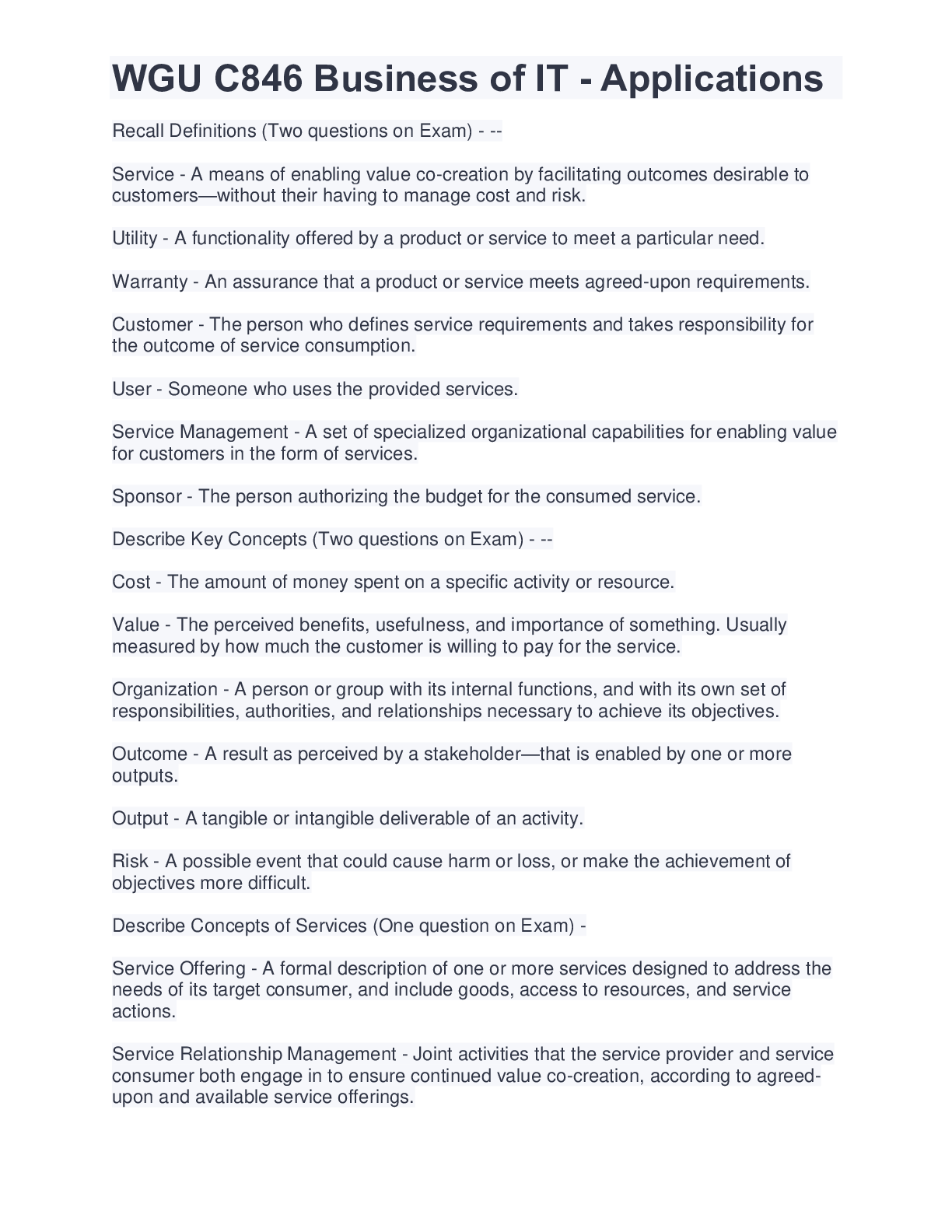
WGU C846, Top Exam Questions and
answers, graded A+
Architecture - ✔✔-The structure of a system or IT service, including the relationships of components to
each other.
Service acceptance criteria (SAC) - ✔✔-A set o
...
WGU C846, Top Exam Questions and
answers, graded A+
Architecture - ✔✔-The structure of a system or IT service, including the relationships of components to
each other.
Service acceptance criteria (SAC) - ✔✔-A set of criteria used to ensure that an IT service meets its
functionality and quality requirements.
Service design - ✔✔-A phase in the service lifecycle. Service design includes the design of the services,
including governing practices, processes, and policies required to realize the service provider's strategy.
Its objective is to facilitate the introduction of services into supported environments.
IT service provider - ✔✔-A service provider that provides IT services to internal or external customers.
Operational-level agreements (OLAs) - ✔✔-An agreement between an IT service provider and another
part of the same organization that assists in the provision of services.
Service improvement plan (SIP) - ✔✔-A formal plan to implement improvements to a processor IT
service.
Service-level agreement (SLA) - ✔✔-A written agreement between the IT service provider and customer.
A service-level agreement describes the IT service, documents service-level targets, and specifies the
responsibilities of the IT service provider and the customer.
Service-level requirements (SLR) - ✔✔-A customer requirement for an aspect of an IT service. Service�level requirements are based on business objectives and used to negotiate agreed service-level targets.
Underpinning contracts (UC) - ✔✔-A contract between an IT service provider and a third party. The third
party provides goods or services that support the delivery of an IT service to a customer.
Availability management - ✔✔-The process responsible for ensuring that IT services meet the current
and future availability needs of the business in a cost-effective and timely manner.
Business continuity management (BCM) - ✔✔-The business process is responsible for managing risks
that could seriously affect the business and ensuring that critical business functions can be made
available following a major disruption, within the timeframe the business requires. Business continuity
management defines what will be required from its IT service provider in terms of IT service continuity
management.
Business impact analysis (BIA) - ✔✔-Business impact analysis is the activity in business continuity
management that identifies vital business functions and their dependencies. It is used to identify what
the business impact will be if an IT service is unavailable.
Capacity management - ✔✔-The process responsible for ensuring that the capacity of IT services and the
IT infrastructure is able to meet agreed-on capacity and performance-related requirements in a cost�effective and timely manner. Capacity management includes three sub-processes: business capacity
management, service capacity management, and component capacity management.
Capacity plan - ✔✔-A plan drawn up to address the current and future capacity and performance
requirements of the business. It shows current and historic usage of services and components and the
expected increase or decrease for capacity for them over the next 12 to 18 months. It recommends
actions to ensure sufficient but not excessive capacity will be available to match these demands; these
actions could include purchase of new equipment and storage or reallocation of current devices. The
plan considers changes in the business, such as downsizing, changes in the demand for individual
services, and technical advances in components, and it puts forward plans to meet a number of possible
scenarios.
Information security management (ISM) - ✔✔-The process responsible for ensuring that the
confidentiality, integrity, and availability of an organization's assets, information, data, and IT services
match the agreed needs of the business.
IT service continuity management - ✔✔-The process responsible for managing risks that could seriously
affect IT services. IT service continuity management supports business continuity management.
Mean time between failures (MTBF) - ✔✔-A metric for measuring and reporting availability, or uptime.
MTBF is the average of the time between when the configuration item starts working until it next fails.
Mean time between service incidents (MTBSI) - ✔✔-A metric used for measuring and reporting
reliability. It is the mean time from when a system or IT service fails until it next fails.
Mean time to restore service (MTRS) - ✔✔-A metric used for measuring and reporting downtime. MTRS
is the average time taken to restore an IT service or other configuration item after a failure. MTRS is
measured from when the configuration item fails until it is fully restored and delivering its normal
functionality.
Service catalog - ✔✔-A database or structured document with information about all live IT services,
which may include services available for deployment.
Service catalog management - ✔✔-The process responsible for providing and maintaining the service
catalog and for ensuring that it is available to those who are authorized to access it.
Service knowledge management system (SKMS) - ✔✔-A set of tools and databases that are used to
manage knowledge, information, and data.
Supplier management - ✔✔-The process responsible for obtaining value for money from suppliers,
ensuring that all contracts and agreements with suppliers support the needs of the business, and
ensuring that all suppliers meet their contractual commitments.
Vital business function (VBF) - ✔✔-Part of a business process that is critical to the success of the
business.
RACI - ✔✔-A model which defines roles and responsibilities. RACI stands for Responsible, Accountable,
Consulted, and Informed.
Request for change (RFC) - ✔✔-A formal proposal for a change to be made. It includes details of the
proposed change and may be recorded on paper or electronically.
Change - ✔✔-The addition, modification, or removal of anything that could affect IT services.
Change advisory board (CAB) - ✔✔-A group of people who support the assessment, prioritization,
authorization, and scheduling of changes.
Change management - ✔✔-The process responsible for controlling the lifecycle of all changes.
Change proposal - ✔✔-A high-level description and business case of a potential service or significant
change. Once the change proposal has been authorized, the se
[Show More]




.png)
.png)
.png)
.png)
.png)