WGU C961 Laws, Full Coverage, graded
A+, latest update.
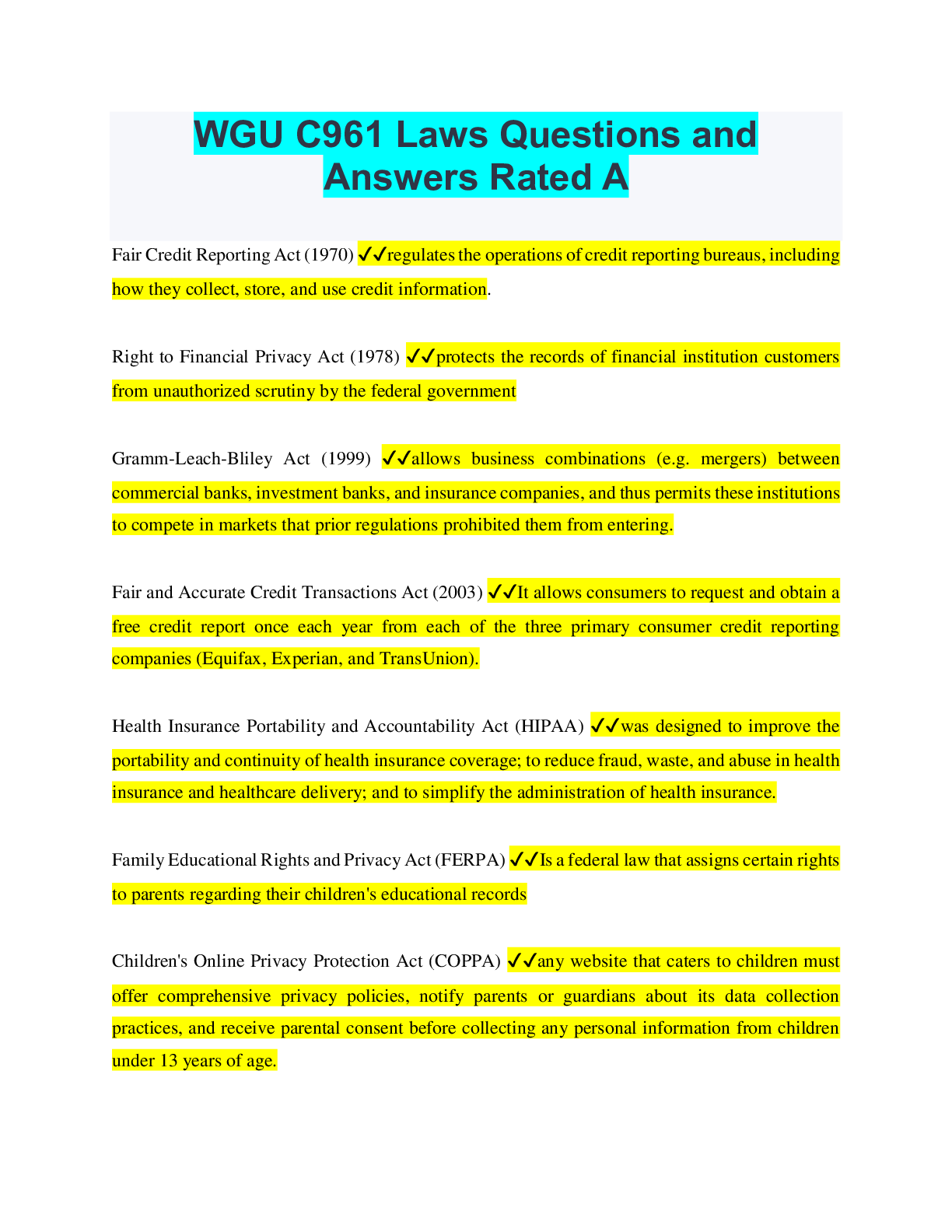
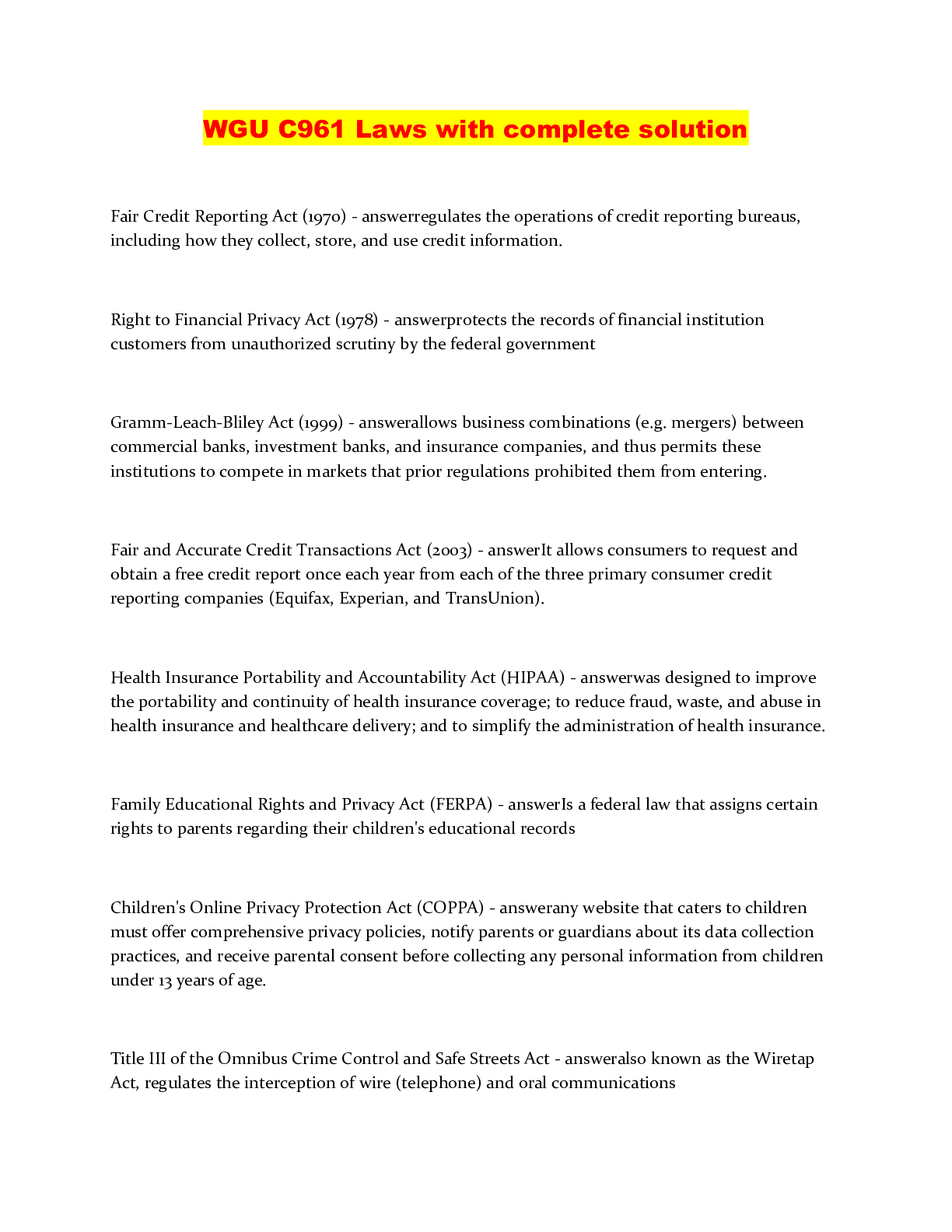
Fair Credit Reporting Act (1970) - ✔✔-regulates the operations of credit reporting bureaus, including
how they collect, store, and use credit information.
Rig
...
WGU C961 Laws, Full Coverage, graded
A+, latest update.
Fair Credit Reporting Act (1970) - ✔✔-regulates the operations of credit reporting bureaus, including
how they collect, store, and use credit information.
Right to Financial Privacy Act (1978) - ✔✔-protects the records of financial institution customers from
unauthorized scrutiny by the federal government
Gramm-Leach-Bliley Act (1999) - ✔✔-allows business combinations (e.g. mergers) between commercial
banks, investment banks, and insurance companies, and thus permits these institutions to compete in
markets that prior regulations prohibited them from entering.
Fair and Accurate Credit Transactions Act (2003) - ✔✔-It allows consumers to request and obtain a free
credit report once each year from each of the three primary consumer credit reporting companies
(Equifax, Experian, and TransUnion).
Health Insurance Portability and Accountability Act (HIPAA) - ✔✔-was designed to improve the
portability and continuity of health insurance coverage; to reduce fraud, waste, and abuse in health
insurance and healthcare delivery; and to simplify the administration of health insurance.
Family Educational Rights and Privacy Act (FERPA) - ✔✔-Is a federal law that assigns certain rights to
parents regarding their children's educational records
Children's Online Privacy Protection Act (COPPA) - ✔✔-any website that caters to children must offer
comprehensive privacy policies, notify parents or guardians about its data collection practices, and
receive parental consent before collecting any personal information from children under 13 years of
age.
Title III of the Omnibus Crime Control and Safe Streets Act - ✔✔-also known as the Wiretap Act,
regulates the interception of wire (telephone) and oral communications
Foreign Intelligence Surveillance Act (FISA) - ✔✔-describes procedures for the electronic surveillance
and collection of foreign intelligence information in communications between foreign powers and the
agents of foreign powers.
Executive Order 12333 - ✔✔-Identifies various government intelligence-gathering agencies and defines
what information can be collected, retained, and disseminated by the agencies. It allows for the
tangential collection of U.S. citizen data—even when those citizens are not specifically targeted.
Electronic Communications Privacy Act (ECPA) - ✔✔-Deals with three main issues: the protection of
communications while in transfer from sender to receiver; the protection of communications held in
electronic storage; and the prohibition of devices from recording dialing, routing, addressing, and
signaling information without a search warrant.
Communications Assistance for Law Enforcement Act (CALEA) - ✔✔-it requires the telecommunications
industry to build tools into its products that federal investigators could use—after obtaining a court
order—to eavesdrop on conversations and intercept electronic communications.
USA PATRIOT Act - ✔✔-It gave sweeping new powers to both domestic law enforcement and U.S.
international intelligence agencies, including increasing the ability of law enforcement agencies to
search telephone, email, medical, financial, and other records. It also eased restrictions on foreign
intelligence gathering in the United States.
USA Freedom Act - ✔✔-terminated the bulk collection of telephone metadata by the NSA. Instead,
telecommunications providers are now required to hold the data and respond to NSA queries on the
data. The act also restored authorization for roving wiretaps, which allows surveillance of individuals
even if they frequently change communications devices, and the tracking of lone wolf terrorists
Privacy Act - ✔✔-establishes a code of fair information practices that sets rules for the collection,
maintenance, use, and dissemination of personal data that is kept in systems of records by federal
agencies. It also prohibits U.S. government agencies from concealing the existence of any personal data
record-keeping system
HITECH (Health Information Technology for Economic and Clinical Health ACT - ✔✔-this act included
strong privacy provisions for electronic health records (EHRs), including banning the sale of health
information, promoting the use of audit trails and encryption, and providing rights of access for patients.
It also mandated that each individual whose health information has been exposed be notified within 60
days after the discovery of a data breach.
FISA of 2004 - ✔✔-authorized intelligence gathering on individuals not affiliated with any known
terrorist organization (so-called "lone wolves").
FISA Amendments Act of 2008 - ✔✔-granted the NSA expanded authority to collect, without court�approved warrants, international communications as they flow through the U.S. telecommunications
equipment and facilities.
PATRIOT Sunsets Extension Act - ✔✔-granted a four-year extension of provisions of the USA PATRIOT
Act that allowed roving wiretaps and searches of business records. It also extended authorization for
intelligence gathering on "lone wolves."
Computer Fraud and Abuse Act (U.S. Code Title 18, Section 1030) - ✔✔-Addresses fraud and related
activities in association with computers, including the following:
1 - Accessing a computer without authorization or exceeding authorized access.
2 - Transmitting a program, code, or command that causes harm to a computer
3 - Trafficking of computer passwords
4 - Threatening to cause damage to a protected computer
Fraud and Related Activity in Connection with Access Devices Statute (U.S. Code Title 18, Section 1029) -
✔✔-Covers false claims regarding the unauthorized use of credit cards
Stored Wire and Electronic Communications and Transactional Records Access Statutes (U.S. Code Title
18, Chapter 121) - ✔✔-Focuses on unlawful access to stored communications to obtain, alter, or prevent
authorized access to a wire or electronic communication while it is in electronic storage
Prioritizing Resources and Organization for Intellectual Property (PRO-IP) Act of 2008 - ✔✔-Created the
position of Intellectual Property Enforcement Coordinator within the Executive Office of the President. It
also increased trademark and copyright enforcement and substantially increased penalties for
infringement. One of its programs, called Computer Hacking and Intellectual Property (CHIP), is a
network of over 150 experienced and specially trained federal prosecutors who focus on computer and
intellectual property crimes. This is a part of GATT and is a multilateral agreement governing
international trade.
General Agreement on Tariffs and Trade (GATT ) - ✔✔-Was a multilateral agreement governing
international trade. It created the WTO and TRIPS
WTO (World Trade Organization) - ✔✔-Deals with the rules of international trade based on
agreements that are negotiated and signed by representatives of the world's trading countries. 16
members as of 2016. HQ in Geneva.
Trade-Related Aspects of Intellectual Property Righ
[Show More]