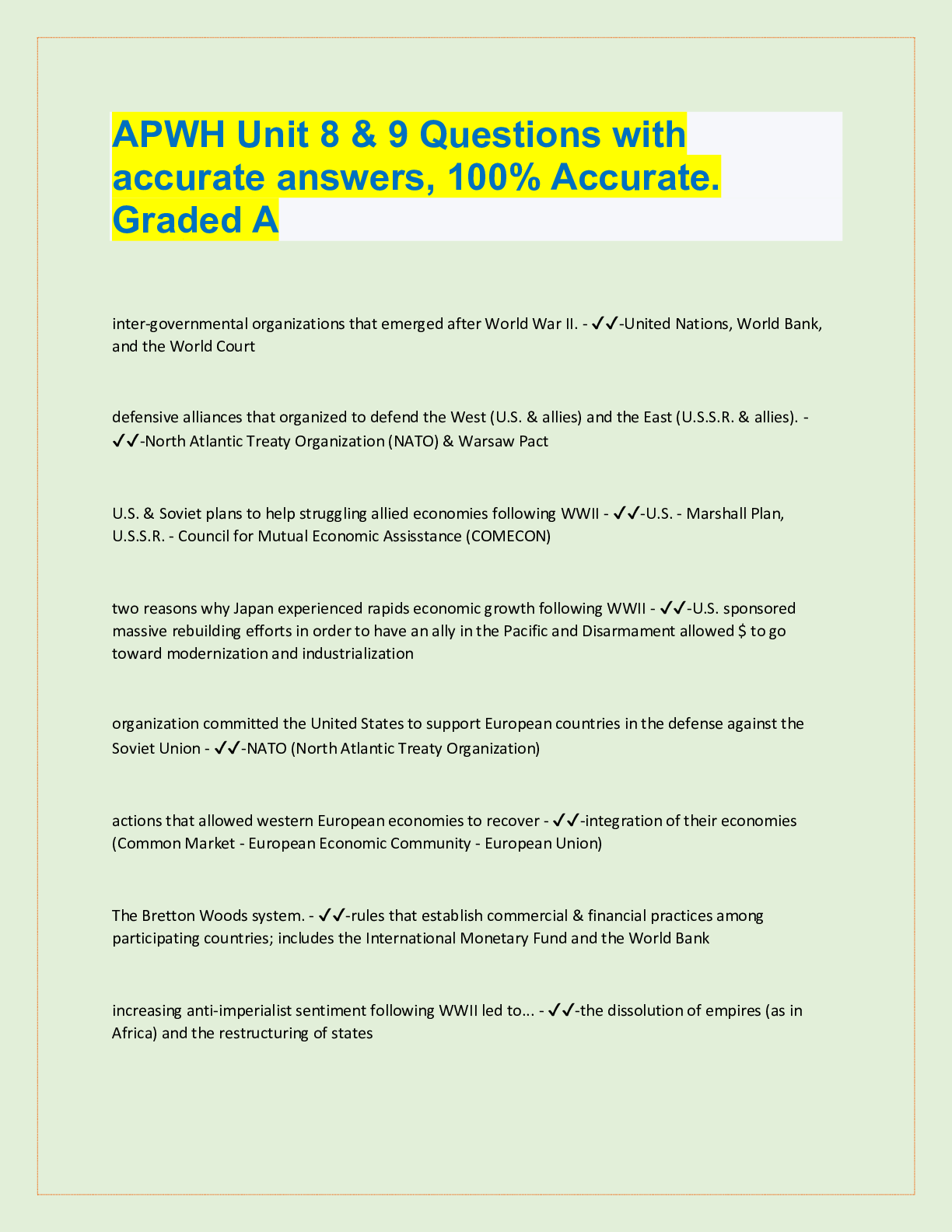
APWH Unit 8 & 9 Questions with
accurate answers, 100% Accurate.
Graded A
inter-governmental organizations that emerged after World War II. - ✔✔-United Nations, World Bank,
and the World Court
defensive alliances
...
APWH Unit 8 & 9 Questions with
accurate answers, 100% Accurate.
Graded A
inter-governmental organizations that emerged after World War II. - ✔✔-United Nations, World Bank,
and the World Court
defensive alliances that organized to defend the West (U.S. & allies) and the East (U.S.S.R. & allies). -
✔✔-North Atlantic Treaty Organization (NATO) & Warsaw Pact
U.S. & Soviet plans to help struggling allied economies following WWII - ✔✔-U.S. - Marshall Plan,
U.S.S.R. - Council for Mutual Economic Assisstance (COMECON)
two reasons why Japan experienced rapids economic growth following WWII - ✔✔-U.S. sponsored
massive rebuilding efforts in order to have an ally in the Pacific and Disarmament allowed $ to go
toward modernization and industrialization
organization committed the United States to support European countries in the defense against the
Soviet Union - ✔✔-NATO (North Atlantic Treaty Organization)
actions that allowed western European economies to recover - ✔✔-integration of their economies
(Common Market - European Economic Community - European Union)
The Bretton Woods system. - ✔✔-rules that establish commercial & financial practices among
participating countries; includes the International Monetary Fund and the World Bank
increasing anti-imperialist sentiment following WWII led to... - ✔✔-the dissolution of empires (as in
Africa) and the restructuring of states
led to a shift in the global balance of power following WWII - ✔✔-technological (weapons, internet, etc.)
and economic gains
evidence of ideological conflict between capitalism and communism outside of the U.S. and Soviet
Union - ✔✔-Suez Conflict, Angolian Civil War, Sandinista-Contra conflict in Nicaragua
examples of nations that chose to become non-aligned (siding with neither the U.S. or U.S.S.R) - ✔✔-
Indonesia, Ghana, India
beyond seeking and maintaining alliances and victory in proxy wars, another result of competition
between the U.S. & U.S.S.R. - ✔✔-nuclear proliferation
an initial policy to the national economy in China - ✔✔-the Great Leap Forward
policies in Africa, Latin America, and Asia that sometimes advocated communism or socialism - ✔✔-land
redistribution
nationalist parties/leaders that sought autonomy from imperial rule - ✔✔-Indian National Congress, Ho
Chi Minh (Vietnam), Kwame Nkrumah (Ghana), Gamal Abdel Nasser (Egypt)
former colonies that negotiated their independence - ✔✔-India, the Gold Coast (W Africa), French West
Africa
former colonies that earned independence through armed struggle - ✔✔-Algeria, Angola, Vietnam
regional, religious, and ethnic movements that challenged colonial rule or "inherited" ways - ✔✔-
Muslims in India, Québécois in Canada, Biafra in Nigeria
news states created with new political boundaries - ✔✔-Israel, Cambodia, Pakistan
places where the redrawing of political boundaries led to conflict - ✔✔-Israel, Cambodia, Pakistan
evidence of strong post-colonial ties between former colonies and "mother countries" - ✔✔-South
Asians to Britain, Algerians to France, Filipinos to the U.S.
leaders who promoted non-violence as a way to achieve political goals - ✔✔-Mohandas Gandhi, Martin
Luther King, Jr., Nelson Mandela
movements that utilized violence to achieve their political goals - ✔✔-Shining Path, Al-Qaeda
places of intensified conflict in the 20th Century - ✔✔-Chile (Augusto Pinochet), Spain (Francisco
Franco), Uganda (Idi Amin)
reasons contributing to the end of the Cold War & collapse of the U.S.S.R. - ✔✔-costly was in
Afghanistan, public discontent, economic weakness
new modes of communication in the 20th century - ✔✔-radio, cellular, internet
new modes of transportation for people and goods - ✔✔-air travel, shipping containers
20th century energy technologies that increased production of material goods - ✔✔-petroleum and
nuclear power
helped to sustain the earth's growing population but also led to chemical and genetically modified foods
- ✔✔-Green Revolution and commercial agriculture
20th century medical innovations contributing to longer life expectancy - ✔✔-vaccines, antibiotics
20th century diseases (often associated with poverty) that affected populations around the world - ✔✔-
Malaria, Tuberculosis, Cholera
epidemic diseases - ✔✔-1918 influenza pandemic, Ebola, HIV/AIDS
diseases that were
[Show More]