MTTC #3 ESL Test Question with
accurate answers, 100% Accurate,
graded A+
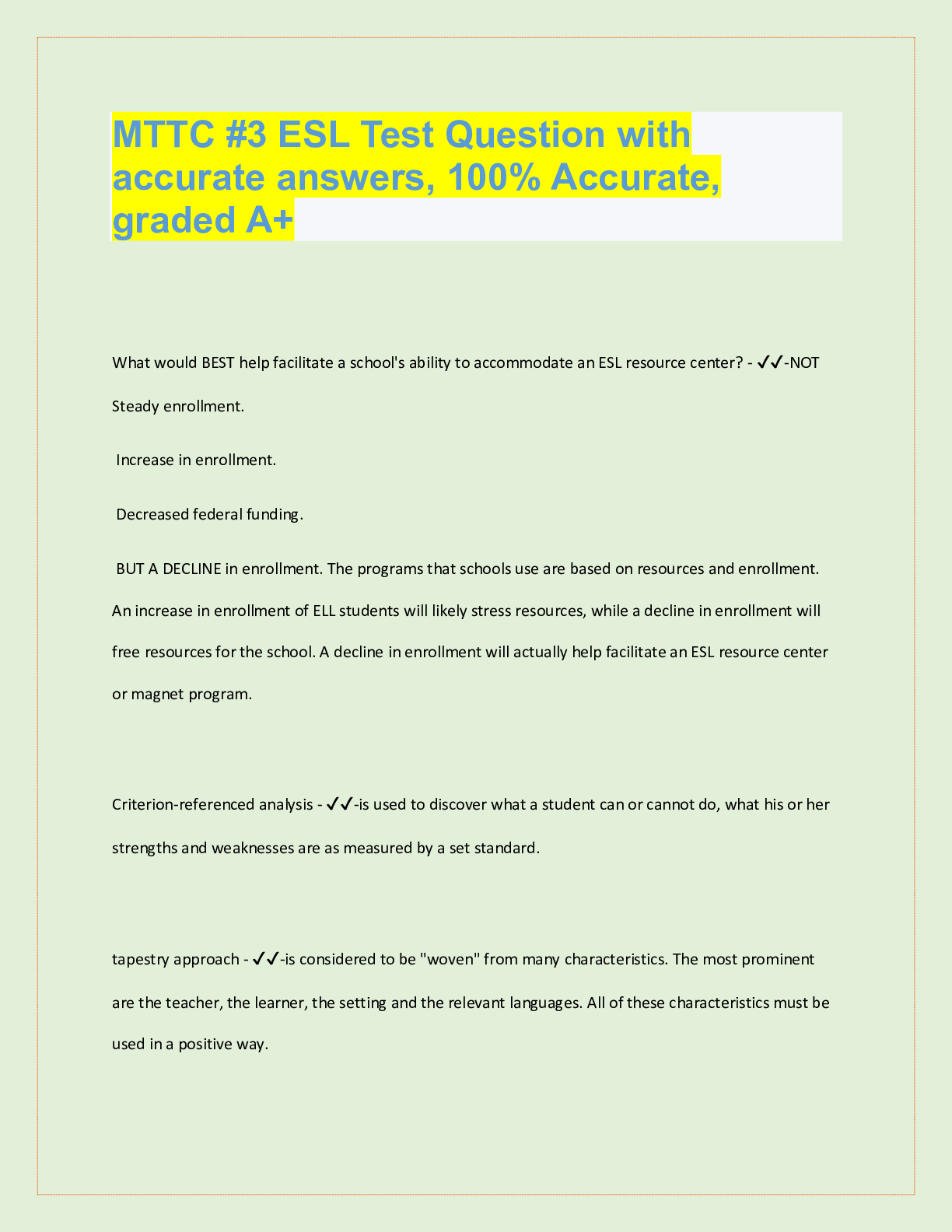
What would BEST help facilitate a school's ability to accommodate an ESL resource center? - ✔✔-NOT
Steady enrollment.
Increase in enrollme
...
MTTC #3 ESL Test Question with
accurate answers, 100% Accurate,
graded A+
What would BEST help facilitate a school's ability to accommodate an ESL resource center? - ✔✔-NOT
Steady enrollment.
Increase in enrollment.
Decreased federal funding.
BUT A DECLINE in enrollment. The programs that schools use are based on resources and enrollment.
An increase in enrollment of ELL students will likely stress resources, while a decline in enrollment will
free resources for the school. A decline in enrollment will actually help facilitate an ESL resource center
or magnet program.
Criterion-referenced analysis - ✔✔-is used to discover what a student can or cannot do, what his or her
strengths and weaknesses are as measured by a set standard.
tapestry approach - ✔✔-is considered to be "woven" from many characteristics. The most prominent
are the teacher, the learner, the setting and the relevant languages. All of these characteristics must be
used in a positive way.
ESSA - ✔✔-Every Student Succeeds Act
Replaced NCLB.
Which of the following points is part of ESSA? - ✔✔-NOT Schools may not exclude any student based on
language(s) of origin
Schools must provide resources for personnel, instructional materials, and space for teaching English
language learners
Schools may not exempt English language learners from any state or federal assessments
BUT Schools must report on the number of ELLs meeting academic standards (even for 4 years after
exiting any English language support programs). ESSA requires schools to report in great detail on the
progress of ELL students as well as assess ELLs within 30 days of enrollment. These requirements were
designed to keep schools accountable to ELL learners and their families.
A new high-school principal has announced some major changes to the ways in which ELL students are
assessed. She wants multiple raters to interpret the students' results, clear scoring criteria, and multiple
assessment measures for every English language learner. The best argument for making these changes is
to ensure - ✔✔-NOT Teacher accountability
Consistency among teachers in different subjects
A high quality ranking for the school by improving test scores
BUT The reliability of tests to classify students. Though it is necessary for ALL of these factors to be in
place to ensure reliable tests, these are all important ways that the ESOL teacher can help ensure that
ELL students are properly assessed for placement in special services.
Many of Ms. Castano's Hispanic third-grade students speak English very well now, but their parents are
concerned that they are losing their fluency in Spanish. Ms. Castano is always looking for ways to
encourage the use of their primary language. Which of the following activities would NOT support this
endeavor? - ✔✔-NOT Ms. Castano brings in a book "My Mexico" filled with a collection of poetry in both
English and Spanish
Ms. Castano plans a field trip to a nearby park to see an adobe wall
Ms. Castano invites a local chef to come in and demonstrate how to make tortillas
BUT Ms Castano creates a 'writers workshop' for the students to attend after school.
Ms. Castano can have the students weave paper placemats and makes a list of new vocabulary words
that will be learned that week with many new Spanish and English words on the list. Her native English
speakers will be learning a lot from the book of poetry as well as seeing and learning about the adobe
wall. Ms. Castano can pick up two ears of corn to take to school so the children will understand how the
tortilla flour is made.
Which of the following is the best term for the study of how people typically convey meanings in
context? - ✔✔-NOT phonics
morphology
metalinguistics
BUTpragmatics
Pragmatics is the analysis of language in terms of the situational context within which utterances are
made, including the knowledge and beliefs of the speaker and the relation between speaker and
listener. It is the study of how people typically convey meanings in context.
In a lower level math class, what particular area must the content teacher be aware of when teaching an
ELL student? - ✔✔-NOT Self-efficacy
Transfer
Note-taking
BUT Prior knowledge
Although a math teacher needs to be aware of the issues surrounding having an ELL student in the
room, one of the biggest in a low level math class, is prior knowledge. Say for instance, the teacher is
using money to help students learn addition nd subtraction etc,. With an ELL student the same things
that money would be spent on may be different than that of an English speaking student.
The ESL teacher has completed the first lesson plan on the typological approach of classification of world
languages. The teacher is quizzing the students to ensure they know what is considered a classification.
All of the following are correct answers, except: - ✔✔-NOT Agglutinative is a classification under the
typological approach.
Polysynthetic is a classification.
Synthetic is a classification under this language approach.
BUT Dualism is a classification under the typological approach.
There are many different approaches in language. The typological approach is used to group languages
based on the similarities and differences based on linguistic structure. Under the typological approach,
languages can be grouped based on the characteristic patterns according to word order. English is an
SVO language, meaning the subject comes first, followed by the verb, followed by the object.
Typological classification classifies world languages into 4 groups. They are analytic, synthetic,
agglutinative, and polysynthetic.
CLIL - ✔✔-Content and Language Integrated Learning
Content and Language Integrated Learning (CLIL) - ✔✔-Using the medium of English to teach a subject
such as geography, natural science or history, to learners whose first language is not English. This type of
instruction is often used in countries that maintain one language while teaching a second language. The
objective is to learn subject matter in the L2 language even if mastery of the L2 language has not yet
been achieved.
The Natural Approach (ESOL) - ✔✔-students acquire a new vocabulary through experiences and
associations with words because the words are used in meaningful ways and contexts. focuses on the
idea that students are capable of receiving and determining speech patterns. The enjoyment of the
learning process is given precedent over correct grammatical use.
Whole Language Approach - ✔✔-Teaching reading by encouraging early use of all language skills-talking
and listening, reading and writing. it looks at learning to read from a real life perspective. In other words,
reading must mean something to a student, and should be reiterated and practiced in real life
communication situations.
Isoglosses - ✔✔-Geographical boundary lines where different linguistic features meet. describe a
geographical area that exhibits the same dialectal features. In simple words ,it simply means a
geographical location where the same dialect is common. New York City dialect, is an example
Critical Pedagogy - ✔✔-Critical Pedagogy is a teaching approach that promotes student learning by
questioning and looking at the real world. Their real world consists of their families, communities,
friends, etc,. The teacher talks with a student about these issues and they both pose a problem that
could arise instead of problem solving.
pragmatics of language - ✔✔-"practical" rules of using language
the meaning of words and grammar used semantically, except within context (inferred meanings);
taking turns speaking
-->idioms "he could eat a horse"=hungry
Pragmatics - ✔✔-has to do with the analysis of language. __________ involves 3 major communication
skills. They are using language for different reasons, following rules for having conversations, and
changing language based on the needs of the listener. ____________problems include: having little
variety with language use, telling stories in an unorganized way, and saying unrelated things in
conversations.
collaborative evaluation - ✔✔-The assessment or evaluation of a curriculum that is jointly done by
classroom teachers, researchers or other trained educational experts is called a collaborative evaluation.
This type of approach provides teachers with the necessary tools for sound educational decision-making.
Bellack and other language researchers found that much classroom talk followed a pattern of structure,
solicit, respond and react and that only the third move (respond) was typically carried out by pupils.
Following the lead of Bellack, what is the name of another system for observation and interaction
analysis? - ✔✔-NOT
FLint
triangulation
language pedagogy BUT
FOCUS (foci for observing communication used in settings) is another system for observation and
interaction analysis. In addition to Bellack's four basic pedagogical moves, the FOCUS observation
schedule includes categories for who is communicating, the mediums used, how content areas are
communicated and what areas of content are being communicated.
Phonics - ✔✔-is the teaching of sensitivity to the sound constituents of words
How do teachers' expectations of their students affect student achievement? Choose which of the
following is not affected. - ✔✔-NOT
Self-efficacy
Self esteem
Learning
BUT Home Life
Although a teacher's expectations for a student may help a child in his home life, the major effect is on
their academic ability. A teacher's expectations can affect a student negatively and positively. If a
teacher has a high expectation of students and gives them the tools to accomplish them, then the
students' self-efficacy and self esteem will rise. Along with this students learn more efficiently, quicker
and better.
transformational grammar - ✔✔-A linguistic theory that focuses on how changes in word order affect
meaning. the idea that sentences have a surface structure and an underlying structure. The rules that
interpret the underlying structures and modify them to create the same surface structure are called
transformations.
Bloom's Taxonomy - ✔✔-A system for categorizing levels of abstraction of questions that commonly
occur in educational settings. Includes the following competencies: knowledge, comprehension,
application, analysis, synthesis, and evaluation.
Picture dictation - ✔✔-A classroom activity in which the teacher describes a scene or an object and
learners draw what they hear. The activity can also
be for learners to describe a scene or an object and other learners draw what they hear, perhaps in
pairs; e.g. learner A describes and learner B draws. students pair off and one has a picture and describes
it to the other. The listening student draws what the other is describing. Once this is completed the
students compare how closely similar th
[Show More]