CASAC pool Questions with accurate
answers. 100% Proven pass rate.
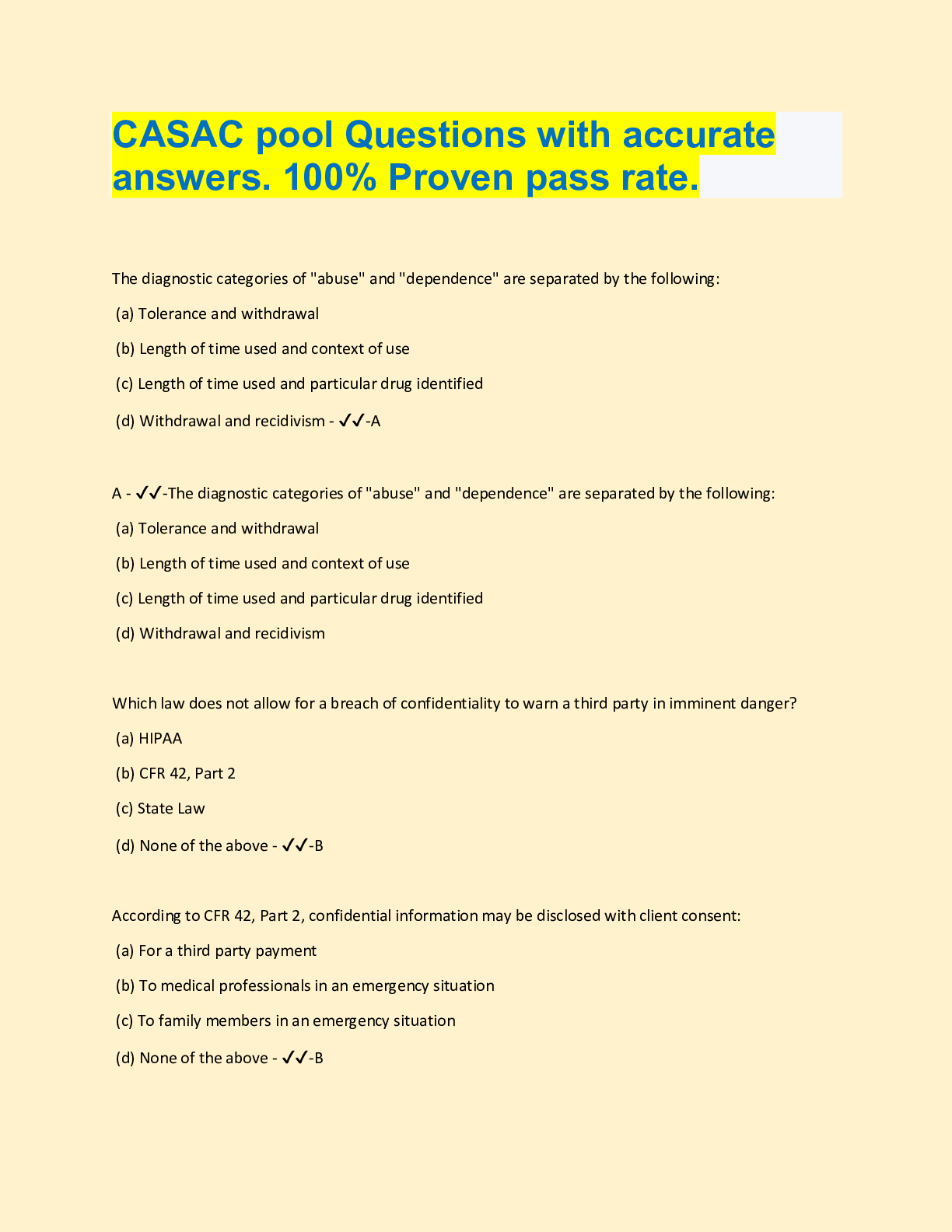
The diagnostic categories of "abuse" and "dependence" are separated by the following:
(a) Tolerance and withdrawal
(b) Length of time used and cont
...
CASAC pool Questions with accurate
answers. 100% Proven pass rate.
The diagnostic categories of "abuse" and "dependence" are separated by the following:
(a) Tolerance and withdrawal
(b) Length of time used and context of use
(c) Length of time used and particular drug identified
(d) Withdrawal and recidivism - ✔✔-A
A - ✔✔-The diagnostic categories of "abuse" and "dependence" are separated by the following:
(a) Tolerance and withdrawal
(b) Length of time used and context of use
(c) Length of time used and particular drug identified
(d) Withdrawal and recidivism
Which law does not allow for a breach of confidentiality to warn a third party in imminent danger?
(a) HIPAA
(b) CFR 42, Part 2
(c) State Law
(d) None of the above - ✔✔-B
According to CFR 42, Part 2, confidential information may be disclosed with client consent:
(a) For a third party payment
(b) To medical professionals in an emergency situation
(c) To family members in an emergency situation
(d) None of the above - ✔✔-B
According to CFR 42, Part 2, disclosure of confidential information requires written consent with several
elements; which of the following is not one of the required elements?
(a) The name of the person or program permitted to make the disclosure
(b) The name of the person or program receiving the disclosed information
(c) The purpose of the disclosure
(d) A statement indicating that the client may revoke consent at any time but only if he or she states
that in writing - ✔✔-D
According to HIPAA, client consent is not required for disclosure of confidential information for all the
following except:
(a) To the client's employer
(b) For the opportunity to agree or object
(c) For treatment, payment, and health care operations
(d) For public interest and benefit activities - ✔✔-A
Which of the following regulations restricts parental access of their children's confidential information
without the minor's consent?
(a) FERPA
(b) IDEA
(c) CFR 42, Part 2
(d) PPRA - ✔✔-C
Problems may arise if a substance abuse counselor and former client attend the same AA meeting for all
the following reasons except:
(a) The former client will benefit more than the substance abuse counselor
(b) It risks the substance abuse counselor anonymity
(c) It risks the former client's confidentiality
(d) The substance abuse counselor may need censor what they share in the meeting - ✔✔-A
Which of the following is not a characteristic of an ethical dilemma?
(a) A choice between two courses of action must be made
(b) There are significant consequences for not selecting either of the options
(c) Each decision is supported by ethical principles
(d) One of the decisions is supported by state regulations - ✔✔-D
The __________ houses the mechanisms that most often interact with substances that cross the blood�brain barrier.
(a) Cortex
(b) Forebrain
(c) Midbrain
(d) Right Hemisphere - ✔✔-B
The limbic system is involved in _______________.
(a) Basic, autonomic functions such as hormonal activity, thirst, hunger, temperature, sex drive and
sleep
(b) Relaying information from the upper brain-stem
(c) Emotional behavior and long-term memory
(d) Thought, perception, motor function, sensory data processing and vision - ✔✔-C
The cortex is significant as related to drug use since it controls
(a) Basic, autonomic functions such as hormonal activity, thirst, hunger, temperature, sex drive and
sleep
(b) Thought, perception, motor function, sensory data processing and vision
(c) Emotional behavior and long-term memory
(d) Taste and craving - ✔✔-B
With the exception of neurons in the hippocampus, after being damaged neurons will:
(a) Regenerate, but slower than other cells
(b) Not regenerate
(c) Grow new axons
(d) Shrink in size - ✔✔-B
Marijuana affects the parts of the brain that
(a) Controls coordination
(b) Relates to memory and learning
(c) Relates to thinking and problem-solving
(d) All of the above - ✔✔-D
Use of cocaine
(a) Has been shown to increase activity and involvement with family
(b) Has been shown to reduce the brains ability to feel pleasure
(c) Is addictive as crack, but not in powder form
(d) None of the above - ✔✔-D
_______________ are considered effective in the short-term treatment of anxiety, regardless of the
cause.
(a) Barbituates
(b) Benzodiazapines
(c) Opiates
(d) Stimulants - ✔✔-B
Chronic cocaine users exhibit _______________.
(a) loss of movement
(b) loss of inhibitions
(c) loss of intelligence
(d) loss of sensory feeling - ✔✔-A
_______________ of the central nervous system include ethanol, barbituates, methaqualone,
meprobamate, and all benzodiazepines.
(a) Depressants
(b) Hallucinogens
(c) Stimulants
(d) Steroids - ✔✔-A
A standard drink is measured as _______________.
(a) a 4- or 5-ounce can or bottle of beer, a 4- or 5-ounce glass of wine, or a single shot (about 4.25
ounces).
(b) a 12 ounce can or bottle of beer, a 4- or 5-ounce glass of wine, or a single shot (about 1.25 ounces).
(c) a 12 ounce can or bottle of beer, a 12 ounce glass of wine, or a single shot (about 12 ounces).
(d) variable from restaurant to restaurant or bar to bar. - ✔✔-B
This 3-pound organ is the central filter for the blood and is the site of 90% of alcohol metabolism.
(a) Brain
(b) Kidney
(c) Liver
(d) Bladder - ✔✔-C
The most serious form of withdrawal is _______________.
(a) Hyperarousal
(b) Alcoholic hallucinosis
(c) Convulsive seizures
(d) Delirium tremens - ✔✔-D
The sociocultural theory addresses substance abuse within the framework of:
(a) Motivation to change
(b) Individual coping and personality factors
(c) Genetic characteristics
(d) Social and environmental factors - ✔✔-D
Types of parenting associated with an increase in substance abuse do not include which of the following:
(a) Authoritative parent
(b) Permissive parent
(c) Authoritarian parent
(d) None of the above - ✔✔-A
According to Moral Theory, individuals do not become addicted for all of the following reasons, except:
(a) Family history of substance abuse
(b) "Maturing out"
(c) Willingness to accept responsibility
(d) Motivation - ✔✔-A
According to the disease concept and research by Jellinek in the 1950's:
(a) There are four stages in the progression of alcoholism
(b) There is further evidence for the genetic vulnerability to alcoholism
(c) An alcoholic is never cured, only considered "in remission" or "in recovery"
(d) Treatment should begin in the later stages when associated problems clearly interfere with
functioning - ✔✔-C
Family factors such as cultural attitudes and customs of the family involving alcohol and other
substances, tolerance toward public intoxication and drug use, and childhood exposure to alcohol and
drug use models are all factors found in which of the following theories?
(a) Behavioral
(b) Moral
(c) Sociocultural
(d) Genetic - ✔✔-C
Within Behavior Theory, aspects associated with the use of drugs include all of the following except:
(a) Coping ability
(b) Positive reinforcements
(c) Motivation
(d) Habit - ✔✔-C
According to the Moral Theory, factors likely to lead to addiction include:
(a) A means to cope with painful and threatening emotions
(b) Childhood factors such as disrupted families, lack of parental supervision, behavior problems, and
drug-using parents
(c) Peer substance abuse
(d) All of the above - ✔✔-D
Adherents of the disease concept of alcoholism widely recommend which form of treatment?
(a) Aversive conditioning
(b) Intensive month-long hospitalization programs
(c) Alcoholics Anonymous
(d) The use of medication - ✔✔-C
All of the following are examples of how to break a substance abuse habit, except:
(a) Get arrested every time you purchase heroine
(b) Have a positive experience every time you smoke marijuana
(c) Replace cocaine use with AA meetings
(d) Gradually reintegrate back into social situations where alcohol is present - ✔✔-B
A major reason that an integrated approach to explaining substance abuse is becoming popular is:
(a) Other theories are confusing
(b) An integrated approach offers a simple explanation of cause and effect
(c) No single theory offers a complete explanation for the cause of substance abuse
(d) Integrated theories are concise, offering simple treatment options - ✔✔-C
The best evidence of the populous-held beliefs that moralizes addiction is _______________.
(a) The stigma attached to it
(b) That some prohibitionist themes continue in our culture
(c) That drug suppliers are viewed as "fiends"
(d) That drug use is viewed as contagious - ✔✔-A
Jellinek's _______________ describes the drinking as a total loss of control and the loss of a choice to
drink.
(a) Prodromal Phase
(b) Chronic Phase
(c) Crucial Phase
(d) Alcoholic Phase - ✔✔-B
Moss, Chen, and Yi's more recent study on alcoholic dependence identified five subtypes:
(a) Child, Pre-Adolescent, Adolescent, Adult, and Mature Adult
(b) Pre-Alcoholic, Alcoholic, Prodromal, Crucial, and Chronic
(c) Young Adult, Functional, Intermediate Familial, Young Antisocial, and Chronic Severe
(d) Adolescence, Working, Transitional, Rebellious, and Protracted - ✔✔-C
Yin states that studies identify three modes of behavioral control which are important for understanding
alcohol addiction:
(a) Punishment and reward approach, objective approach, and pattern
(b) Positive and negative approach, targeted approach, and fixation
(c) Pavlovian approach, goal-direction action, and habit
(d) None of the above - ✔✔-C
In social learning theory, substance use is a function of ______________.
(a) Positive norms
(b) Expectations
(c) Modeling from family members and peers who engage in obtaining and using them
(d) All of the above - ✔✔-D
Time of day of drinking, place of drinking, and association with certain people or emotional states are
referred to as _______________.
(a) Conditional Precursors
(b) Situational antecedents
(c) Positional experiences
(d) Habitual forerunners - ✔✔-B
Social factors that appear to protect youngsters from initiating substance use and progressing toward
abuse include _______________.
(a) Bonding, goal-direction, and monitoring from family, peers, religion, and other societal processes
(b) Participating in rewarding activities and prosocial behaviors and increased self-confidence and
coping skills
(c) Selecting and emulating individuals who model temperance or shun substance use
(d) All of the above - ✔✔-D
The most powerful factor in complicating the clinician's ability to make an accurate diagnosis of a
substance abuse problem with a client is:
(a) Acute intoxication
(b) Denial
(c) Neurological damage
(d) Shame - ✔✔-D
Behavioral symptoms included in the Chronic Phase of substance abuse include all of the following
EXCEPT:
(a) Impaired judgment and irrational thinking
(b) Continuous use of the substance for longer periods
(c) Obsessive use of the substance until recovery or death
(d) The onset of blackouts - ✔✔-D
Which of the following is one of the questions asked of a client as part of the administration of the CAGE
Questionnaire?
(a) What is your primary drug of choice?
(b) Do you drink or use significantly more now than you did two months ago?
(c) Do you ever take a morning eye-opener?
(d) Have you lost a job in the past year? - ✔✔-C
The majority of substance abusers also suffer from the personality disorder of:
(a) Antisocial personality
(b) Narcissistic personality
(c) Dependent personality
(d) None; there is no significant correlation between substance abuse and personality disorders - ✔✔-D
In regard to dual diagnosis, there is often a relationship between:
(a) Alcoholism and depression
(b) Cocaine abuse and paranoid personality
(c) Poly-substance abuse and anxiety
(d) Amphetamine use and post-traumatic stress disorder - ✔✔-A
The first, second and third phases of addiction are labeled as:
(a) Prodromal, crucial, and chronic
(b) Early, middle, and crucial
(c) Primary, dependency, and addiction
(d) Primary, dependency, and chronic - ✔✔-A
Generally, a/an __________ approach is helpful in clarifying the difference between psychiatric and
substance abusing symptoms.
(a) Integrative
(b) Cognitive
(c) Medical Model
(d) Longitudinal - ✔✔-D
What can be compared with the responses given by the client in order to assess the degree of
minimization or denial that may be present?
(a) Previous behaviors
(b) Information gathered from the client on an earlier survey
(c) Information gathered from others
(d) None of the above. It is not possible to assess the degree of minimization or denial that may be
present. - ✔✔-C
What is a treatment plan?
(a) A written document that details how problems are defined
(b) A map to recovery
(c) A verbal client-counselor agreement
(d) A counselor created document for client success - ✔✔-A
Which of the following is not one of the common problem domains that reflect the three major models
of substance abuse according to Richard J. Laban?
(a) Initial treatment
(b) Interpersonal relations
(c) Home environment
(d) Work environment - ✔✔-D
Which of the following is/are type(s) of plan identification?
(a) Early Treatment
(b) Comprehensive Treatment
(c) Modified
(d) Early treatment, comprehensive treatment, modified - ✔✔-D
Detoxification is:
(a) Based on the type of drugs abused and a patient's medical condition
(b) Considered the beginning of treatment
(c) Begun after medical necessity is established
(d) All of these - ✔✔-D
Dual-diagnosis inpatient settings provide all of the following except:
(a) On-site medical and psychiatric care, including 24-hour nursing
(b) Psychiatric and substance abuse crisis stabilization
(c) More intensive and long-term individual therapy
(d) Daily intensive group contact with staff and other clients - ✔✔-C
Hazelden, a treatment facility for alcoholics, is considered to be one of the major contributors to the
________________, which has elements of medical, social, and self-help approaches.
(a) Inpatient program structure
(b) Minnesota Model
(c) 12-Step Program
(d) Long-term outpatient program - ✔✔-B
A _______________ category would be used in the case of a weekly voluntary outpatient substance
abuse treatment program, where clients generally reside in their homes and attend scheduled meetings
with professionals at designated agencies, offices, churches, and/or treatment facilities.
(a) Mild
(b) Moderate
(c) Severe
(d) Strict - ✔✔-B
Often a _______________ in Individualized Treatment Plans is used to encourage clients to participate
successfully in the program.
(a) Reward system
(b) Behavior contract
(c) Level system
(d) Progress report - ✔✔-C
An example of a harm reduction model would
[Show More]