Chapter Quiz - DSM-5, Questions with
accurate answers, 100% Accurate.
Graded A
You are doing an intake on a patient who notes that he engages in cross-dressing. You would likely
diagnose him with a paraphilic diso
...
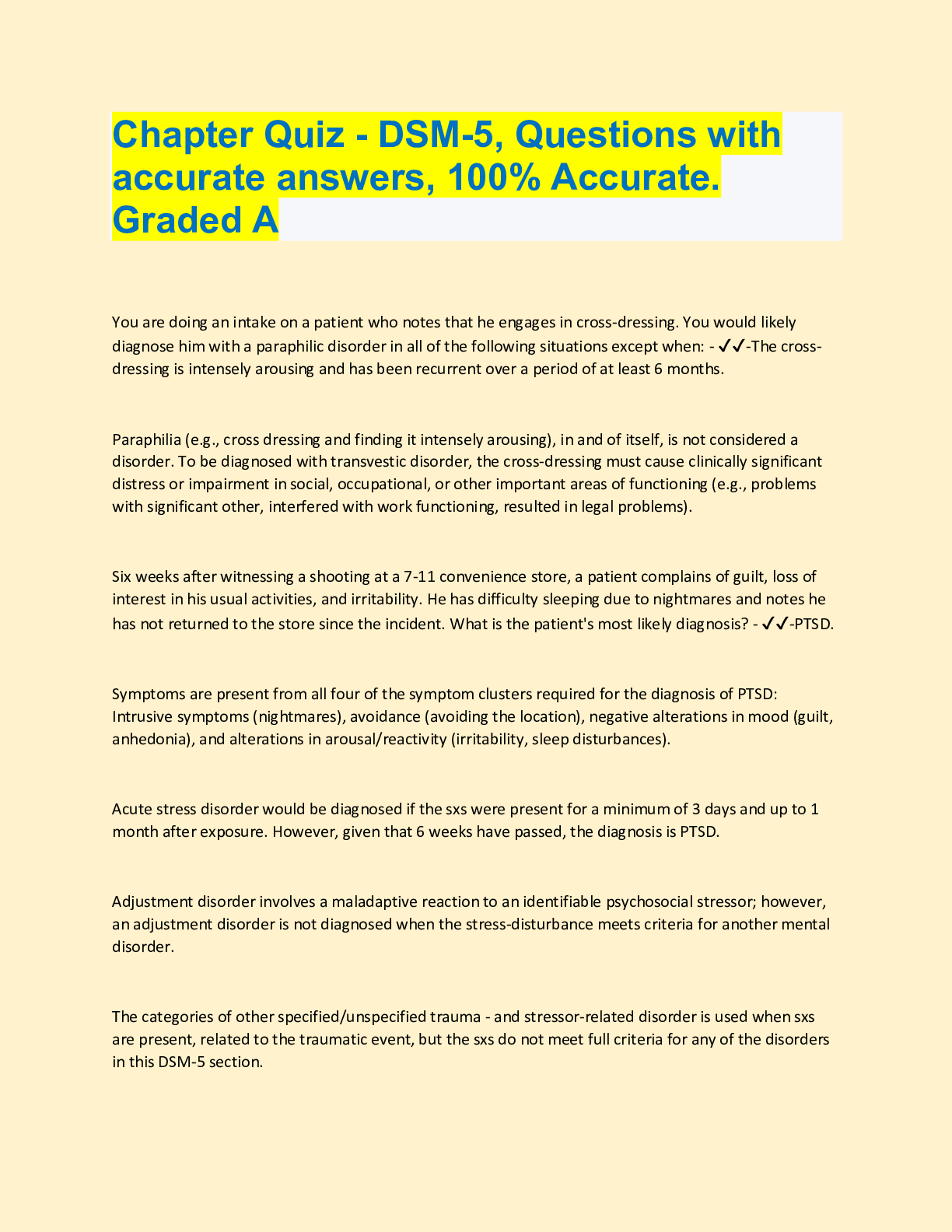
Chapter Quiz - DSM-5, Questions with
accurate answers, 100% Accurate.
Graded A
You are doing an intake on a patient who notes that he engages in cross-dressing. You would likely
diagnose him with a paraphilic disorder in all of the following situations except when: - ✔✔-The cross�dressing is intensely arousing and has been recurrent over a period of at least 6 months.
Paraphilia (e.g., cross dressing and finding it intensely arousing), in and of itself, is not considered a
disorder. To be diagnosed with transvestic disorder, the cross-dressing must cause clinically significant
distress or impairment in social, occupational, or other important areas of functioning (e.g., problems
with significant other, interfered with work functioning, resulted in legal problems).
Six weeks after witnessing a shooting at a 7-11 convenience store, a patient complains of guilt, loss of
interest in his usual activities, and irritability. He has difficulty sleeping due to nightmares and notes he
has not returned to the store since the incident. What is the patient's most likely diagnosis? - ✔✔-PTSD.
Symptoms are present from all four of the symptom clusters required for the diagnosis of PTSD:
Intrusive symptoms (nightmares), avoidance (avoiding the location), negative alterations in mood (guilt,
anhedonia), and alterations in arousal/reactivity (irritability, sleep disturbances).
Acute stress disorder would be diagnosed if the sxs were present for a minimum of 3 days and up to 1
month after exposure. However, given that 6 weeks have passed, the diagnosis is PTSD.
Adjustment disorder involves a maladaptive reaction to an identifiable psychosocial stressor; however,
an adjustment disorder is not diagnosed when the stress-disturbance meets criteria for another mental
disorder.
The categories of other specified/unspecified trauma - and stressor-related disorder is used when sxs
are present, related to the traumatic event, but the sxs do not meet full criteria for any of the disorders
in this DSM-5 section.
A woman presents to an emergency room having recently experienced seizures. Clinical findings suggest
no evidence of an underlying neurological condition. The diagnosis that would most commonly be given
if she is not feigning her symptoms is: - ✔✔-Conversion Disorder.
Conversion disorder involves one or more symptoms or deficits affecting voluntary motor or sensory
function (e.g., seizures, vision loss). The symptoms, which are not intentionally produced or feigned, are
incompatible with a recognized neurological or medical condition.
The concordance rate for schizophrenia for dizygotic twins is: - ✔✔-10-15%
The concordance rate for dizygotic (fraternal) twins or siblings is 10-15%; the concordance rate for
monosygotic (identical) twins is 50%.
You are seeing a client who notes she is terrified of insects. As much as she can, she avoids the outdoors.
She notes that in the summertime, when she comes into contact with spiders, mosquitos, or wasps, she
immediately has a panic attack (frequently several times a week). You would diagnose her with: - ✔✔-
Specific phobia.
The DSM-5 generally allows for the diagnosis of two or more mental disorders, when both exist.
Additionally, anxiety disorders are frequently comorbid. In this scenario, the person's symptoms meet
criteria for specific phobia. She has marked fear or anxiety caused by the presence or anticipation of
insects. When in the presence of the phobic object, she develops panic attacks. She does not, however,
meet criteria for panic disorder (which is characterized by recurrent unexpected panic attacks).
In diagnosing a child with intellectual disability, the level of severity is determined by: - ✔✔-The extent
of deficits in adaptive functioning.
Severity of intellectual disability is categorized as mild, moderate, severe, or profound.
According to the DSM-5, while intellectual disability does require deficits in general mental abilities
(with an IQ score typically at least 2 SD below the mean), the level of severity is based on adaptive
functioning alone.
You are asked to evaluate a 14-year-old boy who, for the past month, has exhibited irritable mood with
temper outbursts, poor concentration, distractibility, impulsivity, and increased motor activity. In
addition, he engaged in risky behaviors, is hyper-sexual, and his schoolwork has been compromised.
What is his most likely diagnosis? - ✔✔-Bipolar Disorder.
Key features of a manic episode include an abnormally elevated, expansive or irritable mood, as well as
increased goal-directed activity or energy, for at least a week. In addition to irritable mood, the boy
presents with increased psychomotor activity, hyper-sexuality, increased risky behavior, increased
distractibility, and impairment in functioning, all of which are symptoms of a manic episode. The
presence of one or more manic episodes is the essential feature of bipolar I disorder. Based on time
frame alone, both ADHD (at least 6 months) and disruptive mood dysregulation disorders (1 year) can be
ruled out. ADHD also requires symptoms to be present before age 12.
A six-year-old engages in repetitive, stereotyped motor movements, insists on eating the same food
every day, and is extremely sensitive to noise To diagnose this child with autism spectrum disorder, in
addition, which of the following must be present?
- deficits in social communication and interaction
- language impairment
- deficits in social communication and interaction AND language impairment
- deficits in social communication and interaction AND language impairment AND intellectual
impairment - ✔✔-Deficits in social communication and interaction.
Autism spectrum disorder is a new disorder that encompasses autistic disorder, Asperger's disorder, and
childhood disintegrative disorder. There are only two criteria required for the diagnosis of autism
spectrum disorder:
1) restrictive, repetitive, patterns of behavior
2) deficits in social communication and interaction
Specifiers include w/ or w/o accompanying language impairment and w/ or w/o accompanying
intellectual impairment.
Dawn is a 30-year-old woman who is single and desperately wants to get married and have children. She
worries that she will never find a partner because she is ugly and unattractive. She believes she is
disfigured secondary to acne scarring, and is extremely distressed by this. Dawn is actually reasonably
attractive and her scarring is minimal, nevertheless, she is completely convinced that her beliefs are
true. Dawn's diagnosis is likely:
-Body Dysmorphic Disorder
-Delusional Disorder, somatic type
-OCD
-GAD - ✔✔-Body Dysmorphic Disorder
The clinical presentation fits with a diagnosis of body dysmorphic disorder. In body dysmorphic disorder,
the person is preoccupied with one or more perceived defects in appearance (e.g., acne scarring), when
the perceived flaws are either not observable or slight. In this situation, because Dawn is completely
convinced her beliefs are true, the specifier "with absent insight/delusional beliefs" would be used.
A man who has been drinking for the past 25 years exhibits deficits in recall of information and difficulty
learning new information. His executive functioning, language skills, and perceptual-motor abilities are
all average to above-average. He relies on his family for most of his needs.
[Show More]