" DSM Quiz #3". All Possible exam
Questions with accurate answers,
graded A+
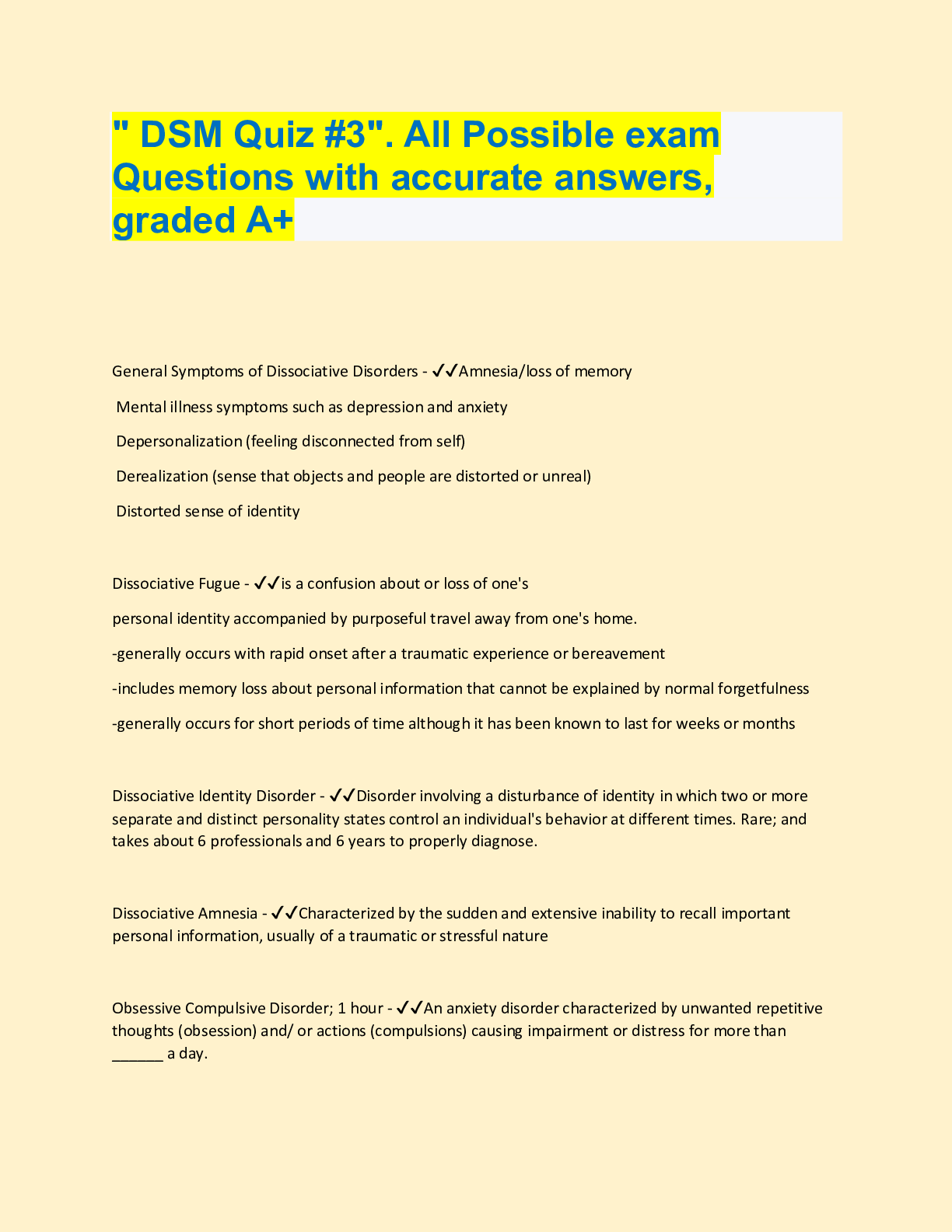
General Symptoms of Dissociative Disorders - ✔✔Amnesia/loss of memory
Mental illness symptoms such as depression and anxiety
Depersonali
...
" DSM Quiz #3". All Possible exam
Questions with accurate answers,
graded A+
General Symptoms of Dissociative Disorders - ✔✔Amnesia/loss of memory
Mental illness symptoms such as depression and anxiety
Depersonalization (feeling disconnected from self)
Derealization (sense that objects and people are distorted or unreal)
Distorted sense of identity
Dissociative Fugue - ✔✔is a confusion about or loss of one's
personal identity accompanied by purposeful travel away from one's home.
-generally occurs with rapid onset after a traumatic experience or bereavement
-includes memory loss about personal information that cannot be explained by normal forgetfulness
-generally occurs for short periods of time although it has been known to last for weeks or months
Dissociative Identity Disorder - ✔✔Disorder involving a disturbance of identity in which two or more
separate and distinct personality states control an individual's behavior at different times. Rare; and
takes about 6 professionals and 6 years to properly diagnose.
Dissociative Amnesia - ✔✔Characterized by the sudden and extensive inability to recall important
personal information, usually of a traumatic or stressful nature
Obsessive Compulsive Disorder; 1 hour - ✔✔An anxiety disorder characterized by unwanted repetitive
thoughts (obsession) and/ or actions (compulsions) causing impairment or distress for more than
______ a day.
Body Dysmorphic Disorder; repetitive behaviors; late teen - ✔✔A disorder marked by excessive worry
that some aspect of one's physical appearance is defective; constantly ask for reassurance; repeatedly
measuring or touching perceived defect; interferes with life; anxious around other people; repeatedly
consulting with medical specialists.
Diagnosis requires preoccupation with 1 or more perceived deficits or flaws in physical appearance, and
at some point has performed ______ ________.
Preoccupation begins in ______ _______ years.
Hoarding disorder; 55-59; excessive acquisition - ✔✔A disorder in which the person has a compulsive
need to acquire objects and extreme difficulty in disposing of those objects; more likely at age _____ to
______.
Those whose hoarding is due to shopping and collecting unnecessary items are hoarding with _____
_____.
Trichotillomania - ✔✔1. pulling out of one's hair
2. relief or graification afterwards
Excoriation Disorder; face, hands, and arms - ✔✔Individuals who repeatedly pick their skin to the point
of developing lesions have a disorder called __________ Disorder. Despite efforts to stop, they are
unable to do so, which leads to distress and functional impairment in at least one major life area, such
as work, school, or interpersonal relationships. Those who engage in picking behavior commonly pick on
their ______, ______, and ______, and sometimes target healthy skin, while others target irregularities,
such as calluses, previous picking sites, blackheads, or pimples.
Obsession - ✔✔An unwanted thought, word, phrase, or image that persistently and repeatedly comes
into a person's mind and causes anxiety or distress.
Compulsion; unrealistic; excessive - ✔✔__________ are repetitive behaviors or mental acts that a
person feels driven to perform in response to an obsession, or according to rules that much be applied
rigidly in order to prevent or reduce anxiety (or dreaded event). Acts are either ________ or _______.
Good/Fair Insight - ✔✔The individual recognizes that beliefs are definitely or probably not true, or that
they may or may not be true.
Poor Insight - ✔✔The individual thinks OCD beliefs are probably true
Absent Insight - ✔✔The individual is completely convinced OCD beliefs are true.
Diagnosing OCD - ✔✔1. Obsessions
2. Compulsions
3. Take more than 1 hour per day and cause distress
4. O/C not drug induced
5. Not associated with another mental disorder
muscle dysmorphia - ✔✔A disorder characterized by distorted body image; affected people inaccurately
perceive themselves as small, with underdeveloped muscles.
Symptom of Body Dysmorphic Disorder - ✔✔A- Preoccupation with one or more perceived defects or
flaws in physical appearance
B- At some point during the course of the disorder, the individual has performed repetitive behaviors
(e.g., mirror checking)
C- Causes clinically significant distress or impairment in life
D- The appearance preoccupation is not better explained by concerns with body fat or weight
Reactive Attachment Disorder; seeking or responding; 9 months; 5 - ✔✔Consistent pattern of inhibited,
emotionally withdrawn behavior towards adult caregivers, manifested by
--the child not _________ or _________ to comfort when distressed.
Developmental age of at least _________ and up to age ____.
Minimal social/emotional response to others, limited positive affect, unexplained irritability, sadness,
fear during nonthreatening interaction with caregivers.
Disinhibited Engagement Disorder; 5; 9 months - ✔✔Culturally inappropriate, overly familiar behavior
with relative strangers that violates social boundaries. Lack of filters. Child must have experienced
extreme neglect. Often persists after neglect has ended. Neglect must have started before age _____.
Disorder is described from developmental age of _____ - middle school age.
Posttraumatic Stress Disorder; 6; 1 month - ✔✔An Anxiety Disorder that involves the development of
characteristic symptoms after exposure to a traumatic event that entails actual or threatened death or
serious injury to self or others. The immediate reaction to the event is characterized by intense fear,
helplessness, or horror; this is followed by persistent reexperiencing of the trauma; persistent avoidance
of stimuli associated with the trauma; and persistent symptoms of increased arousal. Must have
occured after the age of ______. Symptoms must continue for longer than _______.
Acute Distress Disorder; 3 to 31
[Show More]