NAADAC Practice Test 2 Questions with
accurate answers. Latest version. Rated
A+
*Multiple Choice*
Quantity, frequency of use, patterns over-time and progression are necessary questions when taking the
client's _
...
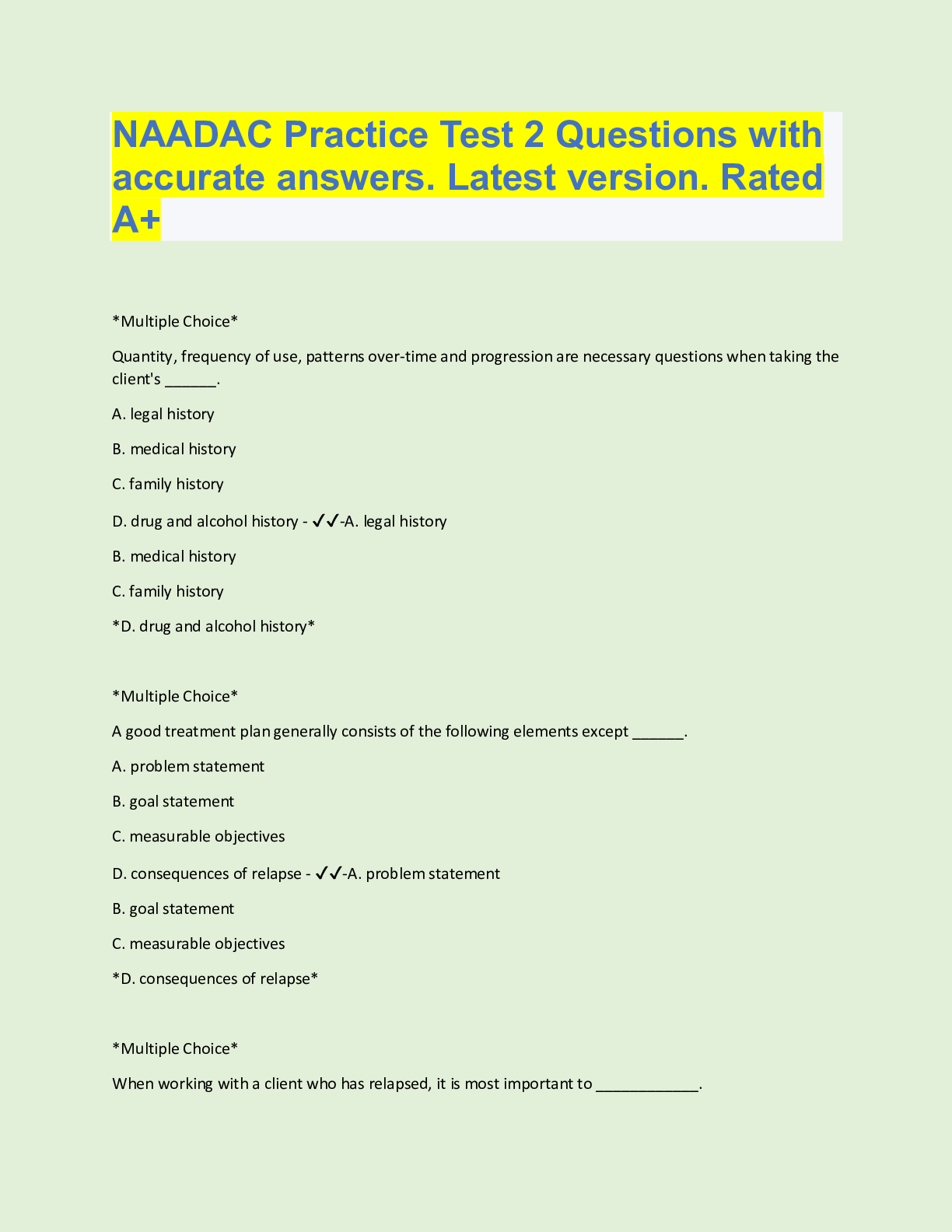
NAADAC Practice Test 2 Questions with
accurate answers. Latest version. Rated
A+
*Multiple Choice*
Quantity, frequency of use, patterns over-time and progression are necessary questions when taking the
client's ______.
A. legal history
B. medical history
C. family history
D. drug and alcohol history - ✔✔-A. legal history
B. medical history
C. family history
*D. drug and alcohol history*
*Multiple Choice*
A good treatment plan generally consists of the following elements except ______.
A. problem statement
B. goal statement
C. measurable objectives
D. consequences of relapse - ✔✔-A. problem statement
B. goal statement
C. measurable objectives
*D. consequences of relapse*
*Multiple Choice*
When working with a client who has relapsed, it is most important to ____________.
A. discontinue treatment
B. help the client identify his or her internal and external relapse triggers
C. make sure the client understands the very serious consequences of using
D. strongly confront the client on his or her behavior - ✔✔-A. discontinue treatment
*B. help the client identify his or her internal and external relapse triggers*
C. make sure the client understands the very serious consequences of using
D. strongly confront the client on his or her behavior
*Multiple Choice*
The DAST is used to assess a client's ______.
A. progress during treatment
B. mental health
C. financial stability
D. level of psychoactive substance abuse - ✔✔-A. progress during treatment
B. mental health
C. financial stability
*D. level of psychoactive substance abuse*
*Multiple Choice*
The systematic process by which a client becomes known to the addiction counselor and/or program is
known as ______.
A. treatment planning
B. followup
C. evaluation
D. intervention - ✔✔-A. treatment planning
B. followup
*C. evaluation*
D. intervention
*Multiple Choice*
History of communication patterns and the generational history of addiction and mental health
problems are associated with interview questions regarding ______.
A. drinking history
B. drug history
C. family history
D. employment history - ✔✔-A. drinking history
B. drug history
*C. family history*
D. employment history
*Multiple Choice*
Interpersonal skills, less confrontation and the frequent use of empathy are qualities that have
empirically found to be characteristics of ______.
A. unsuccessful counseling
B. adequate counseling
C. enabling counseling
D. effective counseling - ✔✔-A. unsuccessful counseling
B. adequate counseling
C. enabling counseling
*D. effective counseling*
*Multiple Choice*
An ______ differs from a listening response in that it deals with the implicit part of a client's message.
A. interpretation
B. action response
C. empathic response
D. integration - ✔✔-*A. interpretation*
B. action response
C. empathic response
D. integration
Page 84,
*Multiple Choice*
______ are not usually seen as a complete treatment process but as a method of crisis intervention or a
prelude to more extended treatment.
A. Inpatient/residential treatment programs
B. Detoxification treatment programs
C. Outpatient programs
D. Intensive outpatient programs - ✔✔-A. Inpatient/residential treatment programs
*B. Detoxification treatment programs*
C. Outpatient programs
D. Intensive outpatient programs
*Multiple Choice*
The purpose of the screening process during evaluation is all of the following, except
_________________.
A. to determine the presence of any dual disorders
B. to determine who will be paying for the client's treatment services
C. to ascertain whether the client is a good fit for the treatment program
D. to gather basic biographical information about the client. - ✔✔-A. to determine the presence of any
dual disorders
*B. to determine who will be paying for the client's treatment services*
C. to ascertain whether the client is a good fit for the treatment program
D. to gather basic biographical information about the client.
*Multiple Choice*
All of the following are methods of confrontation except ________.
A. surprise confrontation
B. weakness confrontation
C. didactic confrontation
D. experimental confrontation - ✔✔-*A. surprise confrontation*
B. weakness confrontation
C. didactic confrontation
D. experimental confrontation
Page 83
*Multiple Choice*
Counselor selfdisclosure too early in the treatment process can often cause the client to feel ______.
A. an enhanced bond with the counselor
B. valued and understood
C. threatened and anxious
D. that the counselor is trustworthy - ✔✔-A. an enhanced bond with the counselor
B. valued and understood
*C. threatened and anxious*
D. that the counselor is trustworthy
*Multiple Choice*
The feelings and attitudes (some of which may be unconscious) the addiction counselor has towards a
client are part of what is known as ______.
A. regression
B. countertransference
C. boundary interference
D. transference - ✔✔-A. regression
*B. countertransference*
C. boundary interference
D. transference
*Multiple Choice*
The counseling skill used to tie together multiple elements or themes in a client's various messages is
______.
A. probing
B. clarifying
C. summarization
D. reflection - ✔✔-A. probing
B. clarifying
*C. summarization*
D. reflection
*Multiple Choice*
Establishing a clear system of constant support to the client once he or she leaves treatment is referred
to as ______.
A. continuing care plan
B. relationship building
C. termination
D. service coordination - ✔✔-*A. continuing care plan*
B. relationship building
C. termination
D. service coordination
*True or False*
A critical analysis and synthesis of all data collected in an assessment clinical summation. - ✔✔-*True*
*True or False*
An addiction counselor who discloses too much can be perceived as lacking discretion, being
untrustworthy, selfpreoccupied, and needing therapy. - ✔✔-*True*
*True or False*
"Congruence" refers to when a counselor's external words and actions match his or her internal feelings
and thoughts. - ✔✔-*True*
*True or False*
The assessment process of evaluation begins once the client has completed detoxification. - ✔✔-*False*
*True or False*
All recovering individuals have the same relapse potential. - ✔✔-*False*
*True or False
[Show More]