ADC Exam 1 Questions & Answers,
100% Accurate, rated A
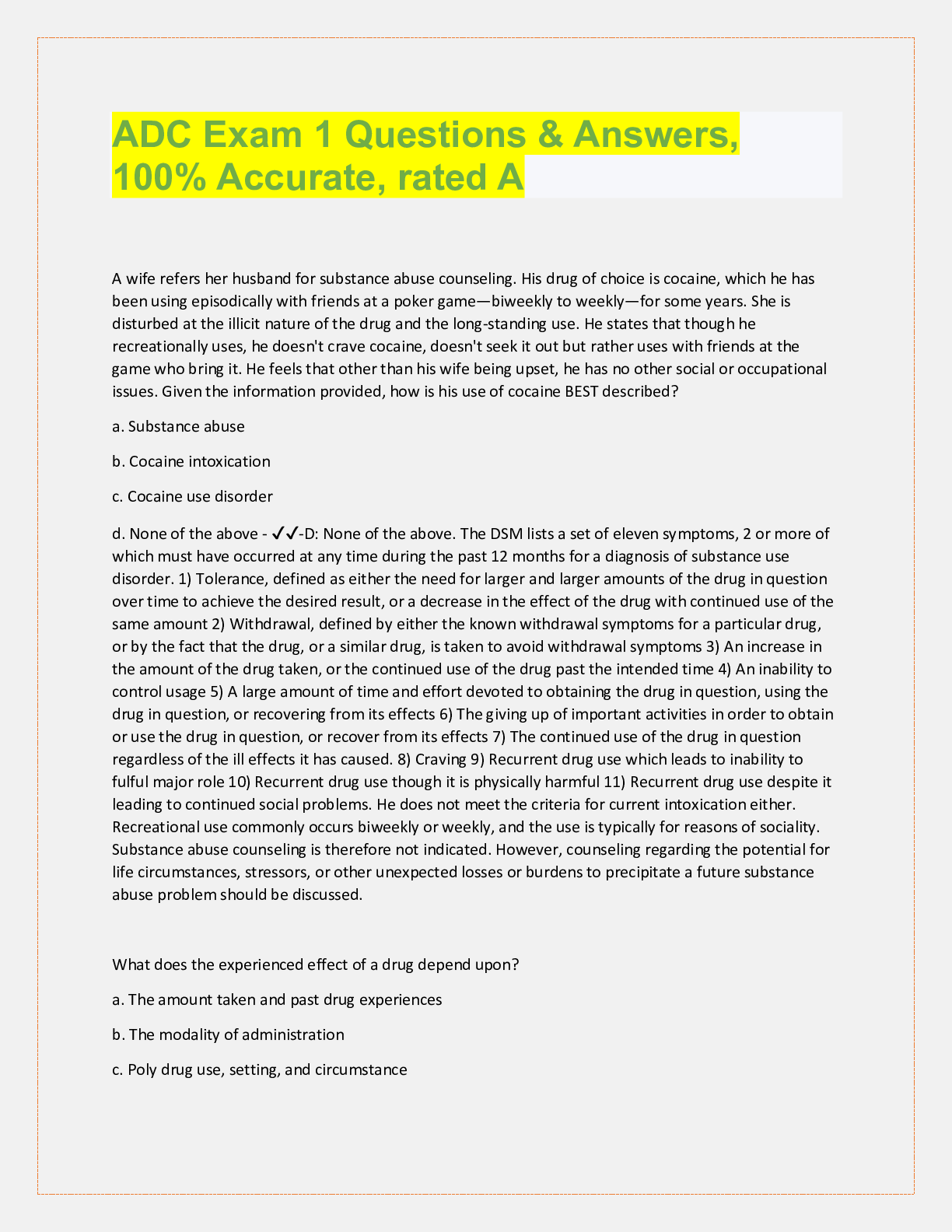
A wife refers her husband for substance abuse counseling. His drug of choice is cocaine, which he has
been using episodically with friends at a poker game—biwee
...
ADC Exam 1 Questions & Answers,
100% Accurate, rated A
A wife refers her husband for substance abuse counseling. His drug of choice is cocaine, which he has
been using episodically with friends at a poker game—biweekly to weekly—for some years. She is
disturbed at the illicit nature of the drug and the long-standing use. He states that though he
recreationally uses, he doesn't crave cocaine, doesn't seek it out but rather uses with friends at the
game who bring it. He feels that other than his wife being upset, he has no other social or occupational
issues. Given the information provided, how is his use of cocaine BEST described?
a. Substance abuse
b. Cocaine intoxication
c. Cocaine use disorder
d. None of the above - ✔✔-D: None of the above. The DSM lists a set of eleven symptoms, 2 or more of
which must have occurred at any time during the past 12 months for a diagnosis of substance use
disorder. 1) Tolerance, defined as either the need for larger and larger amounts of the drug in question
over time to achieve the desired result, or a decrease in the effect of the drug with continued use of the
same amount 2) Withdrawal, defined by either the known withdrawal symptoms for a particular drug,
or by the fact that the drug, or a similar drug, is taken to avoid withdrawal symptoms 3) An increase in
the amount of the drug taken, or the continued use of the drug past the intended time 4) An inability to
control usage 5) A large amount of time and effort devoted to obtaining the drug in question, using the
drug in question, or recovering from its effects 6) The giving up of important activities in order to obtain
or use the drug in question, or recover from its effects 7) The continued use of the drug in question
regardless of the ill effects it has caused. 8) Craving 9) Recurrent drug use which leads to inability to
fulful major role 10) Recurrent drug use though it is physically harmful 11) Recurrent drug use despite it
leading to continued social problems. He does not meet the criteria for current intoxication either.
Recreational use commonly occurs biweekly or weekly, and the use is typically for reasons of sociality.
Substance abuse counseling is therefore not indicated. However, counseling regarding the potential for
life circumstances, stressors, or other unexpected losses or burdens to precipitate a future substance
abuse problem should be discussed.
What does the experienced effect of a drug depend upon?
a. The amount taken and past drug experiences
b. The modality of administration
c. Poly drug use, setting, and circumstance
d. All of the above - ✔✔-D: All of the above. The amount of a drug ingested will typically affect the user's
experience, with higher doses often producing a greater effect (though potentially diminishing over time
as tolerance develops). The modality of administration can greatly influence the rate of the drug's
uptake into the system. Normally the rate of effect, from greatest to least, is: inhalation (snorting or
smoking), injection (intravenous, intramuscular, or subcutaneous), and ingestion (sublingual or
swallowing with or without food). Generally, the faster the systemic uptake, the shorter and more
intense the high experienced. Polydrug abuse greatly complicates the drug experience, particularly if the
drugs used are chemical antagonists (e.g., stimulants and depressants—such as meth and alcohol),
additive (producing a cumulative effect), synergistic (more than cumulative), or potentiating (each
enhancing each other). The setting in which the substance use occurs is also often a significant
contributor to the experience. The feelings engendered by the surroundings, the people with whom the
experience is shared, the attitudes and reactions of others involved, as well as personal past drug
experiences and individual biology all combine to produce a drug experience.
How is drug tolerance BEST described?
a. The inability to get intoxicated
b. The need for more of a drug to get intoxicated
c. Increased sensitivity to a drug over time
d. Decreased sensitivity to a drug over time - ✔✔-D: Decreased sensitivity to a drug over time. When a
drug is used regularly, the body is gradually able to adapt to the effects of the drug. Evidence of
tolerance is twofold: (1) greater doses of the drug are required to achieve previous effects, and (2) doses
that would have produced profound physiological compromise or even death are now readily tolerated
without untoward effects. In some cases, it has been noted that up to ten times a lethal dosage, or even
more, may be taken without any signs of significant physiological compromise. Tolerance develops as
the body seeks homeostasis, or a functional state of equilibrium, in spite of the presence of the drug.
Which of the following is NOT a "drug cue"?
a. A prior drug-use setting
b. Drug use paraphernalia
c. Seeing others use drugs
d. Drug avoidance strategies - ✔✔-D: Drug avoidance strategies. Intense drug euphoria produces
extremely intense, emotionally imprinted memory engrams, coupled with long-term changes in the
amygdala area of the brain, which operate outside of conscious control. Key euphoric memories become
integrally connected to sights, sounds, smells, people, and places previously associated with drug use.
The reappearance of any of these past drug cues will often effectively trigger intense, amygdala-driven
cravings for a drug. Cravings are further intensified by lingering imbalances in brain metabolism
patterns, receptor availability, hormone levels, and other hypothalamus and pituitary-mediated
sensations of dysphoria and distress. The cascading nature of these effects frequently induces a drug�use relapse.
What happens as tolerance for barbiturates develops?
a. The margin between intoxication and lethality increases.
b. The margin between intoxication and lethality decreases.
c. The margin between intoxication and lethality stays the same.
d. Tolerance does not develop for barbiturates. - ✔✔-C: The margin between intoxication and lethality
stays the same. While tolerance for barbiturates does develop, tolerance for an otherwise lethal dose
only marginally increases and never exceeds twofold. This means that the likelihood of an unintentional
fatal dose increases substantially over time as the need for the intoxicating effect pushes that threshold
ever closer to a lethal dose. Given the impairments in memory and judgment that typically accompany
CNS depressant intoxication, simple forgetfulness can lead to a fatal overdose. Finally, using barbiturates
with any other CNS depressant substance, such as alcohol, can result in an additive CNS depression that
can readily be fatal. Death most often occurs via respiratory or cardiac suppression.
What is the MOST common symptom of Wernicke's encephalopathy?
a. New memory formation
b. Loss of older memories
c. Psychosis
d. Confusion - ✔✔-D: Confusion. Other symptoms of Wernicke's encephalopathy include poor muscle
coordination and oculomotor impairment (problems moving the eyes in a controlled fashion).
Wernicke's syndrome is a short-term condition resulting from vitamin B1 (thiamine) deficiency, typically
developing after years of drinking and poor nutrition. Of those with Wernicke's syndrome, 80 to 90
percent will develop long-term psychosis and memory problems known as Korsakoff syndrome. While
poor coordination is a symptom, retrograde amnesia (loss of old memories) and learning impairments
are among the more classic hallmarks of the condition. Because they are so often found together, the
two syndromes are often referred to concurrently as Wernicke-Korsakoff syndrome.
Which of the following conditions does alcohol NOT induce?
a. Steatosis
b. Nephrosis
c. Hepatitis
d. Cirrhosis - ✔✔-B: Nephrosis. Hepatitis refers to inflammation of the liver. Alcohol is toxic to all body
tissues. Because alcohol must be metabolized by the liver, it is particularly susceptible to the toxic
effects. Consequently, many heavy drinkers suffer from alcoholic hepatitis, characterized by abdominal
pain, nausea, vomiting, and a swollen liver. In more extreme cases, jaundice and bleeding can result.
Jaundice (a yellowing of the skin and whites of the eyes) is from bilirubin, a by-product of aging red
blood cells broken down in the liver, that should have been fully metabolized by the liver. Spontaneous
bleeding occurs because key clotting factors are made in the liver, but production is inhibited by
hepatitis. Steatosis consists of fatty deposits in the liver that, if severe, can prove fatal. Cirrhosis refers
to scarring of the liver from alcohol damage, preventing its normal functioning. High blood toxins can
also cause hepatic encephalopathy—a reversible dementia—if the toxins are reduced.
What does formication refer to?
a. The creation of freebase cocaine
b. Sex between two unmarried individuals
c. A sensation of bugs crawling under the skin
d. Extrapyramidal symptoms of agitation - ✔✔-C: A sensation of bugs crawling under the skin. Chronic
users of cocaine, crack cocaine, methamphetamine, and other such stimulants develop a profoundly
unpleasant sensation of bugs crawling under their skin. They may even come to believe the bugs are
present and needing to be removed. In less severe cases, users may pick at their skin to the point of
causing sores and scabs. In more extreme cases, users may cut themselves in a desperate attempt to
release the bugs and find relief. The condition is also known as Magnon's syndrome and may also be
referred to colloquially as coke bugs or crank bugs, and so on.
What is/are the organ(s) most damaged by cocaine abuse?
a. The brain
b. The lungs
c. The kidneys
d. The heart - ✔✔-D: The heart. Considerable medical research demonstrates that cocaine not only
causes arterial constriction secondary to the drug's stimulant effects, but it also causes a cumulative
effect, with more cocaine causing increased arterial narrowing. Atherosclerosis (artery hardening and
plaque buildup) greatly magnifies this deleterious process. The result is that permanent disability or
death due to sudden cardiac arrest or hemorrhagic cerebral stroke is an increasingly real possibility the
longer the drug is abused. Finally, cocaine-induced damage to the prefrontal lobes (where behaviors are
modified and controlled) often results in impaired judgment, disinhibition, loss of foresight, decisional
incapacity, and chronic unpredictability and irritability.
Which of the following is NOT a basic chemical class of amphetamines?
a. Amphetamine sulphate
b. Benzedrine
c. Dextroamphetamine
d. Methamphetamine - ✔✔-B: Benzedrine. Amphetamines consist of a group of synthetic stimulants
chemically similar to the body's natural adrenaline—the hormone released when the body reacts in
high-threat fight-fright-flight circumstances. The three main types are: amphetamine sulphate
(commonly known as speed or by its trade name, Benzedrine), dextroamphetamine (trade name
Dexedrine or colloquially as Dexy's midnight runners), and methamphetamine (Methedrine or meth,
crank, speed, poor man's cocaine, etc.). Among the three classes, methamphetamine has the greatest
abuse risk due to its extremely intense rush. While some drugs such as heroin may be unpleasant at first
use, amphetamines are immediately pleasurable to most users. Consequently, meth is second only to
marijuana as the nonalcoholic drug most abused worldwide.
In terms of difficulty quitting (dependence), which of the following four drugs ranks the highest?
a. Alcohol
b. Cocaine
c. Heroin
d. Nicotine - ✔✔-D: Nicotine. In terms of difficulty quitting, relapse rates, cravings ratings, and persistent
use despite known harm, nicotine is substantially more dependency producing than cocaine, heroin, and
alcohol. In terms of withdrawal symptom severity, nicotine exceeds that of cocaine and is only slightly
behind heroin. Thus, fewer than 7 percent of those trying to quit each year will succeed. Given that
nicotine use greatly increases the risks of heart disease, stroke, lung diseases, and cancer, nicotine abuse
is a serious public health issue. Even only occasional smoking produces lung and vascular damage, and
almost one-fifth of all heart disease deaths are linked to smoking.
Which of the statements below is MOST correct?
a. THC content in all marijuana is about the same.
b. THC content in hashish is lower than in a joint.
c. THC content in marijuana is predictable.
d. THC content in marijuana varies widely. - ✔✔-D: THC content in marijuana varies widely. Historically,
the level of delta 9-tetrahydrocannabinol (THC) in domestic U.S. marijuana was less than 0.5 percent.
Recent cultivation and cross-breeding practices, however, have changed this, and some domestic
marijuana has substantially higher levels. The THC in Mexican marijuana can range as high as 4 percent,
and sinsemilla can reach concentrations as high as 8 percent. The potency of hashish (cannabis plant
resin) can be as great as 10 percent, and hashish oil may contain as much as 20 percent THC. Street
marijuana products may be diluted or cut with other adulterants (oregano, catnip, etc.) and may also be
laced with other undisclosed psychoactive ingredients such as opium or LSD. Unexpectedly high doses of
THC or the addition of other psychoactive substances can greatly affect the unsuspecting user in
potentially troubling ways. Thus, caution is in order.
Regarding substance abuse, what does Convergence Theory propose?
a. Rates of substance abuse among women are converging with those of men.
b. All individuals eventually narrow drug use to a drug of choice preference.
c. Age is a key factor in eventual substance abuse abstinence.
d. As individuals age, gender disparities in rates of abuse tend to converge. - ✔✔-A: Rates of substance
abuse among women are converging with those of men. Convergence theory postulates that substance
abuse rates are becoming more equal during the twenty-first century—currently, 1.6 men have
substance abuse issues for every 1 woman with such issues. Others, however, suggest the data is
flawed, as women are more likely to hide their substance abuse behavior and less likely to see help.
Other gender differences include the following: (1) men externalize accountability, women internalize
(self-blame); (2) issues of self-esteem are more common for women; (3) treatment barriers are higher,
as women tend to have pregnancy issues and children needing their care; (4) women tend to increase
substance abuse when depressed, while men are more likely to decrease use. Women prostitute to
support a habit; men turn to selling drugs or other criminal behavior. Marriage is a deterrent to drug use
for men but a risk factor for women. Women drinkers are four times more likely to live with a drinker
than is a man.
Among psychiatric disorders in the elderly, where does alcohol abuse rank?
a. twenty-fifth
b. fifteenth
c. fifth
d. third - ✔✔-D: Third. Alcohol use disorders rank third among psychiatric disorders of the elderly. Some
2 to 4 percent of the elderly have a substance use disorder (including alcohol, drugs, or both).
Approximately 15 percent of the elderly with an alcohol disorder will also have a concurrent drug abuse
problem. Due to physical changes of age, researchers recommend only one drink per day as the upper
limit. Detecting alcohol and drug abuse in the elderly can be difficult as the symptoms are often very
similar to other health problems associated with age. Isolation, poor health, pain, or depression often
motivates substance abuse in the elderly. Many are ashamed of the abuse and further avoid family and
others to hide the problem. Suicide rates climb as people grow elderly, and 25 to 50 percent of all
attempts by the elderly involve alcohol. Some 10 percent of the elderly misuse their prescription
medication, intentionally or accidentally. Substance abuse may greatly complicate a potentially tenuous
status for many on complex medication
Which of the following subcategories of alcohol use disorder onset is NOT in the elderly?
a. Late-onset alcoholism
b. Delayed-onset alcoholism
c. Late-onset exacerbation drinking
d. Early-onset alcoholism - ✔✔-B: Late-onset alcoholism. Early-onset alcoholism refers to an onset of
alcohol abuse in adolescence or young adult life. This represents about two-thirds of all individuals with
an alcohol use disorder. Late-onset exacerbation drinking refers to individuals with an intermittent
history of alcohol abuse that only became chronic in late adulthood. Late-onset alcoholism refers to
individuals with no prior life history of alcohol abuse who developed an alcohol problem solely in later
life. This category of alcoholism may be more amenable to treatment than the earlier-onset forms.
Detoxification can be protracted in the elderly, requiring a longer treatment stay, due to the metabolic
changes of aging. Group treatment can be complicated by the group milieu, where younger participants
may leave the elderly feeling estranged and out of sync with the other participants. Careful efforts at
inclusion or an alternate group composed of older participants may be required.
At an initial meeting with a new client, what is the FIRST requirement?
a. Establish rapport.
b. Evaluate readiness for change.
c. Review rules and expectations.
d. Discuss confidentiality regulations. - ✔✔-A: Establish rapport. Exploring readiness for change, rules
and expectations, or issues of confidentiality may otherwise serve only to induce client anxiety,
defensiveness, or rejection of potential treatment outright. The counselor must generate an authentic
and safe environment that is conducive to trust and disclosure. This can be achieved, from a
motivational perspective, by assuring the client that he or she will not be told what to do, but rather,
help will be given in deciding what he or she is seeking to accomplish. A direct request about what has
brought the client in can be helpful if they are ready to talk openly. Otherwise, asking about health,
work, or family challenges may provide an oblique entry to asking about substance issues (e.g., "How is
this affected by your substance abuse?"). As rapport grows, issues of confidentiality, program
requirements (e.g., whether or not sessions can be held in spite of intoxication, etc.), session length,
evaluation of change readiness, and so on, can then more naturally unfold.
What does motivational interviewing primarily involve?
a. Focused confrontation
b. Behavioral accountability
c. Reality testing
d. Supportive persuasion - ✔✔-D: Supportive persuasion. The goal of motivational interviewing is to help
the client discover his or her own desire to change. Thus, confrontation, stern accountability, overt
reality testing, and other coercive or argument-inducing approaches are avoided. Five fundamental
principles to guide the motivational interviewing process are: (1) reflective and empathetic listening, (2)
identification of variances between behavior and personal goals, (3) deflection of confrontation or
argument to more positive, goal-oriented dialogue, (4) redirection of client resistance to desires and
goals rather than opposing it outright, and (5) nurturing optimism and a sense of self-efficacy when
confronted with obstacles, challenges, and negative expressions.
What percentage of individuals with a dual diagnosis (co-occurring disorders [COD]—i.e., substance
abuse disorder and an existing mental illness) received treatment for only their mental illness?
a. 32.9 percent
b. 27.6 percent
c. 12.4 percent
d. 8.8 percent - ✔✔-A: 32.9 percent. According to the 2009 National Survey on Drug Use and Health,
when individuals have co-occurring disorders (dual diagnoses) consisting of substance abuse and mental
illness, only 7.4 percent will receive treatment for both disorders, 32.9 percent will receive only mental
health treatment, and 3.8 percent will receive only substance abuse treatment. Where mental illness is
severe, the existence of a substance abuse problem is particularly likely (25.7 percent). And among
individuals with a substance use disorder in the past year, 17.6 percent will have a concurrent mental
illness disorder. Thus, where either a substance abuse disorder or a mental illness disorder is known to
exist, treatment professionals should be particularly careful to screen further and ensure that any
coexisting disorder is identified, if one exists.
What factors can affect screening instrument validity?
a. The screening setting and privacy
b. The levels of rapport and trust
c. How instructions are given and clarified
d. All of the above - ✔✔-D: All of the above. Experienced counselors and researchers are aware that the
setting in which screening occurs (home, office, clinic, or voluntary vs. involuntary facility) can
significantly affect the results of any screening tool used. How instructions are given can substantially
influence the findings as poorly chosen words and presenting attitudes can unquestionably taint client
thinking, presumptions, and willingness to disclose. The presence or absence of privacy can also be a
significant factor, as distractions, fears of disclosures or being overheard, and other such elements can
bias and the screening and intake process. Further, the levels of rapport and trust between the client
and the intake counselor may also alter client perceptions and, consequently, client responses during
any screening interview or when completing any screening instrument. New counselors must, therefore,
be alert to these factors and quickly learn to overcome any deleterious influences.
Which of the following functions is NOT what a Certified Alcohol and Drug Abuse Counselor can usually
perform?
a. Client screening
b. Substance abuse assessment
c. Diagnose mental disorders
d. Formulate a treatment plan - ✔✔-C: Diagnose mental disorders. Certified Alcohol and Drug Abuse
Counselors, absent additional mental health training and licensure, do not have the credentials and
training necessary to diagnose mental disorders. They do have the training and certification necessary to
diagnose substance abuse disorders and are well within their scope of practice to screen, assess, and
otherwise evaluate clients for substance abuse issues and to formulate and carry out substance abuse
treatment plans. Because of the frequency with which co-occurring mental illnesses exist within the
substance abusing community, Certified Alcohol and Drug Abuse Counselors can become very familiar
and proficient with numerous commonly occurring mental disorders. It can therefore seem natural to
broaden the scope of practice as experience grows. However, legal scope-of-practice parameters do not
provide for Certified Alcohol and Drug Abuse Counselors to diagnose mental illness, and it is essential
that they collaborate with other professionals whenever non-substance abuse mental health issues
arise.
What does the acronym GATE stand for?
a. Gather information; Access supervision; Take responsible action; Extend the action
b. Gather resources; Access procedures; Take clinical notes; Extend the intervention
c. Gather documentation; Access contacts; Take counsel; Extend positive outcomes
d. Gather the team; Access records; Take consultation; Extend documentation - ✔✔-A: Gather
information; Access supervision; Take responsible action; Extend the action. GATE was established by a
consensus panel addressing the evaluation of suicidal ideation and behaviors by substance abuse
counselors working with at-risk clients. It consists of activities that are well within the practice scope of a
substance abuse counselor. Gathering information involves (1) screening for suicidality and (2) observing
for warning signs. Screening involves direct questions regarding current thoughts (plans, means, or
preparations) and any past history of attempts. Accessing supervision or consultation (even if the
counselor already has specialized training) ensures issues of risk are fully evaluated. Taking responsible
action protects client well-being and safety. Extending the action involves securing follow-up and
ongoing monitoring as needed. In this way, GATE fully assesses and addresses suicidality. The final step
is thorough documentation to secure a medical and legal record of the care provided.
To which of the following do assessment processes and instruments NOT need be sensitive?
a. Political orientation
b. Age and gender
c. Race and ethnicity
d. Disabilities - ✔✔-A: Political orientation. Political orientation is not typically a sensitive issue in the
assessment process. Comprehensive asse
[Show More]