CH-04: ICD-10-CM Pool Questions and
answers, 100% Accurate, Verified.
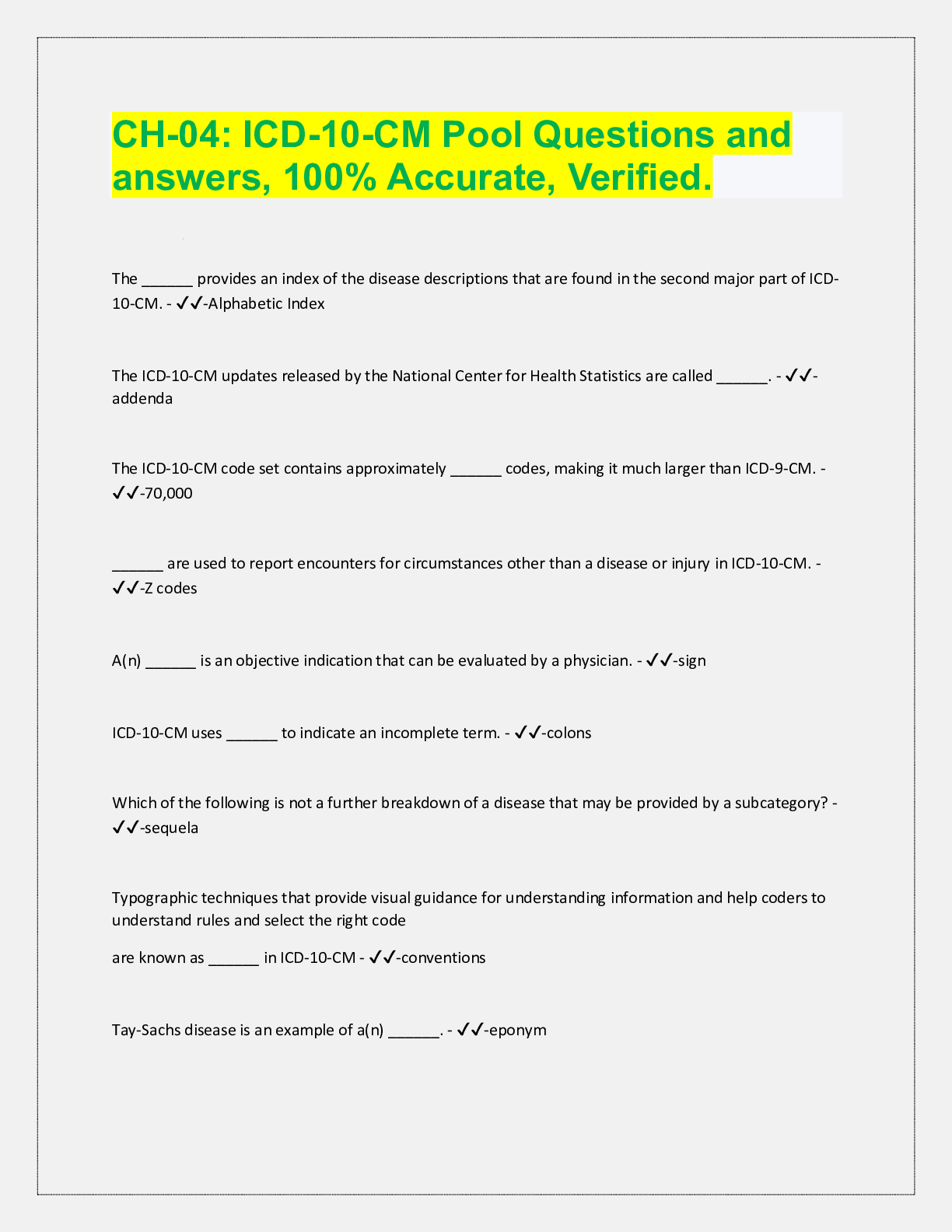
The ______ provides an index of the disease descriptions that are found in the second major part of ICD�10-CM. - ✔✔-Alphabetic Index
The ICD-10-CM
...
CH-04: ICD-10-CM Pool Questions and
answers, 100% Accurate, Verified.
The ______ provides an index of the disease descriptions that are found in the second major part of ICD�10-CM. - ✔✔-Alphabetic Index
The ICD-10-CM updates released by the National Center for Health Statistics are called ______. - ✔✔-
addenda
The ICD-10-CM code set contains approximately ______ codes, making it much larger than ICD-9-CM. -
✔✔-70,000
______ are used to report encounters for circumstances other than a disease or injury in ICD-10-CM. -
✔✔-Z codes
A(n) ______ is an objective indication that can be evaluated by a physician. - ✔✔-sign
ICD-10-CM uses ______ to indicate an incomplete term. - ✔✔-colons
Which of the following is not a further breakdown of a disease that may be provided by a subcategory? -
✔✔-sequela
Typographic techniques that provide visual guidance for understanding information and help coders to
understand rules and select the right code
are known as ______ in ICD-10-CM - ✔✔-conventions
Tay-Sachs disease is an example of a(n) ______. - ✔✔-eponym
The abbreviation ______ is used with a term when there is no code that is specific for the condition. -
✔✔-NEC
Format & Structure - ✔✔-The ICD-10-CM Tabular List contains categories, subcategories and codes.
Placeholder character - ✔✔-The ICD-10-CM utilizes a placeholder character "X". The "X" s used as a
placeholder at certain codes to allow for future expansion.
7th Character - ✔✔-Certain ICD-10-CM categories have applicable 7th characters.
NEC - ✔✔-"Not elsewhere classifiable" This abbreviation represents "other specified". When a specific
code is not available for a condition.
NOS - ✔✔-"Not otherwise specified" This abbreviation is the equivalent of unspecified.
"and" - ✔✔-When the term "and" is used in a narrative statement it represents and/or.
Includes Notes - ✔✔-This note appears immediately under a three character code title to further define
or give examples of, the content of the category.
Inclusion Terms - ✔✔-List of terms is included under some codes. These terms are the conditions for
which that code is to be used.
Excludes 1 - ✔✔-A type 1 Exclude note is a pure exclude note. It means "NOT CODED HERE!" An Exclude
1 note indicates that the code excluded should never be used at the same time as the code above the
Exclude 1 note.
Excludes 2 - ✔✔-A type 2 excludes note represents "Not included here". An excludes 2 note indicates
that the condition excluded is not part of the condition represented y the code but a patient may have
both conditions at the same time. It is acceptable to use both the code and the excluded code together,
when appropriate.
"With" - ✔✔-The word "with" should be interpreted to mean "associated with" or "due to" when it
appears in a code title, the Alphabetic Index, or and instructional not in the Tabular List.
"See" - ✔✔-The "see" instruction following a main term in the Alphabetic Index indicates that another
term should be referenced. It is necessary to go to the main term referenced with the "see" note to
locate the correct code.
"See Also" - ✔✔-A "see also" instruction following a main term in the Alphabetic Index instructs that
there is another main term that may also be referenced that may provide additional Alphabetic Index
entries that may be useful.
"Code also note" - ✔✔-A "code also" note instructs that two codes may be required to fully describe a
condition, but this note does not provide sequencing direction.
Default codes - ✔✔-A code listed next to a main term in the ICD-10-CM Alphabetic Index is referred to
as a default code. The default code represents that condition that is most commonly associated with the
main term, or is the unspecified code for the condition. Example, appendicitis, w/o any additional
information, such as acute or chronic, the default code should be assigned.
Syndromes - ✔✔-Follow the Alphabetic Index guidance when coding syndromes. In the absence of
Alphabetic Index guidance, assign codes for the documented manifestations of the syndromes.
Signs and symptoms - ✔✔-Codes that describe symptoms and signs, as opposed to diagnosis, are
acceptable for reporting purposes when a related definitive diagnosis has not been established
(confirmed) by the provider.
Multiple coding for a single condition - ✔✔-In addition to the etiology/manifestation convention that
requires two codes to fully describe a single condition that affects multiple body systems, there are
other single conditions that also require more than one code.
Acute or Chronic Conditions - ✔✔-If the same condition is described as both acute (subacute) and
chronic, and separate subentries exist in the Alphbetic Index at the same indentation level, code both
and sequence the acute (subacute) code first.
Combination Code - ✔✔-A combination code is a single code used to classify Two diagnoses, or A
diagnosis with an associated secondary process (manifestation)
Late Effects (Sequela) - ✔✔-A late effect is the residual effect (condition produced) after the acute phase
of an illness or injury has terminated.
Impending or Threatened Condition - ✔✔-Code any condition described at the time of discharge a s
"impending" or "threatened" as follows: If it did occur, code as confirmed diagnosis. If it did NOT occur,
reference the Alphabetic Index to determine if the condition has a subentry term for "impending" or
"threatened" and also reference main
[Show More]