CRC Practice Exam A. Top Questions
and answers, 100% Accurate, Graded A+
Which of the following medications are prescribed to cancer patients to eradicate the cancer or for
prophylaxis?
I. Tamoxifen
II. Anastrozo
...
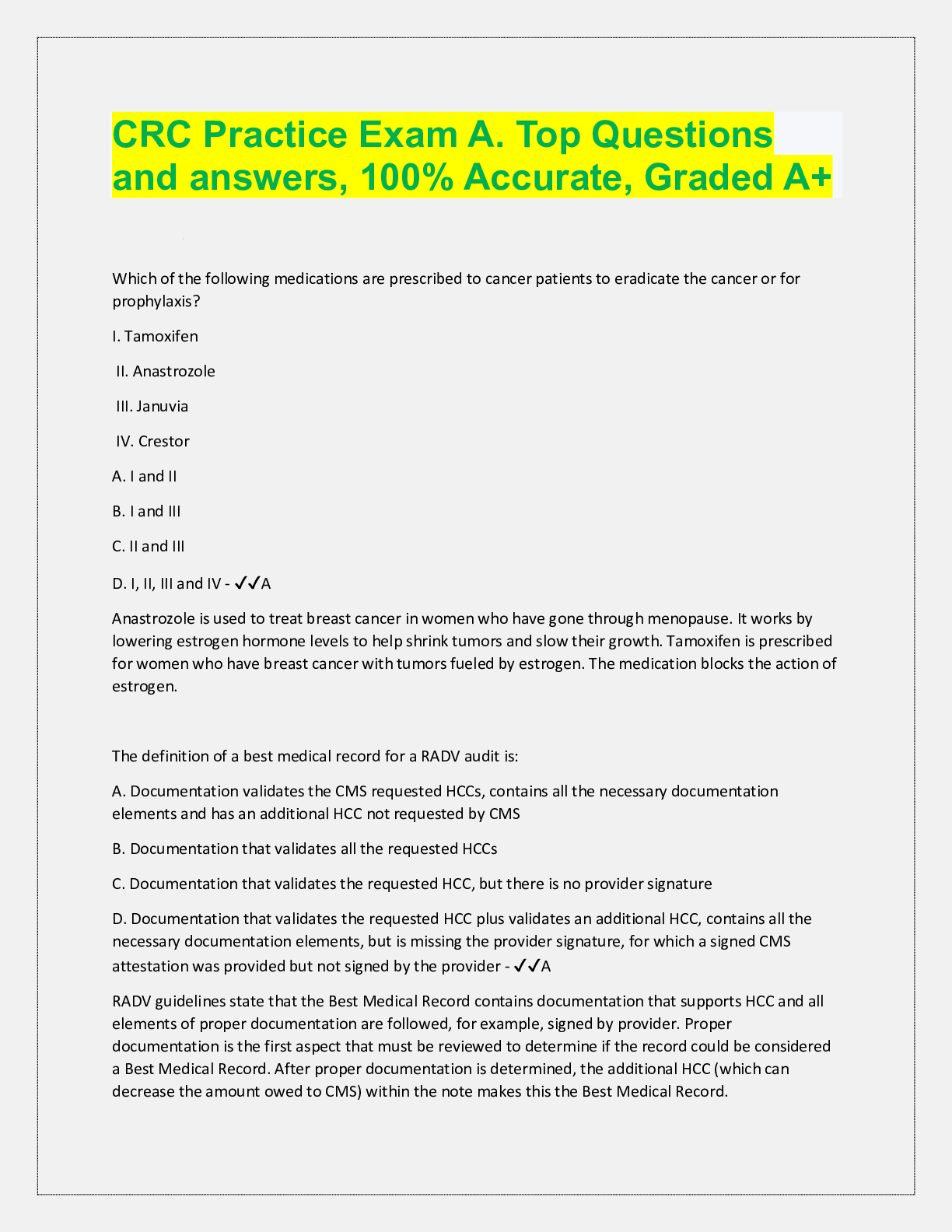
CRC Practice Exam A. Top Questions
and answers, 100% Accurate, Graded A+
Which of the following medications are prescribed to cancer patients to eradicate the cancer or for
prophylaxis?
I. Tamoxifen
II. Anastrozole
III. Januvia
IV. Crestor
A. I and II
B. I and III
C. II and III
D. I, II, III and IV - ✔✔A
Anastrozole is used to treat breast cancer in women who have gone through menopause. It works by
lowering estrogen hormone levels to help shrink tumors and slow their growth. Tamoxifen is prescribed
for women who have breast cancer with tumors fueled by estrogen. The medication blocks the action of
estrogen.
The definition of a best medical record for a RADV audit is:
A. Documentation validates the CMS requested HCCs, contains all the necessary documentation
elements and has an additional HCC not requested by CMS
B. Documentation that validates all the requested HCCs
C. Documentation that validates the requested HCC, but there is no provider signature
D. Documentation that validates the requested HCC plus validates an additional HCC, contains all the
necessary documentation elements, but is missing the provider signature, for which a signed CMS
attestation was provided but not signed by the provider - ✔✔A
RADV guidelines state that the Best Medical Record contains documentation that supports HCC and all
elements of proper documentation are followed, for example, signed by provider. Proper
documentation is the first aspect that must be reviewed to determine if the record could be considered
a Best Medical Record. After proper documentation is determined, the additional HCC (which can
decrease the amount owed to CMS) within the note makes this the Best Medical Record.
Which of the following are reported by a provider for beneficiaries in a Medicare Advantage Plan?
I. Nature of the presenting problem
II. Resolved conditions that have been treated in the past
III. Family history for all conditions
IV. All chronic conditions
A. I
B. II and III
C. I and IV
D. I, II, III and IV - ✔✔C
Providers must report all diagnoses that affect the patient's evaluation, care, and treatment, including:
Nature of the presenting problem All chronic conditions (such as atrial fibrillation, congestive heart
failure (CHF), chronic kidney disease (CKD), rheumatoid arthritis, diabetes with manifestations, chronic
obstruction pulmonary disease (COPD), all active cancers) History on any relevant past conditions ZV�codes (factors that influence health/status codes) E-codes (external causes of injury and poisoning, and
certain other consequences of external causes) HCC scores on individual members determine CMS
reimbursement to the plan. Diagnosis and demographic information should be captured at each face-to�face encounter to obtain a health-based measure of that member's future medical needs.
Which of the following records would be a good source for a retrospective chart audit?
A. DME documentation
B. Cardiologist records
C. Dietician notes
D. RN notes - ✔✔B
A cardiologist is the only approved provider provided as an answer option according to CMS for Risk
Adjustment
Retrospective audits should include the following attributes:
I. Provider signatures
II. Supporting documentation of the patient's diagnoses
III. DOS
A. I
B. II
C. I and II
D. I, II and III - ✔✔D
Which type of audit evaluates appropriate risk scores of patients?
A. ZPIC
B. RADV
C. RAC
D. CERT - ✔✔B
RADV (Risk Adjustment Data Validation) and IVA (Independent Validation Audit) are audits used in risk
adjustment models to verify submitted diagnoses of patients.
What information is required when submitting documentation to support a diagnosis for a RADV/IVA?
A. All patient records for the calendar year resulting in care for a chronic condition
B. All inpatient hospital records where a readmission occurred
C. A single DOS for outpatient records and the full inpatient set for hospital records
D. All professional provider documentation for the previous year - ✔✔C
When submitting documentation for a RADV/IVA, the submission should be the single date of service for
physician and other outpatient records, and the full hospital record from admission to discharge for
inpatient records supporting a diagnosis.
What is TRUE regarding the code assignment requirement for chronic kidney disease requiring dialysis
(N18.6)?
A. The diagnosis should only be reported when the patient is admitted to the hospital.
B. The diagnosis should only be reported when the patient is diagnosed with CKD and is actively being
treated by a specialist.
C. The patient should be diagnosed with CKD and is on chronic dialysis or receiving kidney transplants
are associated with this diagnosis.
D. The diagnosis should only be reported when the patient is diagnosed with chronic renal insufficiency.
- ✔✔C
This code assignment is supported by the inclusion terms under code N18.6, which state Chronic kidney
disease requiring chronic dialysis. Patients who are on chronic dialysis or receiving kidney transplants
may be considered as having end-stage renal disease (ESRD). Assign code N18.6.
Joey is prescribed Oxycodone for a back injury by his orthopedic surgeon two years ago. The surgeon
documents he would like to try another medication to dull the pain. Joey attempts to change to the
newer medication but there is breakthrough pain and he goes back to the Oxycodone. Would code from
category F11.2 be appropriate?
A. Yes, Joey has been on the Oxycodone for two years
B. Yes, Joey's pain could not be controlled by the second medication
C. No, a person must be on a medication a minimal of 3 years before "dependency" can be implied
D. No, the surgeon did not document that Joey was dependent on the Oxycodone - ✔✔D
If the patient is prescribed a narcotic for long-term use and the provider does not document "drug
dependence," assign code Z79.891, Long-term (current) use of opiate analgesic.
Diagnoses must be based on face-to face encounters between members and an MD, PA, or NP and
status conditions like a below knee amputation, must be assessed and documented in order for
payment adjustments to be received. How often should a provider see and assess a patient in a calendar
year to validate amputation status?
A. Twice a year
B. Once a year
C. Four times a year
D. Every two years - ✔✔B
Status conditions must reflect active conditions that require treatment or influence medical decision
making and be assessed at minimum, once per calendar year.
A PEG Tube is:
I. Percutaneous Endoscopic Gastrostomy
II. G tube
III. Gastrostomy
IV. Colostomy
A. I
B. I and III
C. I, II, and III
D. IV - ✔✔C
A PEG tube is called by all of these various names except colostomy.
Patient is here for follow up. She was seen in the ER two weeks ago where she had an MRI of the brain
which showed significant cerebral arteriosclerosis. She was diagnosed with a TIA. She has been
experiencing slight memory loss. Select the correct code(s).
A. I67.2, Z86.73
B. G45.9
C. Z86.73, R41.3
D. G45.9, I67.2, R41.3 - ✔✔A
I67.2 Cerebral atherosclerosis is the correct primary ICD-10-CM code. The personal history TIA code
Z86.73 is reported as the second code. Memory loss (R41.3) would not be reported as it is a symptom of
cerebral arteriosclerosis.
Patient is here for follow up after her dialysis yesterday. What is the ICD-10-CM code for presence of an
AV fistula for dialysis?
A. T82.818D
B. I77.0
C. Z49.31
D. Z99.2 - ✔✔D
In the ICD-10-CM Alphabetic Index look for Status/dialysis.
A patient presents for a routine checkup for his hypertensive heart failure. He is to continue with his
current medication and diet. Select the diagnosis code(s).
A. I50.40, I10
B. I11.0, I50.9
C. I50.9, I10
D. I50.9 - ✔✔B
There is a causal relationship between hypertension and heart failure report code I11.0. The heart
failure is reported as a second code, because of the instructional note under code I11.0 which indicates
to "use additional code to identify type of heart failure (I50.-)."
Today a 54-year-old man presents for his routine follow up after renal transplant two years ago. The
patient has CKD stage 2 and reports no other complaints. Assign the correct ICD-10-CM code(s).
A. N18.2, Z94.0
B. T86.10, Z94.0
C. T86.10
D. Z94.0, N18.2 - ✔✔A
ICD-10-CM guideline I.C.14.a.2), indicates that the presence of CKD after a transplant alone does not
constitute a transplant complication. Also, there is an instructional note below code category N18 in the
Tabular List indicating to use additional code to report transplant status.
A Type 2 diabetic presents with an insulin pump malfunction. What are the correct codes?
A. T85.694A, E11.9
B. T85.694A, E11.620
C. T82.598A, E11.9
D. T82.598A, E11.620 - ✔✔A
ICD-10-CM guideline I.C.4.a.5), indicates insulin pump malfunctions are coded to T85.6-. Insulin pump
malfunction can be an under dose or overdose of medication. With documentation that is non-specific
such as this, the only known element is pump malfunction. Z79.4 for long term (current) use of insulin is
not reported separately; the complication code for the insulin pump captures the long-term drug
therapy.
What is the correct ICD-10-CM code for a patient with COPD exacerbation?
A. J44.1
B. J44.9
C. J45.909
D. J44.9 - ✔✔A
To locate the correct code, look in the ICD-10-CM Alphabetic Index for Disease,
diseased/pulmonary/chronic obstructive/with/exacerbation.
The patient had hip replacement surgery three days ago. The provider documents the patient has had a
"iatrogenic cerebrovascular infarction due to recent hip replacement surgery during her current hospital
stay." Assign the appropriate ICD-10-CM code for the cardiovascular event.
A. I63.50
B. G45.9
C. I97.821
D. I63.9 - ✔✔C
ICD-10-CM guideline I.C.9.c., indicates cerebrovascular infarction that occurs as a result of medical
intervention is coded based on whether it was intraoperative or postprocedural. This was
postprocedural. Look in the in the ICD-10-CM Alphabetic Index for Stroke/postprocedural/following
other surgery referring you to I97.821. The Tabular List for subcategory I97.8 indicates to use an
additional code, if applicable, to further specify the disorder. We have not been given further
information such the location of the infarct, so no other code is required.
What is/are the correct code(s) for a nursing home patient with severe dementia often caught
wandering off from the floor?
A. F03.91, Z91.83
B. F02.81, Z91.83
C. F03.90, Z91.83
D. Z91.83 - ✔✔A
In the ICD-10-CM Alphabetic Index look for Dementia/with behavioral disturbance. The behavioral
disturbance is the wandering. There is an instructional note under code Z91.83 indicates to code first
underlying disorder.
Patient presents to OB for routine obstetric care. The nurse takes the patient's blood pressure and it
reads 140/80. The physician sees the patient and documents the following in the assessment and plan:
"A/P: Hypertension, Transient, Check BP at home daily and return to clinic in two days for nurse BP
check ". Assign the correct ICD-10-CM code(s).
A. I10
B. R03.0
C. O10.919, Z3A.00
D. O13.9, Z3A.00 - ✔✔D
ICD-10-CM guideline I.C.9.a.7), indicates to assign a code from category O13 for transient hypertension
in pregnancy. The trimester and the weeks of gestation are not documented resulting in use of
unspecified codes.
Which of the following is NOT true?
A. Conditions listed on the problem list for a diabetic patient are coded as complications of the diabetes.
B. If documentation does not state the type of diabetes but indicates the patient uses insulin report
Type 2 diabetes code (E11.-).
C. Documentation that indicates a cause and effect relationship includes "due to," "caused by," "with"
and "secondary to."
D. A causal relationship is assumed between diabetes and a complication when the term "with" links the
two together in the Alphabetic Index. - ✔✔A
Conditions listed on the problem list are not coded as complications of the diabetes unless the
documentation supports the causal relationship.
What is the correct ICD-10-CM code for an uncertain gastrointestinal stromal tumor?
A. C49.4
B. C26.9
C. D48.1
D. D37.8 - ✔✔C
In the Alphabetic Index look for Tumor/stromal/gastrointestinal/uncertain behavior. Coders are referred
to D48.1.
A 66 year-old male patient with AIDS presents with new onset of shortness of breath. Tests confirm the
patient has pneumocystis carinii pneumonia. Select the appropriate diagnosis code(s).
A. B59
B. B59, B20, R06.02
C. B20, B59
D. B20 - ✔✔C
The Official ICD-10-CM guideline I.C.1.a.2)(a), indicates if a patient is admitted with an HIV-related
condition you first sequence B20 followed the code for the HIV-related condition. Shortness of breath is
a symptom of the pneumonia and not reported (ICD-10-CM guideline I.B.5).
S. Patient returns for follow up of her osteoporosis on anabolic therapy. She continues on TERIPARATIDE
shots daily and will complete her two years of that in August of this year. She remains on VITAMIN D
reduced to once a week 50,000 units. O: Vital signs are recorded. Despite the above, she seems to be in
good spirits today. Moderate kyphotic posture of the thoracic spine noted. Lungs clear, cardiac exam
regular rate and rhythm. Vitamin D level was over 40 last time, having been undetectable in March. A:
Postmenopausal osteoporosis exacerbated by Vitamin D deficiency and suspected calcium
malabsorption. Seems to be stable at this point in that regard. P: 1. CBC, comprehensive metabolic
panel. May be able to back off further on her VITAMIN D. 2. When she returns next time in September
will obtain DXA to compare with the one she had a year ago. 3. She will complete her two years of
TERIPARATIDE injections in August. Select the diagnosis code(s).
A. M81.0
B. M81.0, E55.9
C. M81.0, E55.9, K90.89
D. M81.8, K90.89 - ✔✔B
[Show More]