LCSW Exam PREP Questions and
answers, 100% Accurate, Graded A+
Conscious
(Sigmund Freud's Psychoanalytic Theory of Personality) - ✔✔-This term refers to the mental activities in
which we are fully aware
Preconsci
...
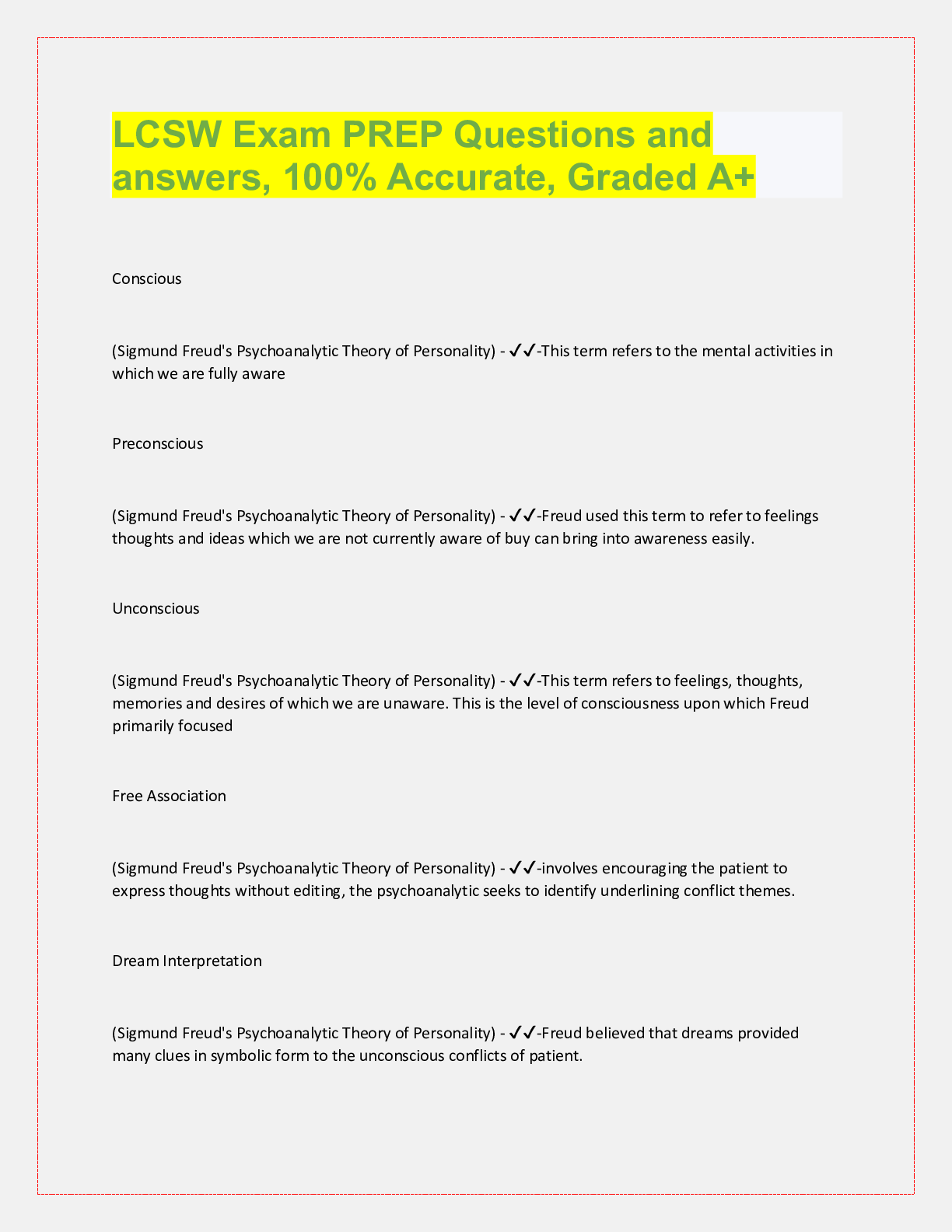
LCSW Exam PREP Questions and
answers, 100% Accurate, Graded A+
Conscious
(Sigmund Freud's Psychoanalytic Theory of Personality) - ✔✔-This term refers to the mental activities in
which we are fully aware
Preconscious
(Sigmund Freud's Psychoanalytic Theory of Personality) - ✔✔-Freud used this term to refer to feelings
thoughts and ideas which we are not currently aware of buy can bring into awareness easily.
Unconscious
(Sigmund Freud's Psychoanalytic Theory of Personality) - ✔✔-This term refers to feelings, thoughts,
memories and desires of which we are unaware. This is the level of consciousness upon which Freud
primarily focused
Free Association
(Sigmund Freud's Psychoanalytic Theory of Personality) - ✔✔-involves encouraging the patient to
express thoughts without editing, the psychoanalytic seeks to identify underlining conflict themes.
Dream Interpretation
(Sigmund Freud's Psychoanalytic Theory of Personality) - ✔✔-Freud believed that dreams provided
many clues in symbolic form to the unconscious conflicts of patient.
Instincts
(The structure of personality-Sigmund Freud's Psychoanalytic Theory of Personality) - ✔✔-inborn factors
that give force and direction to psychological activities.
Eros
(The structure of personality-Sigmund Freud's Psychoanalytic Theory of Personality) - ✔✔-Life instinct�its influence is seen in constructive, loving and and selfless acts
Thanatos
(The structure of personality-Sigmund Freud's Psychoanalytic Theory of Personality) - ✔✔-Death
instinct- its influence is seen in destructive, hateful and aggressive acts
The id
(The structure of personality-Sigmund Freud's Psychoanalytic Theory of Personality) - ✔✔-Only part of
personality that is present at birth. It is unconscious and operates upon the pleasure principle and seeks
immediate gratification of instinctual urges with no regards for anything or anyone else. Ex. A newborn
is seen in id and only has a desire to be fed, changed and eventually develops a need for objects (it's
mother)
The ego
(The structure of personality-Sigmund Freud's Psychoanalytic Theory of Personality) - ✔✔-Develops
from the id. The development of the ego is intertwined with the psychosexual development of the child.
The ego gives the person the power to go beyond being able to keep an image of a need gratifying
object in mind to actually getting needs met. The ego uses perceiving, remembering, analyzing and
acting.
The Superego
(The structure of personality-Sigmund Freud's Psychoanalytic Theory of Personality) - ✔✔-Has two
aspects and arises from the go. The infant's only morality is acting to get pleasure and avoid pain. This is
also intertwined with the psychosexual development of the child. The Superego takes over the position
of the parents (observes, judges, rewards and punishes the child).
The Conscious- contains the "should nots" things for which one has been punished
The Ego Ideal- contains the "shoulds", feelings of righteousness and pride. Punishment include feelings
of guilt and shame.
Psychosexual stages of Development
(Sigmund Freud's Psychoanalytic Theory of Personality: Psychosexual Stages of Development) - ✔✔-At
each stage of development, a different part of the body is the primary source of erotic pleasure. If there
is insufficient or excessive satisfaction of the needs associated with each stage, this results in fixation
(arrested development) . The child's experience at each stage will determine adult personalities as well
as character of future relationships. Trauma can result in fixation because it is often associated with
under-gratification.
Stage 1: Oral Stage (birth to 1 year)
(Sigmund Freud's Psychoanalytic Theory of Personality: Psychosexual Stages of Development) - ✔✔-
Breastfeeding is the initial object for cathexis (the concentration of mental energy for a person, idea or
object) the breast is nourishment.
Stimulation of the lips when not eating reveals a need for satisfaction.
The growing infant also comes to use the mouth as means of investigating the world
Stage 2: Anal Stage (2-3 years)
(Sigmund Freud's Psychoanalytic Theory of Personality: Psychosexual Stages of Development) - ✔✔-
During this stage much attention is focused on teaching the child control over bowel/urinary functions.
The primary focus area associated with erotic pleasure is the anus.
Stage 3: Phallic Stage (3-5 years)
(Sigmund Freud's Psychoanalytic Theory of Personality: Psychosexual Stages of Development) - ✔✔-
During this stage the penis/clitoris and vulva become a source of erotic pleasure. The child begins to
associate pleasure derived from self-stimulation with a love object (mother for boy; father for girl)
Oedipus Complex- the concept of a boy who wants to possess his mother but the presence of his father
makes this impossible
Electra Complex- the concept of a girl who wants to possess his mother but the presence of this father
makes this impossible
Stage 4 - Latency Period (6-11 years)
(Sigmund Freud's Psychoanalytic Theory of Personality: Psychosexual Stages of Development) - ✔✔-
Although the genital area continues to be the primary zone of gratification, during this stage the sexual
feelings typically continue to be repressed, resulting in the resolution of the Oedipus Complex .
The boys and girls cease masturbating out of fear of castration and the loss of parental love respectively.
Stage 5 (12-Adulthood)
(Sigmund Freud's Psychoanalytic Theory of Personality: Psychosexual Stages of Development) - ✔✔-The
primary focus of erotic pleasure if the genitals. The main focus turns to members of the opposite sex.
Repression
(Ego Defense Mechanisms
Anna Freud) - ✔✔-the unconscious pushing of anxiety-producing thoughts and issues out of the
conscious and into the unconscious
Compensation
(Ego Defense Mechanisms
Anna Freud) - ✔✔-the seeking of success in one area of life as a substitute for success in another area of
life in which the individual is barred from excelling because of environmental barriers.
Conversion
(Ego Defense Mechanisms
Anna Freud) - ✔✔-is a mechanism by which anxiety is transformed into a physical dysfunction such as
paralysis or blindness that does not have a physiological basis.
Denial
(Ego Defense Mechanisms
Anna Freud) - ✔✔-is a refusal to acknowledge an aspect of reality, including one's experience, because
to do so would result in overwhelming anxiety.
Displacement
(Ego Defense Mechanisms
Anna Freud) - ✔✔-is shifting if negative feelings one has about a person or situation onto a different
person or situation.
Identification
(Ego Defense Mechanisms
Anna Freud) - ✔✔-is a mechanism by which anxiety is handled through identifying with the person or
thing producing the anxiety, such as "identifying the kidnapper"
Isolation of Affect
(Ego Defense Mechanisms
Anna Freud) - ✔✔-painful feelings are separated from the incident that triggered them initially
Intellectualization
(Ego Defense Mechanisms
Anna Freud) - ✔✔-anxiety is handled through talking and thinking about issues rather than dealing with
the underlying feelings.
Projection
(Ego Defense Mechanisms
Anna Freud) - ✔✔-one's own negative characteristics are denied and instead being seen as being
characteristics of someone else.
Rationalization
(Ego Defense Mechanisms
Anna Freud) - ✔✔-when a person substitutes a more socially acceptable reason for an action for an
action for the actual reason
Reaction Formation
(Ego Defense Mechanisms
Anna Freud) - ✔✔-is adopting the behavior that is antithesis of the instinctual urge (acting as if one has
deep sympathies for an oppressed group when the individual actually has significant prejudices against
that group)
Regression
(Ego Defense Mechanisms
Anna Freud) - ✔✔-is reverting to more primitive modes of coping associated with earlier and safer
developmental periods
Sublimation
(Ego Defense Mechanisms
Anna Freud) - ✔✔-when intolerable drives or desires are diverted into activities which are acceptable
Undoing
(Ego Defense Mechanisms
Anna Freud) - ✔✔-when an individual engages in a repetitious ritual in an attempt to reverse an action
previously taken
Piaget's Developmental Theory (Cognitive Development) - ✔✔-Children move to increasingly
sophisticated thought processes as they progress through the 4 stages
Piaget's 4 stages of Cognitive development - ✔✔-1. Infancy (0-2 yrs) - Sensorimotor
2. Childhood (2-7) Preoperational
3 Preadolescence (7-11) Concrete
4 Adolescence (11 and up) Formal
Infancy - Sensorimotor 0-2yrs (Piagets stages of cognitive development) - ✔✔-0 -2 years- Infants learn
through touching (senses) to form language
Childhood- Preoperational 2-7yrs Piagets stages of cognitive development - ✔✔-2-7 years children are
not able to converse about problem solving. Children experience the greatest language growth and can
classify objects in more than one way.
Preadolescence- Concrete 7-11 (Piagets stages of cognitive development) - ✔✔-7-11 years. Children
have developed conversation skills. Reversible thinking is developed. Children move toward logical
thought and can distinguish reality from fantasy.
Adolescence- Adulthood- Formal 11 & up (Piagets stages of cognitive development) - ✔✔-Capable of
abstract thought and scientific experimentation
Gilligan's Theory of Moral reasoning (Dev. Thry) - ✔✔-People progress in their moral reasoning (ethical
behavior) through a series of stages.
Stage 1- Obedience and Punishment (Infancy)
Stage 2 - Self Interest (Preschool)
Stage 3 - Conformity and Interpersonal Accord (School age)
Stage 4 - Authority and Social Order (School Age)
Stage 5- Social Contract (Teens)
Stage 6 - Universal Principles (Adulthood)
Stage 1- Obedience and Punishment (Gilligan's Theory of Moral reasoning) - ✔✔-Infancy- behave
according to social acceptable norms
Stage 2 - Self Interest (Gilligan's Theory of Moral reasoning) - ✔✔-Preschool- Interests shift to rewards
rather than punishment. Effort is made to secure greatest benefit for oneself.
Stage 3 - Conformity and Social Order (Gilligan's Theory of Moral reasoning) - ✔✔-School Age- The good
girl/boy level. Effort is made to secure approval and maintain friendly relations with others.
Stage 4- Authority and Social Order (Gilligan's Theory of Moral reasoning) - ✔✔-School Age- Orientation
towards fixed rules. The purpose of morality is maintaining the social order. Interpersonal accord is
expanded to include the society.
Stage 5 - Social Contract (Gilligan's Theory of Moral reasoning) - ✔✔-Teens- Mutual benefit, reciprocity
and morally right are not always the same utilitarian (practical) rules that make a better life for all.
Stage 6 - Universal Principles (Gilligan's Theory of Moral reasoning) - ✔✔-Adulthood- Morality is based
on principals that transcend (go beyond) mutual benefit.
Micro level - ✔✔-Individual level
Mezzo - ✔✔-Focuses on family and groups
Macro - ✔✔-Focuses on community and working with policies.
Two views of social welfare - ✔✔-Institutional view and residual view
Institutional view - ✔✔-Prevention focus that focuses on solving individual difficulties. No stigma is
attached to this view.
Residual view - ✔✔-Services provided only when other systems fail (family and market economy). Short
term emergency based, the receiver has obligation.
Stigma associated with residual view - ✔✔-Band- aid approach. 1st to ask people to seek help from
family, then if that fails go to residual welfare.
Example of universal residual program - ✔✔-FEMA
Example universal institutional program - ✔✔-Education
Example of Selective Residual Program - ✔✔-Food stamps, Fire and police stations.
Homeostasis - ✔✔-need for all systems to balance and maintain functioning.
Sustainability - ✔✔-Environmental term, using resources in a way that benefits the world.
Ethnocentrism - ✔✔-Looking at self and accepting own beliefs, no one else's'.
Kohlberg's stages of moral development - ✔✔-Preconventional - Heteronymous morality
Conventional - Interpersonal experiences
Post-conventional - Ethics
Formal operations (11- adulthood) s.
Preconventional - Hetronymous activity (Dev. Therory)
Kohlberg's stages of moral development - ✔✔-Accepting what the world says is
right. Defining the good as whatever is agreeable to the self
and those in the immediate environment.
Conventional - Interpersonal experiences (Dev. Thry)
Kohlberg's stages of moral development - ✔✔-Seeking conformity and consistency in moral action with
significant others. The societal point of view - Seeking
conformity and consistency with what one perceives to be the opinions of the larger
community.
Post-conventional - Ethics
Kohlberg's stages of moral development - ✔✔-Observing individual and group (societal) rights.
Conscience and logic. Seeking to apply universal principles of right and wrong.
Formal Operations
Kohlberg's stages of moral development - ✔✔-The person becomes able to solve real and hypothetical
problems using abstract concepts.
Transpersonal theories of human development - ✔✔-(Transpersonal - means beyond or
through the persona or mask. Going beyond identity rooted in the individual body
or ego to include spiritual experience or higher levels of consciou
[Show More]