AHA PALS Practice exam Questions &
Answers. Graded A+ Verified.
1. A 5-year-old child presents with lethargy, increased work of breathing, and pale color. The primary
assessment reveals that the airway is open and t
...
AHA PALS Practice exam Questions &
Answers. Graded A+ Verified.
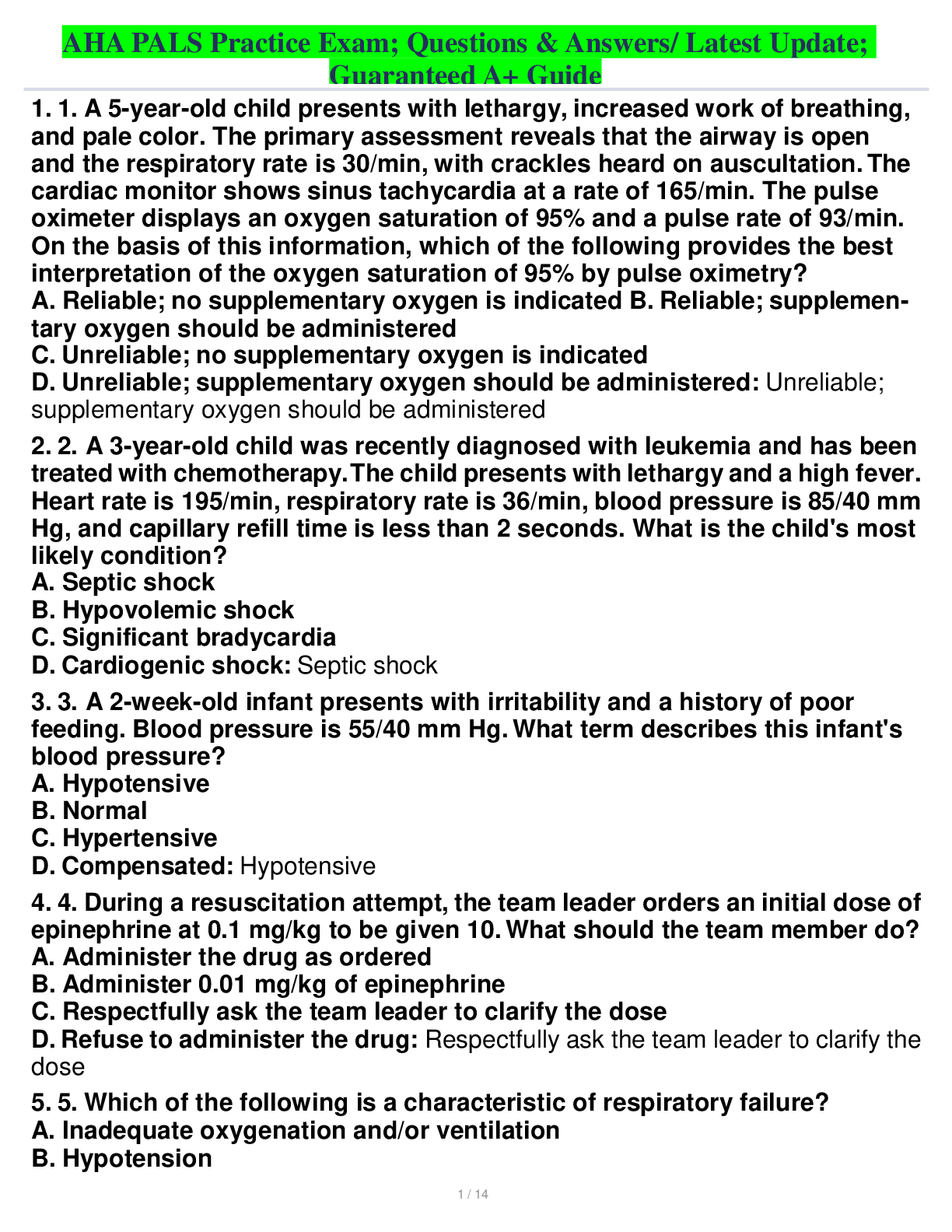
1. A 5-year-old child presents with lethargy, increased work of breathing, and pale color. The primary
assessment reveals that the airway is open and the respiratory rate is 30/min, with crackles heard on
auscultation. The cardiac monitor shows sinus tachycardia at a rate of 165/min. The pulse oximeter
displays an oxygen saturation of 95% and a pulse rate of 93/min. On the basis of this information, which
of the following provides the best interpretation of the oxygen saturation of 95% by pulse oximetry?
A. Reliable; no supplementary oxygen is indicated B. Reliable; supplementary oxygen should be
administered
C. Unreliable; no supplementary oxygen is indicated
D. Unreliable; supplementary oxygen should be administered - ✔✔-Unreliable; supplementary oxygen
should be administered
2. A 3-year-old child was recently diagnosed with leukemia and has been treated with chemotherapy.
The child presents with lethargy and a high fever. Heart rate is 195/min, respiratory rate is 36/min,
blood pressure is 85/40 mm Hg, and capillary refill time is less than 2 seconds. What is the child's most
likely condition?
A. Septic shock
B. Hypovolemic shock
C. Significant bradycardia
D. Cardiogenic shock - ✔✔-Septic shock
3. A 2-week-old infant presents with irritability and a history of poor feeding. Blood pressure is 55/40
mm Hg. What term describes this infant's blood pressure?
A. Hypotensive
B. Normal
C. Hypertensive
D. Compensated - ✔✔-Hypotensive
4. During a resuscitation attempt, the team leader orders an initial dose of epinephrine at 0.1 mg/kg to
be given 10. What should the team member do?
A. Administer the drug as ordered
B. Administer 0.01 mg/kg of epinephrine
C. Respectfully ask the team leader to clarify the dose
D. Refuse to administer the drug - ✔✔-Respectfully ask the team leader to clarify the dose
5. Which of the following is a characteristic of respiratory failure?
A. Inadequate oxygenation and/or ventilation
B. Hypotension
C. An increase in serum pH (alkalosis)
D. Abnormal respiratory sounds - ✔✔-Inadequate oxygenation and/or ventilation
6. Which of the following is most likely to produce a prolonged expiratory phase and wheezing?
A. Disordered control of breathing
B. Hypovolemic shock
C. Lower airway obstruction
D. Upper airway obstruction - ✔✔-Lower airway obstruction
7. A 4-year-old child presents with seizures and irregular respirations. The seizures stopped a few
minutes ago. Which of the following most likely to be abnormal?
A. Vascular resistance
B. Pulse rate
C. Lung compliance
D. Control of breathing - ✔✔-Control of breathing
8. What abnormality is most likely to be present in children with acute respiratory distress caused by
lung tissue disease?
A. Decreased oxygen saturation
B. Stridor
C. Normal respiratory rate
D. Decreased respiratory effort - ✔✔-Decreased oxygen saturation
9. An alert 2-year-old child with an increased work of breathing and pink color is being evaluated. Heart
rate is 110/min, and respiratory rate is 30/min. What would best describe this patient's condition? A.
Respiratory distress
B. Respiratory arrest
C. Respiratory failure
D. Disordered control of breathing - ✔✔-Respiratory distress
10. The parents of a 7-year-old child who is undergoing chemotherapy report that the child has been
febrile and has not been feeling well, with recent onset of lethargy. Assessment reveals the following:
The child is difficult to arouse, with pale color. The child's heart rate is 160/min, respiratory rate is
30/min, blood pressure is 76/45 mm Hg, capillary refill time is 5 to 6 seconds, and temperature is 103°F
(39.4°C). What is the most appropriate intervention?
A. Obtain vascular access and administer 20 mL/kg of isotonic crystalloid over 30 minutes
B. Obtain vascular access and administer 20 mL/kg of isotonic crystalloid over 5 to 10 minutes
C. Obtain immediate blood cultures and chest x-ray D. Obtain expert consultation with an oncologist to
determine the chemotherapeutic regimen - ✔✔-Obtain vascular access and administer 20 mL/kg of
isotonic crystalloid over 5 to 10 minutes
11. A 2-year-old child presents with a 4-day history of vomiting. The initial impression reveals an
unresponsive child with intermittent apnea and mottled color. Heart rate is 166/min, respiratory rate is
now being supported with bag-mask ventilation, capillary refill time is 5 to 6 seconds, and temperature
is 102°F (38.9°C). What is the best method of establishing immediate vascular access? A. Two providers
may attempt peripheral vascular access twice each
B. Three providers may attempt peripheral vascular access once each
C. Place a central venous line
D. Place an intraosseous line - ✔✔-Place an intraosseous line
12. What is the appropriate fluid bolus to administer for a child with hypovolemic shock with adequate
myocardial function?
A. 10 mL/kg normal saline
B. 20 mL/kg of 5% dextrose and 0.2% sodium chloride
C. 20 mL/kg normal saline
D. 10 mL/kg lactated Ringer's - ✔✔-20 mL/kg normal saline
13. An alert toddler presents with a barking cough, moderate stridor, and moderate retractions. The
child's color is pink. What is the most appropriate initial intervention?
A. Obtain a chest radiograph
B. Administer nebulized epinephrine
C. Prepare for a surgical airway
D. Use an epinephrine autoinjector - ✔✔-Administer nebulized epinephrine
14. An 8-year-old child presents with a history of vomiting and diarrhea. The child has the following vital
signs: heart rate 168/min, respiratory rate 15/min, blood pressure 9060 mm Hg, and temperature 98.6°F
(37°C). The child's capillary refill time is 4 seconds. After 2 IV boluses of normal saline (20 mL/kg each),
the child's vital signs are now as follows: heart rate 130/min, respiratory rate 16/min, blood pressure
94/62 mm Hg, capillary refill 2 seconds, and temperature 98.6°F (37°C). The child's urine output is 1 to 2
mL/kg in the past hour. The child is still lethargic. What diagnostic tests or information should be
obtained first?
A. Arterial blood gas
B. Serum potassium concentration
C. Glucose
D. A 12-lead ECG - ✔✔-Glucose
15. A 15-year-old boy presents with acute onset of severe respiratory distress, with retractions and an
oxygen saturation of 85%. His trachea is deviated to the right, and there are no breath sounds on the
left. His heart rate is 140/min, his blood pressure is 84/60 mm Hg, and his capillary refill time is 3
seconds. What is the most appropriate intervention?
A. Obtain a chest x-ray
B. Perform needle decompression on the left chest C. Insert a chest tube on the left side
D. Insert an IV and administer 20 mL/kg of normal saline - ✔✔-Perform needle decompression on the
left chest
16. A 4-year-old is being treated for hypovolemic shock and has received a single fluid bolus of 20 mL/kg
of normal saline. On reevaluation the child remains anxious, with a heart rate of 140/min, a blood
pressure of 84/54 mm Hg, and a capillary refill time of 4 seconds. What describes this patient's
condition?
A. Hypotensive shock
B. Compensated shock
C. No longer in shock
D. Cardiogenic shock - ✔✔-Compensated shock
17. An 8-year-old child had a sudden onset of palpitations and light-headedness. At the time of
evaluation the child is alert. His respiratory rate is 26/ min, and his blood pressure is 104/70 mm Hg. A
cardiac monitor is applied, and the rhythm below is noted. What is the most appropriate initial
intervention?
A. Provide synchronized cardioversion at 0.5 to 1 J/kg
B. Attempt vagal maneuvers
C. Administer adenosine 0.1 mg/kg over 5 minutes D. Administer amiodarone 5 mg/kg over 20 minutes -
✔✔-Attempt vagal maneuvers
18. A 10-year-old child had a sudden witnessed cardiac arrest and received immediate bystander CPR
and defibrillation within 3 minutes. He had a return of spontaneous circulation. The child remains
unresponsive and has an advanced airway in place. There is no history of trauma or signs of shock. What
is the target range for oxygen saturation for this child?
A. 92% to 100%
B. 92% to 99%
C. 94% to 99%
D. 94% to 100% - ✔✔-94% to 99%
19. A 3-month-old infant with bronchiolitis is suctioned to remove upper airway secretions. The infant's
heart rate decreases from 155/min to 65/min as shown below. The infant remains alert, with easily
palpable pulses. Capillary refill time is 1 second. What is the most appropriate initial intervention?
A. Administer oxygen and ensure adequate ventilation; be prepared to intervene further if heart rate
does not increase
B. Establish IV/IO access and administer epinephrine 0.01 mg/kg IV
C. Establish IV/IO access and administer atropine 0.02 mg/kg IV
D. Call for help and prepare to provide transthoracic pacing/transvenous pacing - ✔✔-Administer
oxygen and ensure adequate ventilation; be prepared to intervene further if heart rate
20. A 3-month-old infant with bronchiolitis is intubated for management of respiratory failure. During
transport, the infant develops bradycardia with a heart rate of 60/min, and the infant's oxygen
saturation decreases to 75%. There are breath sounds on the right side, but no air entry is heard on the
left side. What is the most appropriate initial intervention?
A. Administer epinephrine 0.01 mg/kg IV
B. Place a chest tube on the left
C. Verify the endotracheal tube position
D. Aggressively suction the endotracheal tube - ✔✔-Verify the endotracheal tube position
21. For a 6-month-old infant with supraventricular tachycardia and adequate perfusion, which of the
following is the preferred vagal maneuver?
A. Ocular pressure
B. Carotid pressure
C. Valsalva maneuver
D. Ice to the face - ✔✔-Ice to the face
22. A child presents with severe respiratory distress, urticaria, stridor, and tachycardia about 10 minutes
after eating peanuts. What is the most appropriate initial medication for this child?
A. Nebulized albuterol
B. Epinephrine IM
C. Isotonic crystalloid IV
D. Methylprednisolone - ✔✔-Epinephrine I
[Show More]


.png)