EMT Midterm Exam Questions and
answers, 100% Accurate, rated A+
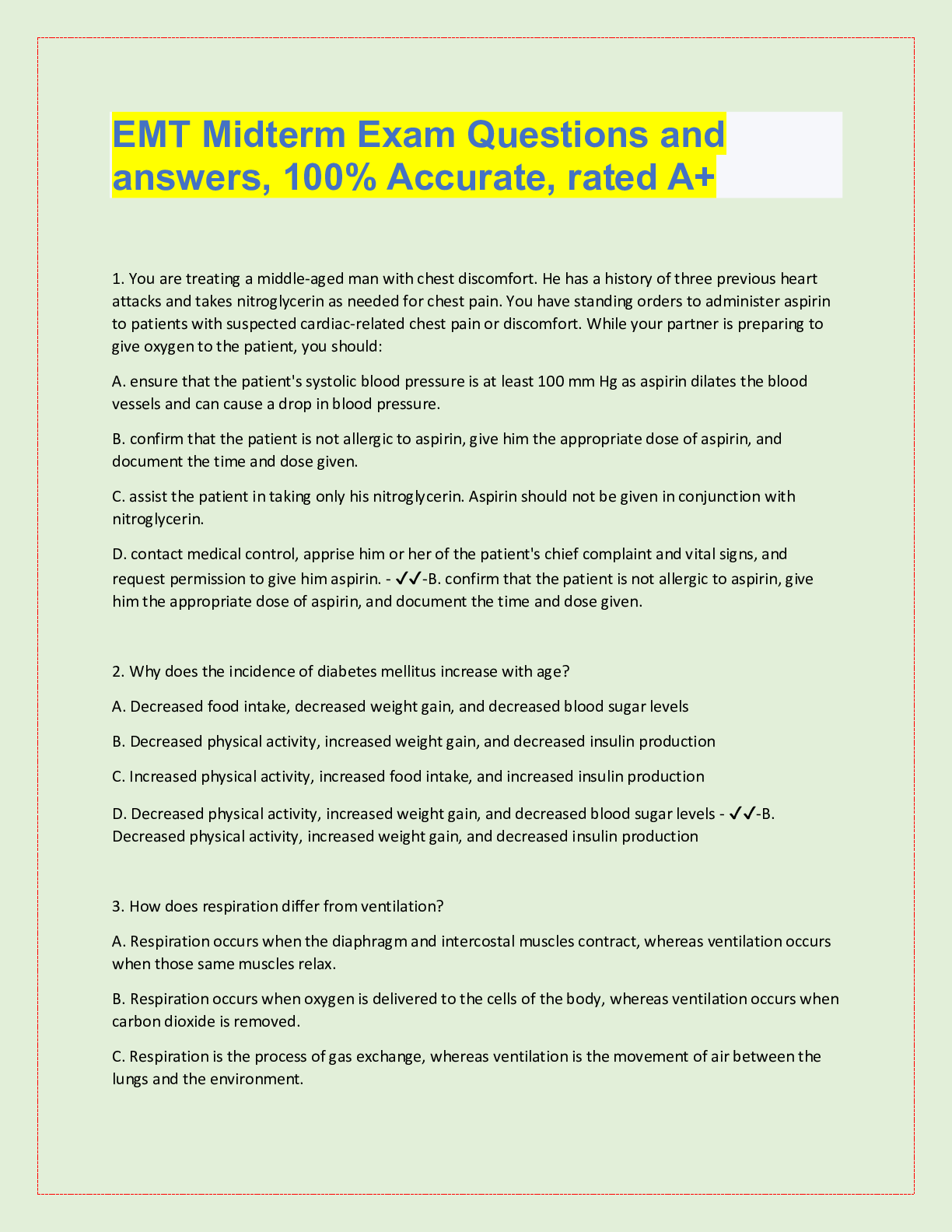
1. You are treating a middle-aged man with chest discomfort. He has a history of three previous heart
attacks and takes nitroglycerin as needed for che
...
EMT Midterm Exam Questions and
answers, 100% Accurate, rated A+
1. You are treating a middle-aged man with chest discomfort. He has a history of three previous heart
attacks and takes nitroglycerin as needed for chest pain. You have standing orders to administer aspirin
to patients with suspected cardiac-related chest pain or discomfort. While your partner is preparing to
give oxygen to the patient, you should:
A. ensure that the patient's systolic blood pressure is at least 100 mm Hg as aspirin dilates the blood
vessels and can cause a drop in blood pressure.
B. confirm that the patient is not allergic to aspirin, give him the appropriate dose of aspirin, and
document the time and dose given.
C. assist the patient in taking only his nitroglycerin. Aspirin should not be given in conjunction with
nitroglycerin.
D. contact medical control, apprise him or her of the patient's chief complaint and vital signs, and
request permission to give him aspirin. - ✔✔-B. confirm that the patient is not allergic to aspirin, give
him the appropriate dose of aspirin, and document the time and dose given.
2. Why does the incidence of diabetes mellitus increase with age?
A. Decreased food intake, decreased weight gain, and decreased blood sugar levels
B. Decreased physical activity, increased weight gain, and decreased insulin production
C. Increased physical activity, increased food intake, and increased insulin production
D. Decreased physical activity, increased weight gain, and decreased blood sugar levels - ✔✔-B.
Decreased physical activity, increased weight gain, and decreased insulin production
3. How does respiration differ from ventilation?
A. Respiration occurs when the diaphragm and intercostal muscles contract, whereas ventilation occurs
when those same muscles relax.
B. Respiration occurs when oxygen is delivered to the cells of the body, whereas ventilation occurs when
carbon dioxide is removed.
C. Respiration is the process of gas exchange, whereas ventilation is the movement of air between the
lungs and the environment.
D. Ventilation occurs when air is forced into the lungs, whereas respiration occurs when air is drawn or
sucked into the lungs. - ✔✔-C. Respiration is the process of gas exchange, whereas ventilation is the
movement of air between the lungs and the environment.
4. During a 30-minute transport of a stable patient, you should reassess him or her at least ________
times.
A. 2
B. 6
C. 4
D. 3 - ✔✔-A. 2
5. Which of the following glands regulates the function of all other endocrine glands in the body?
A. Pituitary
B. Parathyroid
C. Thyroid
D. Adrenal - ✔✔-A. Pituitary
6. Activated charcoal is an example of a(n):
A. suspension.
B. elixir.
C. gel.
D. solution. - ✔✔-A. suspension.
7. In which of the following patients would the head tilt-chin lift maneuver be the MOST appropriate
method of opening the airway?
A. A 50-year-old male who is unconscious following head trauma
B. A 37-year-old female who is found unconscious in her bed
C. A 24-year-old male who is found unconscious at the base of a tree
D. A 45-year-old male who is semiconscious after falling 20 feet - ✔✔-B. A 37-year-old female who is
found unconscious in her bed
8. A 19-year-old male was stung multiple times by fire ants. He is experiencing obvious signs and
symptoms of anaphylactic shock. You administer high-flow oxygen and give him epinephrine via
intramuscular injection. Upon reassessment, you determine that his condition has not improved. You
should:
A. consider that he may actually be experiencing an acute asthma attack.
B. request a paramedic unit that is stationed approximately 15 miles away.
C. provide only supportive care en route to the hospital.
D. repeat the epinephrine injection with the appropriate medical control. - ✔✔-D. repeat the
epinephrine injection with the appropriate medical control.
9. An infant's blood pressure typically increases with age because:
A. the infant's total blood volume decreases with age.
B. his or her normal heart rate usually increases with age.
C. as the infant gets older, his or her blood vessels dilate.
D. blood pressure directly corresponds to body weight. - ✔✔-D. blood pressure directly corresponds to
body weight.
10. A 51-year-old female presents with a sudden onset of difficulty breathing. She is conscious and alert
and able to speak in complete sentences. Her respirations are 26 breaths/min and regular. You should:
A. insert a nasal airway in case her mental status decreases.
B. assist her ventilations with a bag-valve mask.
C. administer oxygen via a nonrebreathing mask.
D. perform a secondary assessment and then begin treatment. - ✔✔-C. administer oxygen via a
nonrebreathing mask.
11. You suspect that a pregnant 16-year-old girl has a broken leg after she was hit by a car. You explain
that you plan to splint her leg, and she agrees to treatment. Which type of consent is her agreement
considered?
A. Minor's
B. Informed
C. Implied
D. Expressed - ✔✔-D. Expressed
12. Alkalosis is a condition that occurs when:
A. dangerous acids accumulate in the bloodstream.
B. the level of carbon dioxide in the blood increases.
C. slow, shallow breathing eliminates too much carbon dioxide.
D. blood acidity is reduced by excessive breathing. - ✔✔-D. blood acidity is reduced by excessive
breathing.
13. Inadequate circulation of blood throughout the body is called ________.
A. hypotension
B. shock
C. hypoxia
D. perfusion - ✔✔-B. shock
14. An infant or small child's airway can be occluded if it is overextended or overflexed because:
A. the tongue is proportionately small and can fall back into the throat.
B. he or she has a long neck, which makes the trachea prone to collapse.
C. the back of the head is flat, which prevents a neutral position.
D. the occiput is proportionately large and the trachea is flexible. - ✔✔-D. the occiput is proportionately
large and the trachea is flexible.
15. Major risk factors for AMI include all of the following, EXCEPT:
A. hypoglycemia.
B. hypertension.
C. diabetes mellitus.
D. elevated cholesterol. - ✔✔-A. hypoglycemia.
16. Which of the following conditions or situations would MOST likely make excited delirium worse?
A. Alcohol withdrawal
B. Limited physical contact
C. Dimly lit environment
D. Elevated blood glucose - ✔✔-A. Alcohol withdrawal
17. Nitroglycerin, when given to patients with cardiac-related chest pain:
A. increases blood return to the right atrium.
B. constricts the veins throughout the body.
C. increases myocardial contraction force.
D. relaxes the walls of the coronary arteries. - ✔✔-D. relaxes the walls of the coronary arteries.
18. The body's backup system of respiratory control, which is based on low concentrations of oxygen in
the blood, is called the:
A. oxyhemoglobin drive.
B. hypocarbic drive.
C. hypoxic drive.
D. pneumotaxic drive. - ✔✔-C. hypoxic drive.
19. An area of swelling or enlargement in a weakened arterial wall is called:
A. a thrombus.
B. atherosclerosis.
C. an aneurysm.
D. an embolism. - ✔✔-C. an aneurysm.
20. You respond to a residence for a patient with a severe leg injury following an accident with a
chainsaw. When you arrive, you find the patient, a 44-year-old male, lying supine in the backyard. He
has a partial amputation of his right lower leg that is actively bleeding. The patient is conscious and
breathing adequately; however, he is restless and his skin is diaphoretic. You should:
A. immediately splint his leg
B. assess the rate and quality of his pulse.
C. immediately evaluate his airway.
D. administer 100% supplemental oxygen. - ✔✔-C. immediately evaluate his airway.
21. The term "supraventricular tachycardia" means:
A. a rapid heart rate that originates from within the ventricles.
B. a slow heart rate that originates from within the ventricles.
C. a rapid heart rate that originates from above the ventricles.
D. a slow heart rate that originates from above the ventricles. - ✔✔-C. a rapid heart rate that originates
from above the ventricles.
22. Which of the following medication routes delivers a drug through the skin over an extended period
of time, such as a nitroglycerin or nicotine patch?
A. Subcutaneous
B. Intraosseous
C. Transcutaneous
D. Sublingual - ✔✔-C. Transcutaneous
23. A patient with spontaneous respirations is breathing:
A. at a normal rate.
B. with shallow depth.
C. without difficulty.
D. without assistance. - ✔✔-D. without assistance.
24. In order for efficient pulmonary gas exchange to occur:
A. the percentage of inhaled carbon dioxide must exceed the percentage of inhaled oxygen.
B. there must be low quantities of pulmonary surfactant to allow for full alveolar expansion.
C. oxygen and carbon dioxide must be able to freely diffuse across the alveolar-capillary membrane.
D. the pulmonary capillaries must be completely constricted and the alveoli must be collapsed. - ✔✔-C.
oxygen and carbon dioxide must be able to freely diffuse across the alveolar-capillary membrane.
25. Which of the following descriptions MOST accurately portrays emergency medical services (EMS)?
A. A vast network of advanced life support (ALS) providers who provide definitive emergency care in the
prehospital setting
B. A system composed exclusively of emergency medical responders (EMRs) and emergency medical
technicians (EMTs) who are responsible for providing care to sick and injured patients
C. A team of health care professionals who are responsible for providing emergency care and
transportation to the sick and injured
D. A team of paramedics and emergency physicians who are responsible for providing emergency care
to critically injured patients - ✔✔-C. A team of health care professionals who are responsible for
providing emergency care and transportation to the sick and injured
26. Crackles (rales) are caused by _________.
A. air passing through fluid
B. severe bronchoconstriction
C. mucus in the larger airways
D. narrowing of the upper airways - ✔✔-A. air passing through fluid
27. When assessing the skin of an unresponsive patient, you note that it has a bluish tint to it. This
finding is called:
A. flushing.
B. pallor.
C. mottling.
D. cyanosis. - ✔✔-D. cyanosis.
28. An elderly patient has fallen and hit her head. Your initial care should focus on:
A. gathering medical history data.
B. providing immediate transport.
C. airway, breathing, and circulation.
D. obtaining baseline vital signs. - ✔✔-C. airway, breathing, and circulation.
29. According to the National EMS Scope of Practice Model, an EMT should be able to:
A. interpret a basic (ECG) rhythm and treat accordingly.
B. insert a peripheral IV line and infuse fluids.
C. administer epinephrine via the subcutaneous route.
D. assist a patient with certain prescribed medications. - ✔✔-D. assist a patient with certain prescribed
medications.
30. You are assisting an asthma patient with his prescribed metered-dose inhaler. After the patient takes
a deep breath and depresses the inhaler, you should:
A. immediately reapply the oxygen mask and reassess his condition.
B. allow him to breathe room air and assess his oxygen saturation.
C. instruct him to hold his breath for as long as he comfortably can.
D. advise him to exhale forcefully to ensure medication absorption. - ✔✔-C. instruct him to hold his
breath for as long as he comfortably can.
31. Worn-out blood cells, foreign substances, and bacteria are filtered from the blood by the:
A. liver.
B. kidney.
C. spleen.
D. pancreas. - ✔✔-C. spleen.
32. If an EMT candidate has been convicted of a felony or misdemeanor, he or she should:
A. contact the state EMS office and provide its staff with the required documentation.
B. recognize that any such conviction will disqualify him or her from EMT licensure.
C. wait at least 24 months before taking another state-approved EMT class.
D. send an official request to the National Registry of EMTs (NREMT) to seek approval to take the EMT
exam. - ✔✔-A. contact the state EMS office and provide its staff with the required documentation.
33. Prior to applying a nonrebreathing mask to a patient, you must ensure that the:
A. flow rate is set at 6 L/min.
B. one-way valve is sealed.
C. patient has reduced tidal volume.
D. reservoir bag is fully inflated. - ✔✔-D. reservoir bag is fully inflated.
34. When caring for a 65-year-old male with respiratory distress, you place him in a comfortable position
but do not apply oxygen. The patient's condition continues to deteriorate and he develops cardiac arrest
and dies at the hospital. This scenario is an example of:
A. battery.
B. negligence.
C. abandonment.
D. assault. - ✔✔-B. negligence.
35. You respond to the home of a 59-year-old
[Show More]