EMT Trauma Exam Questions and
answers, 100% Accurate, rated A+
A young female experienced a laceration to her left eyeball from flying glass when her boyfriend broke a
soda bottle against a wall. There is moderate b
...
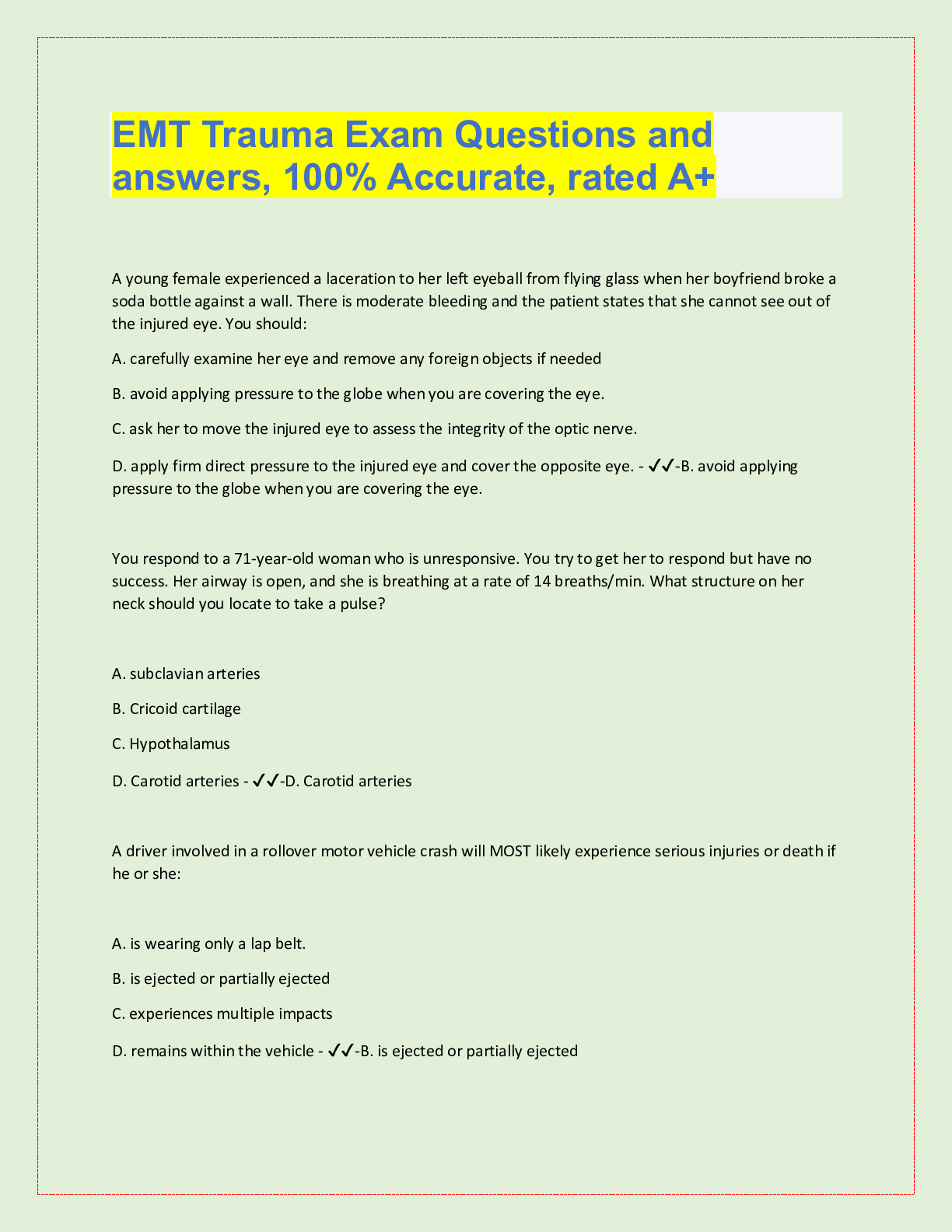
EMT Trauma Exam Questions and
answers, 100% Accurate, rated A+
A young female experienced a laceration to her left eyeball from flying glass when her boyfriend broke a
soda bottle against a wall. There is moderate bleeding and the patient states that she cannot see out of
the injured eye. You should:
A. carefully examine her eye and remove any foreign objects if needed
B. avoid applying pressure to the globe when you are covering the eye.
C. ask her to move the injured eye to assess the integrity of the optic nerve.
D. apply firm direct pressure to the injured eye and cover the opposite eye. - ✔✔-B. avoid applying
pressure to the globe when you are covering the eye.
You respond to a 71-year-old woman who is unresponsive. You try to get her to respond but have no
success. Her airway is open, and she is breathing at a rate of 14 breaths/min. What structure on her
neck should you locate to take a pulse?
A. subclavian arteries
B. Cricoid cartilage
C. Hypothalamus
D. Carotid arteries - ✔✔-D. Carotid arteries
A driver involved in a rollover motor vehicle crash will MOST likely experience serious injuries or death if
he or she:
A. is wearing only a lap belt.
B. is ejected or partially ejected
C. experiences multiple impacts
D. remains within the vehicle - ✔✔-B. is ejected or partially ejected
The cervical spine is MOST protected from whiplash-type injuries when the:
A. rear end of the vehicle is initially struck
B. Patient tenses up at the time of impact
C. air bag correctly deploys upon impact
D. headrest is appropriately positioned. - ✔✔-D. headrest is appropriately positioned.
A 45-year-old male was working on his roof when he fell approximately 12′,landing on his feet. He is
conscious and alert and complains of an ache in his lower back. He is breathing adequately and has
stable vital signs. You should:
A. immobilize his spine and perform a focused secondary exam.
B. allow him to refuse transport if his Vital signs remain stable
C. performa a rapid head-to-toe exam and immobilize his spine.
D. obtain a Glasgow coma score value and give him oxygen - ✔✔-immobilize his spine and perform a
focused secondary exam.
Pleural fluid is contained between the:
A. parietal pelura and the chest wall
B. Visceral and parietal pleurae
C. parietal pleura and the heart
D. Visceral pleura and the lung - ✔✔-B. Visceral and parietal pleurae
A short backboard or vest-style immobilization device is indicated for patients who:
A. are found supine and have stable vital signs
B. are sitting in their car and are clinically unstable
C. require prompt extrication from an automobile
D. are in sitting position and are clinically stable - ✔✔-D. are in sitting position and are clinically stable
When a motor vehicle strikes a tree while traveling at 40 mph, the unrestrained occupant:
A. remains in motion until acted upon by an external force
B. will most likely be thrown over the steering column
C. will decelerate at the same rate as the motor vehicle
D. is thrust under the steering column onto the floorboard - ✔✔-A. remains in motion until acted upon
by an external force
A 39-year-old female experienced a severe closed head injury. She is unresponsive with her eyes slightly
open; her pupils are bilaterally dilated and slow to react. In addition to managing problems with airway,
breathing, and circulation, you should:Select one:
A. irrigate her eyes with water to prevent mucosal drying.
B. inspect her eyes and gently remove impaled objects.
C. secure her eyes open so you can reassess her pupils.
D. close her eyes and cover them with a moist dressing. - ✔✔-The correct answer is: close her eyes and
cover them with a moist dressing.
A female patient with a suspected head injury has slow, shallow breathing. The MOST appropriate
treatment for her includes:
A. ventilation assistance to maintain an ETCO2 of 30 to 35 mm Hg.
B. hyperventilating her at 30 breaths/min
C. ventilation assistance to maintain an oxygen saturation of 90%
D. administering oxygen via a nonrebreathing mask - ✔✔-ventilation assistance to maintain an ETCO2 of
30 to 35 mm Hg.
ch. 28 - pt assessment, page 995
A 37-year-old male was pinned between a flatbed truck and a loading dock. On exam, you find bruising
to the chest, distended neck veins, bilaterally diminished breath sounds, and bilateral scleral
hemorrhaging. You should:
Choose one answer.
A. aggressively manage his airway.
B. request a paramedic ambulance.
C. suspect a severe hemopneumothorax.
D. perform a secondary assessment. - ✔✔-A. aggressively manage his airway.
The MOST commonly fracture bone(s) in the body is/are the:
A. radius and ulna
B. clavicle
C. midshaft femur
D. scapula - ✔✔-B. clavicle
which of the following is NOT a sign or symptom of a laryngeal injury?
A. wheezing
B. difficulty breathing
C. hoarseness
D. subcutaneous emphysema - ✔✔-A. wheezing
ch. 27 - emergency medical care for specific injuries, page 972
Air bags are designed to
A. prevent a second collision inside the car
B. decrease the severity of deceleration injuries
C. be used with or without a shoulder harness
D. prevent the driver from sustaining head trauma - ✔✔-B. decrease the severity of deceleration injuries
By what mechanism is a person injured when he or she falls from a significant height?
A) Kinetic energy is converted to potential energy; the potential energy is then converted into the work
of bringing the body to a stop.
B) Potential energy is created as the person is falling; the potential energy is then converted into kinetic
energy upon impact.
C) As the person falls, the amount of kinetic energy is converted into work; work is then converted to
kinetic energy upon impact.
D) Potential energy is converted to kinetic energy; the kinetic energy is then converted into the work of
bringing the body to a stop. - ✔✔-D) Potential energy is converted to kinetic energy; the kinetic energy
is then converted into the work of bringing the body to a stop.
An __________ fracture occurs in the growth section of a child's bone and may lead to bone growth
abnormalities.
A. metaphyseal
B. greenstick
D. diaphyseal
D. epiphyseal - ✔✔-D. epiphyseal
Chapter 31 musculoskeletal injuries, page 1093
A 77-year-old woman slipped and fell on a throw rug and landed on her left hip. She denies striking her
head or losing consciousness. Assessment of her left leg reveals that it is shortened and externally
rotated. Distal pulses, sensory, and motor functions are intact. You should:
A. manually stabilize her left leg, apply a traction splint, and then secure her to a long backboard or
scoop.
B. place her onto a scoop stretcher, pad around her left hip with pillows, and secure her to the scoop
with straps.
C. bind both of her legs together with triangular bandages and carefully secure her onto the ambulance
stretcher.
D. carefully slide a long backboard underneath her, keep her in a supine position, and apply a splint to
her leg. - ✔✔-B. place her onto a scoop stretcher, pad around her left hip with pillows, and secure her to
the scoop with straps.
During your assessment of a patient with blunt chest trauma, you note that the patient has shallow
breathing and paradoxical movement of the left chest wall. You should:
A. make note of it and continue your assessment
B. apply high-flow oxygen via nonrebreathing mask
C. request a paramedic to decompress the chest
D. assist ventilations with BVM - ✔✔-D. assist ventilations with BVM
If one or more occupants in the same vehicle are killed in a crash, the EMT should:
A. radpidly assess only the survivors who ahve experienced obvious trauma.
B. transport the survivors only if they have injuries or complain of pain
C. allow the survivors to refuse transport if they have no obvious injuries
D. suspect that all living occupants experienced the same serious trauma. - ✔✔-D. suspect that all living
occupants experienced the same serious trauma.
An open neck injury may result in _____ if enough air is sucked into a blood vessel.
A. tracheal deviation
B. subcutaneous emphysema
C. an air embolism
D. hypovolemic shock - ✔✔-an air embolis
[Show More]