The Best Paramedic National Registry
Review (FOR AUDIO USE)
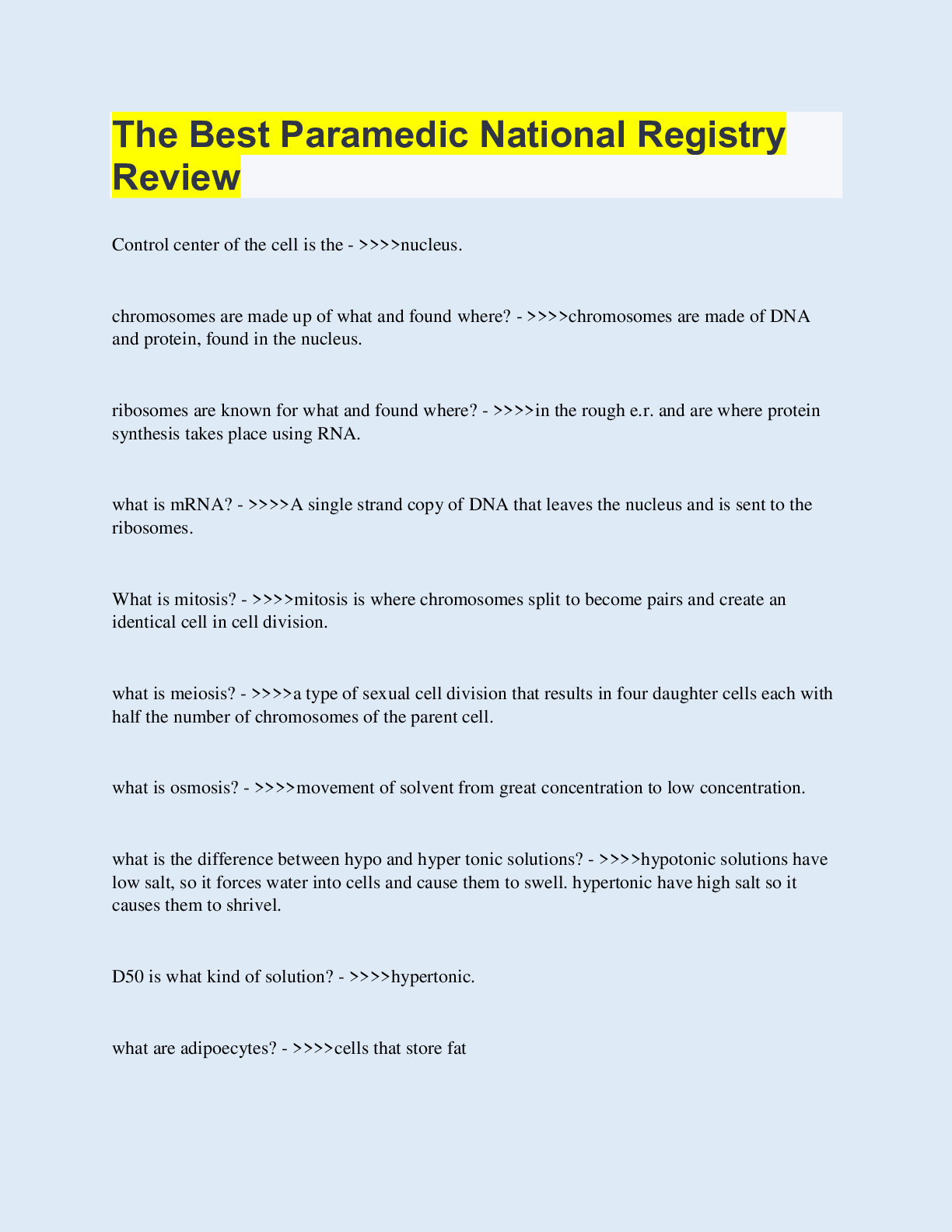
Control center of the cell is the
nucleus.
chromosomes are made up of what and found where?
chromosomes are made of DNA and protein, found in the nucleus.
...
The Best Paramedic National Registry
Review (FOR AUDIO USE)
Control center of the cell is the
nucleus.
chromosomes are made up of what and found where?
chromosomes are made of DNA and protein, found in the nucleus.
ribosomes are known for what and found where?
in the rough e.r. and are where protein synthesis takes place using RNA.
what is mRNA?
A single strand copy of DNA that leaves the nucleus and is sent to the ribosomes.
What is mitosis?
mitosis is where chromosomes split to become pairs and create an identical cell in cell division.
what is meiosis?
a type of sexual cell division that results in four daughter cells each with half the number of
chromosomes of the parent cell.
what is osmosis?
movement of solvent from great concentration to low concentration.
what is the difference between hypo and hyper tonic solutions?
hypotonic solutions have low salt, so it forces water into cells and cause them to swell.
hypertonic have high salt so it causes them to shrivel.
D50 is what kind of solution?
hypertonic.
what are adipoecytes?
cells that store fat
What are endocrine glands?
ductless glands that secrete hormones into capillaries. examples of endocrine glands are:
pituitary, thyroid, parathyroid, adrenal, and pineal.
what are exocrine glands?
glands with ducts that secret fluids away from site of function. (ex: sweat, saliva, etc.)
what is keratin?
a "waterproof" protein used in the integumentary system.
What is the stratum corneum?
outermost layer of epidermis
what is the stratum granulosum?
The the stratum granulosum, also called the Granular layer, is very thin, Just below the outer
most layer of skin. This is where keratin and lamellated granuoles accumulate.
what are sebaceous glands?
Sebaceous glands are glands that open into hair follicles, or directly onto surface.
What are ceruminous glands?
Modified sweat glands found only in auditory canal.
What are apocrine glands?
Mainly in the armpits and the groin area. Contains bit of cytoplasm from the secreting cells. The
cell debris attracts bacteria.
what organ in the GI tract contains both exocrine and endocrine glands?
the pancreas
What are the islets of Langerhans?
cells in the pancreas that produce insulin. Islets of Langerhans are beta cells.
what are alpha cells in the pancreas?
produce glucagon to stimulate liver to make glucose. Just think, alpha cells do the work. Alpha
cells stimulate the liver.
what are beta cells in the pancreas?
produce insulin that transports glucose from blood straight into the cells by increasing
permeability.
what does P.T.H. stand for and what does it do?
parathyroid hormone, important for the maintenance of calcium and phosphate levels in blood.
where is parathyroid hormone created?
parathyroid gland
how does PTH increase Calcium absorption while lowering phosphate in blood?
PTH stimulates activation of vitamin D in the kidneys to reabsorb Calcium and excrete
phosphate.
What does calcitonin do and where is it produced?
Calcitonin is produced in the thyroid gland. It decreases blood calcium levels by stimulated
calcium absorption in bones.
What does the adrenal medulla secrete?
catecholamines and sym-path-o-mimetics, A.K.A. epinephrine and norepinephrine.
what originally stimulates the adrenal medulla in the adrenal glands?
the hypothalamus stimulates the adrenal gland.
what part of the brain controls metabolism and blood temperature?
Hypothalamus
how much of cellular respiration is energy and how much is heat?
throughout the whole process of cellular respiration, only 40% is usable energy, while 60% is
heat.
how much of the body's heat is produced by the liver and skeletal muscle?
[Show More]
.png)

.png)
.png)
.png)
.png)
.png)