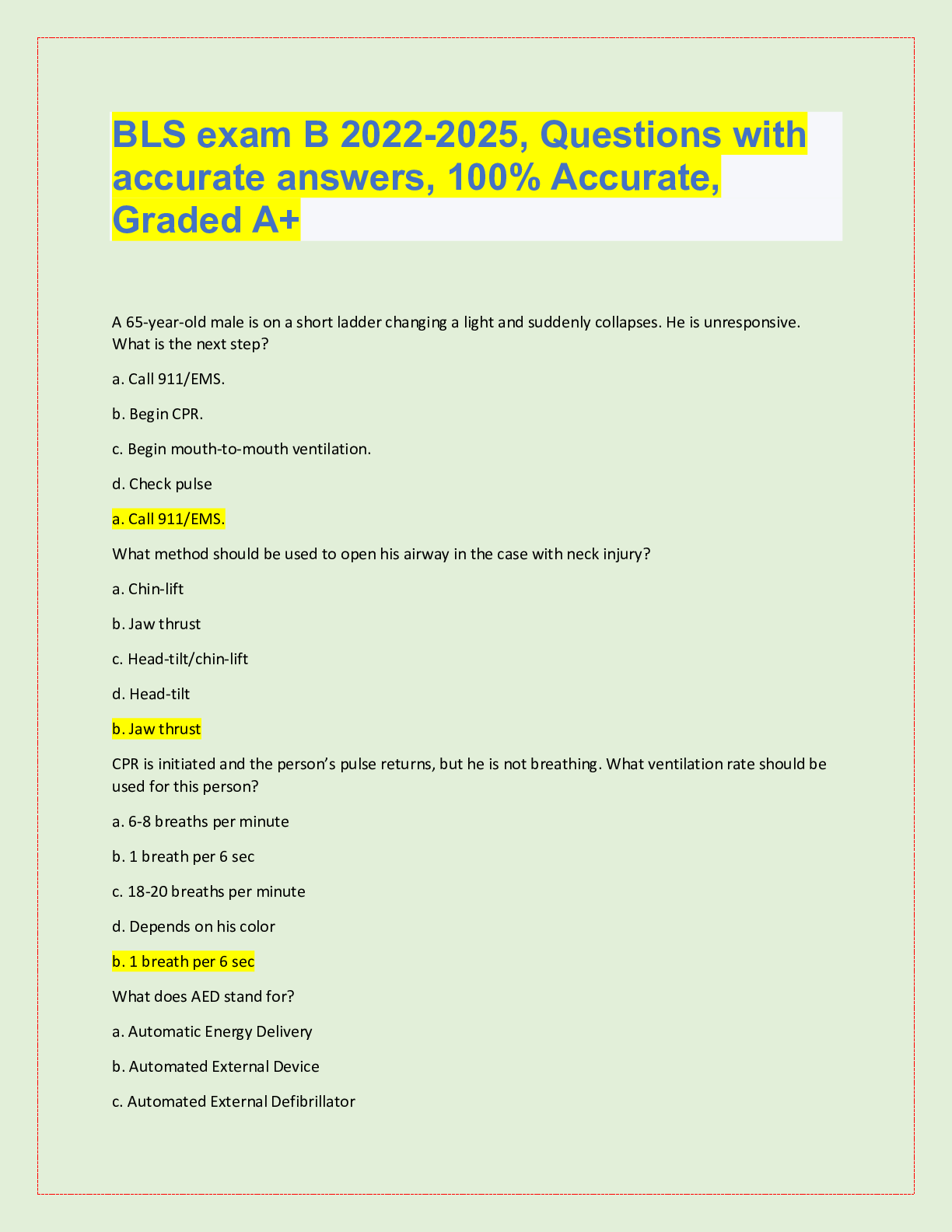
CPMA Chapter 2.3 & 2.4 - Medical
Record Documentation, Questions and
answers, rated A+
Commonly found forms in medical records - ✔✔-1. patient registration form
2. assignment of benefits
3. confirmation of receipt
...
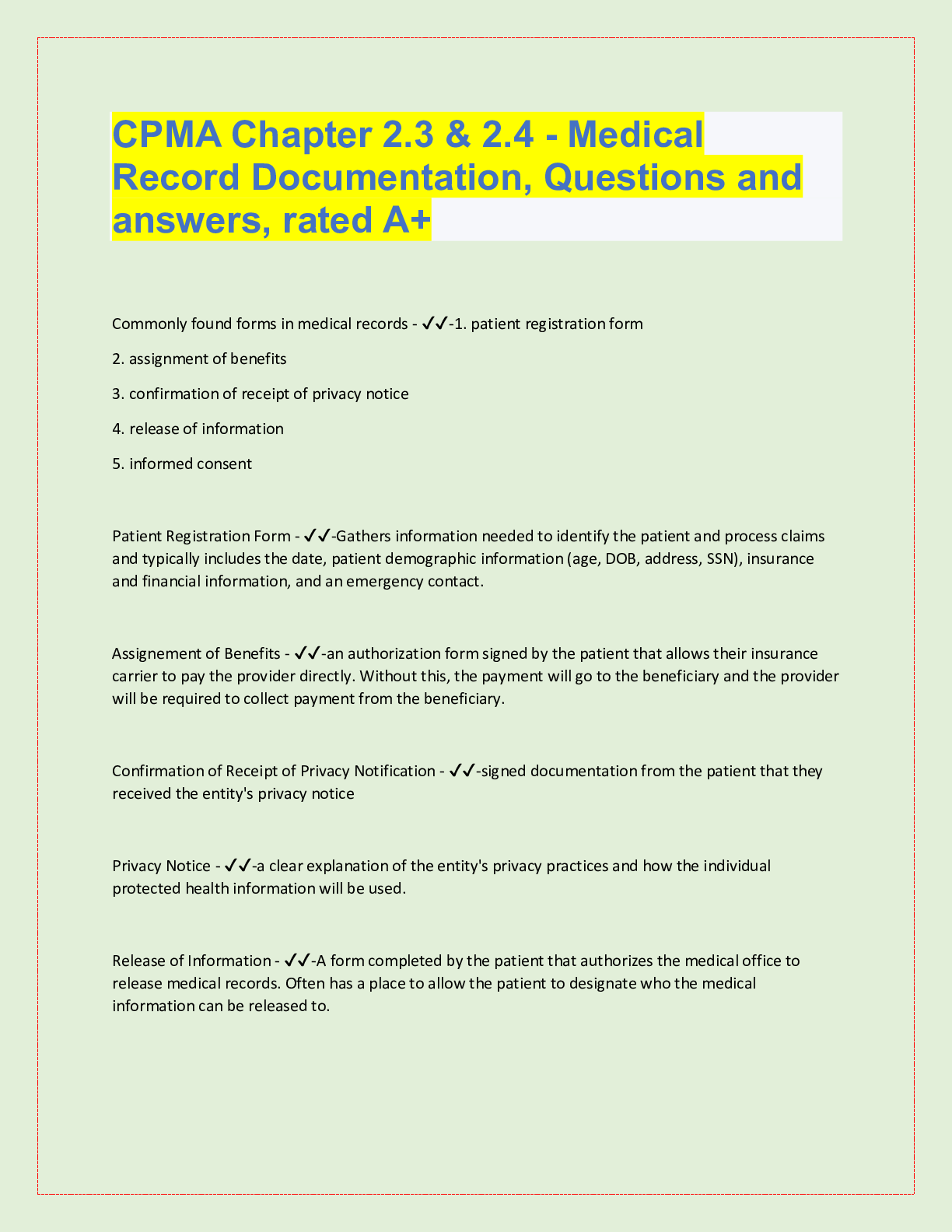
CPMA Chapter 2.3 & 2.4 - Medical
Record Documentation, Questions and
answers, rated A+
Commonly found forms in medical records - ✔✔-1. patient registration form
2. assignment of benefits
3. confirmation of receipt of privacy notice
4. release of information
5. informed consent
Patient Registration Form - ✔✔-Gathers information needed to identify the patient and process claims
and typically includes the date, patient demographic information (age, DOB, address, SSN), insurance
and financial information, and an emergency contact.
Assignement of Benefits - ✔✔-an authorization form signed by the patient that allows their insurance
carrier to pay the provider directly. Without this, the payment will go to the beneficiary and the provider
will be required to collect payment from the beneficiary.
Confirmation of Receipt of Privacy Notification - ✔✔-signed documentation from the patient that they
received the entity's privacy notice
Privacy Notice - ✔✔-a clear explanation of the entity's privacy practices and how the individual
protected health information will be used.
Release of Information - ✔✔-A form completed by the patient that authorizes the medical office to
release medical records. Often has a place to allow the patient to designate who the medical
information can be released to.
Informed Consent Form - ✔✔-signed by the patient to verify that the patient understands procedures,
outcomes, and options. The patient can withdraw this consent for a procedure at any time. An informed
consent consists of:
1.the patient's diagnosis (if known)
2.the nature and purpose of a proposed treatment/procedure
3. alternative treatments/procedures
4. the associated risks and benefits
5. the risks and benefits of not receiving the treatment/procedure
What is informed consent? - ✔✔-a way to indicate that a discussion between the patient and the
provider took place about a patient's condition and the treatment options available to allow the patient
an opportunity to ask questions and make an informed choice on their plan of treatment.
Each E/M generally contains - ✔✔-1. chief complaint
2. history of present illness
3. physical examination
4. determination
Chief Complaint - ✔✔-description of why the patient is presenting for healthcare services. It can also be
referred to as the reason for the patient visit.
History of Present Illness (HPI) - ✔✔-How the patient describes the symptoms he or she is experiencing,
and which have prompted the patient to seek medical attention. (healthcare provider must document
the HPI)
Physical Examination - ✔✔-performed by the healthcare provider through a series of assessments and
observations, focused around the symptoms described by the patient.
Determination/Diagnosis - ✔✔-provider makes a determination about the cause of the symptoms,
which is the provider's assessment of the problem. Based on that assessment, the provider creates a
plan to relive or resolve the patient's symptoms
What is the most common format used in medical records? - ✔✔-SOAP
What does SOAP stand for? - ✔✔-Subject
Objective
Assessment
Plan
S in SOAP - ✔✔-Subject - where the patient provides information about their symptoms and what, if
anything, they have done to relieve the symptoms
O in SOAP - ✔✔-Objective - indicates the physical exam findings of the provider
A in SOAP - ✔✔-Assessment - the provider's assessment of the patient's condition, and where the
provider indicates either a definitive or working diagnosis. In absence of a diagnosis, signs and
symptoms may be documented until further testing can be performed.
P in SOAP - ✔✔-Plan - the provider's plan is documented in direct relation to the provider's assessment
(A in SOAP). In cases where a definitive diagnosis has not been reached, the documentation should
reflect tests that are being ordered, with an indication of the provider's thought process.
What is another, but less commonly used, format in medical records? - ✔✔-CHEDDAR
What does CHEDDAR stand for? - ✔✔-C- chief complaint
H- history
E- examination
D- details of problem and complaint
D- drugs and diagnosis
A- assessment
R- return visit information
If a minor office procedure is performed during an E/M, what documentation is required? - ✔✔-the
documentation for the procedure can be included in the notes for the E/M service. It is NOT necessary
to have a separate operative report.
What are the four main sections of an OP report? - ✔✔-1. header
2. indications for surgery
3. detail or body of the procedur
[Show More]





.png)