Data Management Foundation C175
WGU. Top Exam Question with accurate
answers, rated A+
Associative Entity - ✔✔-An associative entity is an element of the entity-relationship model. All
relationships for the associ
...
Data Management Foundation C175
WGU. Top Exam Question with accurate
answers, rated A+
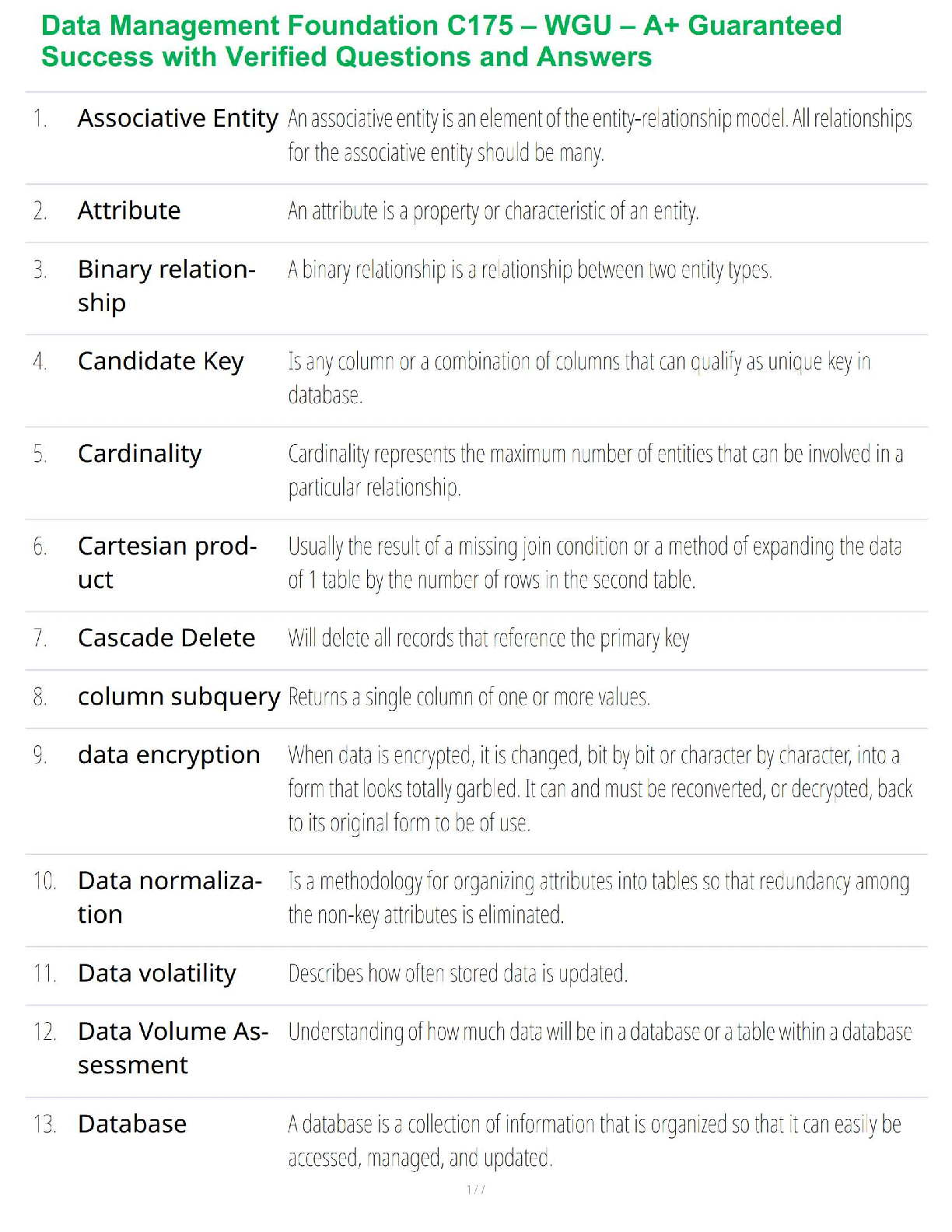
Associative Entity - ✔✔-An associative entity is an element of the entity-relationship model. All
relationships for the associative entity should be many.
Attribute - ✔✔-An attribute is a property or characteristic of an entity.
Binary relationship - ✔✔-A binary relationship is a relationship between two entity types.
Candidate Key - ✔✔-Is any column or a combination of columns that can qualify as unique key in
database.
Cardinality - ✔✔-Cardinality represents the maximum number of entities that can be involved in a
particular relationship.
Cartesian product - ✔✔-Usually the result of a missing join condition or a method of expanding the data
of 1 table by the number of rows in the second table.
Cascade Delete - ✔✔-Will delete all records that reference the primary key
column subquery - ✔✔-Returns a single column of one or more values.
data encryption - ✔✔-When data is encrypted, it is changed, bit by bit or character by character, into a
form that looks totally garbled. It can and must be reconverted, or decrypted, back to its original form to
be of use.
Data normalization - ✔✔-Is a methodology for organizing attributes into tables so that redundancy
among the non-key attributes is eliminated.
Data volatility - ✔✔-Describes how often stored data is updated.
Data Volume Assessment - ✔✔-Understanding of how much data will be in a database or a table within
a database
Database - ✔✔-A database is a collection of information that is organized so that it can easily be
accessed, managed, and updated.
DCL - ✔✔-Data control language is used to control access to data stored in a database.
DDL - ✔✔-Data definition language - involves instructing the DBMS software on what tables will be in
the database, what attributes will be in the tables, which attributes will be indexed, and so forth.
Definer - ✔✔-Definer is a MySQL term where AuthID is the same for another DBMS
Denormalization - ✔✔-The act of duplicating data in a database for performance or the preservation of
historical information
disaster recovery - ✔✔-Involves rebuilding an entire information system or significant parts of one after
a catastrophic natural disaster such as a hurricane, tornado, earthquake, building collapse, or even a
major fire.
DML - ✔✔-Data manipulation language refers to the four basic operations that can and must be
performed on data stored in any DBMS: data retrieval, data update, insertion of new records, and
deletion of existing records.
E-R model - ✔✔-An E-R model is a data model for describing a database in an abstract way.
embedded mode - ✔✔-The SELECT command is embedded within the lines of a higher-level language
program and functions as an input or "read" statement for the program.
Entity - ✔✔-An entity is an object or event in our environment that we want to keep track of.
Foreign Key - ✔✔-Is a field (or collection of fields) in one table that uniquely identifies a row of another
table.
Index - ✔✔-Used to help a DBMS find data quickly
Inner Join - ✔✔-Shows row that have matches in both tables
Intersection Data - ✔✔-Intersection Data associated with the concatenation of two segments.
Join - ✔✔-Joins 2 tables together
logical view - ✔✔-Is a mapping onto a physical table or tables that allows an end user to access only a
specified portion of data.
Modality - ✔✔-Modality represents the minimum number of entity occurrences that can be involved in
a relationship.
outer join - ✔✔-Shows rows in one table that have no match in the other table. Two kinds of outer joins
are left and right joins.
Primary Key - ✔✔-Uniquely identifies each record in the table.
query mode - ✔✔-The command goes directly to the relational DBMS, which evaluates the query and
processes it against the database.
Referential Integrity - ✔✔-Referential integrity is a database concept that ensures that relationships
between tables remain consistent.
referential integrity - ✔✔-Enforces rules to guarantee that the foreign key relationship stays intact with
no mismatches.
Response time - ✔✔-Is the delay from the time that the Enter Key is pressed to execute a query until the
result appears on screen.
Restrict Delete - ✔✔-Will not allow deletes if the primar
[Show More]