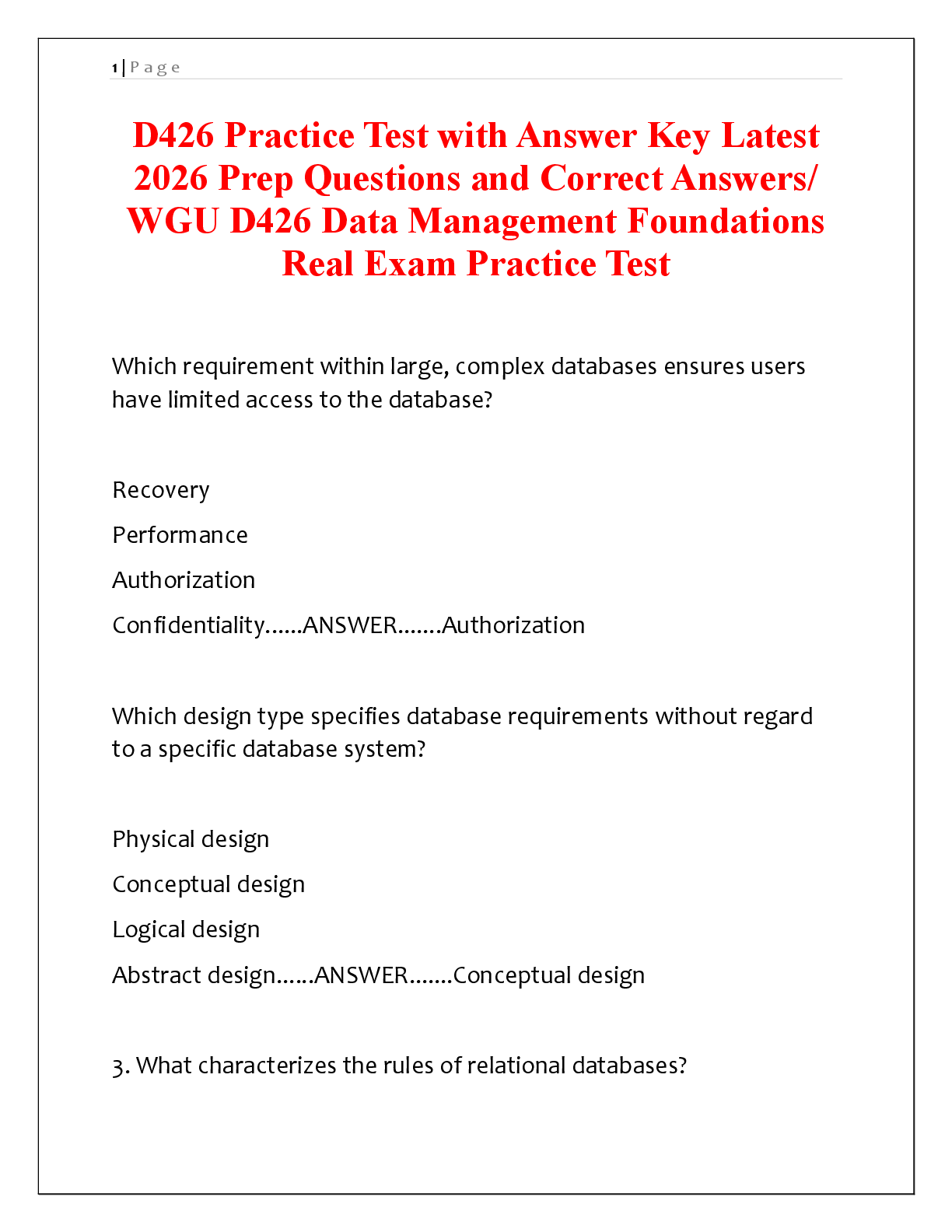
Data Management Foundations - WGU
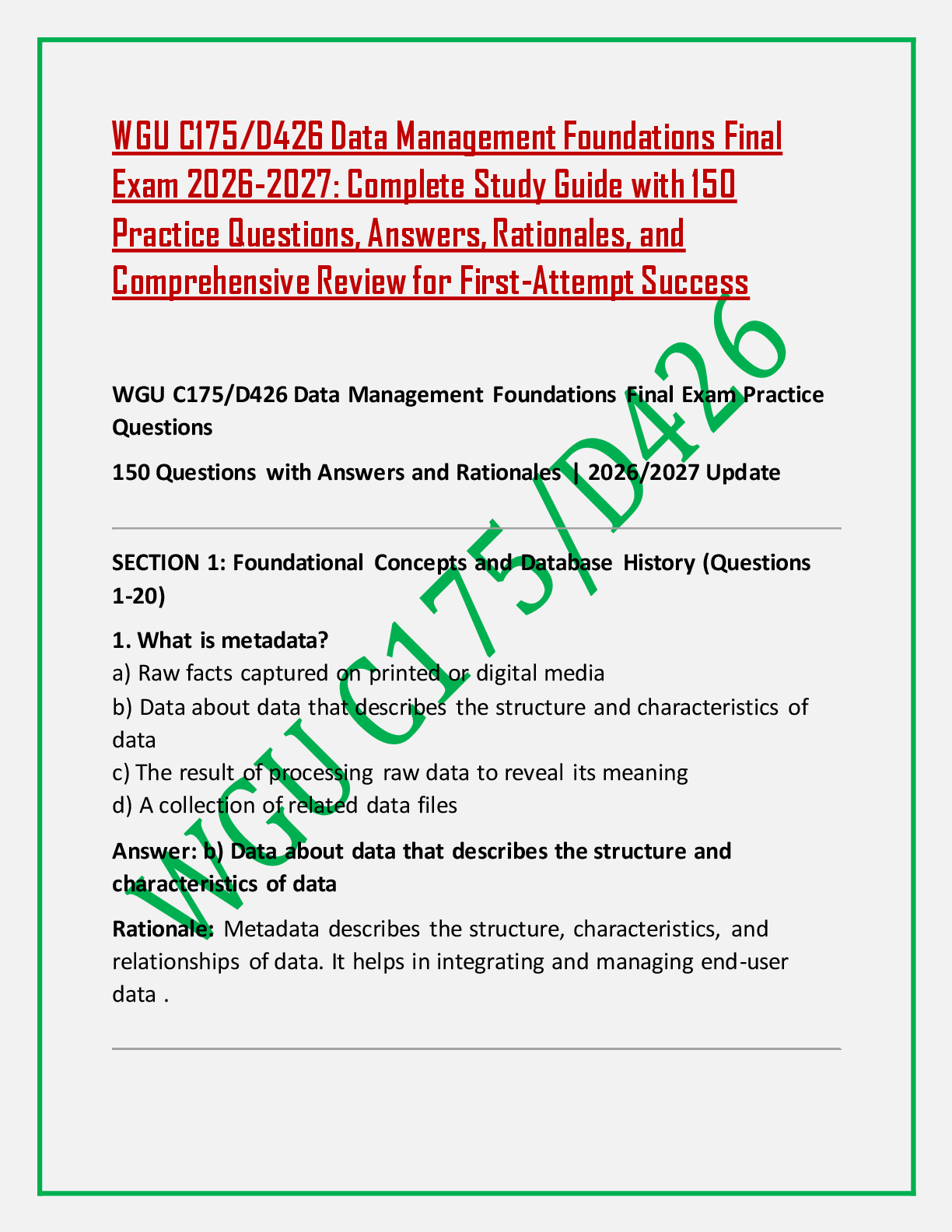
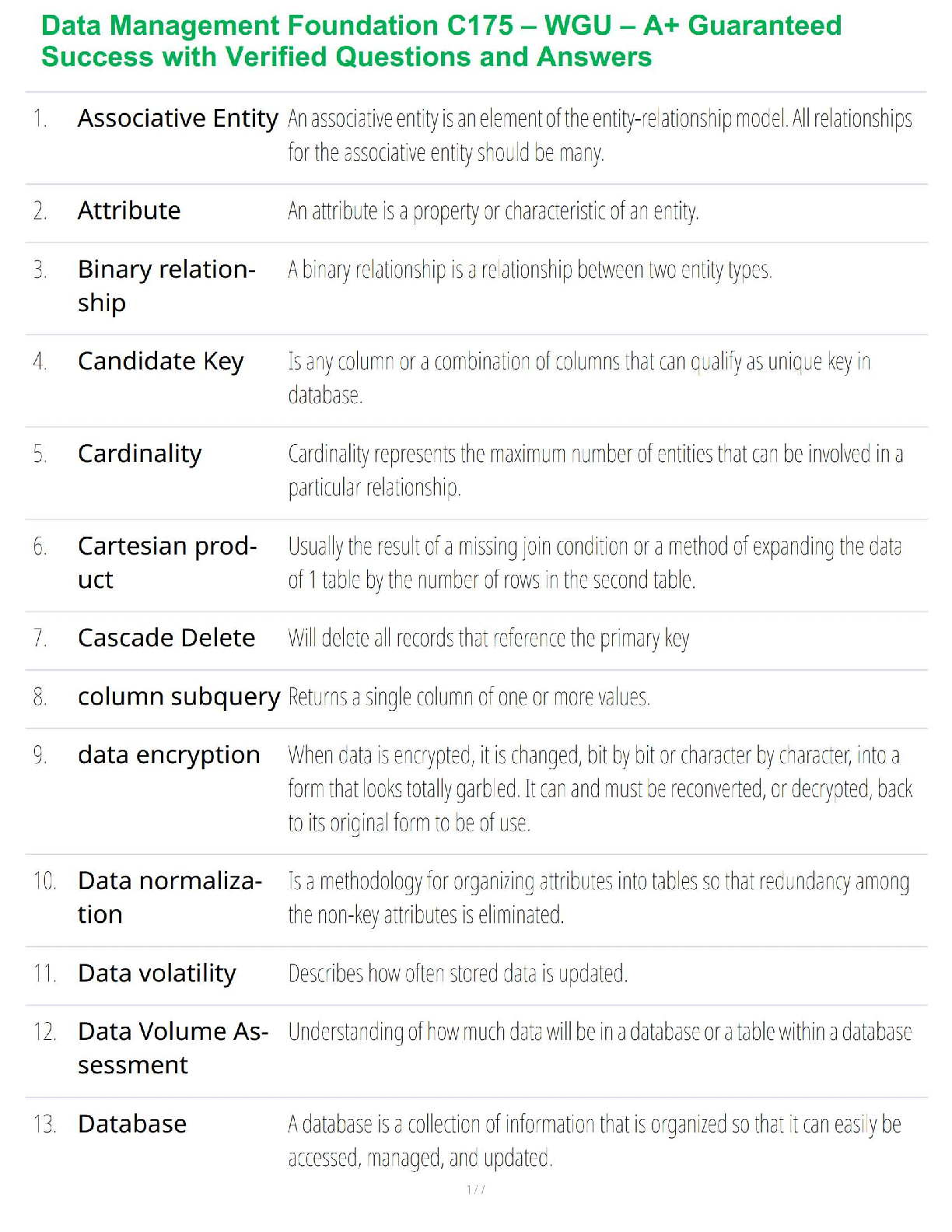
C175. Top Exam Questions with accurate
answers, graded A+
ad hoc query - ✔✔-A "spur-of-the-moment" question
analytical database - ✔✔-A database focused primarily on storing histori
...
Data Management Foundations - WGU
C175. Top Exam Questions with accurate
answers, graded A+
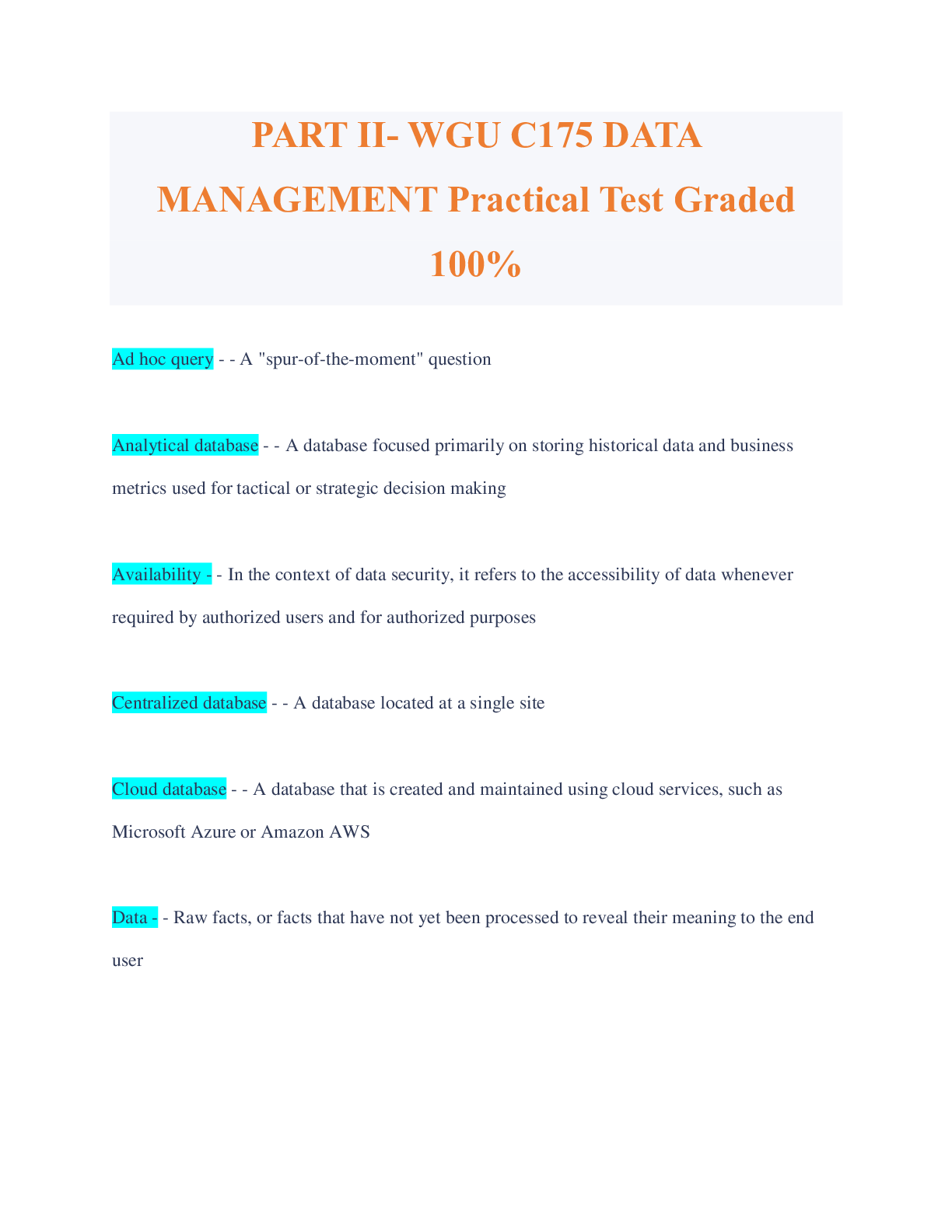
ad hoc query - ✔✔-A "spur-of-the-moment" question
analytical database - ✔✔-A database focused primarily on storing historical data and business metrics
used for tactical or strategic decision making
availability - ✔✔-In the context of data security, it refers to the accessibility of data whenever required
by authorized users and for authorized purposes
centralized database - ✔✔-A database located at a single site
cloud database - ✔✔-A database that is created and maintained using cloud services, such as Microsoft
Azure or Amazon AWS
data - ✔✔-Raw facts, or facts that have not yet been processed to reveal their meaning to the end user
data anomaly - ✔✔-An abnormality of the data in which inconsistent changes have been made to a
database (For example, an employee moves, but the address changes is not corrected in all files in the
database)
data dependence - ✔✔-A data condition in which data representation and manipulation are dependent
on the physical data storage characteristics
data dictionary - ✔✔-A DBMS component that stores metadata. Contains the data definition, as well as
their characteristics and relationships
data inconsistency - ✔✔-A condition in which different versions of the same data yield different results
data independence - ✔✔-A condition in which data access is unaffected by changes in the physical data
storage characteristics
data integrity - ✔✔-In a relational database, a condition in which the data in the database complies with
all entity and referential integrity constraints
data management - ✔✔-A process that focuses on data collection, storage, and retrieval.
data processing (DP) specialist - ✔✔-The person responsible for developing and managing a
computerized file processing system
data redundancy - ✔✔-Exists when the same data is stored unnecessarily at different places
database - ✔✔-A shared, integrated computer structure that houses a collection of related data
including end-user data (raw facts) and metadata (data about the data)
database design - ✔✔-The process that yields the description of the database structure and determines
the database components. The second phase of the database life cycle
database management system (DBMS) - ✔✔-The collection of programs that manages the database
structure and controls access to the data stored in the database
database system - ✔✔-An organization of components that defines and regulates the collection,
storage, management, and use of data in a database environment
desktop database - ✔✔-A single-user database that runs on a personal computer
discipline-specific database - ✔✔-A database that contains data focused on specific subject areas
enterprise database - ✔✔-The overall company data representation, which provides support for present
and expected future needs
field - ✔✔-An alphabetic or numeric character or group of characters that defines a characteristic of a
person, place, or thing. (for example, a person's SSN, address, phone number, and bank balance all
constitute fields)
file - ✔✔-A named collection of related records
general-purpose database - ✔✔-A database that contains a wide variety of data used in multiple
disciplines
hub - ✔✔-A warehouse of data packets housed in a central location on a local area network. It contains
multiple ports that copy the data in the data packets to make it accessible to selected or all segments of
the network
information - ✔✔-The result of processing raw data to reveal its meaning. It consists of transformed
data and facilitates decision making
islands of information - ✔✔-In the old file system environment, pools of independent, often duplicated,
and inconsistent data created and managed by different departments
knowledge - ✔✔-The body of information and facts about a specific subject. It implies familiarity,
awareness, and understanding of information as it applies to an environment
logical data format - ✔✔-The way a person views data within the context of a problem domain
metadata - ✔✔-Data about data
multiuser database - ✔✔-A database that supports multiple concurrent users
NoSQL - ✔✔-A new generation of database management systems that is not based on the traditional
relational database model. It stores structured and unstructured data in efficient ways.
online analytical processing (OLAP) - ✔✔-Decision support system (DSS) tools that use multidimensional
data analysis techniques. It creates an advanced data analysis environment that supports decision
making, business modeling, and operations research
operational database - ✔✔-A database designed primarily to support a company's day-to-day
operations. (Also known as a transactional database, OLTP database, or production database)
performance tuning - ✔✔-Activities that make a database perform more efficiently in terms of storage
and access speed
physical data format - ✔✔-The way a computer "sees" (stores) data
query - ✔✔-A question or task asked by an end user of a database in the form of SQL code. A specific
request for data manipulation issued by the end user or the application to the DBMS
query language - ✔✔-A nonprocedural language that is used by a DBMS to manipulate its data (such as
SQL)
query result set - ✔✔-The collection of data rows returned by a query
record - ✔✔-A collection of related (logically connected) fields
role - ✔✔-In Oracle, a named collection of database access privileges that authorize a user to connect to
a database and use its system resources
router - ✔✔-1) An intelligent devise used to connect dissimilar networks
2) Hardware/software equipment that connects multiple and diverse networks
semistructured data - ✔✔-Data that has already been processed to some extent
single-user database - ✔✔-A database that supports only one user at a time
social media - ✔✔-Web and mobile technologies that enable "anywhere, anytime, always on" human
interactions
structural dependence - ✔✔-A data characteristic in which a change in the database schema affects data
access, thus requiring changes in all access programs
structural independence - ✔✔-A data characteristic in which changes in the database schema do not
affect data access
structured data - ✔✔-Data that has been formatted to facilitate storage, use, and information
generation
structured query language (SQL) - ✔✔-A powerful and flexible relational database language composed
of commands that enable users to create database and table structures, perform various types of data
manipulation and data administration, and query the database to extract useful information
unstructured data - ✔✔-Data that exists in its original, raw state; that is, in the format in which it was
collected
website - ✔✔-Refers to the web server and the collection of web pages stored on the local hard disk of
the server computer
workgroup database - ✔✔-A multiuser database that usually supports fewer than 50 users or is used for
a specific department in an organization
world wide web (WWW or the web) - ✔✔-Worldwide network collection of specially formatted and
interconnected documents known as web pages
XML database - ✔✔-A database system that stores and manages semistructured XML data
file structure - ✔✔-The format that data is arranged and stored
flat files - ✔✔-Files having no internal hierarchy
heap files - ✔✔-Files containing an unsorted set of records that are uniquely identified by a record ID
which allows them to be inserted or deleted using that ID
index files - ✔✔-Files that store a list of lookup field values from a data file
hashed files - ✔✔-Files that are encrypted using hash functions that convert data consisting of various
formats into numeric values
data management - ✔✔-The discipline that focuses on the proper generation, storage, and retrieval of
data
distributed database - ✔✔-Supports data across multiple sites
general purpose database - ✔✔-Contains a wide variety of data used in multiple disciplines
business intelligence - ✔✔-A comprehensive approach to capture and process business data with the
purpose of generating information to support business decision making
semi-structured data - ✔✔-Data that is already processed to some extent
extensible markup language (XML) - ✔✔-Used to represent and manipulate data elements in a textual
format
data dictionary management - ✔✔-Removes structural and data dependency and provides the user with
data abstraction. The DBMS uses this function to look up the required data component structures and
relationships
data transformation and presentation - ✔✔-Exists to transform any data entered into required data
structures. By using this function, the DBMS can determine the difference between logical and physical
data formats
security management - ✔✔-Sets rules that determine specific users that are allowed to access the
database. This function also sets restraints on what specific data any user can see or manage
data modeling - ✔✔-The process of creating a specific data model for a determined problem domain
problem domain - ✔✔-A clearly defined area within the real-world environment, with a well-defined
scope and boundaries that will be systematically addressed
data model - ✔✔-A representation, usually graphic, of a complex "real-world" data structure. Used in
the database design phase of the database life cycle. It represents data structures and their
characteristics, relations, constraints, transformations, and other constructs with the purpose of
supporting a specific problem domain. A blueprint with all the instructions to build a database that will
meet all end-user requirements.
basic building blocks of all data models - ✔✔-Constraints, attributes, relationships, entities (data models
CARE!)
entity - ✔✔-A person, place, thing, concept, or event for which data can be sored
attribute - ✔✔-A characteristic of an entity or object. It has a name and a data type.
relationship - ✔✔-An association between entities
constraint - ✔✔-A restriction placed on data, usually expressed in the form of rules
one-to-one (1:) relationship - ✔✔-Exists between a pair of tables when a single record in the first table is
related to only one record in the second table, and a single record in the second table is related to only
one record in the first table
one-to-many (1:M) relationship - ✔✔-Exists between a pair of tables when a single record in the first
single record in the first table can be related to one or more records in the second table, but a single
record in the second table can be related to only one record in the first table.
many-to-many (M:M) relationship - ✔✔-Exists between a pair of tables when a single record in the first
table can be related to one or more records in the second table and a single record in the second table
can be related to one or more records in the first table.
business rule - ✔✔-A description of a policy, procedure, or principle within an organization.
hierarchical model - ✔✔-An early database model whose basic concepts and characteristics formed the
basis for subsequent database development. It is based on an upside-down tree structure in which each
record is called a segment. The top record is the root segment. Each segment has a 1:M relationship to
the segment directly below it.
segment - ✔✔-In the hierarchical data model, the equivalent of a file system's record type.
network model - ✔✔-An early data model that represented data as a collection of record types in 1:M
relationships.
schema - ✔✔-A logical grouping of database objects, such as tables, indexes, views, and queries that are
related to each other.
subschema - ✔✔-The portion of the database that interacts with application programs
data manipulation language (DML) - ✔✔-The set of commands that allows an end user to manipulate
the data in the database, such as SELECT, INSERT, UPDATE, DELETE etc.
data definition language (DDL) - ✔✔-The language that allows a database administrator to define the
database structure, schema, and subschema
relational model - ✔✔-Based on mathematical set theory and represents data as independent relations.
Each relation (table) is related to each other through the sharing of common entity characteristics.
Developed by E. F. Codd of IBM in 1970
relation or table - ✔✔-A two-dimensional structure composed of intersecting rows (entities) and
columns (attributes).
tuple - ✔✔-A row in the relational model
relational database management system (RDBMS) - ✔✔-A collection of programs that manages a
relational database
SQL-based relational database parts - ✔✔-1. End-user interface
2. A collection of tables stored in the database
3. SQL engine
entity relationship (ER) model (ERM) - ✔✔-A data model that describes relationships (1:1, 1:M, and
M:N) among entities at the conceptual level with the help of ER diagrams.
entity relationship diagram (ERD) - ✔✔-A diagram that depicts an entity relationship model's entities,
attributes, and relations
entity instance or entity occurance - ✔✔-A row in a relational table
entity set - ✔✔-A collection of like entities
object-oriented data model (OODM) - ✔✔-A data model whose basic modeling structure is an object
object - ✔✔-An abstract representation of a real world entity that has a unique identity, embedded
properties, and the ability to interact with other objects and itself
object-oriented database management system (OODBMS) - ✔✔-Data management software used to
manage data in an object-oriented database mod
[Show More]


.png)
.png)


.png)

.png)


.png)