Data Management - Foundations –WGU
C175, Top exam questions with accurate
answers, 100% Accurate.
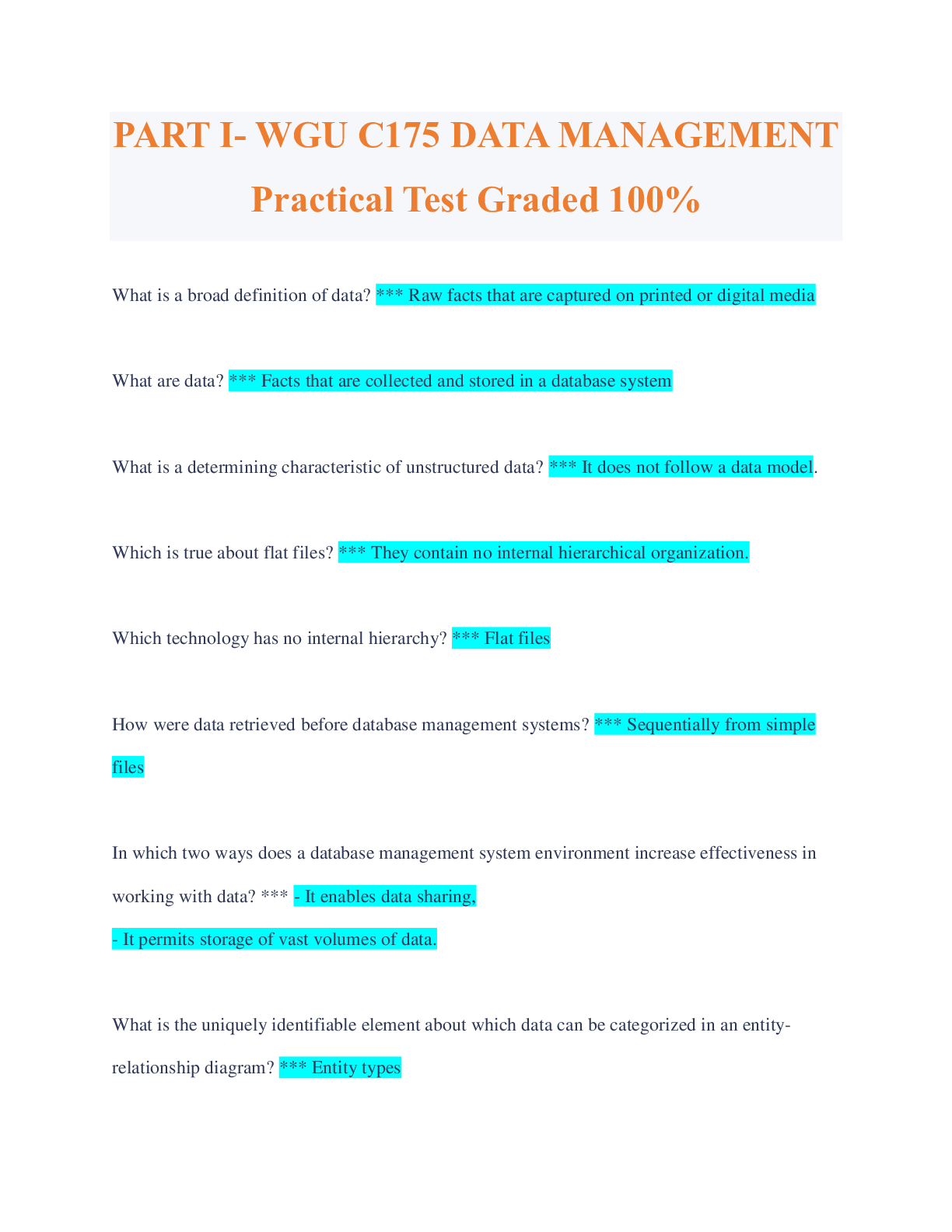
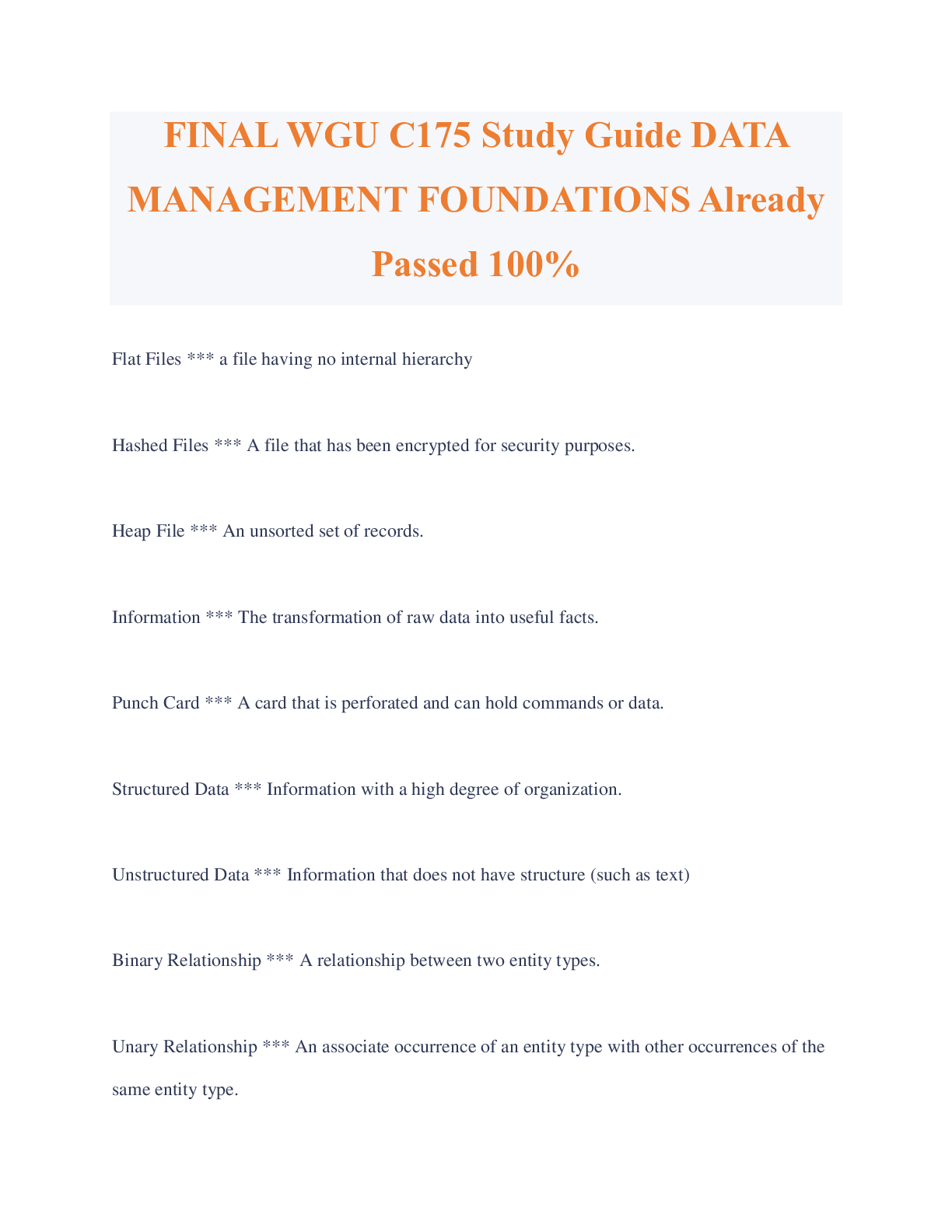
Flat Files - ✔✔-Files having no internal hierarchy
Heap files - ✔✔-Files containing an unsorted set of records that
...
Data Management - Foundations –WGU
C175, Top exam questions with accurate
answers, 100% Accurate.
Flat Files - ✔✔-Files having no internal hierarchy
Heap files - ✔✔-Files containing an unsorted set of records that are uniquely identified by a record id
which allows them to be inserted or deleted using that id.
Index Files - ✔✔-Files that store a list of lookup field values from a data file
end-user data - ✔✔-raw facts of interest to the end user
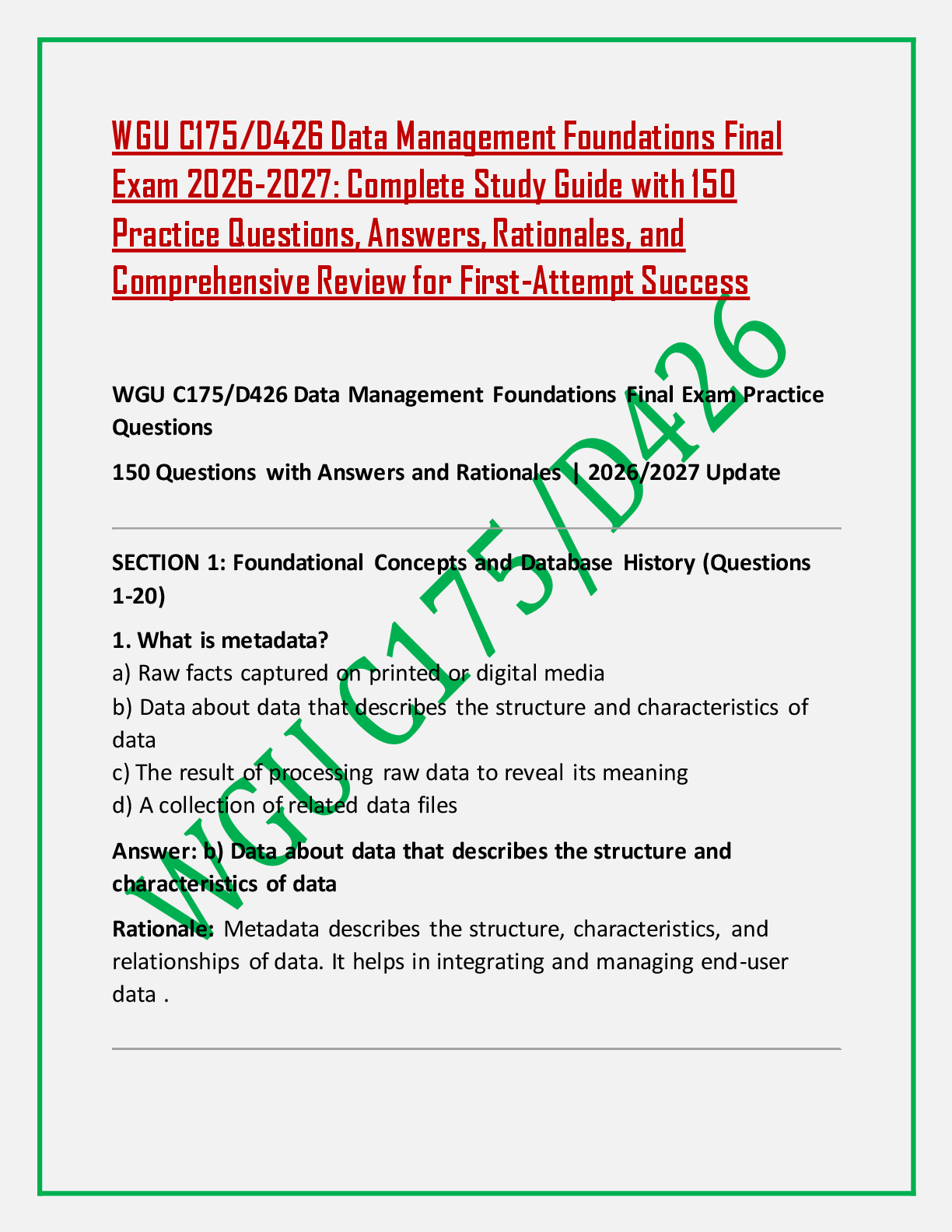
meta data - ✔✔-data about data
database management system (DBMS) - ✔✔-a collection of programs that manages the database
structure and controls access to the data stored in the database
DBMS Advantages - ✔✔-Improved data sharing,
Improved data security
Better data integration
Minimized data inconsistency
Improved data access
Improved decision making
Increased end-user productivity
query - ✔✔-a specific request issued to the DBMS for data manipulation
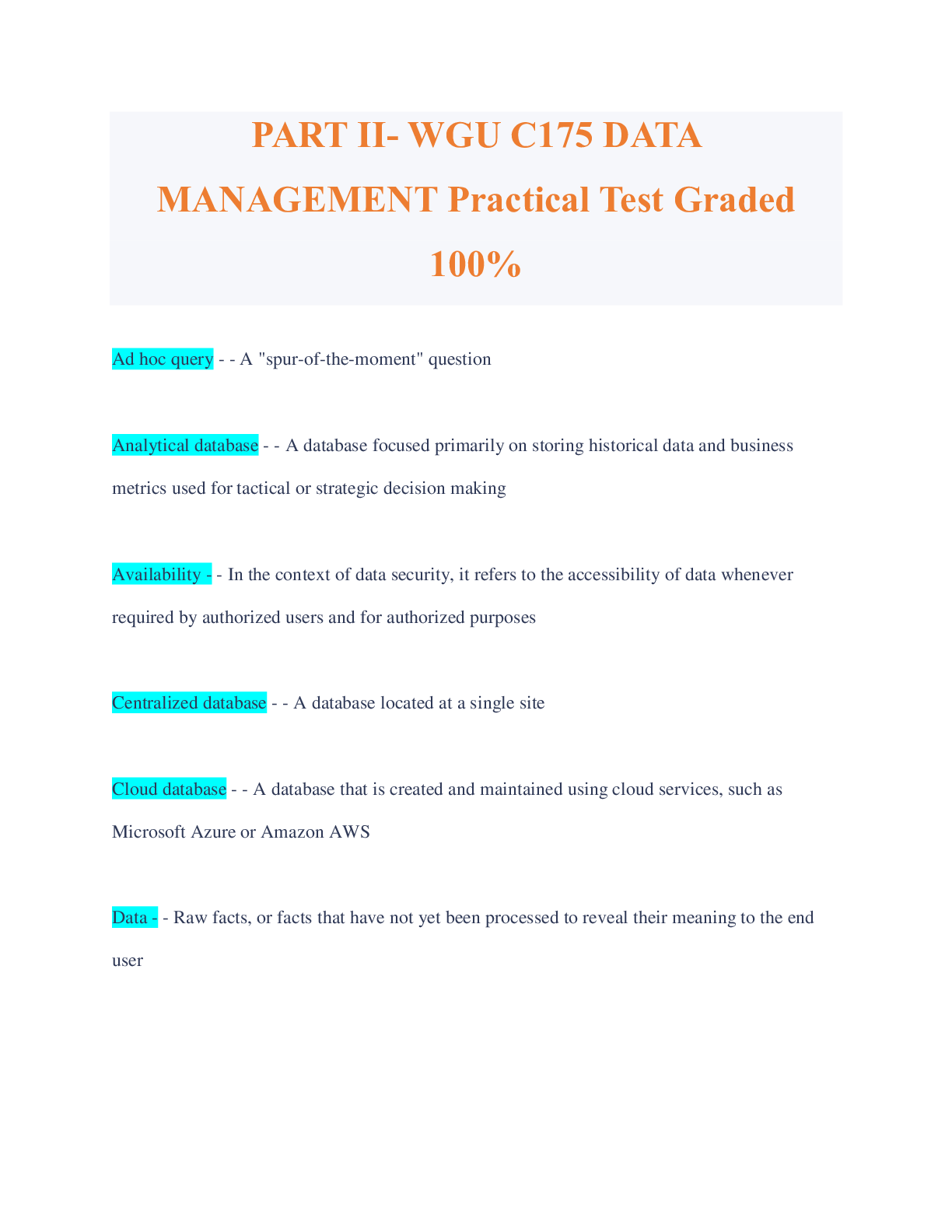
ad hoc query - ✔✔-spur-of-the-moment question
data warehouse - ✔✔-specialized database that stores data in a format optimized for decision support.
Extensible Markup Language (XML) - ✔✔-a special language used to represent and manipulate data
elements in a textual format
NoSQL - ✔✔-generally used to describe a new generation of database management systems that is not
based on the traditional relational database model
file - ✔✔-A collection of related records
field - ✔✔-A character or group of characters (alphabetic or numeric) that has a specific meaning. A field
is used to define and store data.
performance tuning - ✔✔-relates to the activities that make the database perform more efficiently in
terms of storage and access speed.
data dictionary - ✔✔-to look up the required data component structures and relationships
Query language - ✔✔-the de facto query language and data access standard supported by the majority
of DBMS vendors.
database - ✔✔-can be classified according to the number of users supported, where the data is located,
the type of data stored, the intended data usage, and the degree to which the data is structured.
database design - ✔✔-defines the database structure.
limitations of file system data management - ✔✔-requires extensive programming, system
administration can be complex and difficult, making changes to existing structures is difficult, and
security features are likely to be inadequate. Also, independent files tend to contain redundant data,
leading to problems of structural and data dependence.
data modeling - ✔✔-first step in designing a database, a relatively simple representation, usually
graphical, of more complex real-world data structures. an iterative, progressive process.
attribute - ✔✔-a characteristic of an entity.
relationship - ✔✔-describes an association among entities.
constraint - ✔✔-a restriction placed on the data
business rule - ✔✔-a brief, precise, and unambiguous description of a policy,
schema - ✔✔-the conceptual organization of the entire database as viewed by the database
administrator.
subschema - ✔✔-defines the portion of the database "seen" by the application programs that actually
produce the desired information from the data within the database.
relation - ✔✔-(sometimes called a table) as a two-dimensional structure composed of intersecting rows
and columns
tuple - ✔✔-Each row in a relation
end-user interface - ✔✔-Basically, the interface allows the end user to interact with the data (by
automatically generating SQL code)
entity instance or entity occurrence - ✔✔-Each row in the relational table
domain - ✔✔-Each column has a specific range of values
key - ✔✔-consists of one or more attributes that determine other attributes.
determination - ✔✔-the state in which knowing the value of one attribute makes it possible to
determine the value of another
[Show More]