Servsafe Manager Exam Questions and
answers, 100% Accurate, rated A+
foodborne illness - ✔✔-a disease transmitted to people by food
An illness is considered an outbreak when... - ✔✔-• atleast 2 people have the same s
...
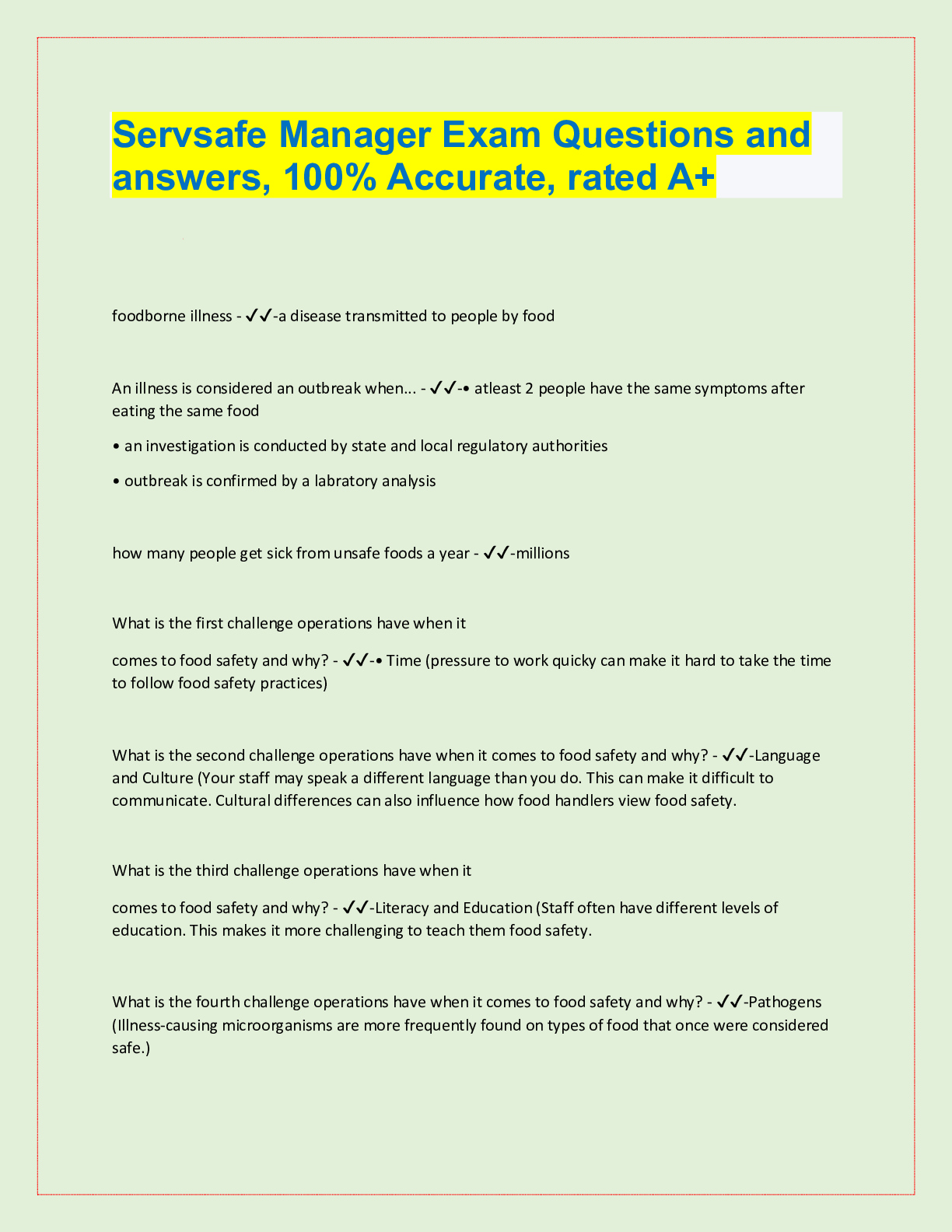
Servsafe Manager Exam Questions and
answers, 100% Accurate, rated A+
foodborne illness - ✔✔-a disease transmitted to people by food
An illness is considered an outbreak when... - ✔✔-• atleast 2 people have the same symptoms after
eating the same food
• an investigation is conducted by state and local regulatory authorities
• outbreak is confirmed by a labratory analysis
how many people get sick from unsafe foods a year - ✔✔-millions
What is the first challenge operations have when it
comes to food safety and why? - ✔✔-• Time (pressure to work quicky can make it hard to take the time
to follow food safety practices)
What is the second challenge operations have when it comes to food safety and why? - ✔✔-Language
and Culture (Your staff may speak a different language than you do. This can make it difficult to
communicate. Cultural differences can also influence how food handlers view food safety.
What is the third challenge operations have when it
comes to food safety and why? - ✔✔-Literacy and Education (Staff often have different levels of
education. This makes it more challenging to teach them food safety.
What is the fourth challenge operations have when it comes to food safety and why? - ✔✔-Pathogens
(Illness-causing microorganisms are more frequently found on types of food that once were considered
safe.)
What is the fifth challenge operations have when it comes to food safety and why? - ✔✔-Unapproved
suppliers ( Food that is recieved from suppliers that are not practicing food safety can cause a
foodborne-illness outbreak.)
What is the sixth challenge operations have when it comes to food safety? - ✔✔-High-risk customers
(the number of customers at high risk for getting a foodborne illness is increasing. An example of this is
the growing elderly population.)
What is the seventh challenge operations have when it comes to food safety? - ✔✔-Staff turnover
(training new staff leaves less time for food safety training)
What is the cost of foodborne illnesses? - ✔✔-One outbreak can cost an operation thousands of dollars,
and it can result in closure.
What are the costs of foodborne illnesses to an operation? - ✔✔-•loss of customers and sales
•loss of reputation
•negative media exposure
•lowered staff morale
•lawsuits and legal fees
•staff missing work
•increased insurance premiums
•staff retraining
What are the cost of foodborne illnesses to the victim? - ✔✔-•lost work
•medical costs and long-term disablity
•death
What is unsafe food usually the result of? - ✔✔-contamination (the presence of harmful substances in
food)
what is a way to prevent foodborne illnesses? - ✔✔-recognize the contaminants that can make food
unsafe (pathogens, chemicals, physical objects, and certain unsafe practices in your operation)
How many categories are contaminants divided into? - ✔✔-3
What is the first category of contaminants - ✔✔-Biological (Pathogens are the greatest threat to food
safety. They include certain viruses, parasites, fungi, and bacteria. Some plants, mushrooms, and
seafood that carry harmful toxins (poisons) are also included im this group.) This category is responsible
for most foodborne illnesses.
What is the second category of contaminants? - ✔✔-Chemical (Foodservice chemicals can contaminate
food if they are used incorrectly. Chemical contaminates may include cleaners, sanitizers, and polishes.)
What is the third category of contaminants? - ✔✔-Physical (Foreign objects such as metal shavings,
staples, and bandages can get into the food. So can glass, dirt, and even bag ties. Naturally occuring
objects, such as fish bones in fillets, are another example.)
What are the five most commom food-handling mistakes, or risk factors, that can cause a foodborne
illness? - ✔✔-•Purchasing food from unsafe sources
•Failing to cook food correctly
•Holding food at incorrect temperatures
•Using contaminated equipment
•Practicing poor personal hygiene
What is the first of the four main factors that 4 of the 5 risk factors or mistakes are related to? - ✔✔-
Time-temperature abuse (Food has been time-temperature abused when it has stayed too long at
temperatures that are good for the growth of pathogens which can result in foodborne illnesses. This an
happen in many ways such as:
• food is not held or stored at the correct temperatures
• food is not cooked or reheated enough to kill pathogens
•food is not cooled correctly)
What is the second of the four main factors that 4 of the 5 risk factors or mistakes are related to? - ✔✔-
Cross-Contamination ( This is when pathogens can be transferred from one surface to another. It can
cause a foodborne illness in many ways such as:
• contaminated ingredients are added to food that recieves no further cooking
•Ready-to-eat food touches contaminated surfaces
•Contaminated food touches or drips fluids onto cooked or ready-to-eat food
•A food handler touches contaminated food and then touches ready-to-eat food
•contaminated cleaning cloths touch food-contact surfaces)
What is the third of the 4 main factors that 4 of the 5 risk factors or mistakes are related to? - ✔✔-Poor
Personal Hygiene ( Actions that food handlers do that cause foodborne illnesses include:
• fail to wash their hands correctly after using the restroom
•cough or sneeze on food
•touch or scratch wounds and then touch food
•work while sick)
What is the fourth of the 4 main factors that 4 of the 5 risk factors or mistakes are related to? - ✔✔-
Poor cleaning and sanitizing (pathogens can be spread to food if equipment has not been cleaned and
sanitized correctly between uses. This can happen in the following way:
•equipment and utensils are not washed, rinsed, and sanitized between uses
•Food-contact surfaces are wiped clean rather than being washed, rinsed, and sanitized
•Wiping cloths are not stored in a sanitizer solution between uses
•Sanitizing solutions are not at the required level to sanitize objects
What is TCS food? - ✔✔-food requiring time and temperature control to limit growth of pathogens
What foods are categorized as TCS food? - ✔✔-•milk and dairy products
•shell eggs (except those treated to eliminate nontyphoidal Salmonella)
•Meat: beaf, pork, and lamb
•poultry
•fish
•shellfish and crustaceans
•baked potatoes
•heat-treated plant food, such as cooked rice, beans, and vegetables
•tofu or other soy protein
•synthetic ingredients, such as textured soy protein in meat alternatives
•sprouts and sprout seeds
•sliced melons
•cut tomatoes
•cut leafy greans
•untreated garlic-and-oil mixtures
What food also needs careful handling to prevent contamination? - ✔✔-Ready-to-eat food (food that
can be eaten without further preparation, washing, or cooking. Including cooked food, washed fruit/
vegetables (whole and cut), deli meat, bakery items, sugar, spices, and seasonings.
What is the first group of
people that have a high risk of getting a foodborne illness? - ✔✔-Elderly people (People's immune
systems weaken with age.)
What is the second group of people that have a high risk of getting a foodborne illness? - ✔✔-Preschool�age children (Very young children have not built up strong immune systems)
What is the third group of people that have a high risk of getting a foodborne illness? - ✔✔-People with
compromised immune systems
(•People with cancer or on chemotherapy)
•People with HIV/AIDS
•Transplant recipients
•People taking certain medications
Training and Monitoring - ✔✔-Staff should be trained when they are first hired and on an ongoing basis.
Your entire staff needs general food safety knowledge and knowledge on specific tasks performed on
the job. Staff need to be retrained in food safety regularly, and document when a food handler
completes this training. Once staff are trained, monitor them.
Government agencies helping - ✔✔-The Food and Drug Administration (FDA) and the U.S Department of
Agriculture (USDA) inspect food and perform other critical duties. State and local regulatory authorities
create regulations and inspect operations. Agencies such as the Centers for Disease Control and
Prevention (CDC) and the US Public Health Service (PHS) help as well.
FDA Role - ✔✔-•inspects all food except meat, poultry, and eggs
•regulates food transported across state lines
•issues a Food Code (provides recommendations for food safety regulations/ created for city, country,
state, and tribal agencies (regulate foodservice for:
•restaurants and retail food stores
•vending operations
•schools and day care centers
•hospitals and nursing homes)
•provide technical support and training for industry and regulatory industries
USDA role - ✔✔-•regulates and inspects meat, poultry, and eggs
• regulates food that crosses state boundaries or involves more than one state
CDC and PHS role - ✔✔-•assist FDA, USDA, and state and local health departments
•conduct research into the causes of foodborne-illness outbreaks
•assist in investigating outbreaks
state and local regulatory authorities - ✔✔-•write or adopt code that regulates retail and foodservice
operations (may differ from Food Code because these agencies aren't required to adopt it)
Regulatory authorities responsibilities:
•inspecting operations
•enforcing regulations
•investigating complaints and illnesses
•issuing licenses and permits
•approving construction
•reviewing and approving HACCP plans
What is a contaminate? - ✔✔-•the presence of harmful substances in food
•can be biological, chemical, or physical
•most cause foodborne illnesses while the others result in physical injury
Where do contaminates come from? - ✔✔-•many are found in the animals we use for food
•air, contaminated water, and dirt
• some occur naturally in food (bones in fish)
How does food become contaminated? - ✔✔-Usually it's contaminated accidentally because most
contaminants get into food and onto food-contact surfaces because of the way
people handle it.
What is the fecal-oral route of contamimation? - ✔✔-When food handlers (who don't wash their hands
after using the restroom) contaminate food and surfaces with feces from their fingers. Once the
contaminated food is eaten, a foodborne illness may result
How do food handlers pass on contaminants when they are in contact with a person who is ill? - ✔✔-
•From person to person
•Through sneezing or vomiting onto
food or food-contact surfaces
•From touching dirty food-contact surfaces and equipment, and then touching food
How can simple mistakes result on contamination? - ✔✔-•allowing ready-to-eat food to touch surfaces
that have come in contact with raw meat, seafood, and poultry can lead to contamination
•storing food incorrectly or cleaning produce incorrectly can lead to contamination
•failure to spot signs of pests in the establishment, because pests are a major source of disease
What are microorganisms? - ✔✔-small, living organisms that can be seen
only through a microscope
What are pathogens? - ✔✔-Harmful microorganisms that make you sick when you eat them or produce
poisons (or toxins) that make you sick
What is the first step to preventing foodborne-illness outbreaks? - ✔✔-understanding biological
contaminants
What are the four types of pathogens? - ✔✔-bacteria, viruses, parasites, and fungi (includes mold and
yeast)
How many pathogens can cause a foodborne illness? - ✔✔-Over 40 different kinds of bacteria, viruses,
parasites, and molds can occur in food and cause a foodborne illness
What is the Big Six? - ✔✔-The 6 pathogens that have been singled out by the FDA for being highly
contagious and can cause severe illness
Which 6 pathogens are in the Big Six? - ✔✔-•Shigella spp.
•Salmonella Typhi
•Nontyphoidal Salmonella (NTS)
•Shiga toxin-producing Escherichia coli (STEC) (E. Coli)
•Hepatitis A
•Norovirus
2 Toxins from Fish - ✔✔-Ciguatoxin: Grouper, Barracuda, Amberjack, Snapper
Histamine: Tuna, Bonito, Makerel, Mahimahi
Symtoms of toxins - ✔✔-Immediate reaction: Reversal of hot and cold sensations, reddening of face and
neck, sweating, headache, burning sensation in mouth, nausea, vomiting, tingling, joint and muscle pain.
Parasite: Giardia duodenalis - ✔✔-Parasite found in the feces of infected people. Incorrectly treated
water, and produce are commonly linked foods.
Symptoms: Fever, Diarrhea, Abdominal cramps, Nausea
What are the common symptoms for a foodborne illness? - ✔✔-•Diarrhea
•Vomiting
•Fever Dizziness
•Nausea
•Abdominal cramps
•Jaundice (a yellowing of the skin and eyes)
What is the onset time of the illness? - ✔✔-•how quickly foodborne-illness symptoms appear in a
person
•depends on the type of foodborne illness
• can range from 30 min. to six weeks
•how severe the illness is can range from mild diarreah to death
What are the basic characteristics of Bacteria that cause foodborne illnesses? - ✔✔-• Location (found
almost everywhere including our bodies)
• Detection (can't be seen, smelled, or tasted)
•Growth ( if FAT TOM conditions are right, bacteria will grow in rapid numbers)
•Prevention (control time and temperature)
What is FAT TOM? - ✔✔-It stands for all the conditions Bacteria needs to grow
What does the F in FAT TOM stand for? - ✔✔-Food (most bacteria need nutrients to survive, and TCS
food supports the growth of bacteria better than other types of food)
What does the A in FAT TOM stand for? - ✔✔-Acidity (Bacteria grow best in food that contains little or
no acid as in food that is neutral or slightly acidic (14 is highly alkaline)
What does the first T in FAT TOM stand for? - ✔✔-Temperature (Bacteria grows rapidly in the
temperature range of 41 degrees farenheit (5 degrees Celcius)- 135 degrees farenheit (57 degrees
Celcius) and more rapidly between 70 degrees Farenheit (21 degrees Celcius) and 125 degrees Farenheit
(52 degrees Celcius). Bacteria growth is limited when
[Show More]