WGU-C175, Top Exam Question with
accurate answers, 100% Accurate, rated
A+
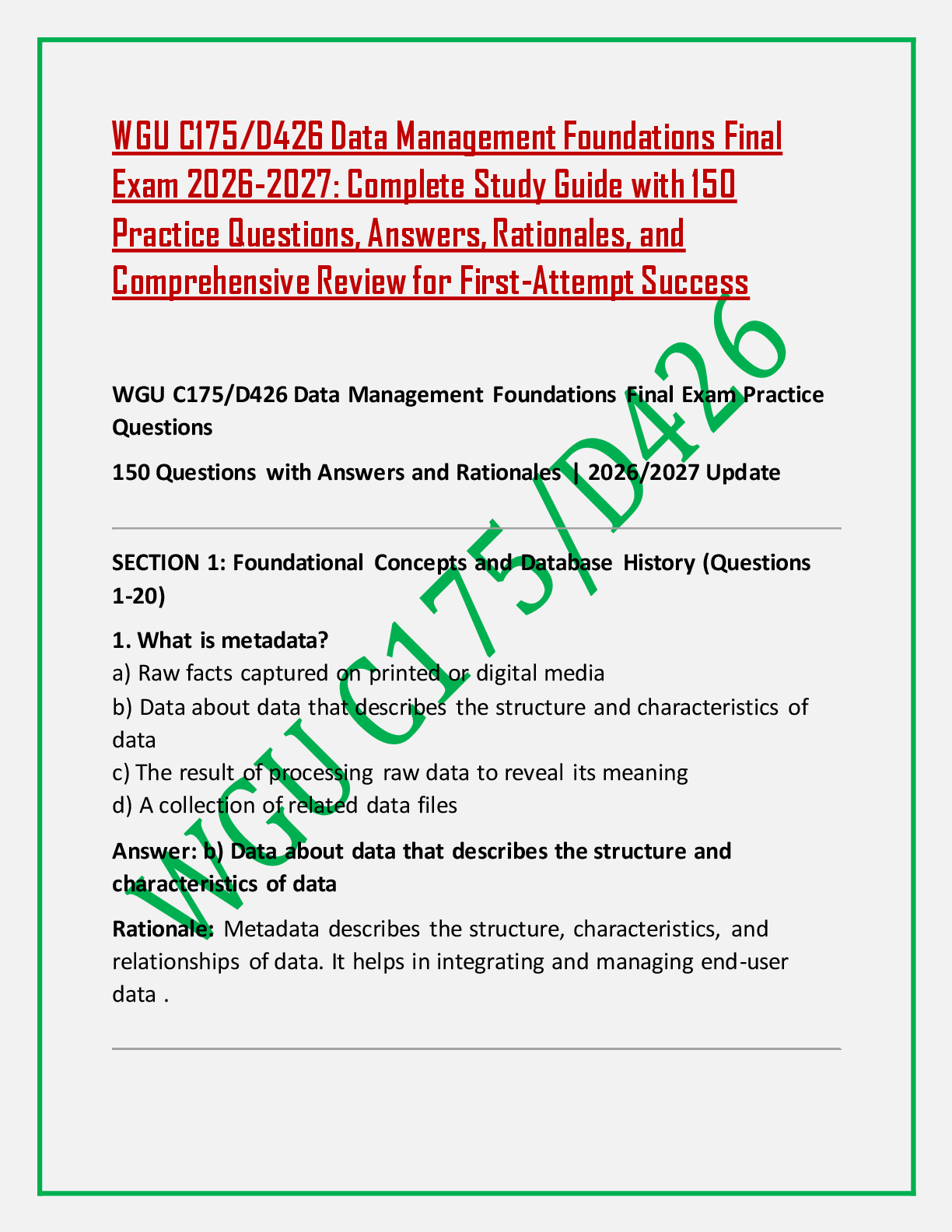
Data - ✔✔-Facts gathered together for analysis
1640-Blaise Pascal - ✔✔-adding machine similar to odometer
1805-Joseph Marie Jacquard - ✔✔-
...
WGU-C175, Top Exam Question with
accurate answers, 100% Accurate, rated
A+
Data - ✔✔-Facts gathered together for analysis
1640-Blaise Pascal - ✔✔-adding machine similar to odometer
1805-Joseph Marie Jacquard - ✔✔-punch card for textile weaving patterns (Loom)
1833-Charles Babbage - ✔✔-loom records patterns in punch cards
1890-Herman Hollerith - ✔✔-tabulator/sorter punch cards Amercian census-ABM
1911-James Powers - ✔✔-automatic feeders Powers tabulators machine comp>UNIVAC>UnisysCorp
1930's - ✔✔-Erasable magnetic tape for storage
1940's - ✔✔-magnetic drum's begin prototype
Flat Files - ✔✔-A file having no internal hierarchy
Hashed Files - ✔✔-A file that has been encrypted for security purposes
Heap Files - ✔✔-An unsorted set of records
Information - ✔✔-The transformation of raw data into useful facts
indexed-sequential file - ✔✔-an index built over a field
Punch Card - ✔✔-A card that is perforated and can hold commands or data
Structured Data - ✔✔-Information with a high degree of organization, organized in rows and columns
Unstructured Data - ✔✔-Information that does not have structure (such as text) cannot be stored in
rows and text such as email, sticky notes, business cards IM's...
Big Data - ✔✔-structured and unstructured data, large amount of data to handle
Digital Data - ✔✔-stored as strips of binary numbers
Binary relationship - ✔✔-It is a relationship between two entity types. (simplest relationship)
Cardinality - ✔✔-(Means Count) It is the maximum number of entities that can be involved in a
particular relationship ie: one-one, one-many, many-many (Closest to entity cannot be zero, crows foot)
E-R Model (entity-relationship) - ✔✔-It is well named, as it diagrams entities (together with their
attributes) and the relationships among them
Intersection data - ✔✔-It is a data that describes a many-to-many relationship.
Modality - ✔✔-It is a minimum number of entity occurrences that can be involved in a relationship.
(farthest from entity can be zero)
One-to-One Binary Relationship - ✔✔-It means that a single occurrence of one entity type can be
associated with a single occurrence of the other entity type and vice versa.
Simple Linear Index - ✔✔-very close in structure to the index in the back of a book.
Ternary relationship - ✔✔-A relationship that involves three different entity types.
Unary relationship - ✔✔-It is an associate occurrence of an entity type with other occurrences of the
same entity type.
Unique identifier - ✔✔-It is used to uniquely identify each record in a database table.
Referential Integrity - ✔✔-trying to refer data in one relation in the DB, data staying the same across
tables when you insert/update/delete
Attribute - ✔✔-a property of, a characteristic of, or a fact that we know about an entity
B+ tree index - ✔✔-family tree organizational method better to insert/delete records.
Each index record, at every level of the tree, contains space for the same number of key value/pointer
pairs. This index record capacity is arbitrary, but once it is set, it must be the same for every index record
at every level of the index.
Candidate key (alternate key) - ✔✔-If a relation has more than one attribute or minimum group of
attributes that represents a way of uniquely identifying the entities, then they are each called a
candidate key. unique, non-volatile, minimal. A candidate key is a candidate to become a primary key.
Composite key - ✔✔-2 or more attributes are combined 2 columns (ie: flight # and flight date)
Computer security - ✔✔-It includes protecting the physical hardware environment, defending against
hacker attacks, encrypting data transmitted over networks, educating employees on the importance of
protecting the company's data, and many more.
Concurrency problem - ✔✔-If two or more users are trying to update a particular record simultaneously,
they run the risk of generating what is known as a "concurrency problem."
Database index - ✔✔-Improves DB query performance. Data structure that contains a copy of some of
the data from one or more existing DB tables.
Data integration - ✔✔-It refers to the ability to tie together pieces of related data within an information
system.
Data redundancy - ✔✔-It refers to the same fact about the business environment being stored more
than once within an information system.
Data retrieval - ✔✔-It involves the fetching of desired data from a database.
Direct access - ✔✔-It is a retrieval of a single record of a file or a subset of the records of a file based on
one or more values of a field or a combination of fields in the file.
Entity - ✔✔-A "thing" or "object" in our environment that we want to keep track of. Something of
importance (theme) needs to be represented in a DB. You want to track using attributes IE Employee: #,
name, dep.
Entity set - ✔✔-A collection of entities of the same type (e.g., all the company's employees) is called an
entity set.
Equijoin - ✔✔-combines two or more tables based on a column that is common to the tables.
Fields - ✔✔-The columns representing the facts are called fields.
File - ✔✔-The entire structure is called a file.
Foreign key - ✔✔-when in a collection of relations that make up a relational database, an attribute or
group of attributes serves as the primary key of one relation and also appears in another relation
Functional dependency - ✔✔-value of one attribute depends on the value of another attribute
(relationships of attributes) Defining associations.
Key - ✔✔-one or more columns of a relation whose values are used to identify a row
JOIN operator - ✔✔-It specifies how to relate tables in the query
Logical sequential access - ✔✔-the records are retrieved in order based on the values of one or a
combination of the fields.
Natural Join - ✔✔-matches each row in a table against each row in another table based on common
values found in columns sharing a common name and data type.
Non-unique key - ✔✔-data value may be shared among several rows ie: Dep same for multiple
employees
Null value - ✔✔-no data exists in the cell, can be an anomaly/ambigious not "zero"
horizontal add - ✔✔-adds an attribute that accounts for data integration issue
Physical sequential access - ✔✔-the records are retrieved one after the other, just as they are stored on
the disk device.
Primary key - ✔✔-It is an attribute or group of attributes whose values are unique throughout all rows
of the relation. Chosen to be the main key.
Record - ✔✔-a collection of related data items
Record type - ✔✔-structural definition of every record in file
Record occurrence - ✔✔-specific record of file
Re-engineering - ✔✔-data and information systems are aggressively used to redesign business processes
for maximum efficiency
Referential integrity - ✔✔-every value of a foreign key must match a value of an existing primary key
Relation table - ✔✔-2D table that has specific characteristics.
-rows must contain instances of an entity.
-Columns is an attribute
-Cells hold a single value
-all values in a column use same data type
-each column has a unique name
-order of row or column is unimportant
-no two rows can be the same
Relations - ✔✔-are tables not all tables are relations
Relational algebra - ✔✔-It is a formal system for manipulating relations.
Retrieve or Read - ✔✔-It refers to the data without changing it.
Sequential access - ✔✔-It means the retrieval of all or a portion of the records of a file one after
another, in some sequence, starting from the beginning, until all the required records have been
retrieved
Simple linear file - ✔✔-It is a collection of records listed one after the other on a long line
Surrogate key - ✔✔-used when no primary key can be identified no value when numbers are used ie
employee id #
Transitive Dependencies - ✔✔-non-key attribute is
[Show More]


.png)
.png)
.png)


.png)

.png)