WGU C846 Business of IT –
Applications. All Terms, rated A+
The terms mentioned in this list are of the terms mentioned in the ITIL V4 Foundation Syllabus;
all terms on list are potentially on the certification exam.
...
WGU C846 Business of IT –
Applications. All Terms, rated A+
The terms mentioned in this list are of the terms mentioned in the ITIL V4 Foundation Syllabus;
all terms on list are potentially on the certification exam. NOTICE: make sure you know these
terms like the back of your hand; I pulled the definitions from the course material, and some of
the EXACT definitions were on the exam itself.
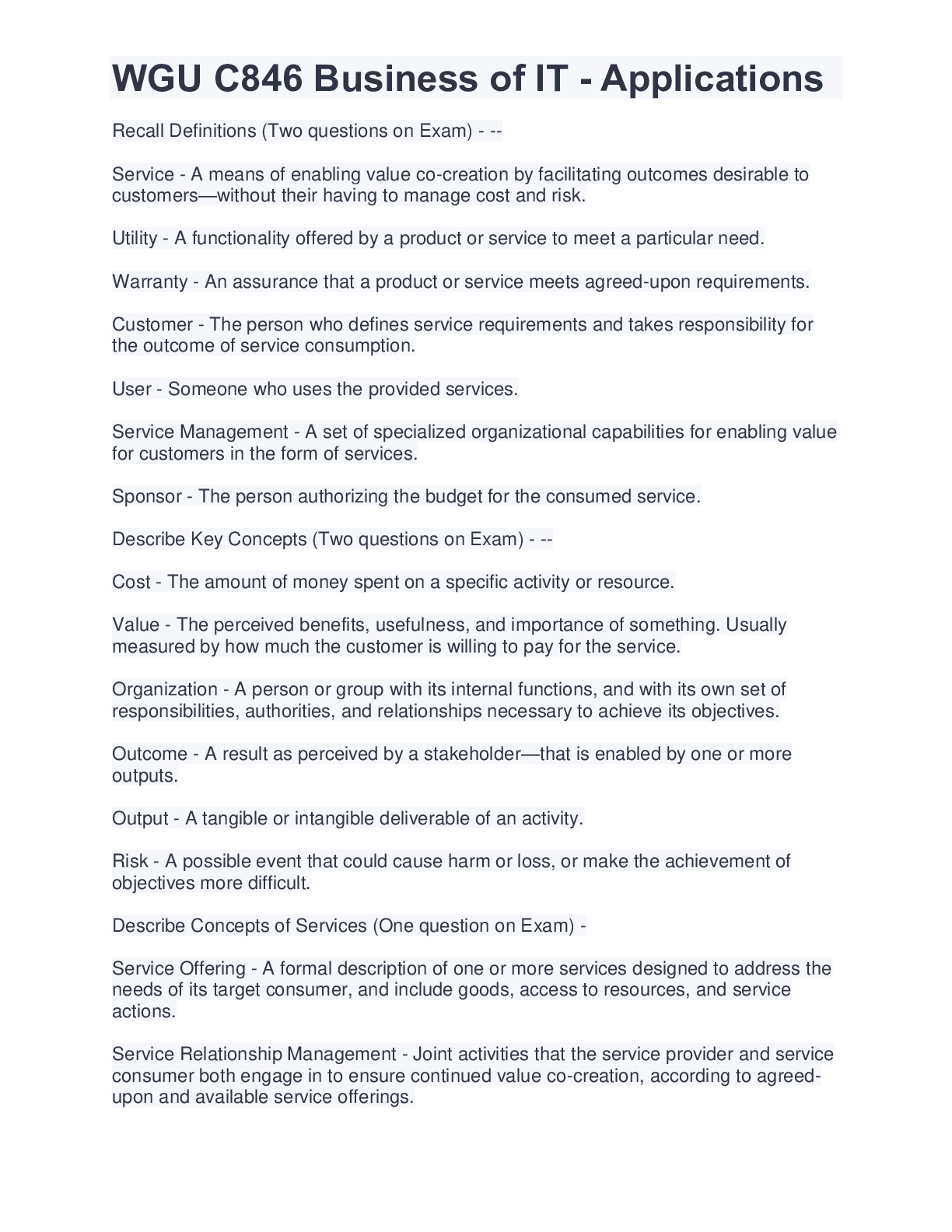
Service - ✔✔-A means of enabling value co-creation by facilitating outcomes desirable to customers—
without their having to manage cost and risk.
Utility - ✔✔-A functionality offered by a product or service to meet a particular need.
Warranty - ✔✔-An assurance that a product or service meets agreed-upon requirements.
Customer - ✔✔-The person who defines service requirements and takes responsibility for the outcome
of service consumption.
User - ✔✔-Someone who uses the provided services.
Service Management - ✔✔-A set of specialized organizational capabilities for enabling value for
customers in the form of services.
Sponsor - ✔✔-The person authorizing the budget for the consumed service.
Cost - ✔✔-The amount of money spent on a specific activity or resource.
Value - ✔✔-The perceived benefits, usefulness, and importance of something. Usually measured by how
much the customer is willing to pay for the service.
Organization - ✔✔-A person or group with its internal functions, and with its own set of responsibilities,
authorities, and relationships necessary to achieve its objectives.
Outcome - ✔✔-A result as perceived by a stakeholder—that is enabled by one or more outputs.
Output - ✔✔-A tangible or intangible deliverable of an activity.
Risk - ✔✔-A possible event that could cause harm or loss, or make the achievement of objectives more
difficult.
Service Offering - ✔✔-A formal description of one or more services designed to address the needs of its
target consumer, and include goods, access to resources, and service actions.
Service Relationship Management - ✔✔-Joint activities that the service provider and service consumer
both engage in to ensure continued value co-creation, according to agreed-upon and available service
offerings.
Service Provision - ✔✔-Activites an organization engages in to provide services, such as possibly
supplying goods, fulfillment of agreed-upon service actions, and ensuring user access to these resources.
Service Consumption - ✔✔-Management of consumer resources necessary to use the service
Describe the Nature, use and interaction of the Guiding Principles (One question on Exam) - ✔✔---
ITIL Guiding Principles' Key Message - ✔✔-A guiding principle is a recommendation that guides an
organization in all circumstances, regardless of changes in its goals strategies type of work or
management structure. A guiding principle is universal and enduring.
Focus on Value (Guiding Principle #1) - ✔✔--Understand their expected outcomes, how each service
contributes to them, and how the service consumers perceive the service provider. Continually collect
feedback regarding value—not merely at the start of the service relationship.
-Everything the organization does must map, directly or indirectly, to stakeholder value.
Start Where You Are (Guiding Principle #2) - ✔✔--The current state should be investigated and observed
directly to make sure its fully understood
-Don't start from scratch, use available services and processes.
Progress Iteratively with Feedback (Guiding Principle #3) - ✔✔--Comprehend the whole, but do
something. Often, the greatest enemy of this is the desire to understand and account for everything.
This can lead to what's known as "analysis paralysis," whereby so much time is spent analyzing the
situation that nothing is done about it. Understanding the big picture is no doubt important, but so is
making progress!
-Don't attempt everything at once! Even huge initiatives can and should be accomplished iteratively.
Collaborate and Promote Visibility (Guiding Principle #4) - ✔✔--Communicate in a way the audience can
hear. In an attempt to bring different stakeholders into the loop, many organizations use very traditional
methods of communication, or they use the same method for all communication. Selecting the right
method and message for each audience is critical to success.
-Work together across boundaries for greater buy-in, more relevance to objectives, and increased the
likelihood of long-term success.
Think and Work Holistically (Guiding Principle #5) - ✔✔--Recognize the complexity of the systems.
Different levels of complexity require different heuristics for decision making. Applying methods and
rules designed for a simple system can be ineffective, or even harmful, in a complex system, in which
relationships among components are complicated and tend to change more frequently.
-No service—or element used to provide it—stands alone. Outcomes achieved by the service provider
and service consumer will suffer unless the organization works on the service as a whole, not merely on
its component parts.
Keep it Simple and Practical (Guiding Principle #6) - ✔✔--Ensure that there's value. Every activity should
contribute to the creation of value.
-If a value stream, process, service, action, or metric fails to provide value or produce a useful outcome,
eliminate it.
Optimize and Automate (Guiding Principle #7) - ✔✔--Selecting what to do and how to do so should be
performed according to what creates the best value for the organization.
-Resources of all types, particularly human resources, should be used to their best effect. -People should
intervene only when doing so truly contributes value.
Service Value System (SVS) - ✔✔-This describes how all components and activities of an organization
work together as a system to enable value creation. Each organization's SVS interfaces with other
organizations, thus forming an ecosystem that services to facilitate value for the organizations, their
customers, and other stakeholders. This includes components such as: governance, SVC, and Continual
Improvement
Describe Nautre of Service Vaule Chain (One question on Exam) - ✔✔---
Service Value Chain (SVC) - ✔✔-An operating model which outlines the key activities required to
respond to demand and facilitate value realization through the
[Show More]


.png)
.png)
.png)



.png)