50 Question CNA Practice. Top Exam
Question with accurate answers,
verified.
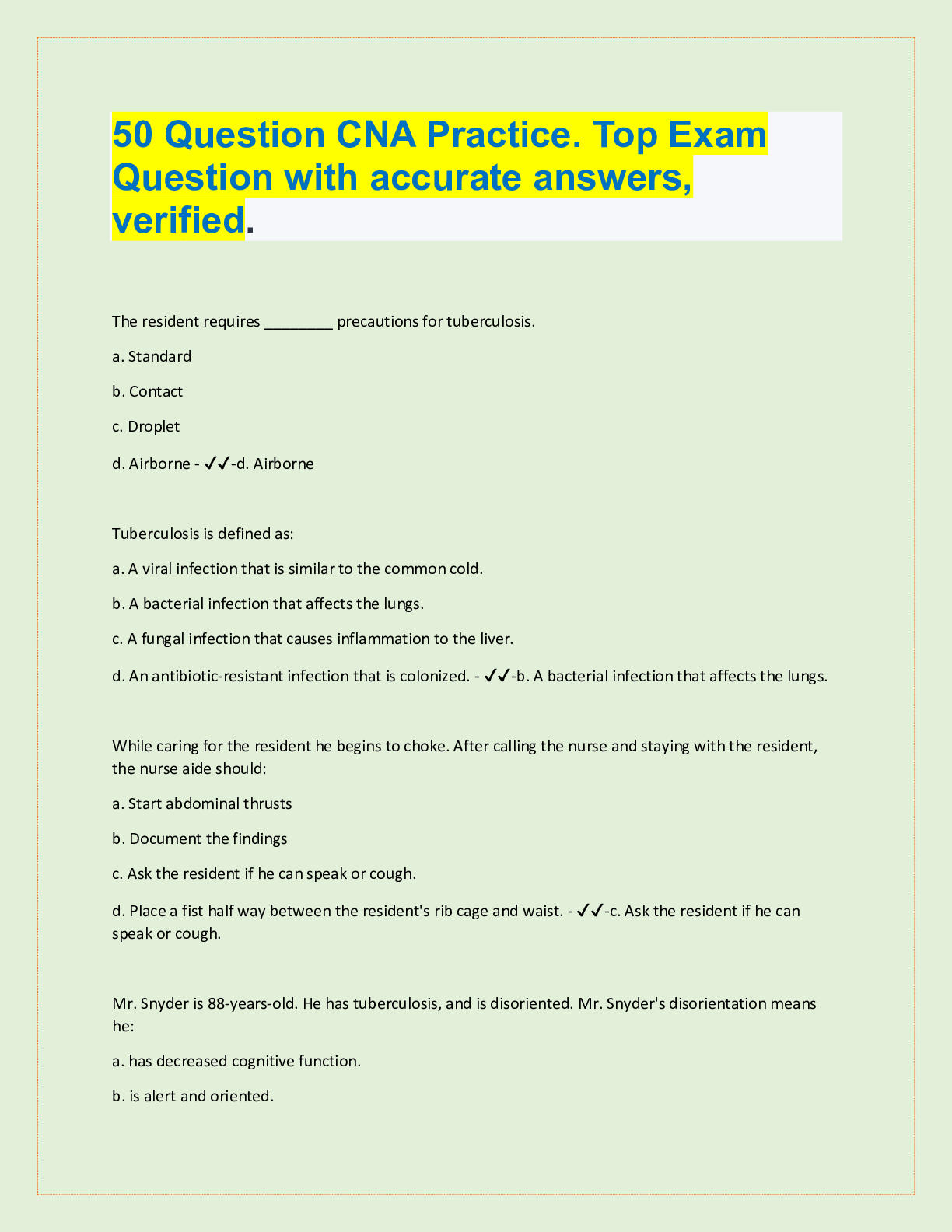
The resident requires ________ precautions for tuberculosis.
a. Standard
b. Contact
c. Droplet
d. Airborne - ✔✔-d. Airborne
Tuberculo
...
50 Question CNA Practice. Top Exam
Question with accurate answers,
verified.
The resident requires ________ precautions for tuberculosis.
a. Standard
b. Contact
c. Droplet
d. Airborne - ✔✔-d. Airborne
Tuberculosis is defined as:
a. A viral infection that is similar to the common cold.
b. A bacterial infection that affects the lungs.
c. A fungal infection that causes inflammation to the liver.
d. An antibiotic-resistant infection that is colonized. - ✔✔-b. A bacterial infection that affects the lungs.
While caring for the resident he begins to choke. After calling the nurse and staying with the resident,
the nurse aide should:
a. Start abdominal thrusts
b. Document the findings
c. Ask the resident if he can speak or cough.
d. Place a fist half way between the resident's rib cage and waist. - ✔✔-c. Ask the resident if he can
speak or cough.
Mr. Snyder is 88-years-old. He has tuberculosis, and is disoriented. Mr. Snyder's disorientation means
he:
a. has decreased cognitive function.
b. is alert and oriented.
c. paralyzed on one side of the body.
d. requires droplet precautions. - ✔✔-a. has decreased cognitive function.
The resident asks the nurse aide to view the facility's survey results. The best response by the nurse aide
is:
a. "You don't need to look at that right now."
b. "Why do you want to see that? You won't understand what you're reading." c. "Those results can be
seen after you sign a release to view them."
d. "Do you have a specific question I can answer for you?" - ✔✔-d. "Do you have a specific question I can
answer for you?"
The resident states his daughter is only mean to him when he asks too many questions. This is an
example of:
a. Rationalization
b. Displacement
c. Denial
d. Misappropriation - ✔✔-a. Rationalization
Which vital sign should be reported to the licensed nurse immediately? a. Blood pressure 138/88 mmHg
b. Respiratory rate 28 breaths per minute
c. Oral temperature 99.1 F
d. Pulse rate 99 bpm - ✔✔-b. Respiratory rate 28 breaths per minute
When checking the resident's pulse rate, the Nurse Aide will observe the _____. a. rate, regularity,
sound
b. rhythm, sound, force
c. rate, rhythm, force
d. rate, rhythm, characteristics - ✔✔-c. rate, rhythm, force
Maintaining proper body alignment while the resident is lying in bed will help to: a. prevent
contractures.
b. restrain the resident.
c. decrease risk of falling.
d. stop blood clots from forming. - ✔✔-a. prevent contractures
When transferring the resident from the bed to the chair, all actions are appropriate EXCEPT:
a. place non-skid footwear on the resident.
b. place the resident in lateral position.
c. place the bed in the lowest position.
d. position the chair to the resident's unaffected side. - ✔✔-b. place the resident in lateral position.
When caring for the resident with C-diff, the nurse aide should remember to: a. use sanitizing gel to
hand hygiene before and after resident contact.
b. use airborne precautions before entering the resident's room.
c. only use standard precautions when caring for the resident.
d. hand hygiene using soap and water. - ✔✔-d. hand hygiene using soap and water.
The resident who is bed-bound should be repositioned every:
a. 30 minutes
b. Hour
c. 2 hours
d. Day - ✔✔-c. 2 hours
The resident who needs assistance with eating should be placed in the ____ position. a. supine
b. lateral
c. prone
d. Semi-Fowler's - ✔✔-d. Semi-Fowler's
In the chain of infection link, the ____ describes the person who could become infected. a. mode of
transmission
b. portal of exit
c. susceptible host
d. causative agent - ✔✔-c. susceptible host
The resident was recently found to have pediculosis. This will require _____ precautions.
a. airborne
b. contact
c. droplet
d. standard - ✔✔-b. contact
[Show More]