AAPC - CRC TEST 1 Questions and
answers, 100% Accurate, graded A+
Which of the following medications are prescribed to cancer patients to eradicate the cancer or for
prophylaxis?
I. Tamoxifen
II. Anastrozole
III.
...
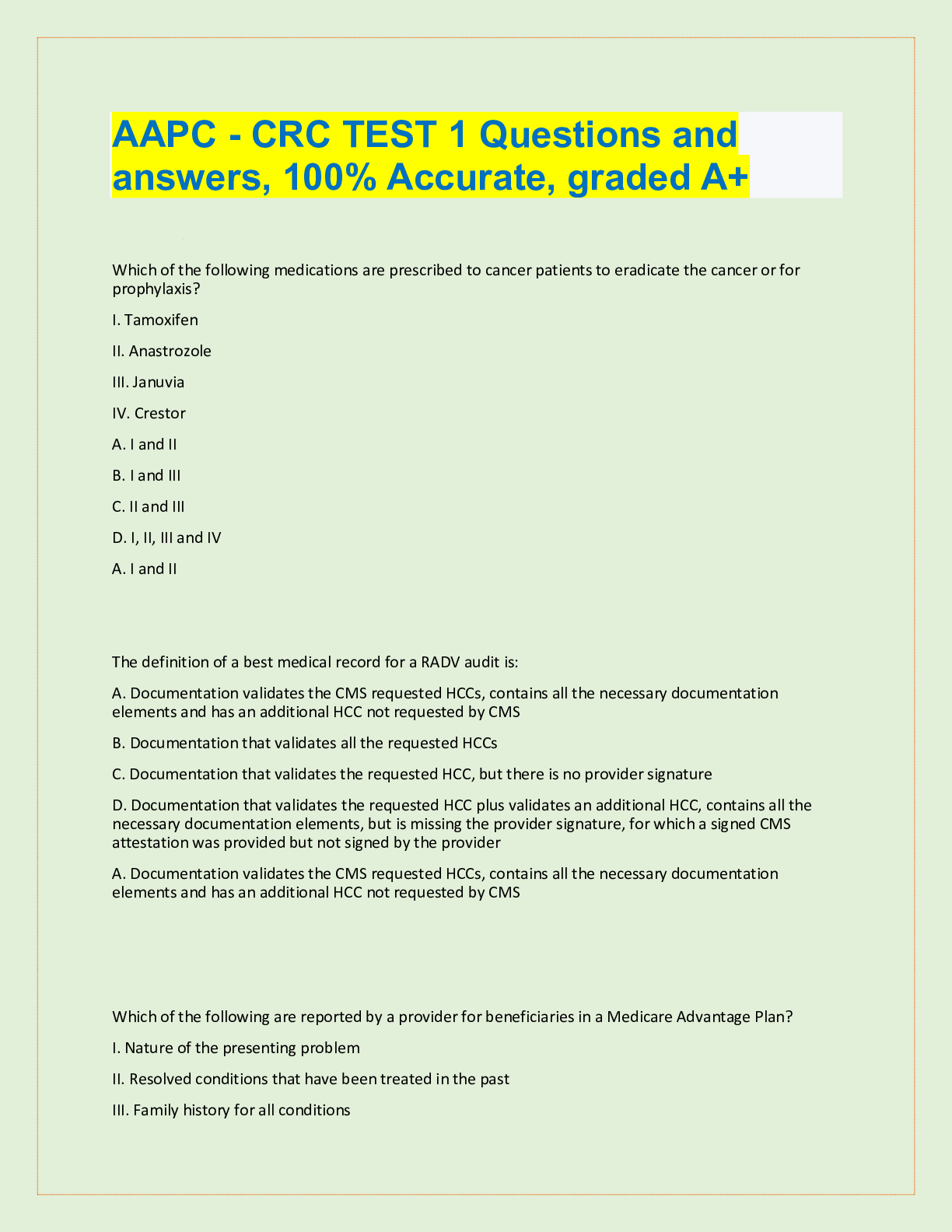
AAPC - CRC TEST 1 Questions and
answers, 100% Accurate, graded A+
Which of the following medications are prescribed to cancer patients to eradicate the cancer or for
prophylaxis?
I. Tamoxifen
II. Anastrozole
III. Januvia
IV. Crestor
A. I and II
B. I and III
C. II and III
D. I, II, III and IV
A. I and II
The definition of a best medical record for a RADV audit is:
A. Documentation validates the CMS requested HCCs, contains all the necessary documentation
elements and has an additional HCC not requested by CMS
B. Documentation that validates all the requested HCCs
C. Documentation that validates the requested HCC, but there is no provider signature
D. Documentation that validates the requested HCC plus validates an additional HCC, contains all the
necessary documentation elements, but is missing the provider signature, for which a signed CMS
attestation was provided but not signed by the provider
A. Documentation validates the CMS requested HCCs, contains all the necessary documentation
elements and has an additional HCC not requested by CMS
Which of the following are reported by a provider for beneficiaries in a Medicare Advantage Plan?
I. Nature of the presenting problem
II. Resolved conditions that have been treated in the past
III. Family history for all conditions
IV. All chronic conditions
C. I and IV
Which of the following records would be a good source for a retrospective chart audit?
A. DME documentation
B. Cardiologist records
C. Dietician notes
D. RN notes
B. Cardiologist records
Retrospective audits should include the following attributes:
I. Provider signatures
II. Supporting documentation of the patient's diagnoses
III. DOS
D. I, II and III
Which type of audit evaluates appropriate risk scores of patients?
A. ZPIC
B. RADV
C. RAC
D. CERT
B. RADV
What information is required when submitting documentation to support a diagnosis for a RADV/IVA?
A. All patient records for the calendar year resulting in care for a chronic condition
B. All inpatient hospital records where a readmission occurred
C. A single DOS for outpatient records and the full inpatient set for hospital records
D. All professional provider documentation for the previous year
C. A single DOS for outpatient records and the full inpatient set for hospital records
What is TRUE regarding the code assignment requirement for chronic kidney disease requiring dialysis
(N18.6)?
A. The diagnosis should only be reported when the patient is admitted to the hospital.
B. The diagnosis should only be reported when the patient is diagnosed with CKD and is actively being
treated by a specialist.
C. The patient should be diagnosed with CKD and is on chronic dialysis or receiving kidney transplants
are associated with this diagnosis.
D. The diagnosis should only be reported when the patient is diagnosed with chronic renal insufficiency.
C. The patient should be diagnosed with CKD and is on chronic dialysis or receiving kidney transplants
are associated with this diagnosis.
Joey is prescribed Oxycodone for a back injury by his orthopedic surgeon two years ago. The surgeon
documents he would like to try another medication to dull the pain. Joey attempts to change to the
newer medication but there is breakthrough pain and he goes back to the Oxycodone. Would code from
category F11.2 be appropriate?
A. Yes, Joey has been on the Oxycodone for two years
B. Yes, Joey's pain could not be controlled by the second medication
C. No, a person must be on a medication a minimal of 3 years before "dependency" can be implied
D. No, the surgeon did not document that Joey was dependent on the Oxycodone
D. No, the surgeon did not document that Joey was dependent on the Oxycodone
Diagnoses must be based on face-to face encounters between members and an MD, PA, or NP and
status conditions like a below knee amputation, must be assessed and documented in order for
payment adjustments to be received. How often should a provider see and assess a patient in a calendar
year to validate amputation status?
A. Twice a year
B. Once a year
C. Four times a year
D. Every two years
B. Once a year
A PEG Tube is:
I. Percutaneous Endoscopic Gastrostomy
II. G tube
III. Gastrostomy
IV. Colostomy
A. I
B. I and III
C. I, II, and III
D. IV
C. I, II, and III
Patient is here for follow up. She was seen in the ER two weeks ago where she had an MRI of the brain
which showed significant cerebral arteriosclerosis. She was diagnosed with a TIA. She has been
experiencing slight memory loss. Select the correct code(s).
A. I67.2, Z86.73
B. G45.9
C. Z86.73, R41.3
D. G45.9, I67.2, R41.3
A. I67.2, Z86.73
Patient is here for follow up after her dialysis yesterday. What is the ICD-10-CM code for presence of an
AV fistula for dialysis?
A. T82.818D
B. I77.0
C. Z49.31
D. Z99.2
D. Z99.2
A patient presents for a routine checkup for his hypertensive heart failure. He is to continue with his
current medication and diet. Select the diagnosis code(s).
A. I50.40, I10
B. I11.0, I50.9
C. I50.9, I10
D. I50.9
B. I11.0, I50.9
Today a 54-year-old man presents for his routine follow up after renal transplant two years ago. The
patient has CKD stage 2 and reports no other complaints. Assign the correct ICD-10-CM code(s).
A. N18.2, Z94.0
B. T86.10, Z94.0
C. T86.10
D. Z94.0, N18.2
A. N18.2, Z94.0
A Type 2 diabetic presents with an insulin pump malfunction. What are the correct codes?
A. T85.694A, E11.9
B. T85.694A, E11.620
C. T82.598A, E11.9
D. T82.598A, E11.620
A. T85.694A, E11.9
What is the correct ICD-10-CM code for a patient with COPD exacerbation?
A. J44.1
B. J44.9
C. J45.909
D. J44.9
A. J44.1
The patient had hip replacement surgery three days ago. The provider documents the patient has had a
"iatrogenic cerebrovascular infarction due to recent hip replacement surgery during her current hospital
stay." Assign the appropriate ICD-10-CM code for the cardiovascular event.
A. I63.50
B. G45.9
C. I97.821
D. I63.9
C. I97.821
What is/are the correct code(s) for a nursing home patient with severe dementia often caught
wandering off from the floor?
A. F03.91, Z91.83
B. F02.81, Z91.83
C. F03.90, Z91.83
D. Z91.83
A. F03.91, Z91.83
Patient presents to OB for routine obstetric care. The nurse takes the patient's blood pressure and it
reads 140/80. The physician sees the patient and documents the following in the assessment and plan:
"A/P: Hypertension, Transient, Check BP at home daily and return to clinic in two days for nurse BP
check ". Assign the correct ICD-10-CM code(s).
A. I10
B. R03.0
C. O10.919, Z3A.00
D. O13.9, Z3A.00
D. O13.9, Z3A.00
Which of the following is NOT true?
A. Conditions listed on the problem list for a diabetic patient are coded as complications of the diabetes.
B. If documentation does not state the type of diabetes but indicates the patient uses insulin report
Type 2 diabetes code (E11.-).
C. Documentation that indicates a cause and effect relationship includes "due to," "caused by," "with"
and "secondary to."
D. A causal relationship is assumed between diabetes and a complication when the term "with" links the
two together in the Alphabetic Index.
A. Conditions listed on the problem list for a diabetic patient are coded as complications of the diabetes.
What is the correct ICD-10-CM code for an uncertain gastrointestinal stromal tumor?
A. C49.
[Show More]