ATLS EXAM Questions and answers.
100% Accurate, Graded A
True or false? Although the mechanism of injury may be similar to those for the younger population,
data shows increased mortality with similar severity of in
...
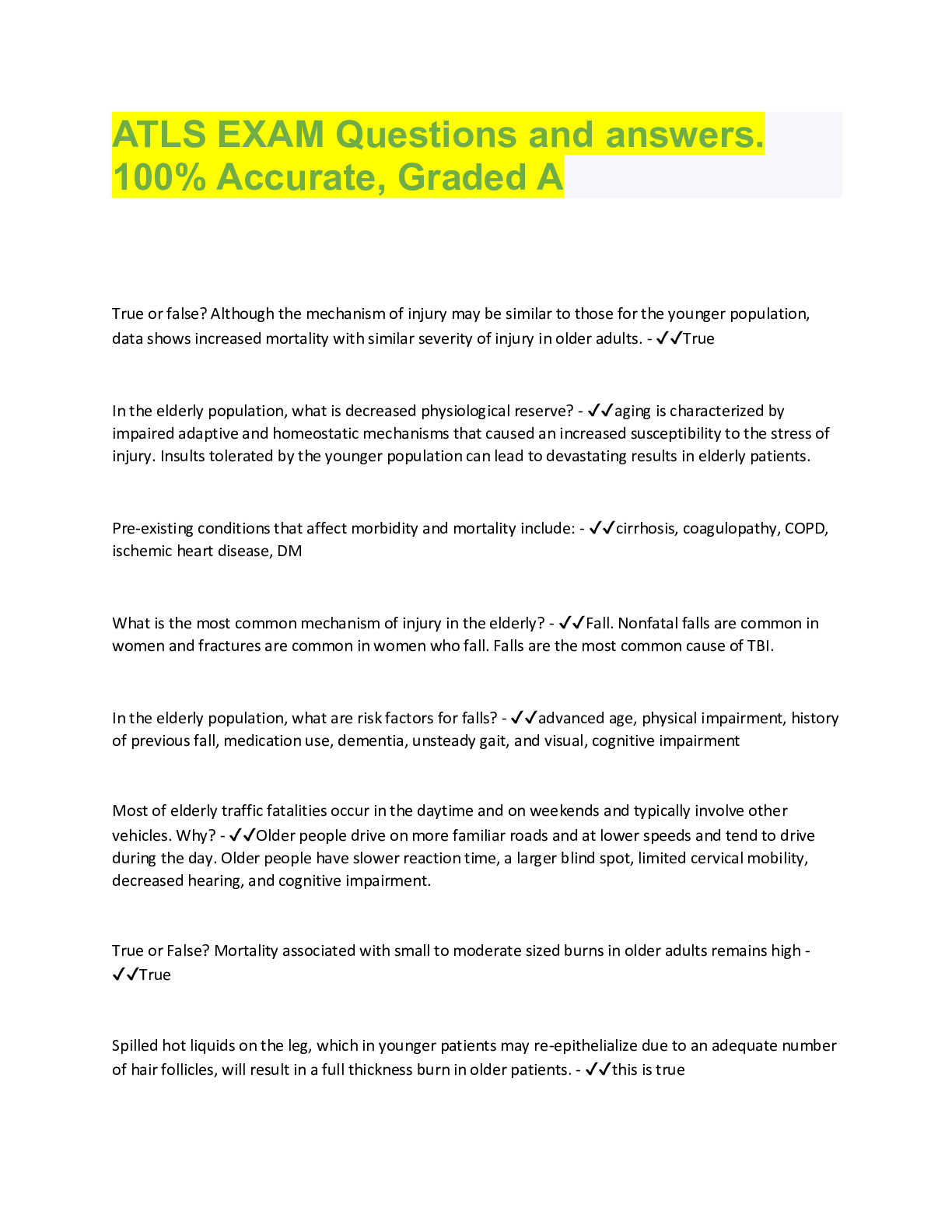
ATLS EXAM Questions and answers.
100% Accurate, Graded A
True or false? Although the mechanism of injury may be similar to those for the younger population,
data shows increased mortality with similar severity of injury in older adults. - ✔✔True
In the elderly population, what is decreased physiological reserve? - ✔✔aging is characterized by
impaired adaptive and homeostatic mechanisms that caused an increased susceptibility to the stress of
injury. Insults tolerated by the younger population can lead to devastating results in elderly patients.
Pre-existing conditions that affect morbidity and mortality include: - ✔✔cirrhosis, coagulopathy, COPD,
ischemic heart disease, DM
What is the most common mechanism of injury in the elderly? - ✔✔Fall. Nonfatal falls are common in
women and fractures are common in women who fall. Falls are the most common cause of TBI.
In the elderly population, what are risk factors for falls? - ✔✔advanced age, physical impairment, history
of previous fall, medication use, dementia, unsteady gait, and visual, cognitive impairment
Most of elderly traffic fatalities occur in the daytime and on weekends and typically involve other
vehicles. Why? - ✔✔Older people drive on more familiar roads and at lower speeds and tend to drive
during the day. Older people have slower reaction time, a larger blind spot, limited cervical mobility,
decreased hearing, and cognitive impairment.
True or False? Mortality associated with small to moderate sized burns in older adults remains high -
✔✔True
Spilled hot liquids on the leg, which in younger patients may re-epithelialize due to an adequate number
of hair follicles, will result in a full thickness burn in older patients. - ✔✔this is true
Airway-patients may have dentures that may loosen or obstruct the airway. If dentures are not
obstructing the airway, leave them in place for what? - ✔✔bag mask ventilation, as it improves mask
fitting.
When preforming rapid sequence intubation, the dose of benzos, barbiturates, and other sedatives
should be reduced to what percentage to minimize the risk of cardiovascular depression? - ✔✔20-40%
Functional changes in cardiac system include declining function, decreased sensitivity to
catecholamines, atherosclerosis of coronary vessels, increased afterload, fixed heart rate (beta blockers)
- ✔✔this results in lack of classic response to hypovolemia, risk for cardiac ischemia, elevated BP at
baseline, and increased risk of dysrythmias.
Functional changes in pulmonary system include decreased elastic recoil, reduced residual capacity,
decreased gas exchange and decreased cough reflex - ✔✔thus they are at increased risk for respiratory
failure, increased risk for pneumonia, and poor tolerance to rib fractures
Functional changes in renal system include loss of renal mass, decreased GFR, and decreased sensitivity
to ADH and aldosterone - ✔✔resulting in drug dosing for renal insufficiency, decreased ability to
concentrate urine, increased risk for AKI and urine flow may be normal with hypovolemia
Functional changes to MSK include loss of lean body mass, osteoporosis, changes in joints and cartilage,
c spine degenerative changes and loss of skin elastin and subcutaneous fat - ✔✔resulting in increased
risk for fractures, decreased mobility, difficulty for oral intubation, risk of skin injury, increased risk for
hypothermia, challenges in rehabiliation
Functional changes in Endocrine system include decreased production and response to thyroxin and
decreased dehydroepiandrosterone (DHEA) - ✔✔resulting in occult hypothyroidism, relative
hypercortisone states and increased risk of infection
True or false: Arthritis can complicate the airway and cervical spine. Patients can have multilevel
degenerative changes affecting disk spaces and posterior elements associated with severe central canal
stenosis, cord compression, and myelomalacia - ✔✔true
In elderly population, due to their changes in pulmonary system, placing a gauze between gums and
cheek to achieve seal when using bag valve mask ventilation is okay. In addition, because aging causes a
suppressed heart rate response to hypoxia...... - ✔✔respiratory failure may present insidiously in older
adults.
Age related changes in the cardiovascular system place the elderly trauma patient at significant risk for
being inaccurately categorized as hemodynamically stable. - ✔✔Elderly patients have a fixed heart rate
and fixed cardiac output, thus, their response to hypovolemia will involve increasing their systemic
vascular resistance. Furthermore, since older patients have HTN, an acceptable BP may truly reflect a
hypotensive state. A systolic BP of 110 is to be utilized as the threshold for identifying hypotension in
patients 65 and older.
Do no equate blood pressure with shock in older patients - ✔✔BP in older patients may look normal due
to the medications they are on. Use lactate and base deficit to evaluate for evidence of shock
what 2 factors place elderly patients at risk for intracranial hemorrhage? - ✔✔aging causes dura to
become more adherent to the skull increasing risk of injury and older patients are on anticoagulant and
antiplatelet medications.
Loss of subcutaneous fat, nutritional deficiencies, chronic medical conditions place elderly patients as
risk for hypothermia and complications for immobility. - ✔✔Rapid evaluation and when possible early
liberation from spine boards and cervical collars will minimize complications.
True or False: Fall prevention is the mainstay of reducing the mortality associated with pelvic fractures. -
✔✔true
poor hygiene, dehydration, oral injury, contusions affecting the inner arms, inner thighs, palms, soles,
scalp, ear, nasal bridge and temple injury from being struck while wearing glasses, contact burns and
scalds. These are all signs of.......? - ✔✔Elder maltreatment. The presence of physical findings of
maltreatment should prompt a detailed history. if history conflicts with findings, immediately report
findings to authorities.
True of false: early activation of the trauma team may be required for elderly patients who do not meet
traditional criteria for activation - ✔✔True. A simple injury such as an open tibia fracture in a frail elderly
patient may become life threatening.
Common mechanisms of injury include falls, MVC, burns, and penetrating injuries - ✔✔common injuries
in the elderly include rib fractures, TBI, pelvic fractures
The best initial treatment for the fetus is to provide optimal resuscitation of the mother. True or False? -
✔✔True. Also if xray examination is indicated during the pregnant patient's treatment, it should not be
withheld because of the pregnancy.
What happens as the uterus enlarged and the bowel is pushed cephalad. - ✔✔When the uterus enlarges
it pushes the bowel cephalad and the uterus lies in the upper abdomen. As a result, the bowel is
somewhat protected from blunt abdominal trauma, whereas the uterus and its contents (fetus and
placenta) become more vulnerable. Uterus remains intrapelvic until 12 weeks and then at 20 weeks it is
at the umbilicus, and at 34-36 weeks it reaches the costal margin.
Amniotic fluid can cause amniotic fluid embolism and disseminated intravascular coagulation following
trauma if fluid enters maternal intravascular space. True or False - ✔✔True
By the third trimester, what is the complication of trauma to the pelvis of the mother? - ✔✔by the third
trimester, the uterus is large and thin walled. In vertex presentation, fetal head is usually in the pelvis
and the remainder of the fetus is exposed above the pelvic brim. Pelvic fractures in late gestation can
result in skull fracture or intracranial injury to the fetus. Also we can have a placental abruption due to
its little elasticity and vulnerability to sheer forces.
An abrupt decrease in maternal intravascular volume can result in a profound increase in uterine
vascular resistance reducing fetal oxygenation despite reasonably normal maternal vital signs. - ✔✔this
is true
Physiological anemia of pregnancy - ✔✔A smaller increase in red blood cell volume can occur resulting
in a decreased hematocrit level. Thus, in late pregnancy a hematocrit of 31-33% is normal.
Healthy pregnancy patients can lose 1200-1500 mL of blood before exhibiting signs and symptoms of
hypovolemia. How can this manifest? - ✔✔this amount of hemorrhage may be reflected by fetal distress
as evidenced by an abnormal fetal heart rate.
What are some of the lab changes in pregnancy? - ✔✔WBC increases to 12000 and during labor can be
25000. Fibrinogen and other clotting factors are mildly elevated and PT and pTT are shortened, but
bleeding time and clotting time are unchanged.
After the 10th week of pregnancy, cardiac output can increase 1.0-1.5 L/min because of the increase in
plasma volume and decrease in vascular resistance of the uterus and placenta. - ✔✔The placenta
receives 20% of the patient's cardiac output during the 3rd trimester. In supine position, vena cava
compression can decrease cardiac output by 30% because of decreased venous return from lower
extremities.
During pregnancy the heart rate increases to a maximum of 10-15 beats per minute over baseline by the
third trimester. - ✔✔this heart rate must be considered when interpreting a tachycardic response to
hypovolemia.
Blood pressure falls 5-15 mm Hg in systolic and diastolic pressures during second trimester, although it
returns to near normal levels at term. - ✔✔some women experience hypotension when placed in the
supine position due to the compression of teh inferior vena cava.
hypertension in the pregnant if accompanied by proteinuria may represent what? - ✔✔pre-eclampsia.
EKG findings in pregnant patient - ✔✔Flatted or inverted T waves in leads III and AVF and the precordial
leads may be normal. Ectopic beats are increased during pregnancy.
Minute ventilation increases primarily due to an increase in tidal volume. Hypocapnia (30 mm Hg) is
common in late pregnancy - ✔✔Monitor ventilation in late pregnancy with arterial blood gas values. A
PaCO2 of 35-40 mm Hg may indicate impending respiratory failure during pregnancy. Pregnant patients
should be hypocapneic.
Anatomical alterations in the thoracic cavity seem to account for the decreased residual volume
associated with diphragmatic elevation and chest x ray reveals increased lung marking and prominence
of the pulmonary vessels. - ✔✔oxygen consumption increases during pregnancy and its important when
resuscitating injured pregnant patients to maintain adequate oxygenation above 95%
In patients with advanced pregnancy, those that require a chest tube placement, where should the test
tube be placed? - ✔✔it should be positioned higher to avoid intra-abdominal placement given the
elevation of the diaphragm.
Urinary system: what happens to the GFR, serum creatinine and urea nitrogen levels? - ✔✔GFR and
renal blood increases during pregnancy, whereas levels of the serum creatinine and urea nitrogen fall to
one half of the normal pre pregnancy levels. Glycosuria is common in pregnancy.
When interpreting x ray films of the pelvis in a pregnant patient, the symphysis pubis widens 4-8 mm
and the sacroiliac joint spaces increase by the 7th month - ✔✔keep this in mind
Eclampsia - ✔✔Maintain a high index of suspicion for eclampsia when seizures are accompanied by
HTN, proteinuria, hyperreflexia, and peripheral edema in pregnant trauma patients. This can mimic head
injury.
External contusions and abrasions of the abdominal wall are signs of blunt uterine trauma. - ✔✔true.
Fetal injuries can occur when the abdominal wall strikes an object, such as the dashboard or steering
wheel, or when a pregnant patient is struck by a blunt instrument.
Using a shoulder restraints in conjunction with a lap belt reduces the likelihood of direct and indirect
fetal injury, presumably because the shoulder belt dissipates deceleration forces over a great surface
area and helps prevent the mother from flexing forward over the gravid uterus. - ✔✔the deployment of
air bags in vehicles does not appear to increase pregnancy specific risks. Using lap belt alone allows for
forward flexion and uterine compression with possible uterine rupture or placental abruption. Lap belt
worn too high over uterus may produce uterine rupture.
Penetrating injury to pregnant women - ✔✔As uterus grows larger, other viscera are protected from
penetrating injury. Dense uterine musculature in early pregnancy can absorb significant amount of
energy from penetrating objects decreasing their velocity and lowering risk of injury to other viscera.
However, fetal outcome is generally poor with penetrating injury to uterus.
carefully observe pregnant patients with even minor injuries since occasionally minor injuries are
associated with placental abruption and fetal loss. - ✔✔True. AND to optimize outcomes for mother and
baby, clinicians must assess and resuscitate the mother first and then assess the fetus before conducting
second survey of the mother.
Failure to displace the uterus to the left side in a hypotensive pregnant patient - ✔✔logroll all patients
appearing clinically pregnant (second and third trimester) to the left 15-30 degrees and elevate the right
side 4-6 inches and support with a bolstering device to maintain spinal motion restriction and
decompression of the vena cava.
Due to increases intravascular volume, pregnant patients can lose a significant amount of blood before
tachycardia, hypotension, and other signs of hypovolemia occur. Thus, what do stable vital signs in a
pregnant patient indicate about the fetus? - ✔✔The fetus may be in distress and the placenta deprived
of vital perfusion while the mother's condition and vital signs appear stable. Administer crystalloid fluid
resuscitation and blood to support the physiological hypervolemia of pregnancy. vasopressers should be
an absolute last resort in restoring maternal blood pressure as the
[Show More]