CRC Exam, All Questions with accurate
answers, 100% Accurate,, Graded A+
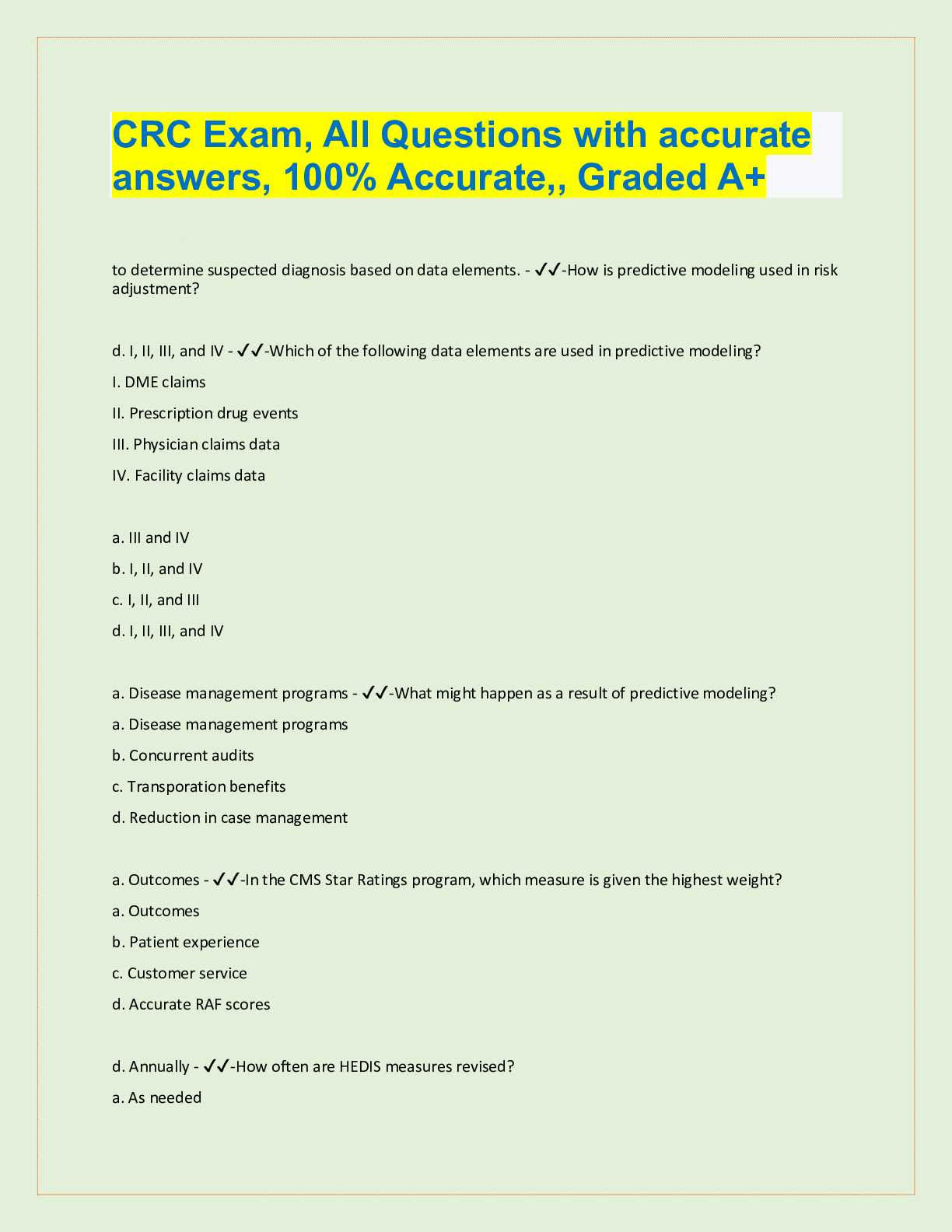
to determine suspected diagnosis based on data elements. - ✔✔-How is predictive modeling used in risk
adjustment?
d. I, II, III, and IV - ✔✔-
...
CRC Exam, All Questions with accurate
answers, 100% Accurate,, Graded A+
to determine suspected diagnosis based on data elements. - ✔✔-How is predictive modeling used in risk
adjustment?
d. I, II, III, and IV - ✔✔-Which of the following data elements are used in predictive modeling?
I. DME claims
II. Prescription drug events
III. Physician claims data
IV. Facility claims data
a. III and IV
b. I, II, and IV
c. I, II, and III
d. I, II, III, and IV
a. Disease management programs - ✔✔-What might happen as a result of predictive modeling?
a. Disease management programs
b. Concurrent audits
c. Transporation benefits
d. Reduction in case management
a. Outcomes - ✔✔-In the CMS Star Ratings program, which measure is given the highest weight?
a. Outcomes
b. Patient experience
c. Customer service
d. Accurate RAF scores
d. Annually - ✔✔-How often are HEDIS measures revised?
a. As needed
b. Monthly
c. Bi-annually
d. Annually
b. Quality bonus payments are made to Medicare Advantage plans who score at least four stars. - ✔✔-
Which statement is TRUE regarding the CMS Stars quality rating system?
a. Quality bonus payments are made to physician who score at least four stars.
b. Quality bonus payments are made to Medicare Advantage plans who score at least four stars.
c. Quality bonus payments are made to physician who score at least five stars.
d. Quality bonus payments are made to Medicare Advantage plans who score at least five stars.
c. I, II, III, and V - ✔✔-Merit-based Incentive Payment System (MIPS) includes which performance
categories?
I. Promoting Interoperability
II. Cost
III. Improvement Activities
IV. Quantity
V. Quality
a. I and II
b. I, III, and V
c. I, II, III, and V
d. I, II, III, IV, and V
c. I, II, III, IV and V - ✔✔-Which of the following are domains in CMS Part C & D Stars Rating?
I. Staying Healthy
II. Managing Chronic Conditions
III. Member Experience with Health Plans
IV. Member Complaints, Problems Getting Services, and Improvement in the Health Plan's Performance
V. Health Plan Customer Service
a. I, II and III
b. I, III, and V
c. I, II, III, IV and V
d. I, II, III and V
c. I and III - ✔✔-What are the participation tracks available through Medicare Access and CHIP
Reauthorization Act (MACRA)?
I. Merit-based Incentive Payment Systems
II. Sustainable Growth System
III. Advanced Alternative Payment Models
a. I
b. II and III
c. I and III
d. I, II and III
a. An analytical review of known data elements to establish a hypothesis related to the future health of
patients. - ✔✔-What is predictive modeling?
a. An analytical review of known data elements to establish a hypothesis related to the future health of
patients.
b. An analytical review of payments to health plans to determine the cost of future healthcare.
c. An average of costs associated with diagnoses used to determine which providers to contract with for
a health plan.
d. An average payment associated with diagnoses used to determine which health plans providers
should contract with.
d. NCQA - ✔✔-Who developed and maintains HEDIS?
a. CMS
b. OIG
c. BCBS
d. NCQA
a. Top performing health plans based on quality - ✔✔-What do the Star Ratings identify?
a. Top performing health plans based on quality
b. Top performing doctors based on quality
c. Cost of healthcare in facilities
d. Cost of healthcare by provider
b. Allow patients to compare health plans. - ✔✔-What is the goal of HEDIS?
a. Allow for patients to rate their physicians.
b. Allow patients to compare health plans.
c. Allow patients to schedule appointments online.
d. Allow patients to access their medical records.
c. October of each year. - ✔✔-When are Star Ratings are publicly published?
a. January of each year.
b. January and June of each year.
c. October of each year.
d. April and October of each year
b. Determine suspected diagnoses based on data elements. - ✔✔-How is predictive modeling used in
risk adjustment?
a. Determine the RAF score in HCC compared to FFS.
b. Determine suspected diagnoses based on data elements.
c. Determine the correct enrollment process.
d. Determine the return on investment for hiring coders.
b. Asthma - ✔✔-If you were using predictive modeling and the results were:
• Rx Claim: Albuterol (quick-relief inhaler)
• Medical Claim: Pulmonary Function Test
• DME claim: Home Nebulizer
a. Diabetes mellitus
b. Asthma
c. Osteoporosis
d. Hypertension
d. Osteoporosis - ✔✔-If you were using a predictive model and the results were:
• The member had a DME claim for a cane.
• The member had an Rx Claim for a Fosamax.
• The member had a medical claim for a bone density scan.Which diagnosis would you predict this
member has?
a. Osteoarthritis
b. Degenerative joint disease of the knee
c. Spinal Stenosis
d. Osteoporosis
b. Health plans often use predictive modeling to anticipate potential future diagnoses for an individual
patient. - ✔✔-Which statement is TRUE regarding predictive modeling?
a. Predictive models are only used to identify patients who develop comorbidities due to a lack of care.
b. Health plans often use predictive modeling to anticipate potential future diagnoses for an individual
patient.
c. Predictive modeling identifies needs a patient had in the past that was not provided.
d. Providers can use predictive modeling to identify when additional staff is required.
all of the above - ✔✔-How is HEDIS data collected?
I. Surveys
II. Medical chart reviews
III. Insurance claims
All of the above
d. I, II, and III - ✔✔-Predictive modeling can use many data elements. Which are beneficial for identifying
a person with diabetes?
I. Rx claims
II. Medical claims
III. DME claims
a. I only
b. I and II only
c. II and III only
d. I, II, and III
a. Inpatient admission note - ✔✔-Which type of documentation can be used to support diagnoses
reported under risk adjustment models?
a. Inpatient admission note
b. CT scan results
c. CBC lab test
d. Comprehensive problem list
c. not all diagnosis codes are assigned an HCC - ✔✔-Which statement is TRUE regarding diagnosis codes
and assigned HCCs?
a. all diagnosis are assigned an HCC.
b. all chronic illness are assigned an HCC.
c. not all diagnosis codes are assigned an HCC.
d. all acute exacerbations of an acute illness are assigned an HCC.
b. CMS website. - ✔✔-Where can a list of diagnosis mappings to HCCs be located?
a. OIG website.
b. CMS website.
c. OCR website.
d. QPP website.
b. States can either use the federal methodology or propose an alternate for certification by HHS. - ✔✔-
Which of the following is TRUE regarding the risk adjustment model by HHS?
a. States are mandated to use the Medicare HCCs.
b. States can either use the federal methodology or propose an alternate for certification by HHS.
c. States can either use the federal methodology or exclude risk adjustment logic from reimbursement.
d. States can determine their own policy for payment without a risk adjustment component.
c. No, any approved provider can validate any diagnosis. - ✔✔-When reporting a code for retinopathy,
must the coder find documentation from an ophthalmologist in order to code the condition as an active
condition?
a. yes, speciality specific diagnosis can only be reported by a specialist.
b. yes, ophthalmologist must diagnosis all eye related conditions.
c. No, any approved provider can validate any diagnosis.
d. No only PCP can provide supporting documentation for reported diagnoses.
c. No, health plans can not charge different premiums based on health status. - ✔✔-Under the
Affordable Care Act(ACA), can health plans change the premium rate based on a patient's health status
where patients with more complex medical issues are required to pay a higher premium than patients
with less complex medical issues?
a. Yes, as long as the more complex medical conditions are documented.
b. Yes, as long as the patient discloses the information when enrolling in a plan on the health care
exchange.
c. No, health plans can not charge different premiums based on health status.
d. No, health plans are prohibited from participating in the ACA risk adjustment model.
c. yearly
RA must be compared to average FFS expenses and rates. The purpose of the FFS normalization
adjustment issue that CMS payments are based on a population with an average risk score of 1.0. This s
the national average. Annually, Medicare normalizes the risk scores to maintain an average res score of
1.0. - ✔✔-How often is the normalization factor adjusted?
a. monthly
b. twice per year
c. yearly
d. as needed
b. Determine projected costs of healthcare based on conditions of patients. - ✔✔-Risk adjustment
models are used to:
a. Limit coverage of chronic conditions.
b. Determine projected costs of healthcare based on conditions of patients.
c. Determine the return on investment for developing proactive disease prevention outreach.
d. Limit the coverage of hospital admissions.
a. interactions
Interactions are extra risk adjustment values or factors added when a patient has more than one major
significant diagnosis identified in the model. These interactions add value because it is understood that
having a combination of some diagnoses together increase clinical risk and associated costs of care. -
✔✔-What are the extra risk adjustment values or factors added when a patient has more than one
major significant diagnosis identified in the model?
a. interactions
b. risk factors.
d. demographic variances
e. exceptions
1.0 - ✔✔-Each year, Medicare normalizes risk scores to maintain an average of what?
c. Chronic Disability Payment System
CDPS is the RA model used by Medicaid - ✔✔-What does the abbreviation CDPS indicate?
a. Chronic Disability Provider Services
b. Chronic Diagnosis Processing System
c. Chronic Disability Payment System
d. Chronic Disability Payment System
c. I and II
CMS is required to make an adjustment to reflect "differences in coding patterns between Medicare
Advantage plans and providers under Pay A and B to the extent that the Secretary has identified such
differences. - ✔✔-What is the purpose of the coding intensity adjustment?
I. Determine different coding patterns in HCC compared to inpatient claims covered by Part A.
II. Determine different coding patterns in HCC compared to outpatient claims covered by Part B.
III. Determine different coding patterns in HCC compared to claims processed under CDPS.
a. I
b. II
c. I and II
d. I, II, & III
c. Bronze - ✔✔-Under the Health and Human Services (HHS) Hierarchial Condition Category model,
which of the below plans has the highest out of pock expense once the premium is paid?
a. Silver
b. Gold
c. Bronze
d. Platinum
a. Silver - ✔✔-Which plan offers the best value for savings out of pock costs for the HHS HCC model?
a. Silver
b. Gold
c. Bronze
d. Platinum
b. Individuals 21 and over. - ✔✔-For the HHS HCC model who is included in the adult model?
a. Individuals 18 years and older
b. Individuals 21 and over.
c. Individuals who are the head of the household.
d. Individuals who are making more than $13,000 per year.
a. Prior to the diagnosis and risk factor data being reported to CMS. - ✔✔-When are prospective reviews
performed?
a. Prior to the diagnosis and risk factor data being reported to CMS.
b. After the diagnosis and risk factor data has been reported to CMS.
c. Once the patient is enrolled in Medical Part C plan.
d. Once the provider has finalized the documentation to submit diagnosis codes.
d. Registered Nurse. - ✔✔-Which provider is NOT an approved provider for diagnosis code capture
under the Medicare HCC model?
a. Gynecologist.
b. Pathologist.
c. Oral surgeon.
d. Registered Nurse.
b. Medium - ✔✔-In the CDPS risk adjustment model, what category do heart attacks fall under>
a. Low
b. Medium
c. High
d. Very high
d. all of the above - ✔✔-Which elements are considered the Medicare HCC model?
a. age
b. disability status
c. conditions that affect the long-term treatment of the patient insurance status.
d. All of the above
d. MA plan risk scores increase faster than FFS scores.
CMS is required to make an adjustment to reflect "differences in coding patterns between Medicare
Advantage plans and providers under Pay A and B to the extent that the Secretary has identified such
differences. To do this, CMS conducts extensive research to analyze changes inMA and original fee-for�service (FFS) Medicare risk scores, differences between those changes, and coding patterns behind
these changes. CMS uses the results of this analysis to develop a factor that is applied to the risk score
to account for these differences. MA plan risk score increaser faster than FFS scores. The goal of the MA
coding adjustment is to maintain MA risk scores at the level they would be if MA plans coded similarity
to FFS providers (not necessarily a 1.0 average). - ✔✔-Which statement is TRUE regarding the Coding
Intensity Adjustment?
a. MA plan risk scores and FFS scores typical decrease.
b. FFS scores and MA plan risk scores increase at the same rate.
c. FFS scores increase faster than MA plan risk scores.
d. MA plan risk scores increase faster than FFS scores.
b. CDPS - ✔✔-Which RA model is mostly commonly used by Medicaid?
a. HCC
b. CDPS
c. Blended
d. Fee for Services (FFS)
b. HHS - ✔✔-Which RA model is used for commercial plans and uses metal levels to classify patients?
a. CDPS
b. HHS
c. HCC
d. Commercial plans do not use risk adjustment models
c. The average FFS expenses and rates are used to determine the FFS normalization adjustment. - ✔✔-
How is the fee-for-services (FFS) data used for purposes of risk adjustment?
a. the FFS reimbursement is used to determine the RAF score.
b. the FFS data is used to determine which patient should be enrolled in the RA plan.
c. The average FFS expenses and rates are used to determine the FFS normalization adjustment.
d. The average FFS expenses and rates are used to determine the maximum payment per RAF score.
d. Platinum - ✔✔-Under the Health and Human Services (HHS) Hierarchal Condition Category (HCC)
model, which plan has the lowest out of pocket expense once the premium is paid?
a. Silver
b. Gold
c. Bronze
d. Platinum
a. Perform a retrospective audit to confirm proper diagnosis code selection. - ✔✔-What is the step after
predictive modeling identifies a diagnosis gap?
a. Perform a retrospective audit to confirm proper diagnosis code selection.
b. Develop a process to capture more accurate diagnosis going forward.
c. Change the diagnosis if it results in higher risk adjustment.
d. Change the diagnosis regardless of the risk adjustment.
d. MIPS - ✔✔-Which of the following is a quality review measure?
a. APC
b. DRG
c. Uniform Hospital Discharge Data Set (UHDDS)
d. Merit-based Incentive Payment System (MIPS)
b. 4 - ✔✔-What is the lowest star rating a plan must achieve to void penalties?
a. 5
b. 4
c. 3
d. 2
c. When two chronic illnesses paired together are complex to treat - ✔✔-When is added value factored
into the RAF for the HCC model for disease interaction?
a. When two or more chronic conditions are reported
b. When there is an exacerbation of a chronic illness
c. When two chronic illnesses paired together are complex to treat
d. When a diagnosis code has been reported for at least three years
b. Determine the combined risk adjustment factor - ✔✔-What is the purpose for capturing diagnosis
codes in an HCC model?
a. Determine the correct fee for service payment
b. Determine the combined risk adjustment factor
c. Determine the QPP bonus payment
d. Determine the patient premium
d. All of the above - ✔✔-Diagnoses carry a Risk Adjustment Factor (RAF) values that:
a. Are added together cumulatively for a total score
b. Recognize the highest or most severe in a family or hierarchy
c. Are added to a demographic score for a total score
d. All of the above
c. Diagnosis codes can be reported for all conditions supported as active in the medical record - ✔✔-
Which of the following statements are TRUE:
a. Diagnosis codes can only be reported for conditions documented in the assessment
b. Diagnosis codes can only be reported for conditions documented in the plan
c. Diagnosis codes can be reported for all conditions supported as active in the medical record
d. Diagnosis codes can be reported for conditions confirmed by diagnostic tests
d. Failing to report all the diag - ✔✔-Which of the following would lead to an underpayment?
a. Reporting diagnosis codes that were not documented
b. Reporting a disease with a complication that is not supported in the medical record
c. Failing to report a sign or symptom of a definitive diagnosis
d. Failing to report all the diagnoses supported in the medical record
b. Five
Rationale: The health plans must submit up to five best records demonstrating diagnoses as current in
the year being audited that support the HCC values that were paid. - ✔✔-How many records are
submitted by health plans per patient in a RADV audit?
a. One
b. Five
c. Ten
d. None it is performed with claims data
a. Previous year's known diagnoses
Rationale: In Medicare, each current year's financial funding is allocated based on the previous year's
known diagnoses (or medical problems). - ✔✔-For Medicare, funding is allocated based on:
a. Previous year's known diagnoses
[Show More]