DOT exam - NRCME Training Institute
Material, Questions and answers. Rated
A+
What is the mission of FMCSA? - ✔✔FMCSA is focused on reducing crashes, injuries, and fatalities
involving large trucks and buses.
Who
...
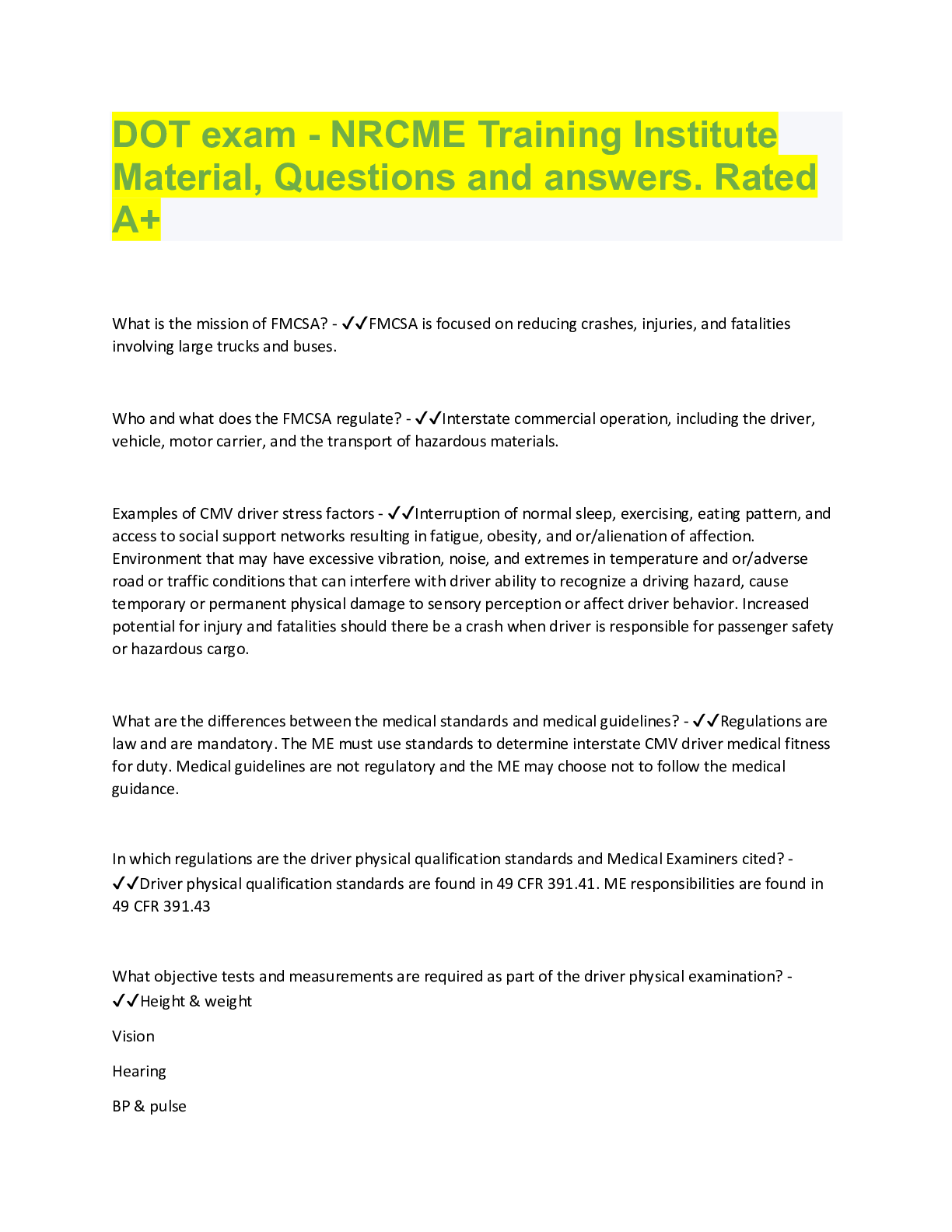
DOT exam - NRCME Training Institute
Material, Questions and answers. Rated
A+
What is the mission of FMCSA? - ✔✔FMCSA is focused on reducing crashes, injuries, and fatalities
involving large trucks and buses.
Who and what does the FMCSA regulate? - ✔✔Interstate commercial operation, including the driver,
vehicle, motor carrier, and the transport of hazardous materials.
Examples of CMV driver stress factors - ✔✔Interruption of normal sleep, exercising, eating pattern, and
access to social support networks resulting in fatigue, obesity, and or/alienation of affection.
Environment that may have excessive vibration, noise, and extremes in temperature and or/adverse
road or traffic conditions that can interfere with driver ability to recognize a driving hazard, cause
temporary or permanent physical damage to sensory perception or affect driver behavior. Increased
potential for injury and fatalities should there be a crash when driver is responsible for passenger safety
or hazardous cargo.
What are the differences between the medical standards and medical guidelines? - ✔✔Regulations are
law and are mandatory. The ME must use standards to determine interstate CMV driver medical fitness
for duty. Medical guidelines are not regulatory and the ME may choose not to follow the medical
guidance.
In which regulations are the driver physical qualification standards and Medical Examiners cited? -
✔✔Driver physical qualification standards are found in 49 CFR 391.41. ME responsibilities are found in
49 CFR 391.43
What objective tests and measurements are required as part of the driver physical examination? -
✔✔Height & weight
Vision
Hearing
BP & pulse
Urinalysis (spec gravity, protein, blood, glucose)
What are the possible outcomes of the driver physical examination? - ✔✔Certification
Disqualification
Determination pending
What date is used to determine medical examiners certificate expiration? - ✔✔The date of the exam is
used as the basis for certificate expiration, except when determination pending is chosen.
When determination pending is chosen, if the driver returns with the necessary information prior to the
expiration of the driver's current certificate and the driver is qualified based on that information
provided, the date used for the basis of the certification timeframe is the date the driver returned with
the necessary information.
What is the ME certificate expiration date for the following drivers?
A - Exam 4/16/2011, meets standards in 49 CFR 391.41, qualifies for 2 year certificate.
B - Exam 4/16/2011, meets standards, but periodic monitoring required due to HTN, qualifies for 1 year
certificate.
C - Exam 4/16/2011, determination pending due to not having results of post-CABG stress test, pt
returns and provides that info on 4/25/2011, driver is qualified for 1 year.
D - Exam 4/16/2011, disqualified due to benign position vertigo on 3/15/2011, returned to ME for
certification examination on 5/20/11. He has been asymptomatic since 3/11/2011. Qualified for two
years. - ✔✔A: 4/16/2013
B: 4/16/2012
C: 4/25/2012
D: 5/20/2013
Patient example:
Karen, recertification exam
42 y/o female
No health history, no medications.
Vision acuity: right 20/20, left 20/30. Both 20/20. Horizontal field of vision Rt 80 degrees, Lt 80 degrees.
Not corrected vision.
No monocular vision.
No hearing aids, Whisper test 5' bilaterally. N/A audiometric testing
UA: spec grav 1.020, protein 1+, blood 4+, glucose neg.
Hgb 12.4
BP 134/88, P 80, regular.
PE: on 4th day of menses with heavy bleeding. Advised to consult PCP or GYN for eval of excessive
bleeding that could lead to anemia, leading to fatigue that would affect her driving. - ✔✔Two year
certification - no disqualifying health history or PE abnormalities.
Ask about medication use, including OTC medications.
ME obtained hemoglobin testing based on PE findings. (not required)
The ME should correctly note the body system in which there was an abnormal finding. The note reflects
inquiry as to the affect on driving ability and is also supported by Hgb test results. ME also documented
medical follow up advice.
Who can perform the vision portion of the interstate CMV driver physical examination? - ✔✔The
certified ME, optometrist, or an opthalmologist. If the specialist provider performs the exam, they
should complete and sign the provider's information on the report form and provide the results.
To pass the interstate CMV driver vision exam, a visual acuity of ___/___corrected or uncorrected is
required. - ✔✔20/40 on Snellen chart in each eye individually AND in both eyes combined.
What eye conditions must the ME ask the driver about and if indicated, request specialist evaluation? -
✔✔Retinopathy, cataracts, aphakia, glaucoma, and macular degeneration.
Pt example:
Mr. Brown, 48 y/o male. No current meds, injury 5 years ago. Hunting accident 2 years ago with facial
trauma and left orbital fracture. Presented a "may drive" note from eye surgeon (dated 3 months prior
to examination). Uncorrected vision, right eye 20/20. left eye 20/40. Both 20/20. Horizontal field of
vision Right 80 degrees, left eye is inconclusive. No monocular vision. No hearing aids. Whisper test 5'
bilaterally. N/A audiometric test. UA normal. BP 122/74, p 80, regular. - ✔✔Exam findings: Left eye
muscles do not move eye to the left, discussed disqualification pending eye exam by specialist.
Explained the specialist will get precise visual field measurements. Provided driver with appropriate
medical release and copy of medical exam report with vision section highlighted.
Driver does not meet requirements. He is pending specialist vision exam. Diminished vision in left eye
noted. Pt could be functionally monocular.
What is the purpose of the interstate CMV driver physical examination? - ✔✔To detect the presence of
physical, mental, or organic conditions of such character and extent as to affect the driver ability to
operate a CMV safely. This exam is for public safety determination and is considered by FMCSA to be a
"medical fitness for duty" examination.
Examples of "yes" answers for hearing and ears on the health history that may require further
examination before a certification decision can be made - ✔✔Ear disorders
Loss of hearing
Loss of balance
Pt example:
Pt has hearing of 4' in left and right ears. Do they meet the hearing standards? - ✔✔No, hearing
minimum for whisper test is equal or greater than 5' in the better ear. This driver needs an audiometric
hearing test.
Pt example:
Does this driver meet hearing standards for interstate CMV driver certification?
Audiometric test results - [Hearing loss in decibles 500 Hz, 1,000 Hz, 2,000 Hz]
Right ear: 30, 45, 40
Left ear: 45, 45, 35 - ✔✔Yes, the average hearing loss in the right ear is less than 40 dB.
Rt ear average is 38.33 = pass
Lt ear average is 41.67 = fail
*only one ear has to meet requirement of less than 40 dB of hearing loss
Pt example:
Mr. Chin, 54 y/o male
Admits loss of hearing. No medications.
History of frequent ear infections in childhood, multiple TM ruptures and infections in elementary and
middle school. He has "always been hard of hearing" in his left ear.
Uncorrected vision acuity, right eye 20/30. left eye 20/30. Both 20/30. Horizontal field of vision 90
degrees bilaterally. No monocular vision.
No hearing aids used for test.
Whisper test - right ear 5', left ear 3'.
UA normal
BP 134/80, P 86, regular - ✔✔PE comments:
Right ear passed forced whisper test, left ear failed. The left TM is misshapen and scarred. PND noted.
Certify Mr. Chin for two years. To meet certification requirements, he only has to pass hearing test in
one ear. Mr. Chin passed with his right ear. There were no other medical findings that would warrant a
more frequent follow-up.
If forced whisper test would have been 4', 3', he would have be referred for audiometric testing. He only
has to pass one test with one ear to meet the hearing standard.
What problems with the test environment exist with the forced whisper tests that do not exist with
audiometric tests? - ✔✔Many variables that can impact the validity of the test, such as estimating the
distance instead of measuring, performing the test in a room with poor acoustics or subject to outside
noise or other distractions. The ME should attempt to control as many of the variables as possible, so
the test is given as consistently as possible.
Should the ME advise Mr. Chin to see a specialist because of future hearing problems? - ✔✔No, his
hearing loss in the left ear is stable for years. Mr. Chin should be educated on ways to preserve the
hearing in his better ear, he is at risk for noise induced hearing loss..
Can an interstate CMV driver who has had an acute MI be qualified to drive? - ✔✔Yes, if the AMI was at
least two months prior to the date of the driver physical examination, the driver meets all
recommended cardiac qualification criteria.
A patient provides the ME with a copy of records from cardiologist, indicating a diagnosis of CHF and EF
of 38%. Can he be certified? - ✔✔No, EF% must be greater than 40% to be certified.
What criteria must be met in order for the FMCSA ME to qualify a driver with a known diagnosis of CHF?
- ✔✔Pt must be asymptomatic, have no ventricular arrhythmia, have a left ventricular EF greater than
40%, be under the care of a cardiologist or appropriate medical professional.
Should the following patients be certified or medically disdqualified?
1. PCI 9 months ago, no cardio follow up, no ETT
2. CABG 4 months ago, echo and 3 months showed LVEF 55%, cleared by cardiologist, no chest pain.
3. CHF with dyspnea at rest.
4. Driver with increasing angina lasting 20 minutes after tarping a load, unresponsive to Nitroglycerin. -
✔✔1. Disqualified, after PCI should have cardio follow up and ETT 3-6 months post PCI.
2. Medically qualified, CABG may be qualified at 3 months post-op if asymptomatic, LVEF >40%, and
meets all other recommendations (qualify with annual certification).
3. Medically disqualified, a driver with symptomatic CHF is not medically fit for duty.
4. Medically disqualified, a driver with unstable angina is not fit for duty.
Driver had AAA, recent abdominal sonogram shows aneurysm size 5.3 cm in diameter. Should this pt be
qualified? - ✔✔No, AAA should be less than 5 cm in diameter to be considered for qualification.
Pt with recent 9 cm AAA repair four months ago, cleared by cardiologist. Can he be certified? - ✔✔Yes,
for up to one year. A driver with successfully repaired AAA can return to driving 3 months post-op if
cleared by surgeon. Yearly recheck.
What signs and symptoms of CHF should a ME look for? How do these symptoms affect the ability of the
driver to safely operate a CMV? - ✔✔Fatigue, swelling in the legs, ankles, other parts of the body, SOB,
especially at rest.
Fatigue & swelling can present immediate risk to driving. Fatigue interferes with the ability to remain
alert to traffic conditions and environment, may result in falling asleep while driving.
Swelling in extremities can interfere with gross and fine motor movements used in shifting gears,
operating pedals, dashboard switches, buttons, levers, etc.
Pt example:
Ms. Donovan 62 y/o female
No meds and no medical history reported. Does report she is post-menopausal, smokes two PPD for the
past 23 years.
Family history positive for hypercholesterolemia and cardiac events, mother had MI at 53, father had
sudden death at age 59.
Denies CP, palpitations, or SOB.
Uncorrected vision Right eye 20/30, left eye 20/40, both 20/30. Horizontal field of vision 90 degrees
bilaterally.
BP 138/88, P 90, regular
No monocular vision.
No hearing aid use.
Forced whisper test 5' bilaterally.
UA normal - ✔✔PE comments: markedly overweight female in no distress with no interference with
ability to drive. Advised weight loss to help lower her risk for CHD. Meets standards for certification, but
periodic monitoring is required given multiple cardiac risk factors. She does not have a clinical diagnosis,
but she has risk factors and over 45 years old, so it is recommended she is on annual certification. She is
not disqualified because she does not have a higher than acceptable likelihood of acute incapacitation
from a cardiac event.
Noted non-modifiable risk factors: Noted family history and ages of events, noted she is over 45 (62
years old), and postmenopausal state.
Noted modifiable risk factors: BP, smoking history, family history of hypercholesterolemia, low HDL,
asked about DM history, noted weight, noted denial of exercise regimen, discussed nutritional habits.
Is it appropriate for the ME to mention weight control, smoking cessation, exercise since they are not
the patients PCP? - ✔✔Yes, it should be discussed to encourage appropriate remedial care, advice is
needed especially when a condition, if neglected, could develop into a serious illness that could affect
driving. It does help to add that she is at risk for developing conditions that could lead to
disqualifications, but less likely if identified and treated early.
When is spirometry testing recommended? - ✔✔Smokers who are 35 years old and older.
Pt example:
Mr. Feldstein, 62 y/o male.
PSH: CABG 6 weeks ago. On ASA daily, no adverse side effects.
Presence of unstable angina lead to CABG 6 weeks ago, pt reports he feels much better after surgery.
Cardiologist reported 3.5 weeks after surgery, pt was cleared to drive. Pt denies any post-CABG angina.
Uncorrected vision right eye 20/50, left eye 20/25, both 20/25. Horizontal field of vision 80 degrees
bilaterally. Meets standard only when wearing corrective lenses. No monocular vision. No hearing aid
use.
Forced whisper test 5' bilaterally.
BP 112/66, P 64, regular.
UA normal
LVEF is not reported in his cardiologist report. - ✔✔PE comments:
On exam, there is an S4 gallop heard best at the sternum, he has a median sternotomy scar consistent
with recent surgery.
Pt is disqualified. He must have waited 3 month waiting period after CABG to allow for adequate
healing. He also needs to have a report of his LVEF (must be greater than 40%). His S4 heart sound
should be evaluated. Will need ETT in 5 years. It would be ideal to have resting EKG after CABG, whether
that be at the clinic or from the hospital after surgery.
Post CABG guidance for certification requirements - ✔✔Cleared by cardiologist
Waited 3 months since procedure
Asymptomatic
Has no side effects that would interfere with driving
Tolerates medications
LVEF greater than 40%
After 5 years, ETT due to accelerated graft closures
Renewed yearly
EKG after surgery, at clinic or in hospital
Pt example:
Mr. Gray, 45 y/o male. Health history includes heart disease or heart attack. Takes ASA daily.
Currently sees cardiologist for single episode of CP that was 2 weeks ago while roofing his home. CP
lasted 30 minutes, gradually resolved without treatment, located in the left pectoral area, not radiating,
aggravated by movement of the left arm. Mild residual soreness present for 24 hours, "felt like a charley
horse". Consulted PCP who referred him to cardio. Cardio report: ASA started day after event, normal
EKG, scheduled labs and ETT in two weeks, no additional meds prescribed, no activity restrictions, no
recurrence of chest pain, continue to run 2 miles three times a week, no previous history of CV disease,
nonsmoker, no history of hyperlipidemia, father had MI at age 69.
Uncorrected vision right eye 20/25, left eye 20/25, both eyes 20/25. Horizontal field of vision 90
bilaterally. No monocular vision. No hearing aid used. Whisper test N/A, audiometric testing hearing loss
Rt 30, Lt 28.33.
Bp 112/70, P 84, regular
UA normal - ✔✔Exam comments:
Certified for three months, pending labs and stress test result follow-up. The etiology of chest pain has
not been proven or disproven to be CHD.
What is the maximum certification period for an interstate CMV driver with stage 1 HTN? - ✔✔1 year
What is the proper determination for an interstate CMV driver with HTN, who presents with confirmed
BP of 182/112?
if he comes back and it is controlled below 140/90, what is the certification period? - ✔✔Disqualified
until BP is controlled below 140/90. Can have six month certificate if he comes back with controlled BP.
What is the BP range for stage 1 HTN? - ✔✔140/90-159/99
140-159 over 90-99
A BP of 140/90 should be confirmed with a second reading during the exam. What certification would
you give if:
1. Repeat reading is less than 140/90
2. Repeat reading is greater than 140/90
3. Repeat reading is exactly 140/90 - ✔✔1. Can certify for 2 years if patient is not taking HTN
medications. If pt is taking meds, 1 year is the max.
2. Follow stage 1 HTN guidelines, 1 year certification
3. Repeat reading or use clinical judgement to make decision on certification.
Pt example:
Ms. Hall 42 y/o female
History of HTN, takes HCTZ 25 mg daily, Enalapril 20 mg daily
Smokes 1.5 ppd x 20 years
Hasn't slept in 10 hours, just got off work
Cups of coffee and cigs in the past two hou
[Show More]