OAE Practice Test Questions #1,
Questions and answers, 100% Accurate,
Verified.
Problems that children believe are worth solving and that capture their interest are known as which of
the following?
A. Development
...
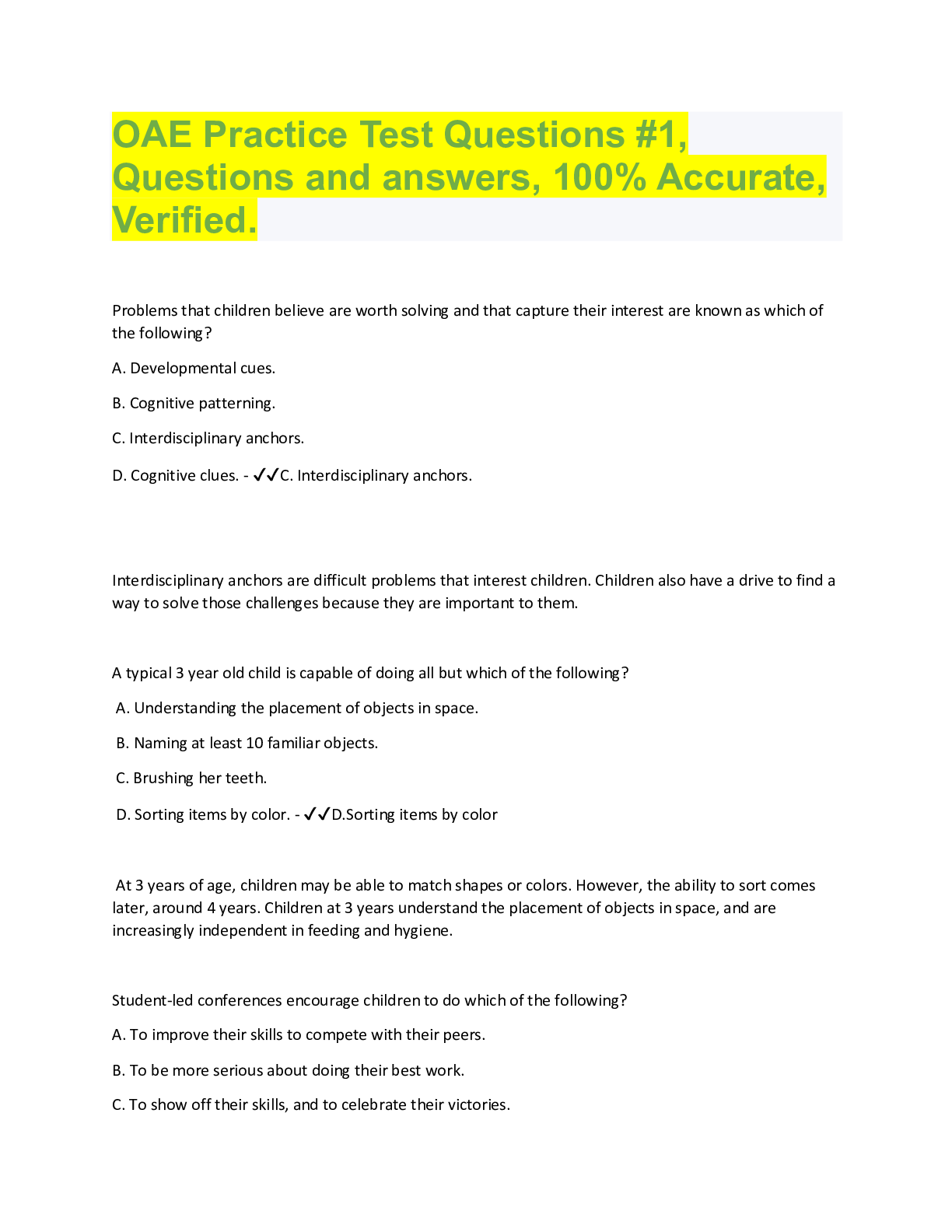
OAE Practice Test Questions #1,
Questions and answers, 100% Accurate,
Verified.
Problems that children believe are worth solving and that capture their interest are known as which of
the following?
A. Developmental cues.
B. Cognitive patterning.
C. Interdisciplinary anchors.
D. Cognitive clues. - ✔✔C. Interdisciplinary anchors.
Interdisciplinary anchors are difficult problems that interest children. Children also have a drive to find a
way to solve those challenges because they are important to them.
A typical 3 year old child is capable of doing all but which of the following?
A. Understanding the placement of objects in space.
B. Naming at least 10 familiar objects.
C. Brushing her teeth.
D. Sorting items by color. - ✔✔D.Sorting items by color
At 3 years of age, children may be able to match shapes or colors. However, the ability to sort comes
later, around 4 years. Children at 3 years understand the placement of objects in space, and are
increasingly independent in feeding and hygiene.
Student-led conferences encourage children to do which of the following?
A. To improve their skills to compete with their peers.
B. To be more serious about doing their best work.
C. To show off their skills, and to celebrate their victories.
D. To reflect on what they have produced, and to consider their goals. - ✔✔D. To reflect on what they
have produced, and to consider their goals.
Student-led conferences allow the child's hard work to be acknowledged by parents and others who are
interested. Supportive comments are satisfying for the child, and are a powerful mechanism for
evaluating the child's growth. They encourage children to reflect on what they have produced, and to
consider their goals
According to Piaget, in which substage of the preoperational stage do children begin to have the ability
to mentally represent an object which is not present?
A. Symbolic function substage.
B. Emotional function substage.
C. Intuitive thought substage.
D. Conservation substage. - ✔✔A. Symbolic function substage
According to Piaget, the symbolic substage is the substge of the preoperational stage where children
begin to be able to mentally represent objects that are not present. This occurs for most children
between the ages of 2 and 4 years.
When determining the assessment tool or strategy to use, what should the teacher first consider?
A. The purpose.
B. The outcome.
C. Time requirements.
D. Ease of use. - ✔✔A. The purpose.
Many factors affect the strategy or tool used for assessing children. The first thing the teacher must
determine is the purpose of the assessment.
A teacher observes two students, Donna and Matt, on the playground. Each student picks up a ball.
Donna kicks the ball, then she picks it up. Then Matt rolls the ball, and picks it up. Which of the following
best describes both students' actions?
A. Spatial awareness.
B. Perceptual-motor skills.
C. Static balance.
D. Temporal awareness. - ✔✔B.Perceptual-motor skills.
Perceptual motor skills are activities that lead to cognitive and academic results. Both children in the
scenario are aware of the balls. However, their use of the balls is based on their perception, which leads
to the perceptual process. Movement focuses on how they play with the ball. For instance, Donna's
perceptual motor skill is to kick the ball, whereas Matt's is to roll it.
What is an effective way to encourage parents to attend school functions or visit their child's classroom
to observe their child's progress?
A. Call them to discuss when they will visit.
B. Mail invitations asking them to attend the monthly parent meeting.
C. Send reminders home with students.
D. Email times and dates of open house meetings. - ✔✔B. Mail invitations asking them to attend the
monthly parent meeting.
Many families have busy work and activity schedules that make it difficult to accommodate school hours
of operation. Direct confrontation may be misconstrued as accusing the parent of disinterest. However,
reminders can be lost if sent home with younger students, and emails can remain unopened or be
erroneously deleted as Spam. Mailed invitations are still the most successful way to encourage parents
to attend school functions or visit their child's classroom for an update on the child's progress.
Which of the following is NOT one of the domains evaluated on the KIDS?
A. Motor.
B. Social.
C. Self-help.
D. Self-awareness. - ✔✔D. Self-awareness
The KIDS measures 5 domains. These are Cognitive, Social, Self-help, Motor, and Communication. While
self-awareness may be measured under one or more of these domains, it is not evaluated as a domain
itself.
Mr. Jones asks his students to count the number of blue blocks in the multicolored cube. Which of the
following principles will the students use?
A. The Order Principle.
B. The Stable-Order Principle.
C. The Abstraction Principle.
D. The One-to-One Principle. - ✔✔C. Abstraction Principle
The students will use the Abstraction Principle, in which the approach is to count part of a mixed set of
objects or items. In the scenario described in the question, the students will count the number of blue
blocks that are located in the multicolored cube.
Which of the following conditions is the leading cause of mental retardation in children?
A. Oppositional defiant behavior.
B. Down Syndrome.
C. Motor development impairment.
D. Autism spectrum disorder. - ✔✔B. Down Syndrome.
Down Syndrome is the leading cause of mental retardation in children. It is a genetic disorder that is due
to an extra chromosome which is usually chromosome number 21 or 22.
Which of the following is NOT true of physical development during early childhood?
A.It is not as rapid as physical development during infancy.
B. Body fat decreases to approximately 12% of body weight.
C. Boys grow much faster than girls at this age.
D. Children grow approximately 3 inches per year at this stage. - ✔✔C. Boys grow much faster than girls
at this age.
During early childhood, particularly the preschool years, boys and girls develop and grow at
approximately the same rate. Body fat decreases, physical growth slows compared to infancy, and
children grow approximately 3 inches per year.
Which of the following illnesses is the second most common type that children may develop?
A. A cold.
B. The flu.
C. Ear infections.
D. Diarrhea. - ✔✔C. Ear infections.
The most common illness that children develop throughout the school year is the common cold; and an
ear infection is the second most common illness that children develop within that same time frame. It is
important therefore, that teachers be familiar with ear infection symptoms to help prevent damage to a
child's hearing.
A five-year-old, Courtney is asked to write a sentence from a storybook. In the storybook, the sentence
is on one line. However, as Courtney writes the sentence on her paper, she runs out of space. Courtney
exhibits issues with which of the following?
A. Figure ground perception.
B. Temporal awareness.
C. Behavioral awareness.
D. Spatial awareness. - ✔✔D. Spatial awareness.
An emerging writer, Courtney has not developed an understanding of spatial awareness. Because she is
running out of space on her paper, it is apparent that she has misjudged the amount of space that she
needs to write the sentence, due to her lack of spatial awareness.
Ongoing assessments are sometimes called formative assessments. They may also be called a(n):
A. Skills assessment.
B. Summative assessment.
C. Performance assessment.
D. Informal assessment. - ✔✔D. Informal assessment
Ongoing assessments are sometimes called formative assessments. Ongoing assessments may also be
called formative assessments. Formative assessments, however, can be either formal or informal.
A learning style in which the learner prefers practicality and clarity, and learns concretely step by step, is
known as which of the following?
A. Cooperative learning.
B. Mastery learning.
C. Interpersonal learning.
D. Expressive learning. - ✔✔B. Mastery learning.
Mastery learners learn step by step in concrete fashion. They prefer practicality and clarity in
instruction.
Mrs. Carter notices that there is an increased number of students with colds in her class. Which of the
following is an effective way to prevent the spread of the cold viruses affecting her students?
A. Check with the office staff to ensure that all of the children have had a flu shot for the year.
B. Have the children properly and regularly wash their hands throughout the day.
C. Send children home immediately if they cough or sneeze.
D. Send children to the restroom to blow their nose. - ✔✔B. Have the children properly and regularly
wash their hands throughout the day.
Children develop more colds each year than adults. The reason is that children love to play, and are
always exploring, touching objects, touching their nose or mouth, or playing with other children. Those
activities are ideal ways to spread cold viruses. The best approach for Mrs. Carter to employ to reduce or
prevent cold viruses in the classroom therefore, is to make sure that the children wash their hands
properly and regularly.
Who might be interested in information and collected data about what children are being taught and
how well children are learning
[Show More]



.png)


 Block 1 to 7.png)
.png)